
SHADOWNET ANALYSIS — SPECIAL INVESTIGATION
PURSUE: Inside the Pentagon’s Historic UAP Disclosure — What the Files Actually Say, What They Don’t, and Why the Real Story Has Only Just Begun
On May 8, 2026, the U.S. government released 162 classified UAP files to the public. The documents span 79 years, six continents, and encounters from the lunar surface to the Strait of Hormuz. But what was released may matter far less than what was withheld — and why.
SHADOWNET DESK
James Mercer — SHADOWNET Field Analysis | May 13, 2026
I t began with a social media post. In February 2026, President Donald Trump directed federal agencies to identify and declassify all records related to alien and extraterrestrial life, unidentified aerial phenomena, and unidentified flying objects. The directive was not new in spirit — congressional pressure, whistleblower testimony, and military confirmation of UAP footage had been building toward this moment for nearly a decade. But on May 8, 2026, something unprecedented occurred: the U.S. government opened a public portal and began uploading its secrets.
The platform is called PURSUE — the Presidential Unsealing and Reporting System for UAP Encounters — and it lives at war.gov/UFO. The first tranche contained 162 files: 120 PDF documents, 28 videos totaling 41 minutes of footage, and 14 image files. The materials were drawn from the FBI, NASA, the Department of Defense, the State Department, the Office of the Director of National Intelligence, and the Department of Energy. They span incidents from 1947 to late 2025. They cover six continents and the surface of the Moon.
Defense Secretary Pete Hegseth called it “unprecedented transparency.” Director of National Intelligence Tulsi Gabbard described a “comprehensive” multi-agency declassification process underway. Trump posted on Truth Social that the American people could now “decide for themselves, WHAT THE HELL IS GOING ON?”
What they released was significant. What they omitted may be more significant still.
The Department of War launched the PURSUE portal on May 8, 2026, releasing 162 declassified UAP files spanning 79 years. | U.S. Department of War / ABC News
SECTION 01
The Architecture of PURSUE — What the Government Actually Released
The 162 files do not constitute a single archive. They represent a cross-agency sampling of unresolved cases — incidents that Pentagon analysts could not fully explain using available evidence, and which have now been deemed releasable after review. The Department of War was explicit: these are cases without definitive resolution. They are not proof of anything. They are, in the government’s own framing, questions without answers.
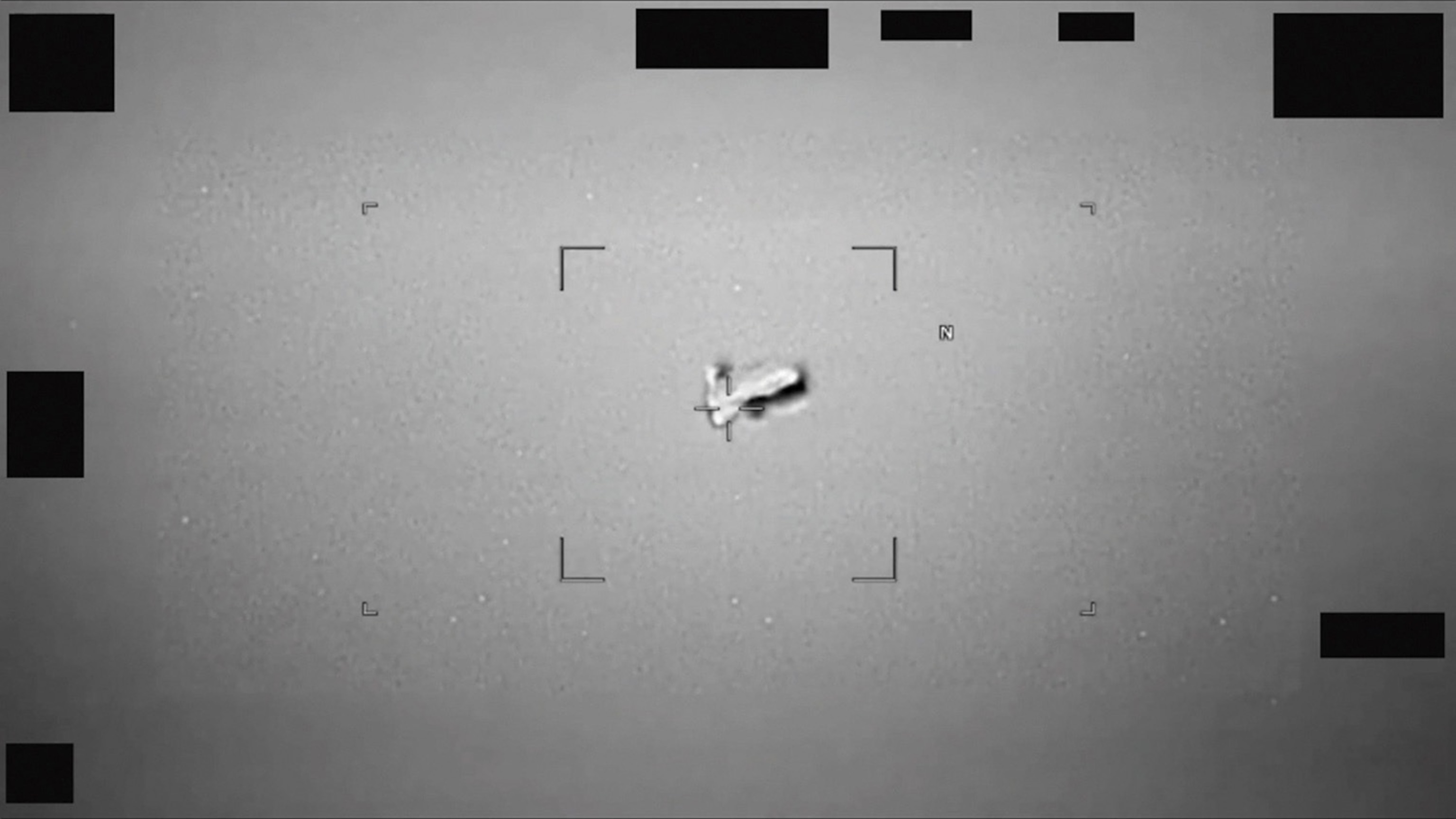
The videos are mostly infrared. Most show small white objects tracked by military cameras — specks on screens, moving through air over military operational zones. The footage runs for 41 minutes total. One video, taken over Greece in 2023, shows an object making multiple 90-degree turns at approximately 80 miles per hour. Another shows what the U.S. Indo-Pacific Command described as a “football-shaped” body near Japan in 2024. A third, from Syria, shows two semi-transparent irregularly shaped orange areas that appear and vanish within two seconds.
Of the 162 files, 108 contain redactions. The Pentagon stated that no redactions were made to information about the nature or existence of any UAP encounter — only to protect identities of eyewitnesses, locations of government facilities, and sensitive military site information unrelated to UAP. That clarification is itself notable. It means what was blacked out was operational context, not phenomenological content.
| File Type | Count | Source Agencies | Time Span |
|---|---|---|---|
| PDF Documents | 120 | FBI, State Dept, DoD, AARO | 1947–2025 |
| Videos | 28 (41 min total) | INDOPACOM, CENTCOM, EUCOM | 2020–2026 |
| Photographs | 14 | NASA, FBI, DoD | 1969–2025 |
| Files with Redactions | 108 of 162 | Multiple | — |
SECTION 02
The Apollo Files — 54 Years on the Lunar Surface
Among the most discussed elements of the PURSUE release are the NASA materials from the Apollo program. Six photographs show phenomena observed during the Apollo 12 and Apollo 17 missions — images taken from the lunar surface and near-lunar orbit that contain highlighted anomalies which, in the government’s own words, have not been definitively explained.
The Apollo 17 photograph is the most significant. Taken in December 1972 during the final crewed lunar mission, the image shows the Moon’s surface with a small inset highlighting three bright dots arranged in a triangular formation in the lower right quadrant of the lunar sky. The photograph is not new — it has circulated in UAP research communities for years. What is new is what the Pentagon said about it: “There is no consensus about the nature of the anomaly. New preliminary U.S. government analysis suggests the image feature is potentially the result of a physical object in the scene.”
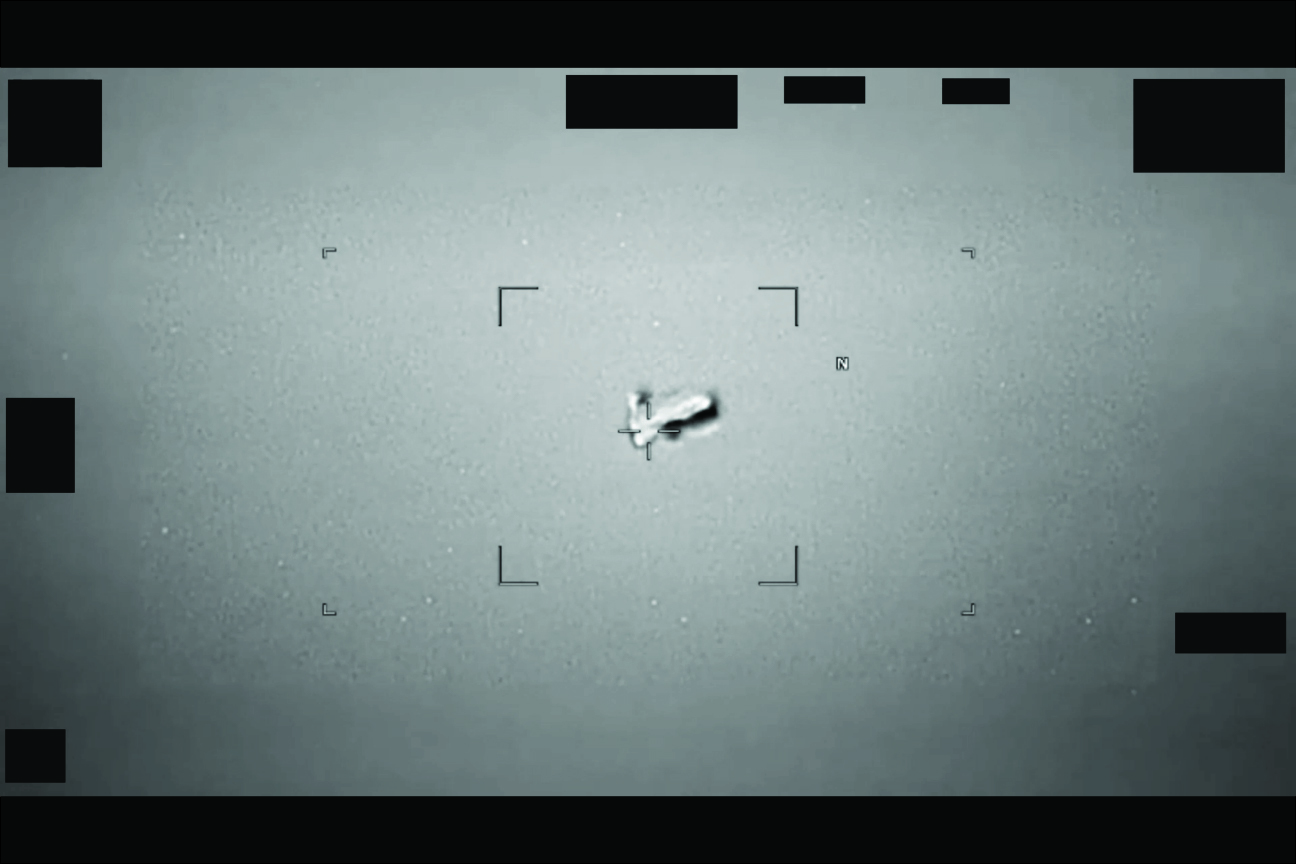
PURSUE File DOW-UAP-PR46: U.S. Indo-Pacific Command reported a UAP resembling a football-shaped body near Japan in 2024. The case remains unresolved. | U.S. Department of War (war.gov/UFO)
The implications of that language deserve careful attention. The U.S. Department of War has now formally stated, in an official public document, that an unidentified object of potentially physical nature was photographed in the vicinity of the Apollo 17 mission. To investigate further, the government obtained the original film from the mission. Full NASA and DoD analysis results will be released when complete.
The Apollo 12 release is similarly significant. Photographs from the November 1969 landing at Oceanus Procellarum show highlighted areas of interest above the lunar horizon. Astronaut Alan Bean reported seeing “flashes of light” that he described as “sailing off into space.” From Apollo 17, astronaut Harrison Schmitt described “very bright particles tumbling and rotating way out in the distance” that looked “like the Fourth of July.” These are not secondhand accounts. They are official NASA transcripts, now formally part of the U.S. government’s UAP record.
“Now we’ve got a few very bright particles or fragments or something that go drifting by as we maneuver.”
SECTION 03
Military Encounter Patterns — Six Continents, One Pattern
The geographic distribution of cases in the PURSUE release is not random. Sightings concentrate around active military operations with high sensor density: the Middle East, the Indo-Pacific, and European command zones. Iraq, Syria, the Strait of Hormuz, Greece, Japan, the UAE, Africa, and the western United States all appear in the files. The Pentagon offered its own explanation for this clustering: it most likely reflects where the most advanced monitoring equipment is deployed and conducting frequent missions.
That explanation is technically reasonable. But it creates a structural problem for those who invoke it too readily. If advanced surveillance naturally surfaces more UAP incidents, then the absence of similar documentation from less-monitored environments does not mean UAP are absent from those environments. It may simply mean we are not looking. The monitoring gap itself becomes epistemologically significant.
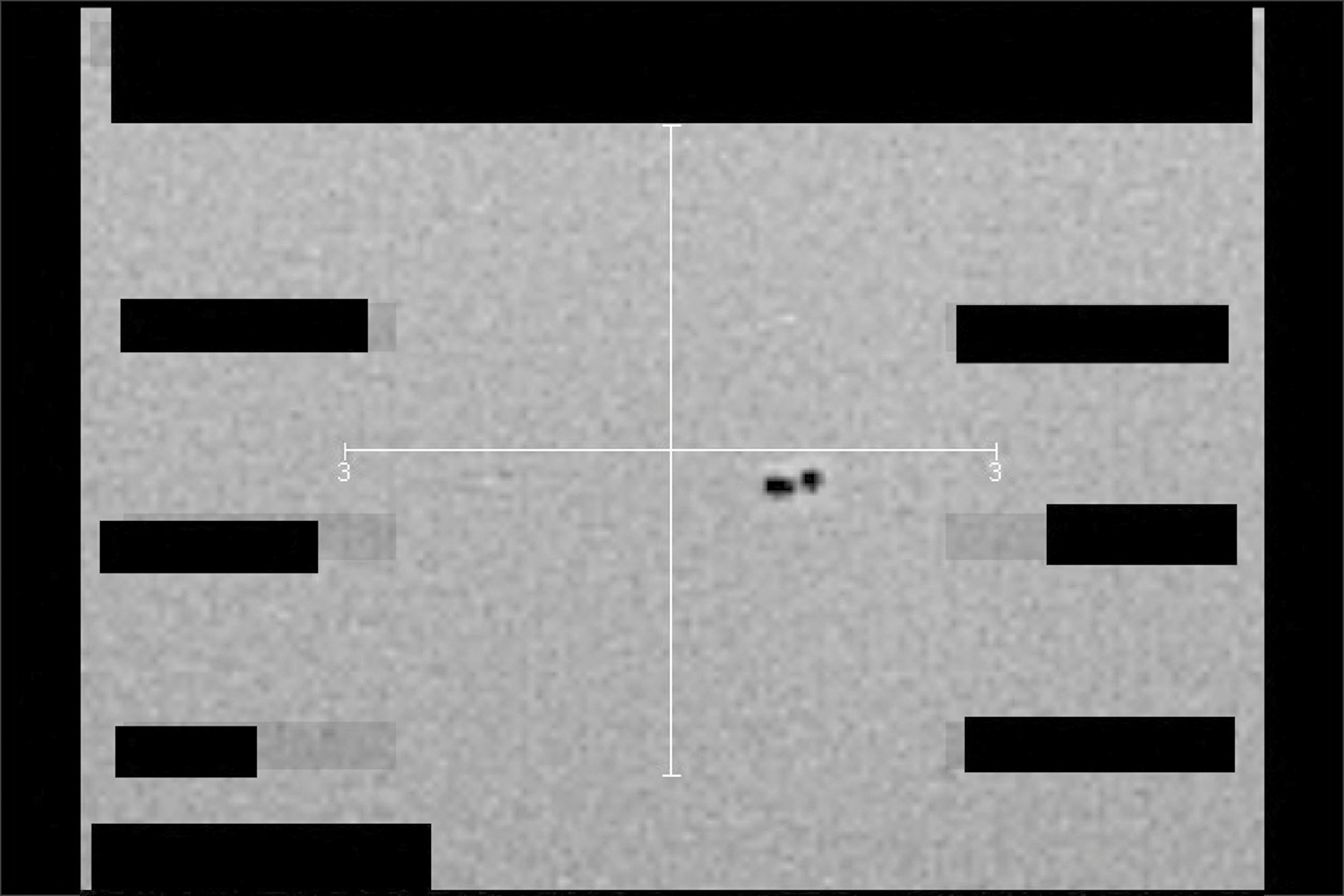
An infrared still image derived from a U.S. military system showing unidentified object(s) over the western United States, September 2025. Parts of the image have been redacted. | U.S. Department of Defense / AFP via Getty Images
Among the specific incidents that stand out from the PURSUE files: an object over Greece in 2023 executing multiple 90-degree turns at approximately 80 miles per hour; a pilot over the Mediterranean reporting “a triangular and metallic UAP” at 25,000 feet; a 2024 encounter in Iraq in which a mysterious craft zipped across U.S. aircraft surveillance systems at high speed during an unrelated combat operation; and a 2025 infrared observation over the western United States showing a small, dark, irregularly shaped object that the FBI confirmed was captured by a U.S. military system with parts of the frame redacted.
The State Department files add a diplomatic dimension. Cables from U.S. embassies in Papua New Guinea, Kazakhstan, Turkmenistan, Georgia, Mexico, and Tajikistan report UAP incidents relayed from local authorities and commercial aviation between 1985 and late 2025. A 1994 cable from the U.S. Embassy in Tajikistan relayed the experience of a commercial pilot and crew who reported encountering a strange object at 41,000 feet. These are not military reports. They are diplomatic channels carrying civilian aviation data, suggesting the phenomenon extends well beyond any operational context.
SECTION 04
Orbs That Launch Other Orbs — The Pentagon’s Most Compelling Case
The Pentagon identified one case as among the “most compelling” in the entire PURSUE archive — a two-day encounter in the western United States in 2023. Federal law enforcement officers, operating independently from multiple locations and vantage points, reported witnessing orbs that appeared to launch other orbs. The Pentagon’s description of the event is precise: “It is not known whether there was a single orange ‘mother’ orb that released the groups of red orbs or whether there were multiple orange orbs at play.”
That sentence is extraordinary in its specificity. The U.S. government is not describing sensor glitches or atmospheric phenomena. It is describing — officially, in a declassified document — structured behavior. Objects releasing other objects. A sequential pattern observed from multiple independent positions over 48 hours. The Pentagon calling this its most compelling case is not a small statement. It is the closest the government has come to formally acknowledging behavioral intelligence in an unidentified aerial phenomenon.

An FBI composite sketch — based on an actual site photo and corroborating eyewitness reports from September 2023 — depicts an ellipsoid bronze metallic object, 130–195 feet in length, materializing from a bright light and disappearing instantaneously. | FBI / U.S. Department of War (war.gov/UFO)
A related case involves the FBI composite sketch released as part of the PURSUE archive. Based on an actual site photograph combined with “corroborating eyewitness reports” from September 2023, the sketch depicts what the FBI describes as “an apparent ellipsoid bronze metallic object materializing out of a bright light in the sky, 130-195 feet in length, and disappearing instantaneously.” The object is not described as fast-moving. It is described as instantaneous. It did not travel away from the scene. It ceased to exist in the observable frame.
The Pentagon’s “most compelling” case involves structured behavior — objects releasing other objects over 48 hours, from multiple independently verified positions. This is not a sensor anomaly. It is a documented behavioral pattern.
SECTION 05
Why the Cover-Up Theory Refuses to Die — The Structural Case
Former AARO Director Sean Kirkpatrick, the Pentagon’s own former UAP investigation chief, responded to the PURSUE release with notable skepticism. In a statement to ABC News, he cautioned that without “analysis or context,” the release would “only serve to fuel more speculation, conspiracy and armchair pseudoscience.” His position is technically defensible. Raw footage without interpretive framework is epistemologically ambiguous. But Kirkpatrick’s critique also sidesteps a harder question: why did it take this long?
The Apollo 17 photograph has sat in government archives for 54 years. The Roswell FBI memo — confirming that an Air Force major called the FBI’s Dallas field office in 1947 to report recovery of “an object purporting to be a flying disc” described as “hexagonal in shape, suspended from a balloon by cable” — has been technically available for years. Yet it required a presidential order and a new government portal to bring these materials into a single accessible location. The institutional resistance to consolidation is itself data.
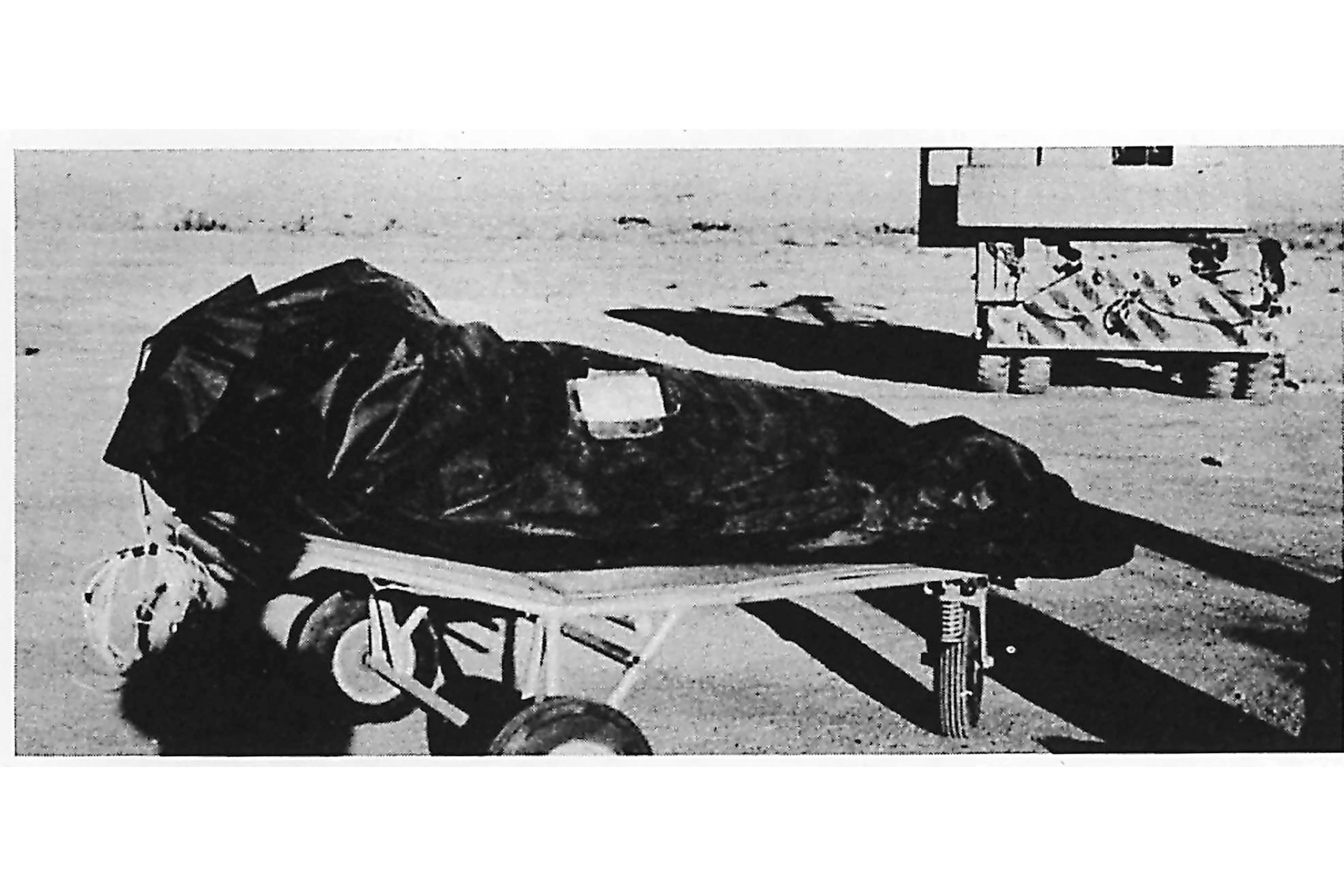
The U.S. Air Force’s 1947 Roswell report, included in the PURSUE release. An FBI Dallas agent documented a major’s report of “an object purporting to be a flying disc” recovered near Roswell, New Mexico. | U.S. Air Force via AP
The cover-up theory — more precisely, the hypothesis that governments possess UAP-related knowledge they have not shared with the public — does not depend on any single piece of evidence. It depends on the pattern of institutional behavior over eight decades: the classified programs, the retroactive redactions, the compartmentalized briefings, the delay between incident and disclosure. PURSUE does not refute this pattern. In important ways, it confirms it. These files existed. They were classified. They are only now accessible because a president explicitly ordered it.
David Grusch, the intelligence community whistleblower who testified before Congress in 2023 claiming the existence of a “non-human intelligence” recovery program, was notably measured about the PURSUE release. His public comments suggested the disclosed materials represent the accessible tier of a much larger, more sensitive archive. Whether that assertion is accurate cannot be verified. But the documented existence of classification programs that have persisted for decades — programs that PURSUE has only partially opened — makes the hypothesis structurally coherent.
SECTION 06
Theories, Hypotheses, Facts — A Scientific Framework for What Was Released
The scientific community’s reaction to the PURSUE release has been characteristically divided. Several astrophysicists immediately noted that the Apollo imagery anomalies had already been investigated: micrometeoroid impacts, camera and film defects, floating debris, and lens flares account for most of what was previously analyzed. New Scientist observed that the Pentagon’s released images “had already been investigated and explained as micrometeoroid impacts, bits of floating debris, and camera or film defects.”
But “previously investigated” is not the same as “definitively resolved.” The Pentagon itself acknowledged that no consensus exists on the Apollo 17 anomaly and that new analysis suggests a physical object. The difference between “probably debris” and “possibly a physical object of unknown origin” is the difference between a closed case and an open one. Science requires the second answer to be taken seriously until evidence eliminates it.

Apollo 17 archival photograph, December 1972: three dots in triangular formation in the lunar sky. The Pentagon confirmed no consensus exists on the anomaly and that preliminary analysis suggests a possible physical object. The original film has been obtained for further analysis. | NASA / U.S. Department of War (war.gov/UFO)
The 90-degree turns documented in the Greece 2023 footage present a more immediate scientific challenge. Objects making 90-degree directional changes at 80 miles per hour without deceleration are inconsistent with known aerodynamic constraints. They do not behave like balloons, drones, or aircraft. The explanation most consistent with the physics is either sensor artifact — the camera system, not the object, creating the apparent turn — or propulsion technology that does not rely on aerodynamic lift.
Neither answer is benign. If it is a sensor artifact, the U.S. military’s surveillance systems are producing systematic false positives with behavioral characteristics — which creates its own national security implications. If it is genuine object behavior, the implications are obvious and require no elaboration.
| Hypothesis | Supported By PURSUE? | Unresolved Questions |
|---|---|---|
| Sensor artifacts / camera effects | Partially — some footage consistent with FLIR flares | Does not explain multi-sensor corroboration or eyewitness accounts |
| Advanced adversarial technology | Not confirmed — no PURSUE file attributes UAP to foreign state | Explains some modern cases; cannot explain 1947–1972 incidents |
| Classified human aerospace programs | Plausible for some modern cases | Cannot explain Apollo-era lunar anomalies or 1940s–1960s historical cases |
| Non-human intelligence | Not confirmed, not ruled out | Consistent with behavioral patterns; no physical evidence publicly confirmed |
| Atmospheric / natural phenomena | Explains some isolated historical cases | Cannot account for structured behavior (orbs launching orbs, 90-degree turns) |
SECTION 07
Forward Scenario Matrix — Where PURSUE Leads From Here
The PURSUE release is explicitly a beginning, not an end. Defense Secretary Hegseth confirmed more tranches will follow. The Apollo 17 film analysis results will be released. Additional cases from across the declassification pipeline are being processed. SHADOWNET identifies four trajectories from this point.
The PURSUE archive at war.gov/UFO — the first U.S. government portal dedicated to the public release of classified UAP records. Additional tranches are scheduled on a rolling basis. | U.S. Department of War
SCENARIO A — Probability: Low-Moderate
Future Tranches Confirm Non-Human Origin for Specific Cases
The Apollo 17 film analysis returns inconclusive on debris origin. Additional PURSUE files include military encounters with behavioral characteristics inconsistent with any known technology. Congressional oversight compels further investigation. The conversation moves from “unresolved” to “unexplained by any known human cause” — a meaningful institutional shift even short of confirmed extraterrestrial origin.
SCENARIO B — Probability: High
PURSUE Produces Volume Without Resolution
Rolling tranches add hundreds of additional unresolved cases. Most are ambiguous sensor readings, eyewitness accounts, and archived reports without definitive explanation. The public accumulates data without framework. Interest cycles up and down with each new release. No single document provides the clarity the community has sought since 1947. Disclosure continues indefinitely as a process rather than an event.
SCENARIO C — Probability: Moderate
Classified Programs Surface Through PURSUE’s Own Process
As declassification progresses, materials emerge that were originally classified not to protect UAP secrets, but to protect human aerospace programs operating under extraordinary classification. Some percentage of “unexplained” encounters are revealed as classified U.S. or allied technology. This partial resolution satisfies skeptics but deepens the questions around the genuinely anomalous cases that remain unexplained even after classified programs are accounted for.
SCENARIO D — Probability: Low But Institutionally Significant
PURSUE Is Managed Transparency — Selective Release by Design
The most sensitive materials — including any evidence of recovered craft, non-human biological material, or confirmed non-human intelligence contact — remain in classification structures that PURSUE was not designed to reach. The portal releases the second tier of classified material while the first tier remains intact. This would be consistent with how intelligence agencies manage phased declassification of genuinely sensitive programs.
The question that PURSUE raises — and does not answer — is not whether UAP exist. The government has now officially confirmed that objects with unexplained characteristics have been repeatedly observed by military personnel, astronauts, and law enforcement across eight decades and six continents. That question is settled. The question that remains is what those objects are, who or what operates them, and whether the next tranche of PURSUE files moves the answer meaningfully forward.
Sean Kirkpatrick warned that releasing files without analysis would fuel speculation. He was correct. But the inverse question is equally valid: what would the absence of this release have produced? The speculation existed before May 8, 2026. It had been building for 79 years. PURSUE did not create the mystery. It simply made the files accessible — and in doing so, made the mystery harder to dismiss.
SHADOWNET FINAL ASSESSMENT
The PURSUE release is not disclosure. It is the beginning of a process that governments have resisted for eight decades. The documents confirm the phenomenon is real. They do not explain it.
162 files spanning 79 years. Apollo transcripts with unexplained lunar observations. Infrared footage of objects making physically anomalous turns. An FBI composite sketch of a 130-195 foot metallic object that appeared from light and vanished instantaneously. An orb releasing other orbs, witnessed independently over two days — the Pentagon’s own “most compelling” case.
None of this confirms non-human intelligence. None of it is explainable by balloons, debris, or camera artifacts. The gap between what has been released and what that evidence implies is precisely where the next 79 years of this conversation will be decided.
The portal is open. The question is whether what comes through it next will be the answer — or more carefully managed silence.
TAGS
SOURCES
- U.S. Department of War — PURSUE official portal, first tranche release, May 8, 2026. war.gov/UFO
- U.S. Department of War official press release — “Department of War Releases Unidentified Anomalous Phenomena Files in Historic Transparency Effort,” May 8, 2026.
- ABC News — Luis Martinez and Steve Beynon, “Pentagon releases declassified UFO files from various federal agencies,” May 8, 2026.
- NBC News — “Pentagon releases declassified UFO files including videos and photos held by the government for decades,” May 8, 2026.
- CBS News — “Pentagon begins releasing new UFO files, unveiling dozens of photos, videos and documents,” May 8, 2026.
- CNN Politics — “Pentagon releases initial batch of declassified files detailing UFOs,” May 8, 2026.
- Scientific American — “See the Pentagon’s new UFO image release,” May 8, 2026.
- Stars and Stripes — “Pentagon publishes first batch of declassified UAP files under new program,” May 8, 2026.
- The War Zone (twz.com) — “The Newly Released Government UFO Archives Will Leave You Shrugging,” May 8, 2026.
- NASA — Apollo 12 and Apollo 17 mission transcripts and archival photographs, 1969–1972, now part of PURSUE public archive.
- FBI — Historical UAP investigative files, 1947–1968; composite sketch based on September 2023 eyewitness reports, released via PURSUE May 8, 2026.
- Sean Kirkpatrick, former AARO director — statement to ABC News, May 8, 2026.