
The Briefing That Would Set the Earth on Fire: What Congress Actually Knows About UAP
A congressman tells America it would lose sleep. The real question isn’t what he saw. It’s why you’re not allowed to see it too — and who made that decision.
“`
“You’d Be Up at Night”: Decoding the Warning
On April 2, 2026, Tennessee congressman Tim Burchett sat down with Newsmax host Rob Finnerty and said something that should have detonated across every major newsroom in the country. Instead, it generated a few days of click-driven coverage before sinking beneath the usual political noise. That response — or rather its absence — is itself a piece of data worth analyzing.
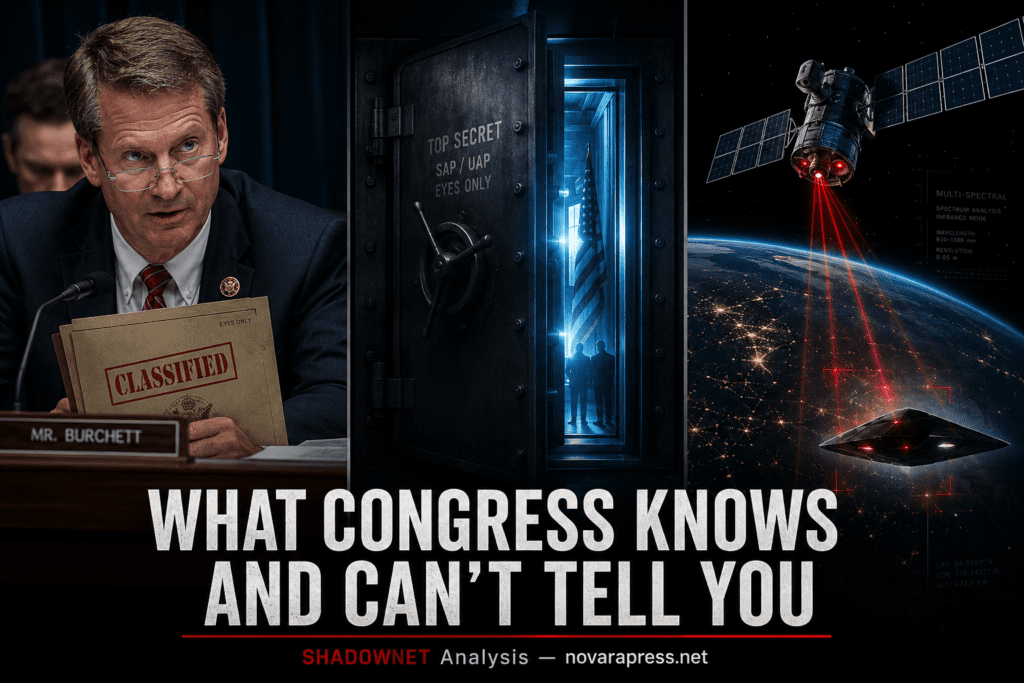
Burchett, a member of the House Task Force on the Declassification of Federal Secrets and one of the most persistent congressional voices on UAP transparency, told Finnerty: “I’ve been briefed by just about every alphabet agency there is. And, I’ll just say this, if they were to release the things that I’ve seen, you’d be up at night, worrying about, thinking about this stuff.” He then added that he had been briefed two weeks prior on a matter that “would have set the Earth on fire” and left him convinced “this country would’ve come unglued” if the information were made public.
He also said, unprompted, that he is “not suicidal” and “does not take risks” — a preemptive statement that would be bizarre from any other member of Congress, but which has become a ritualized disclaimer among those who push the UAP file hardest.
“We’ve had departments tell us that they have recovery units, but they won’t release full reports. Everything’s covered up.”
These are not the words of a fringe backbencher. Burchett sits on the House Oversight Committee. He has received classified briefings from the CIA, DIA, NSA, and NRO. He has been present in closed-door sessions where colleagues — across the aisle — have reportedly walked out visibly shaken. What is being withheld? And more precisely: withheld from whom, by whom, and under what legal authority?
The Architecture of Secrecy: How UAP Programs Hide in Plain Sight
To understand why a congressman can be briefed on information that “would set the Earth on fire” and still be legally prohibited from sharing it with his own constituents, you need to understand the classification architecture the United States has built — and how that architecture has evolved specifically to insulate certain programs from congressional oversight.
At its most basic level, U.S. classification runs from Confidential through Secret to Top Secret. But above Top Secret sits a parallel universe of compartmentalized access: Special Access Programs (SAPs), Unacknowledged Special Access Programs (USAPs), and at the apex, a category colloquially known as “Waived SAPs” — programs so sensitive that even the standard SAP notification requirements to the congressional oversight committees can be bypassed by the President under specific national security determinations.
| Classification Tier | Congressional Visibility | Override Authority | Known UAP Relevance |
|---|---|---|---|
| Top Secret / SCI | Select committee briefings | SECDEF, DNI | AARO reports, military intercepts |
| Special Access Programs (SAPs) | Gang of Eight notification only | President | Acknowledged retrieval programs |
| Unacknowledged SAPs (USAPs) | Existence denied to Congress | President + SECDEF written determination | Grusch-alleged legacy programs |
| Waived / Contractor-Run Programs | None — legally shielded | Private contractors + Presidential waiver | “Immaculate Constellation” (alleged) |
The crucial loophole is the last row. Under the current legal framework, the President of the United States can waive the notification requirement to Congress for any SAP deemed “necessary to avoid serious damage to the national security.” If that program is then transferred to a private defense contractor — a Lockheed, a Northrop, a SAIC — it exits the military chain of command entirely. Congressional oversight, which is constitutionally grounded in the power of the purse, cannot follow a program that is no longer funded through public budgets.
This is not a conspiracy theory. The mechanism is codified in Title 50 of the U.S. Code, Section 3093(c)(2). A 1969 memo signed by Brigadier General Carroll H. Bolender confirmed, decades before this became a political controversy, that the Air Force had withheld UAP sightings from its own research program, Project Blue Book. The concealment architecture predates modern UAP discourse by more than half a century.
The Whistleblower File: What Grusch, Nell, and the Others Actually Claimed
The most significant development in UAP transparency since 2017’s New York Times revelations about the Pentagon’s secret AATIP program was David Grusch’s July 2023 testimony before the House Oversight Committee. Grusch is not a UFO enthusiast. He is a decorated intelligence officer, a former NRO representative to the UAP Task Force, and a man who formally filed a whistleblower complaint with the Intelligence Community Inspector General before speaking publicly — a legal step that carries serious personal and professional risk.
Under oath, Grusch stated that the U.S. government has operated “a multi-decade UAP crash retrieval and reverse-engineering program” to which he was denied access through official channels. He further testified that “non-human biologics” had been recovered from crash sites — a claim he qualified by acknowledging it came from secondhand classified reports and direct interviews with individuals who claimed firsthand knowledge, not from his own physical observation of materials.
“I was informed, in the course of my official duties, of a multi-decade UAP crash retrieval and reverse-engineering program to which I was denied access.”
Grusch was not alone. At a follow-up hearing in 2024, additional former intelligence and military personnel testified — some anonymously — about legacy programs operating outside normal congressional oversight. More significant still: the Senate Intelligence Committee issued a separate statement indicating it had received classified briefings suggesting such legacy programs might exist in ways that violate the National Security Act. That is not tabloid speculation. That is a formal bipartisan concern from the oversight body constitutionally charged with monitoring U.S. intelligence activities.
Retired Army Colonel Karl Nell, who served on the UAP Task Force, publicly corroborated Grusch’s account in 2024, stating that he found Grusch to be “credible” and that “non-human intelligence” had been confirmed to interact with Earth — a statement extraordinary for its source and almost entirely ignored by mainstream outlets. Nell has not been discredited, and no government agency has publicly contradicted his assessment by name.
| Source | Background | Core Claim | Status |
|---|---|---|---|
| David Grusch | Former NRO / UAP Task Force | Multi-decade crash retrieval + reverse engineering program; NHI biologics recovered | Testified under oath; IC IG found “urgent and credible” |
| Karl Nell (Col., ret.) | U.S. Army / UAP Task Force | Corroborated Grusch; stated NHI contact with Earth is confirmed within government | Publicly stated; not officially contradicted |
| David Fravor (Cmdr., ret.) | U.S. Navy pilot, Nimitz incident | Direct observation of Tic-Tac UAP displaying physics-defying maneuvers (2004) | Pentagon confirmed incident; video declassified |
| Ryan Graves | Former Navy F/A-18 pilot | Routine UAP encounters near naval operating areas; pilots pressured not to report | Founded Americans for Safe Aerospace; testified Congress |
| “Anonymous” (Senate briefees) | Former intelligence/military personnel | Legacy programs operate outside Congressional oversight — potentially illegal under NSA | Senate Intel Committee flagged concern formally |
AARO: The Oversight Body That Can’t Oversee Itself
In 2022, Congress created the All-domain Anomaly Resolution Office — AARO — as the public-facing investigation hub for UAP reports. The mandate was clear: centralize reporting, investigate historical programs, interface with Congress. On paper, AARO represents the government’s most serious institutional attempt to address the phenomenon. In practice, it is undermined by a structural contradiction that critics, including former AARO personnel, have been unable to resolve.
AARO sits within the Office of the Under Secretary of Defense for Intelligence and Security — OUSD(I&S). This is the same organizational umbrella that houses many of the legacy programs AARO is tasked with investigating. As a 2024 congressional report bluntly noted: “The office that Congress created to investigate unreported UAP programs is troublingly close to the organizations running the alleged programs.” That is not an outside critic’s framing. That language comes from materials submitted directly to the House Oversight Committee.
AARO’s February 2024 Historical Report — its most comprehensive public document — found “no verifiable evidence” of programs to retrieve or reverse-engineer non-human technology. Critics immediately noted that AARO investigators reported being denied access to certain legacy programs during their review, which means the report’s negative finding is not evidence of absence; it is evidence of a locked door. Grusch, Nell, and members of the Senate Intelligence Committee disputed the findings directly.
“AARO’s work may be a continuation of the U.S. government’s UAP public relations — not its UAP investigations — since 1953.”
The parallel to the CIA’s 1953 Robertson Panel — which concluded Project Blue Book should function as a public reassurance mechanism rather than a genuine investigation — is not subtle. The pattern, if the critics are right, is a 70-year institutional reflex: establish a visible, credible-seeming inquiry body, place it close enough to the classified programs to appear legitimate, deny it actual access, and then point to its negative findings as proof of transparency.
“Immaculate Constellation”: The Active Collection Program Nobody Confirmed — or Denied
In November 2024, investigative journalist Ross Coulthart reported the existence of a program named “Immaculate Constellation” — an alleged active intelligence collection operation tasked specifically with monitoring and cataloguing UAP encounters using classified sensor platforms and satellite assets. The program’s existence was subsequently referenced in materials submitted to the House Oversight Committee by Rep. Matt Gaetz’s office, and the name appeared in a formal congressional inquiry.
The Pentagon denied the program’s existence. It did not, however, deny that a program with those functions existed under a different name — a technical distinction with real implications. The whistleblower report reviewed by congressional investigators described a “central or parent USAP that consolidates observations of UAPs by both tasked and incidental collection assets,” with access restricted to a small number of individuals reporting outside normal SECDEF-authorized channels.
If accurate, this would mean the U.S. government is not merely sitting on old historical files about Roswell-era incidents. It is actively collecting real-time intelligence on UAP — and doing so through a program that Congress cannot audit, cannot fund-trace, and cannot compel testimony about. The sensors described include multi-spectral satellite platforms capable of capturing “characteristics that are difficult or impossible to observe with the human eye alone,” including infrared signatures, electromagnetic anomalies, and acoustic profiles.
In 2024, AARO partnered with MIT, Stanford, and Harvard’s Galileo Project to create a scientific task force applying machine learning and multi-sensor analysis to anomalous cases. This is the public layer. The question that nobody in official Washington can currently answer on the record: does a parallel classified layer exist, collecting the same data from orbital assets, and to whom does that data report?
The Disclosure Endgame: Trump’s Order, the NDAA Clock, and the Ontological Question
In February 2026, President Trump posted a directive on Truth Social ordering the Secretary of Defense and relevant agencies to begin identifying and releasing government files related to “alien and extraterrestrial life, unidentified aerial phenomena (UAP), and unidentified flying objects.” This is not a minor administrative note. It is the first time a sitting U.S. president has explicitly ordered the release of records specifically described as pertaining to alien life — not just anomalous flight data, but the underlying intelligence on origin and nature.
The order arrived in the context of the FY2026 National Defense Authorization Act, which included new requirements compelling AARO to provide exhaustive briefings on UAP intercepts dating back to 2004 and mandating that all federal agencies produce a disclosure schedule for relevant records. The AARO 2026 Annual Report — due later this year — is expected to be the most detailed public document the Pentagon has ever released on the subject, though what “most detailed” means in this context remains to be seen.
The AARO 2026 report releases a curated set of declassified sensor data and historical documents confirming UAP reality and anomalous characteristics without directly addressing origin, retrieval programs, or biologics. Framed as transparency; designed to satisfy public interest without triggering institutional crisis. Burchett and peers remain unsatisfied.
Agencies invoke national security exemptions to delay or redact the bulk of responsive records. The NDAA mandates are technically complied with through heavily redacted document releases. Contractor-held materials are ruled outside governmental scope. The cycle restarts for the next administration. Nothing changes except the rhetoric.
Congressional pressure, whistleblower testimony, and Trump’s direct involvement converge to force the release of materials confirming the existence of retrieval and reverse-engineering programs. Partial confirmation of non-human technology origin. Markets react. Religious institutions respond. The “ontological shock” scenario former Bank of England analysts warned about becomes politically managed, not suppressed.
A whistleblower with direct physical access — not secondhand classified reports — releases materials through a foreign intermediary or domestic media outlet. The government’s response would be suppression followed by damage control, not validation. This is the scenario Burchett’s “not suicidal” disclaimer most plausibly anticipates.
The deeper issue is one that no legislation can fully resolve. The Schumer-Rounds UAP Disclosure Act of 2023 — modeled on the JFK Records Act — was substantially weakened before passing, with key declassification mandates stripped by House conferees under what multiple congressional sources described as intelligence community pressure. The mechanism that would have given a Presidential Review Board eminent domain authority over privately-held non-human materials was removed. The pattern is consistent: every serious legislative attempt to mandate transparency is modified in conference before it can compel access to the most sensitive layer.
What Burchett is describing — and what every serious analyst of this issue is now tracking — is not a mystery about flying lights. It is a governance crisis about whether democratic institutions can exercise meaningful oversight over programs that have been deliberately structured to evade them. The UAP question, at its core, is a question about institutional accountability and the legal limits of executive secrecy. Whether the objects in question are non-human in origin or represent the most advanced classified human aerospace technology ever built, the fact that elected representatives cannot audit them, fund-trace them, or compel testimony about them is a constitutional problem that exists independent of whatever the answer turns out to be.
“`
Tim Burchett’s April 2026 statement is not anomalous. It is one data point in a consistent pattern of congressional testimony, whistleblower disclosure, and classified briefing that has been accumulating since at least 2017. The fact that it was met with a news cycle measured in hours rather than weeks tells you more about institutional media than it does about the underlying subject matter.
The question SHADOWNET is tracking is not whether UAP are real — the Pentagon’s own declassified sensor data resolves that to the satisfaction of any serious analyst. The question is whether the mechanisms that have insulated the deepest programs from oversight for seven decades will survive the convergence of a president who has ordered disclosure, a Congress with more UAP-credentialed members than any previous session, and a whistleblower pipeline that has now produced sworn testimony from former intelligence officers with security clearances still intact.
The answer, if it comes, will not arrive in a press conference. It will arrive in the gap between what is officially released and what the people who were briefed are still not allowed to say.
Classification: Open Source Intelligence Synthesis
UAP Disclosure
Tim Burchett
David Grusch
AARO
Non-Human Intelligence
Special Access Programs
Pentagon Cover-Up
Immaculate Constellation
Trump UAP Order
NDAA 2026
- Rep. Tim Burchett, interview with Rob Finnerty, Newsmax, April 2, 2026
- The Hill — “Burchett on aliens: ‘You’d be up at night’ if the things that I’ve seen are released,” April 2, 2026. thehill.com
- The Hill — “Burchett calls on Trump to release files on UFOs, aliens,” May 2026. thehill.com
- U.S. House Oversight Committee — David Grusch Testimony, “Unidentified Anomalous Phenomena: Implications on National Security,” 118th Congress, July 26, 2023. oversight.house.gov
- AARO — “Historical Record Report Vol. I,” U.S. Department of Defense, February 2024. aaro.mil
- Michael Shellenberger — Testimony submitted to House Oversight Committee, November 13, 2024. docs.house.gov
- NYU Journal of Legislation and Public Policy — Yang, “The UAP Disclosure Act: Implications for Congressional Oversight,” 2025. nyujlpp.org
- New Paradigm Institute — “Confronting the UAP Secrecy Regime,” June 2025. newparadigminstitute.org
- New Space Economy — “Understanding the UAP Whistleblower Phenomenon and Legal Framework,” January 2026. newspaceeconomy.ca
- Trump, Donald — Truth Social post directing Pentagon and agencies to begin UAP file release process, February 2026
- Ross Coulthart / NewsNation — “Report Names ‘Immaculate Constellation’ UAP Program,” November 2024. newsnationnow.com
- Brigadier General Carroll H. Bolender — Air Force Memo on UAP Reporting Practices, 1969 (declassified)
- 50 U.S.C. § 3093(c)(2) — National Security Act provisions on presidential notification waivers for SAPs