
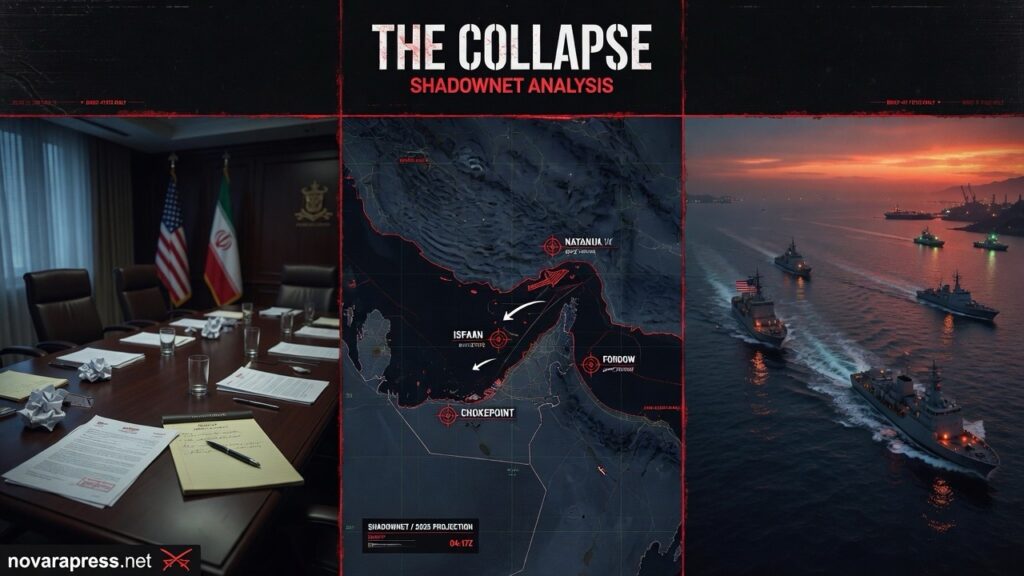
The Collapse of US–Iran Diplomacy: What Comes Next
SHADOWNET Analysis | April 12, 2026 | Iran & Middle East
ISLAMABAD — April 12, 2026. After 21 hours of direct negotiations at the Serena Hotel in Islamabad—the most sustained face-to-face contact between the United States and Iran in 47 years—Vice President JD Vance walked out without a deal. “The bad news is that we have not reached an agreement,” Vance said in brief remarks before boarding Air Force Two. “And I think that’s bad news for Iran much more than it’s bad news for the United States of America.”
Iran’s side told it differently. Sources close to Tehran’s delegation said the United States was “looking for an excuse to leave,” and that the ball is squarely in Washington’s court.
Both statements cannot be true. But together, they describe the full shape of a diplomatic failure that did not begin in Islamabad—and will not end there.
From Geneva to War: The Road Nobody Wanted to Take
The story of this diplomatic collapse begins not in Pakistan but in a Geneva hotel room in late February. Three rounds of indirect talks—Muscat in early February, then two sessions in Geneva—produced what Oman’s foreign minister Badr Al Busaidi called “substantial progress.” Iran had handed over a written proposal. Technical talks were scheduled for the following week in Vienna. The Omani mediator was heading to Washington to brief Vice President Vance.
Then, on February 27, President Trump told reporters he was “not happy” with the pace of negotiations or “the way they’re negotiating.” Twenty-four hours later, on February 28, the United States and Israel launched coordinated, large-scale strikes on Iran. Supreme Leader Ali Khamenei was killed. So was Ali Larijani—a senior official who had been central to Iran’s negotiating posture. The nuclear sites at Natanz, Fordow, and Isfahan were struck. The Iran war had begun.
The Arms Control Association later reported that by the time the third round of Geneva talks concluded, Trump had likely already made the decision to go to war. No Iranian concession short of total capitulation, analysts concluded, would have prevented the strikes.
The Witkoff Problem: Diplomacy Without a Diplomat
Accounts from the February negotiations reveal a structural failure at the heart of the US approach. Steve Witkoff, Trump’s special envoy for the Middle East, lacked the technical command of Iran’s nuclear file that effective diplomacy requires. His briefings to reporters contained mischaracterizations of Iran’s nuclear program and misreadings of Iranian proposals that fed Trump’s impatience and accelerated the march toward military action.
Veteran arms control experts were blunt: Witkoff’s failure to surround himself with technically qualified advisors was, in the words of the Arms Control Association, “a diplomatic disservice to US and international nonproliferation goals.” Jared Kushner’s presence alongside Witkoff—a presidential son-in-law with business ties rather than foreign policy credentials—further undermined American credibility at the table. Oman’s foreign minister had openly told US media that a deal was “within our reach.” Witkoff and Kushner reportedly told Trump it would be “difficult, if not impossible.”
The gap between those two assessments cost the region a war.
The Ceasefire and the Second Chance That Wasn’t
Iran fought back. Following the February 28 strikes, Tehran launched retaliatory attacks on Israel and American military bases across the region. The war settled into a devastating exchange of strikes. Global oil markets reacted. Gold prices surged. The Strait of Hormuz—through which approximately 20% of the world’s seaborne oil passes—became Iran’s primary strategic pressure point, with Tehran restricting shipping through the waterway.
On April 7, hours before a Trump deadline threatening “wide-scale destruction” of Iranian civilian infrastructure, a ceasefire was brokered via Pakistan. Iran agreed to allow safe passage through the Strait; the US and Israel suspended bombing operations for two weeks. Pakistan’s Prime Minister Shehbaz Sharif invited both delegations to Islamabad.
The ceasefire, however, was fragile from the start. Israel explicitly said it did not apply to Lebanon, where its attacks on Hezbollah continued. Iran’s delegation arrived in Islamabad dressed in black—in mourning for Khamenei and others killed in the war. They brought with them four non-negotiable conditions: full sovereignty over the Strait of Hormuz, complete war reparations, unconditional release of frozen Iranian assets, and a durable ceasefire across the entire West Asia region.
Washington’s 15-point proposal, in contrast, demanded significant curbs on Iran’s nuclear and missile programs, the dismantling of enrichment infrastructure, and the reopening of Hormuz as a precondition—not a result—of any deal.
Islamabad: 21 Hours, Zero Agreement
The Islamabad talks were historic in form—the highest-level, face-to-face US-Iran contact since the 1979 Islamic Revolution—and unsuccessful in substance. The US delegation numbered nearly 300, led by Vance with Witkoff and Kushner at his side. Iran’s 70-person delegation was led by Parliament Speaker Mohammad Bagher Qalibaf and Foreign Minister Abbas Araghchi.
Three rounds of discussions stretched across 21 hours. Pakistan’s Prime Minister and Foreign Minister shuttled between the delegations. The overall tone, Pakistani sources told CNN, remained “largely positive”—but on the central issues, the two sides could not close the distance.
The core dispute, as it has been throughout this entire diplomatic arc, is the nuclear question. Vance stated plainly after the talks: the US needed a firm Iranian commitment to never develop a nuclear weapon. “We haven’t seen that yet. We hope that we will.” Iran’s position—that it accepts international inspections and has no intention of building a bomb, but retains the sovereign right to enrich uranium for civilian use—was not a commitment Washington could accept.
The Strait of Hormuz compounded the deadlock. Iran’s four non-negotiable conditions included full sovereignty over the waterway, a demand that directly contradicts the US position of open, free maritime passage. Iranian state media reported that Washington’s “excessive demands” on Hormuz rendered the talks the delegation’s “last chance” in this round—a premonition that proved correct.
Vance announced the result, told the press the US had made its “best and final offer,” and departed. Iran’s team said the US was looking for a pretext to leave.
What Comes Next: Three Scenarios
With the Islamabad talks collapsed and a two-week ceasefire set to expire, the region now faces a narrowing set of paths forward.
Scenario One — Renewed Escalation. If no diplomatic channel reopens before the ceasefire expires, the logic of the conflict reasserts itself. Israel has made clear it considers the war unfinished. Netanyahu stated this week that the campaign is “not yet over” and that Iran’s enriched uranium will be removed “by an agreement or by other means.” Trump retains both the military posture and the political incentive to maintain pressure. A return to strikes—on Iranian infrastructure, military sites, or Hormuz-related naval assets—remains a live possibility.
Scenario Two — Extended Ceasefire, No Deal. Both sides may choose, through intermediaries, to extend the ceasefire without resolving the core disputes. This buys time but resolves nothing. Iran continues to control Hormuz; the US continues its naval mine-clearing operations. Global energy markets remain in a state of managed anxiety. The nuclear file stays open. This is a holding pattern, not a settlement.
Scenario Three — A Restructured Negotiation. The failure of the Witkoff-Kushner model may create pressure for a more professional diplomatic track—possibly involving experienced arms control negotiators, technical working groups on the nuclear file, and a broader multilateral framework that includes Gulf states and European powers. This path is the most durable but also the most politically difficult for an administration that has staked credibility on force as leverage. Iran expert Trita Parsi argued this week that “Trump’s failed use of force has blunted the credibility of American military threats, introducing a new dynamic into US-Iran diplomacy.” If threats ring hollow, the equation changes.
SHADOWNET Assessment
The US-Iran diplomatic failure is not a story of two equally intractable adversaries. It is, at its core, the story of what happens when military options are pursued before diplomatic ones are exhausted—and what happens when the diplomats sent to the table lack the expertise to hold it.
Iran entered every round of talks from Geneva to Islamabad with written proposals, technical delegations, and consistent red lines: enrichment rights, sanctions relief, sovereign control of Hormuz. The US entered with maximalist demands, negotiators who misunderstood the nuclear file, and a president who said, days before the Islamabad talks concluded, that it “makes no difference to me” whether a deal is reached.
That asymmetry is the story. A deal was achievable in February, before the war. Whether it remains achievable now—after the assassination of Khamenei, after months of strikes, after the symbolic catastrophe of 21 hours in Islamabad ending with Vance on a plane—is a question the next few days will begin to answer.
The two-week ceasefire clock is ticking. The Strait of Hormuz remains contested. And the region’s energy supply—along with whatever diplomatic capital Pakistan, Oman, and Qatar have built—hangs on whether either side finds a reason to try again.
Analysis. Intelligence. Clarity. — novarapress.net
Related Analysis
Iran’s Hormuz Strategy: The Choke Point That Rewrote the Rules
How Tehran turned a narrow strait into a geopolitical weapon — and why no one has a clean answer to it.