
After Islamabad: Five Scenarios for the US-Iran War — And None of Them Are Easy
The diplomats have gone home. The clock is running. SHADOWNET Analysis maps what happens next.
JD Vance boarded Air Force Two on Sunday morning with a thumbs up and no deal. After 21 consecutive hours of the highest-level US-Iran talks since the 1979 Islamic Revolution, the two sides walked away from Islamabad with competing blueprints, a collapsing ceasefire, and a Strait of Hormuz still choked with Iranian sea mines. The next ten days — before the fragile two-week ceasefire expires on April 22 — may determine whether this war ends, escalates, or simply freezes into something the world has never seen before.
The gap between the two sides is not just political. It is architectural. The United States arrived in Pakistan with a 15-point framework demanding Iran permanently abandon nuclear enrichment and surrender its existing stockpiles. Iran brought a 10-point counterproposal requiring an end to Israeli strikes on Lebanon, the lifting of all sanctions, war reparations, and the internationally recognized right to enrich uranium for civilian purposes. Iranian Parliament Speaker Mohammad Bagher Qalibaf summed up the atmosphere bluntly: his delegation did not trust the US side, he said, “due to the experiences of the two previous wars.”
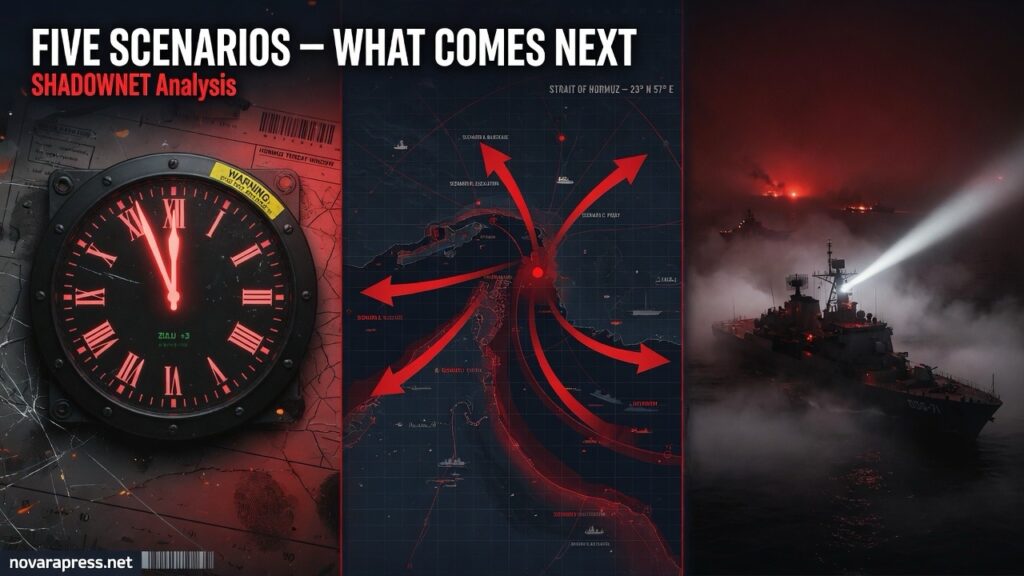
That distrust is the structural reality any future diplomacy must navigate. Here are the five scenarios now in play.
Scenario One: Diplomatic Limbo — The War That Won’t End or Restart
The most likely near-term outcome is not resolution, but suspension. Iran has explicitly said “negotiations will continue despite remaining differences.” Pakistan’s Foreign Minister Ishaq Dar has pledged to keep mediating. A second ceasefire extension — perhaps for another two weeks or thirty days — buys time without resolving anything.
This is the scenario both sides can live with, at least temporarily. Trump has little domestic appetite for resuming a war he has already declared won. Iran, whose regime survived six weeks of strikes that assassinated its Supreme Leader and gutted its military infrastructure, has every incentive to drag out the diplomatic process while it rebuilds capacity and waits for Washington’s resolve to erode. Former US State Department negotiator Aaron David Miller captured Tehran’s logic precisely: “They are clearly in no hurry to make concessions.”
The risk is that “limbo” itself becomes destabilizing. The Strait of Hormuz remains partially blocked. Global fuel and fertilizer prices are already rising sharply across Africa and Asia. A prolonged stalemate without a clear energy settlement is its own form of slow-motion catastrophe for the world economy.
Scenario Two: War Resumes on April 22
The ceasefire expires in ten days. If no new agreement or extension is reached, Washington faces a binary choice: accept a humiliating status quo, or resume military operations. Trump’s rhetoric has been maximalist from the start — he demanded “unconditional surrender” as recently as early March and threatened to bomb Iranian power plants and bridges if Hormuz was not reopened within 48 hours. That posture has not fundamentally changed.
The trigger for renewed war could come from multiple directions. US Navy destroyers have already transited the Strait of Hormuz in mine-clearing operations — a move Iran characterized as a ceasefire violation. Any direct exchange of fire between Iranian and American naval assets in the strait would almost certainly collapse the ceasefire immediately. Israel’s continued bombardment of Lebanon, which Iran has demanded halt as a precondition for any deal, provides a second potential fuse.
The scenario is real. But it is constrained by the fact that the Trump administration has no clear military path to the objectives — regime change, permanent nuclear dismantlement — that would justify renewed strikes to a domestic audience that has grown deeply skeptical of this war.
Scenario Three: A Quiet Deal Through Back Channels
The history of US-Iran diplomacy is a history of back channels. Oman brokered the original JCPOA framework. Qatar has served as a go-between on prisoner exchanges and financial transfers. The Islamabad talks themselves were made possible by Pakistan’s back-channel work over weeks before any official announcement.
A narrow deal is theoretically achievable: Iran agrees to cap enrichment below weapons-grade levels under IAEA verification, reopen Hormuz fully, and freeze its nuclear stockpile in return for staged sanctions relief and security guarantees. Neither side gets what it wants. Both sides get what they can sell domestically as a victory.
The obstacle is the personnel. Critics from both Republican and Democratic foreign policy establishments have questioned whether Witkoff and Kushner — businessmen without technical nuclear expertise — are capable of constructing the kind of detailed, verifiable framework such a deal requires. Arms Control Association analyst Daryl Kimball put it plainly: the US negotiators may have been “too technically ill-informed to understand the significance of what was on the table” in earlier rounds. If the same team leads the next round, the structural problem persists.
Scenario Four: Iran Escalates — The Hormuz Gambit
Tehran holds a card that Washington cannot easily counter: the Strait of Hormuz. A fifth of global oil supply and a third of the world’s urea fertilizer exports passed through that 33-kilometer waterway before the war. Iran has already demonstrated it can mine it, control it, and use it as a geopolitical weapon. Reports have emerged that Iran itself lost track of some of the mines it planted — a fact that makes the US Navy’s mine-clearing mission both more urgent and more dangerous.
If talks remain stalled and Washington signals it will not return to the table on Iran’s terms, Tehran’s escalation option is to formally re-close the strait, attack the US naval assets currently clearing mines, or strike Gulf infrastructure again — as it did when it hit Saudi Aramco’s East-West pipeline last week, cutting 700,000 barrels per day of production before Riyadh restored the line on Sunday.
This scenario transforms the conflict from a bilateral US-Iran war into a global economic crisis. China — the world’s largest oil importer, and Tehran’s most important economic partner — has so far remained publicly neutral. An Iranian escalation in Hormuz that directly threatens Chinese energy security would force Beijing into a position it has carefully avoided: choosing between its economic relationship with Iran and its need for uninterrupted energy flows.
Scenario Five: Internal Fracture — Iran Blinks
This is the scenario Washington is betting on, and the one Tehran is most determined to prevent. Six weeks of war killed Iran’s Supreme Leader, dismantled much of its air defense and missile infrastructure, and subjected its economy to the most intense sanctions pressure in its history. The rial has recovered dramatically during the ceasefire — from over one million to the dollar to around 830,000 — a sign of just how economically devastating even a short war has been.
Large-scale protests had already erupted inside Iran before the ceasefire, with demonstrators demanding an end to the war and economic relief. The regime that sits across the table from Washington is not the same one that confidently launched proxy campaigns across the Middle East eighteen months ago. Its military is degraded. Its supreme leadership is gone. Its population is under enormous pressure.
If internal pressure becomes unmanageable, a future Iranian leadership — facing a choice between economic collapse and a compromise on enrichment — might accept terms that the current delegation in Islamabad flatly refused. The problem for Washington is that the same war that weakened Iran also eliminated the moderate voices inside the regime who might have been willing to cut that deal. The leadership that survived is the hardline remnant, for whom capitulation on the nuclear file is existential.
The Ten-Day Window
None of these scenarios are clean. The most dangerous period is the next ten days. The ceasefire is fragile — Iran called the US Navy’s Hormuz mine-clearing operation a violation. Israel is still bombing Lebanon. Netanyahu has explicitly refused to halt military operations, which Iran has made a precondition for any agreement. Pakistan is urging both sides to hold the line, but it has no enforcement mechanism.
Vance left a “final and best offer” on the table. Iran has not rejected it outright — it said talks will continue. That is the narrow reed on which the ceasefire, and potentially the global energy order, now depends.
Trump, asked about the outcome before the results were known, said “we win, regardless.” He then spent Saturday night watching a UFC fight in Miami. Whether that confidence is strategic or performative may be the most consequential unknown of the next ten days.
The Strait remains closed. The clock is running. And no one in Islamabad left with a deal.