
SHADOWNET Analysis | April 12, 2026
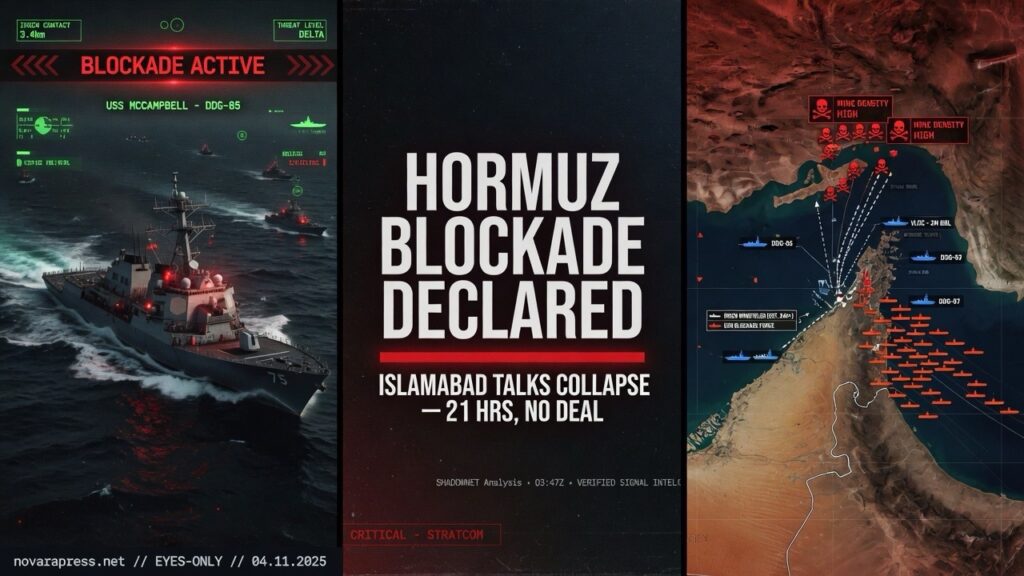
The ceasefire is hanging by a thread. Twenty-one hours of direct US-Iran negotiations in Islamabad ended without a deal Sunday morning, and within hours President Donald Trump declared an immediate naval blockade of the Strait of Hormuz — the narrow chokepoint through which nearly a fifth of the world’s oil supply normally flows. What began as the most significant diplomatic engagement between Washington and Tehran in decades has now escalated into a confrontation that could drag the global economy — and the region — back into open warfare.
The Talks That Went Nowhere
The setting was extraordinary. Vice President JD Vance flew personally to Islamabad to lead the American delegation in face-to-face negotiations with Iran — the highest-level direct engagement between the two adversaries since the war began on February 28. Across the table sat Mohammad Bagher Ghalibaf, Speaker of Iran’s Parliament and a figure deeply embedded in the regime’s security architecture, leading Tehran’s team.
Pakistan played host and mediator, a role Islamabad has publicly committed to maintaining. The talks were substantive: both sides exchanged detailed written proposals. The US put forward a 15-point framework demanding significant curbs on Iran’s military and nuclear capabilities, the reopening of the Strait of Hormuz, and a binding commitment to abandon the pursuit of nuclear weapons. Iran countered with its own 10-point plan calling for the release of approximately $6 billion in frozen assets, the lifting of all primary and secondary sanctions, continued Iranian control over the Strait of Hormuz, the right to enrich uranium for peaceful purposes, and an end to Israeli attacks on Lebanon.
Neither side budged on the two issues that matter most. When Vance emerged Sunday morning, the answer was simple and final: no deal.
Vance told reporters at a press conference before boarding Air Force Two: “The bad news is that we have not reached an agreement. And I think that’s bad news for Iran much more than it’s bad news for the United States. They have chosen not to accept our terms. We need to see an affirmative commitment that they will not seek a nuclear weapon — we haven’t seen that yet.” He described the US offer as the delegation’s “final and best,” leaving the door technically open while signaling Washington’s patience had a hard ceiling.
Trump Pulls the Trigger
The response from the Oval Office was not measured. Within hours of Vance’s departure, Trump took to Truth Social in a series of posts that read less like presidential statements and more like operational orders: “Effective immediately, the United States Navy, the Finest in the World, will begin the process of BLOCKADING any and all Ships trying to enter, or leave, the Strait of Hormuz. I have also instructed our Navy to seek and interdict every vessel in International Waters that has paid a toll to Iran. No one who pays an illegal toll will have safe passage on the high seas.”
He did not stop there. Trump announced the US would also begin destroying Iranian mines laid throughout the strait, and issued a stark warning to Iranian forces: anyone who fires on US vessels or commercial shipping “will be BLOWN TO HELL.” A separate post declared US forces “LOCKED AND LOADED” and threatened to resume military strikes, writing that the American military would “finish up the little that is left of Iran” at an appropriate moment. He also blamed the collapse squarely on Tehran’s nuclear ambitions, posting: “IRAN IS UNWILLING TO GIVE UP ITS NUCLEAR AMBITIONS!”
The announcements represent a dramatic escalation. A fragile two-week ceasefire — agreed under pressure last week — is now in serious jeopardy. The blockade declaration, if enforced, would put US Navy ships on a direct collision course with Iranian forces in waters Tehran has effectively controlled since the first week of the war.
A Double Blockade — And 230 Tankers Going Nowhere
The strategic picture around Hormuz is now almost paradoxical. Iran closed the strait from the eastern approach at the outset of the war, deploying naval mines, drone boats, missile threats, and GPS jamming to deter commercial traffic. The closure has been near-total: maritime traffic through the world’s most critical oil corridor dropped by over 90%, removing approximately 10 million barrels per day from global supply chains. Brent crude has already surged 10–13% since the conflict began, with analysts warning the $100-per-barrel threshold could be breached if the disruption persists.
Inside the Gulf, the human and economic cost is becoming impossible to ignore. Abu Dhabi National Oil Company CEO Sultan Al Jaber confirmed last week that more than 230 fully loaded oil tankers remain trapped in the Arabian Gulf, unable to move. They are not a metaphor — they are a slow-building crisis in physical form, sitting idle while their cargoes drive up energy and food prices from Africa to Southeast Asia.
Now, with Trump declaring an American blockade from the western approach, the strait faces simultaneous pressure from both ends. The practical effect: any ship attempting transit faces interdiction threats from Iran on one side and the US Navy on the other. The strait has effectively become a no-man’s-land.
The US military was already moving before the announcement. On Saturday — while negotiations were still ongoing in Islamabad — two Arleigh Burke-class guided-missile destroyers, the USS Frank E. Petersen Jr. and USS Michael Murphy, transited the Strait of Hormuz for the first time since the war began, as part of a mine-clearing operation. Admiral Brad Cooper, Commander of US Central Command, stated: “Today, we began the process of establishing a new passage and we will share this safe pathway with the maritime industry soon to encourage the free flow of commerce.” The timing — mid-negotiations — was not subtle.
Iran’s Confidence Is Not an Act
Tehran’s reaction to the collapsed talks was notable for its composure. Iranian officials did not express alarm. They expressed certainty. Ghalibaf placed blame squarely on Washington, saying US officials had “failed to gain the trust of the Iranian delegation.” Iranian state broadcaster IRIB declared the talks failed due to “excessive demands by America.” Deputy Parliament Speaker Ali Nikzad went further: “In the 40 days of war, the US has learned that the victorious side is determined by the will of nations and superiority on the battlefield, not by rhetoric on social media.”
Lawmaker Mahmoud Nabavian, who sat on the Iranian negotiating team in Islamabad, delivered the most unambiguous message: “The Strait of Hormuz will not be opened. The world will experience a new form of management in the Strait of Hormuz.” Iranian state media, citing a source close to the delegation, added: “Iran is in no hurry, and until the US agrees to a reasonable deal, there will be no change in the status of the Strait.” The foreign ministry left a technical opening — spokesperson Esmaeil Baqaei stated that “diplomacy never comes to an end” — but Iran’s official position was that no new round of talks is currently planned.
Former Iranian Vice President Ataollah Mohajerani framed the outcome in terms Washington would find uncomfortable: “The US proposed negotiations, arranged a mediator, agreed to Iran’s 10 conditions for talks — but then sought to achieve at the negotiating table what it failed to gain on the battlefield.”
Who Actually Holds the Cards?
Aaron David Miller, a former State Department Middle East negotiator with decades of experience in the region, offered a sober assessment after the talks ended: “The Iranians hold more cards than the Americans. They are clearly in no hurry to make concessions.” Miller identified Iran’s remaining leverage with precision — the highly enriched uranium stockpile, physical control of Hormuz, demonstrated battlefield resilience, and the simple fact that the regime has survived. “They’ve demonstrated a terrifying capacity to undermine security and stability. All of these things represent cards.”
He added a particularly pointed observation: Iran would likely rather risk resumed US and Israeli military strikes than walk away from negotiations empty-handed. That calculus — absorbing more strikes in exchange for keeping nuclear and geographic leverage — explains why Tehran is projecting confidence rather than urgency. The math is not comfortable for Washington either. A naval blockade of Hormuz is legally and operationally complex. Iran laid mines throughout the strait in the early weeks of the war — and according to one intelligence report, Iranian forces themselves may have lost track of the precise locations of some of those mines, complicating any rapid clearance operation.
Lebanon Burns as Diplomacy Fails
While Vance was still in Islamabad, Israeli warplanes struck multiple towns in southern Lebanon overnight, including Nabatieh, killing several people according to Lebanon’s state news agency. A third location came under artillery fire. Israeli Prime Minister Benjamin Netanyahu has publicly stated he wants a lasting peace agreement with Lebanon — but Israeli strikes continued uninterrupted through the ceasefire period and through the collapse of the Islamabad talks alike. Iran’s negotiating framework had explicitly demanded an end to Israeli attacks on Lebanon as a condition of any broader settlement. That condition went unmet.
Three Scenarios From Here
The situation now resolves toward one of three trajectories. The first is a delayed diplomatic return: Iran accepts or modifies the US “final offer,” a new round of talks begins under revised terms, and the ceasefire holds — shakily. The second is a sustained standoff: both sides maintain their blockades, the strait remains a dead zone, oil prices grind higher, and economic pressure builds on all parties simultaneously. The third is the one no one wants to name directly: a naval incident in the strait, a mine strike, a miscalculation under rules of engagement, and a return to direct military hostilities.
Trump said US forces are “LOCKED AND LOADED.” Iran said the strait will not open. Two US destroyers are already inside the waterway. Iran’s mines are still there. The ceasefire that was announced with considerable fanfare less than two weeks ago now looks like a pause, not a conclusion. The Strait of Hormuz — 21 miles wide at its narrowest point, carrying a fifth of the world’s oil — is now simultaneously the most important diplomatic problem on earth and its most dangerous military flashpoint. What happens in those 21 miles in the next 72 hours will determine whether the war that began on February 28 is entering its final chapter — or just its most dangerous one.