
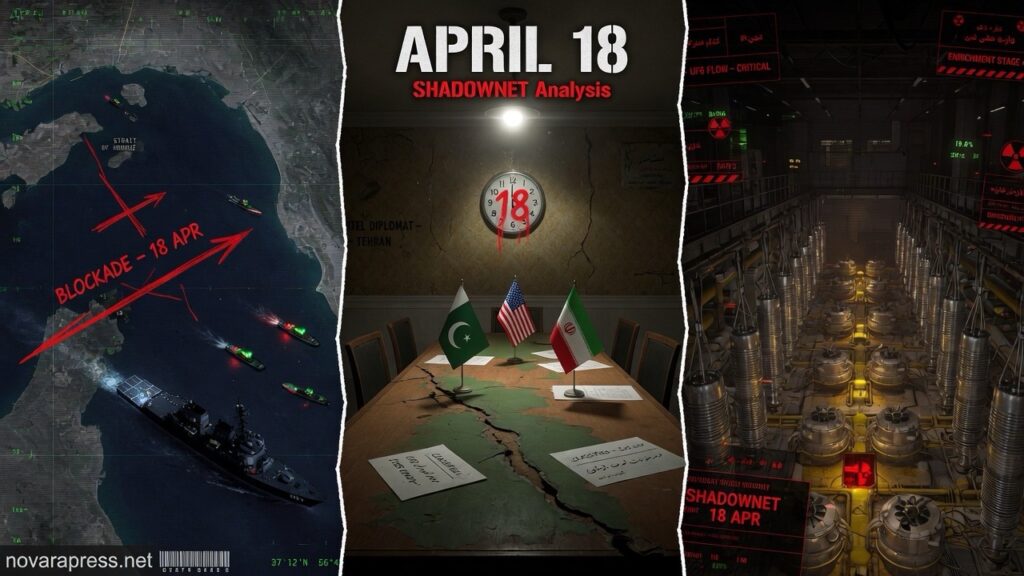
April 18: The Day the Blockade Either Works — or the War Restarts
Wars rarely end in a single moment. But they often restart in one.
The US-Iran conflict has reached an inflection point so compressed, so loaded
with overlapping deadlines and military triggers, that a single 24-hour window
now carries the weight of the entire war’s future. That window is April 18.
This is not a symbolic date. It is a structural one — the product of
colliding timelines: a failed negotiation, an active naval blockade, a ceasefire
running out of oxygen, and a regime in Tehran that has already told the world
exactly what it will do if pushed past a certain line. SHADOWNET Analysis has
tracked the signals converging on this date for days. What follows is the case
for why April 18 may be remembered as the day the war either found its exit —
or lost it entirely.
I. The Collapse That Created the Window
To understand April 18, you have to understand what broke on April 12.
The Islamabad talks were the highest-level direct engagement between Washington
and Tehran since the 1979 Islamic Revolution. Twenty-one hours of negotiations.
Pakistani, Egyptian, and Turkish mediators in the room. Both delegations arriving
with prepared technical papers. By any historical measure, the infrastructure for
a deal was present.
It collapsed anyway.
The American position, as articulated by Vice President Vance before he boarded
Air Force Two, was unambiguous: Iran must make a binding, long-term commitment to
abandon not just nuclear weapons but the tools that could enable them —
enrichment capacity, stockpiles, the entire upstream architecture of a weapons
program. Iran’s position was equally unambiguous: enrichment is a sovereign right,
and no agreement signed under military duress carries legitimacy.
Iranian Foreign Minister Araghchi said the two sides came within inches of an
understanding before the US shifted its demands. American officials did not confirm
that characterization — but they did not deny the progress either. What both sides
agree on is the outcome: no deal, and a ceasefire that now expires in seven days.
The collapse did not end the war. It restarted its countdown.
II. The Blockade Clock
Within hours of Vance’s departure from Islamabad, President Trump announced
what the breakdown had always threatened to produce. Effective Monday, April 14,
US Central Command began enforcing a naval blockade of all Iranian ports and
coastal areas — applied, in CENTCOM’s words, “impartially against vessels of
all nations.”
This is not a symbolic gesture. A blockade of Iranian ports is an act of
economic warfare with immediate physical consequences: oil tankers diverted,
import cargo rerouted, the already-strained Iranian economy placed under a new
layer of pressure that sanctions alone could not achieve. It is also, under
international law, an act that sits on the threshold between coercion and
warfare — a threshold that Iran’s military has historically treated as a
tripwire.
The blockade started April 14. By April 18 — four days in — its operational
reality will have fully materialized. The first contested ships will have arrived
at the boundary. The Iranian Navy will have made its first decisions about whether
to comply, to confront, or to escalate laterally. The window for quiet
de-escalation will have narrowed to hours.
Four days is the compression zone. It is long enough for both sides to test
the blockade’s edges, and short enough that no diplomatic intervention has had
time to produce relief. April 18 sits at the precise center of maximum
pressure — after the blockade has bitten, before anyone has blinked.
III. The Ceasefire’s Expiration Architecture
The two-week ceasefire, brokered by Pakistan and announced around April 7,
expires on April 21. That date is not a negotiating deadline — it is a physical
clock. When it reaches zero, the legal and political framework restraining both
sides’ military operations dissolves.
Mediators from Pakistan, Egypt, and Turkey are now working against that
clock. Their window is not seven days — it is effectively three. Any agreement
framework, to be credible, must be reached by April 18 to allow time for
technical drafting, leadership sign-off, and the minimal confidence-building
measures required to prevent either side from treating the expiration as a
green light.
This is why April 18 functions as the real deadline — not April 21.
Diplomacy does not happen at the last second. It happens in the last window
before the last second. That window closes on April 18.
If no framework is in place by then, the ceasefire will expire not as a
negotiating failure but as a strategic vacancy — an absence of restraint into
which military logic will immediately flow.
IV. Iran’s Calculated Threats
Tehran has not been quiet about its options. Iran’s military spokesman, in
the hours following the Islamabad collapse, delivered two specific threats that
analysts should not dismiss as posturing.
The first: warships approaching the Strait of Hormuz will face a “strong and
decisive response.” This is not a new position — but the timing of its
restatement, immediately after failed talks and during an active US naval
blockade, gives it a different operational weight. It is a public red line
issued at a moment when red lines are about to be tested.
The second threat is the one that should concern global markets more than
any other development in this conflict: Iran’s explicit threat to close the
Bab el-Mandeb Strait. The Bab el-Mandeb connects the Red Sea to the Gulf of
Aden — the chokepoint through which a significant portion of Europe-bound
energy and cargo flows. Closing it would not punish America. It would punish
the entire global trading system simultaneously, creating immediate pressure
on European and Asian governments to intervene in a conflict they have so far
watched from a safe distance.
This threat reframes the entire conflict. Iran is signaling that its
response to a naval blockade will not be symmetric — it will be
systemic. And the timeline for that response converges, by all
available indicators, on the April 17–19 window.
V. The Nuclear Arithmetic
Beneath the military theater, the core issue remains unresolved: Iran’s
nuclear program.
Iran has enriched uranium to 60 percent — well above civilian power
requirements, within striking distance of the 90 percent weapons-grade
threshold. US strikes earlier in the conflict targeted Iran’s three main
nuclear sites. Trump declared the program “obliterated.” Intelligence
assessments published in the 2026 Worldwide Threat Assessment told a
different story — no confirmed decision by Tehran to weaponize, but
sufficient capacity to move quickly if the political decision were made.
The Islamabad talks broke down precisely because neither side could find
a formula that satisfied both Washington’s demand for permanent dismantlement
and Tehran’s insistence on sovereign enrichment rights. That gap did not close
in 21 hours of negotiations. It will not close in the four days between now
and April 18.
What April 18 will determine, instead, is whether the gap is managed —
or exploded. A partial framework, even an ambiguous one, gives mediators
something to work with. A military incident in the Strait, a confrontation
at the blockade line, or an Iranian move against Bab el-Mandeb gives
everyone nothing to work with except the next escalation.
VI. The Actors Who Will Decide Everything
Three sets of actors hold the variables that will determine April 18’s
outcome — and none of them are fully in control of their own decisions.
Trump. The American president has publicly stated that he
considers Iran’s nuclear refusal a justification for resumed strikes. He has
also described the Islamabad meeting as “really good — except for one issue.”
This is a president who negotiates through escalation and has demonstrated
willingness to use military force as a bargaining tool. The blockade is, by
US officials’ own admission, part of the negotiating strategy — not a prelude
to peace, but a lever. Whether Trump pulls harder on that lever on April 18
depends entirely on whether Iran has signaled movement by then.
Iran’s decision-making core. The Iranian delegation in
Islamabad was led not by a diplomat but by Parliament Speaker Qalibaf —
a figure with deep Revolutionary Guard roots and a constituency that views
any nuclear concession as existential capitulation. The internal debate in
Tehran between pragmatists who see a deal as survival and hardliners who see
it as surrender is unresolved. April 18 will force that internal debate into
an external decision.
The mediators. Pakistan, Egypt, and Turkey are now the
most consequential actors in global geopolitics — a sentence that would have
seemed implausible six months ago. Their ability to bridge the gap between
Washington’s “final offer” and Tehran’s “legitimate rights” framing in less
than four days is the single variable most likely to determine whether April
18 produces a diplomatic opening or a military escalation.
VII. What April 18 Looks Like in Each Scenario
Scenario One — The Framework: Mediators broker a partial
understanding on enrichment limits and blockade suspension. Both sides declare
it a step toward a larger agreement. The ceasefire is extended by 72 hours.
Markets recover. The war does not end, but the clock is reset. Probability:
possible, but requires movement from Tehran that has not yet been signaled.
Scenario Two — The Standoff: No framework emerges. The
blockade continues. Iran does not act militarily but signals it will on April
21. The ceasefire expires in a vacuum. Both sides reposition. The war resumes
at a higher intensity than before the ceasefire. Probability: the current
trajectory.
Scenario Three — The Trigger: An Iranian naval vessel or
proxy force directly challenges the US blockade. A US warship fires. Or Iran
moves against Bab el-Mandeb. The ceasefire collapses before its expiration
date. Trump authorizes resumed strikes. The conflict enters a phase with no
diplomatic off-ramp. Probability: lower than Scenario Two, but rising with
every hour the blockade operates without political progress.
SHADOWNET Assessment
April 18, 2026 is not a date chosen by analysts. It is a date constructed
by events — the fourth day of a naval blockade, the last viable window for
diplomatic progress before a ceasefire expires, and the moment when Iran must
decide whether its threats are strategy or theater.
The signals converging on this window — military positioning, diplomatic
deadlines, internal Iranian pressure, and Trump’s escalatory logic — do not
point to certainty. Wars contain the possibility of restraint until they don’t.
But the structural architecture of this moment is as dangerous as any point
in the US-Iran conflict since the first strike on February 28.
The world is watching Islamabad’s aftermath. It should be watching
April 18.
SHADOWNET Analysis monitors conflict systems, proxy networks, and
geopolitical risk across the Middle East and beyond. All assessments are
based on open-source intelligence and pattern analysis.