
SHADOWNET ANALYSIS · NOVARAPRESS.NET
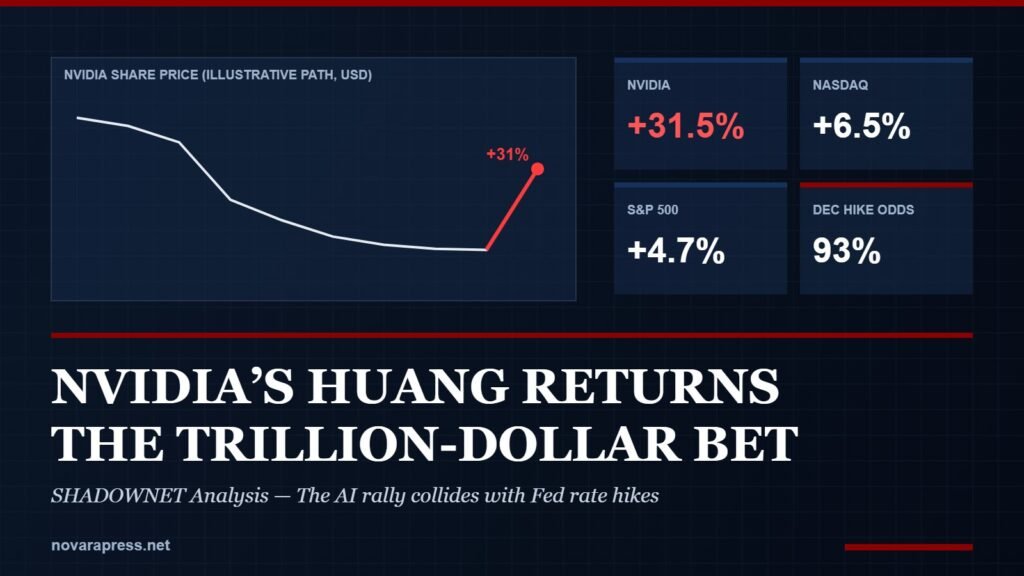
Nvidia’s board brought Jensen Huang back after eleven days, and markets added close to a trillion dollars in a single session. The rebound exposes how much of the world economy now rests on one company, one chip and one person.
SHADOWNET DESK · NOVEMBER 24, 2026 · ECONOMIC INTELLIGENCE · 8 MIN READ
KEY POINTS
- Nvidia’s board unanimously reinstated Jensen Huang as CEO on November 23, saying it had received input from senior levels of the US government.
- Nvidia shares closed about 31% higher, the Nasdaq rose 6.5% and the S&P 500 gained 4.7%, according to market data cited by CNBC and others.
- The rally arrives as the Federal Reserve signals more rate hikes; futures price a December increase as highly likely, with 30-year mortgages above 7%.
- Independent, SEC and Justice Department reviews continue, and Huang is due to speak to House committees on December 1.
SECTION 01
Nvidia Huang Reinstated: What Happened in Eleven Days
On November 12, Jensen Huang, the co-founder who built Nvidia into the backbone of the artificial intelligence boom, stepped down as chief executive and left the board. The company gave no formal reason. Media reports, including from Al Jazeera and Axios, linked the exit to personal-conduct allegations and to US intelligence claims about a former associate who ran a Singapore data-centre firm. China rejected those intelligence claims as baseless, ABC News reported.
The board named finance chief Colette Kress as interim CEO and appointed long-serving director Harvey C. Jones as its first chair. It also set up an independent committee, hired outside counsel, and created a new National Security and Export Control Committee.
Eleven days later, the board reversed course. In a statement on November 23, Nvidia said directors voted unanimously to restore Huang as president, CEO and board member, effective immediately. The board said it was satisfied with his candour and ability to lead.
The most important line for markets was about Washington. Nvidia said the board “received input from senior levels of the United States government” and was confident the return posed no national security risk. President Donald Trump later said on Truth Social that the decision was correct, according to Al Jazeera.
The investigation itself is not over. Nvidia said the independent review “will proceed to conclusion” and that it will keep cooperating with government inquiries. Al Jazeera reported that the SEC and the Justice Department also have open investigations.
SECTION 02
A Near-Trillion-Dollar Day for the AI Trade
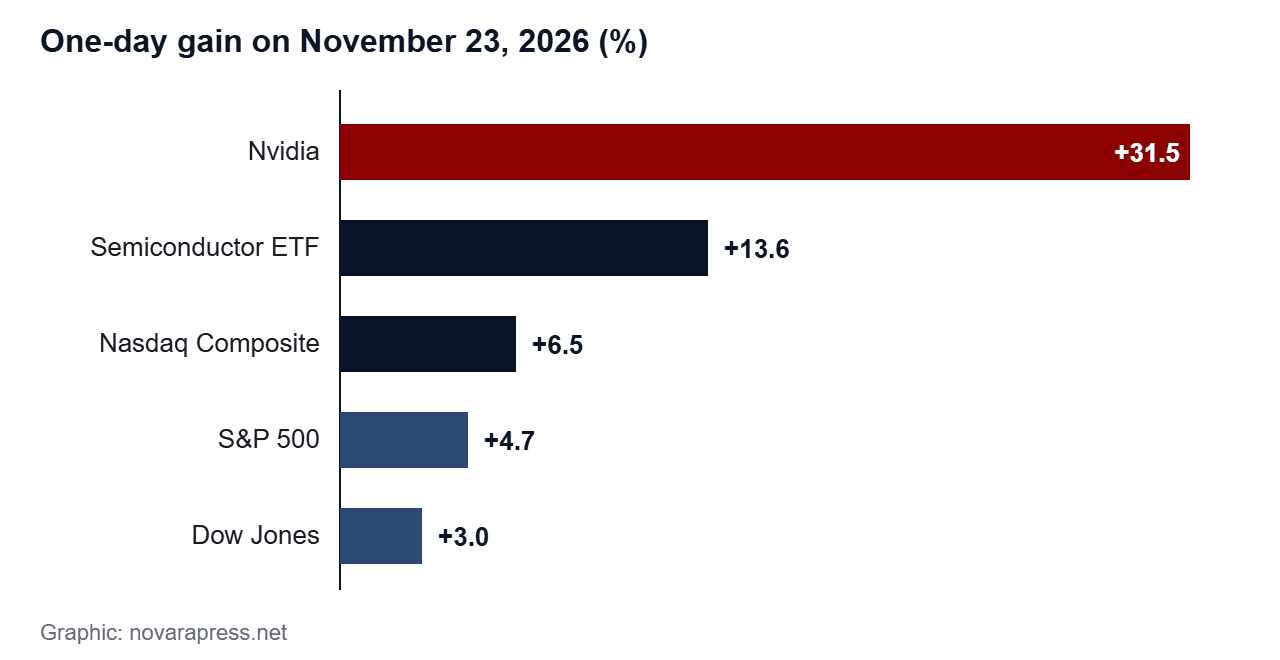
The market reaction was one of the largest single-day moves ever recorded for a listed company. Nvidia closed at about $165, up roughly 31.5% from $125.53, according to closing data compiled by FinanceFeeds from CNBC. That added an estimated $950 billion in market value in one session.
The move spread far beyond one stock. The Nasdaq Composite rose 6.5%, its best day since April 2025. The S&P 500 gained 4.7% and the Dow added 3%. Chip stocks jumped more than 13%, and the VIX volatility index fell about 26%.
Asia joined in on Tuesday. Broker research from Tickmill reported Taiwan’s Taiex up about 9% and South Korea’s KOSPI up about 7%, led by chip suppliers. CaixaBank Research said the rally came as Huang’s return eased concerns surrounding the AI sector.
The context matters. Before Monday, the S&P 500 had fallen for seven straight sessions and the Nasdaq had dropped about 10% in a week. Monday was a relief rally from deeply oversold levels, not proof that the underlying risks have gone away.
SECTION 03
Key-Person Risk Becomes a Macro Risk
The episode reveals something uncomfortable. When Huang left, Axios estimated that Nvidia had lost about $1.4 trillion in value over two weeks. When he returned, most of it came back in hours. Few economies in history have priced one executive this heavily.
Nvidia controls an estimated 90% of the market for advanced AI chips, Al Jazeera reported. Its suppliers in Taiwan and South Korea, its cloud customers, and AI developers such as Anthropic all depend on its roadmap. Nvidia’s own investments in AI firms tie that web even tighter.
For pension funds and index investors, this is concentration risk in plain sight. A handful of chip and cloud names now make up a large share of major US indexes. A shock to one company moves retirement accounts around the world, whether savers chose to bet on AI or not.
“Almost as big a shock as his departure.”
— Lindsey Stewart, Morningstar, on Huang’s return, quoted by ABC News
Stewart also raised questions about governance and board oversight, ABC News reported. That is the core tension. Investors cheered continuity, but the process showed how hard it is for any board to act independently when a company is this central to markets and to national strategy.
SECTION 04
Washington’s Hand: Chips as Strategic Infrastructure
The board’s reference to government input is unusual for a private company leadership decision. Trump told CNBC he had spoken with Huang and with the board, according to ABC News, and called him a “national treasure.”
Supporters see this as a recognition that AI chips are now strategic infrastructure, like energy or defence. Critics see a precedent that blurs the line between state and corporate governance. Senator Elizabeth Warren said on X that Huang and Nvidia still owe Congress answers, Al Jazeera reported.
Export policy is part of the picture. ABC News reported that the Commerce Department issued a new rule last week on remote access to advanced AI chips, aimed at foreign firms with data centres near China. Nvidia’s new export-control committee will now oversee that exposure.
The next checkpoint is Capitol Hill. ABC News reported that Huang will sit for a closed-door transcribed interview on December 1 before the House Foreign Affairs Committee, the Select Committee on the CCP and the House Intelligence Committee. Nvidia’s general counsel is due the following day. Any new disclosures there could test the rally quickly.
SECTION 05
Who Gains, Who Pays: The AI Rally Meets Rate Hikes
The clearest winners are Nvidia shareholders, chip suppliers in East Asia, and the cloud and AI companies that need a stable product roadmap. Governments counting on AI-led growth also gain, because the sector is a large driver of business investment.
The bill falls elsewhere. The Federal Reserve is moving in the opposite direction to the stock market. New York Fed President John Williams said this month that more hikes are likely, and that the Fed still has “work to do,” Mortgage Professional America reported.
The same report said CME FedWatch priced a 93% chance of a quarter-point hike at the December 8–9 meeting. Governor Christopher Waller even said a half-point move should be considered. A strong AI boom adds to demand for power, land and labour, which can keep inflation sticky.
| Indicator | Latest reported level |
|---|---|
| Fed funds target range | 3.75%–4.00% |
| 10-year Treasury yield (Nov 23 close) | about 4.94% |
| 30-year fixed mortgage (Freddie Mac, week to Nov 12) | 7.11% |
| Unemployment rate | 4.1% |
| Market odds of a December Fed hike (CME FedWatch) | 93% |
Sources: Mortgage Professional America, CaixaBank Research, CNBC data via FinanceFeeds. Figures as reported in mid-to-late November 2026.
For ordinary households, this is the real story. Stock gains flow mainly to people who already own shares. Higher borrowing costs reach everyone with a mortgage, a car loan or a credit card. A record day on Wall Street does little for a family facing a 7% mortgage rate.
SECTION 06
What Happens Next: Three Scenarios
MOST LIKELY · UNEASY STABILITY
Huang stays, the December 1 interviews pass without major new disclosures, and Nvidia’s shares settle below Monday’s peak. Markets shift focus back to inflation data and the Fed. Governance questions linger but do not change the business.
POSSIBLE · RATES TAKE OVER
Hot inflation data and a December hike, possibly larger than expected, push long-term yields above 5%. High-valuation tech stocks lose part of the rebound even with Huang in place, and the leadership story fades behind the cost of money.
WORST CASE · THE REVIEW BITES
The independent, SEC or Justice Department reviews produce findings that reopen the leadership question or tighten export rules. Another sharp swing in the world’s most important AI stock would hit index funds, Asian suppliers and confidence in AI spending at the same time.
SHADOWNET ASSESSMENT
Huang’s return removed a leadership shock, but it did not remove the structural risk the shock exposed. The AI economy is concentrated, politically entangled and highly sensitive to interest rates.
Watch four things: the December 1 congressional interviews, the October PCE inflation data, the Fed decision on December 9, and any update from the independent review. Together they will decide whether this week marks a durable recovery or a pause in a volatile market.
For more context, read our analysis of how rising US borrowing costs are testing Washington, our look at how China gained leverage in its rivalry with Washington, and our report on how AI agents are reshaping professional jobs.
SOURCES
- NVIDIA Newsroom — NVIDIA Board Reinstates Jensen Huang as President, CEO and Board Director (Nov 23, 2026)
- US SEC — NVIDIA Form 8-K filing, November 23, 2026
- ABC News — Jensen Huang reinstated as Nvidia CEO
- Al Jazeera — Nvidia board reinstates Jensen Huang as CEO
- Al Jazeera — Why did Nvidia CEO Jensen Huang resign, and who is Colette Kress?
- Axios — Jensen Huang resigns as Nvidia CEO
- CaixaBank Research — Financial Markets Daily Report, 24 November 2026
- Mortgage Professional America — Fed’s Williams signals more rate hikes
- FinanceFeeds — Stock Market Today: Nasdaq Jumps 6.5% as Huang Returns
All claims in this analysis are attributed to the sources listed. Market figures are as reported at publication and may be revised. This article is for information only and is not financial or investment advice. It will be updated as information develops.