
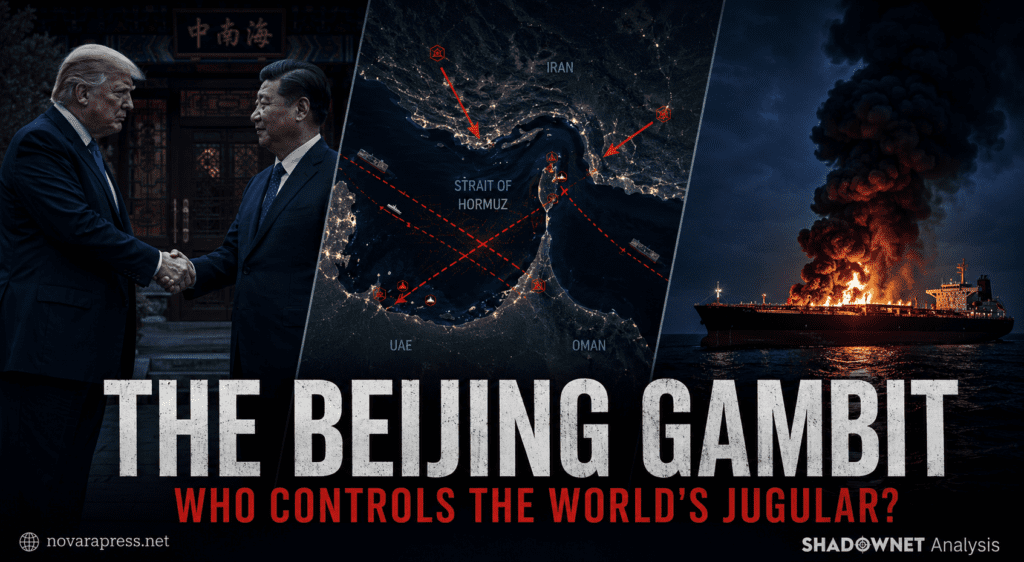
The Beijing Gambit: What Trump’s China Visit Really Means for the Hormuz Crisis
How the Iran war handed Xi Jinping leverage Washington never expected him to have — and why the world’s most critical chokepoint hangs in the balance
|
MAY 16, 2026
|
STRATEGIC ASSESSMENT
W
hen Air Force One touched down in Beijing on May 13, 2026, it marked the first presidential visit to China in nearly a decade. But the circumstances could not have been more fraught. The U.S.-Israel war against Iran — now in its third month — had turned the Strait of Hormuz, the jugular vein of global energy, into an active war zone. Behind Trump lay billions in Gulf deals and five weeks of inconclusive bombing. Ahead of him sat the one man on earth with real leverage over Tehran: President Xi Jinping. Washington had arrived in Beijing not as the world’s uncontested hegemon, but as a superpower in need of a favor.
A War That Rewrote the Rules of Leverage
On February 28, 2026, the United States and Israel launched coordinated airstrikes against Iran, assassinating Supreme Leader Ali Khamenei and targeting military and nuclear infrastructure. The stated objective was swift and surgical: neutralize Iran’s military capacity and its nuclear program in one decisive blow. What followed defied every projection in Washington’s war planning. Iran did not collapse. It absorbed the strikes, launched thousands of missiles and drones at Israel, U.S. bases, and Gulf allies — and then played its masterstroke: sealing the Strait of Hormuz on March 4.
The economic shockwave was immediate and global. Brent crude surged past $120 per barrel. The collective oil output of Kuwait, Iraq, Saudi Arabia, and the UAE collapsed by more than 10 million barrels per day by March 12. QatarEnergy declared force majeure on all exports. European gas storage, already at historically low levels of 30% capacity following a brutal winter, faced the prospect of a catastrophic shortfall. Dutch TTF gas benchmarks nearly doubled to over €60/MWh. The Philippine government declared a state of emergency. Pakistan, Bangladesh, and Nigeria faced acute fuel shortages. In a single maritime closure, Iran had transformed a regional war into a global energy crisis.
“The war in Iran has given President Xi sources of leverage that he would not have anticipated having at the beginning of this year.”
Ali Wyne — International Crisis Group
The Strait: Thirty-Four Kilometers That Govern the World
At its narrowest point, the Strait of Hormuz measures just 34 kilometers wide. Yet its strategic weight dwarfs any geographic measurement. Through its two unidirectional sea lanes, roughly 20 million barrels of oil flowed daily before the conflict — approximately 20% of all global seaborne crude trade. Another 20% of the world’s liquefied natural gas exports transited the same passage. Some 3,000 vessels used the strait every month. By mid-March 2026, that figure had fallen to barely 5% of normal traffic levels.
On April 13, Trump formalized a U.S. naval blockade of Iranian ports. On May 4, he launched Operation Project Freedom — a Navy escort mission to shepherd commercial vessels through the strait — only to freeze it two days later over “great progress” toward a possible deal. Meanwhile, Iran established the Persian Gulf Strait Authority, a new state agency to levy transit fees on shipping, denominated in Chinese yuan. Secretary of State Rubio called it “unacceptable,” asking the world bluntly: “Is the world going to accept that Iran now controls an international waterway?” The question went unanswered.
| Indicator | Pre-Crisis | May 2026 |
|---|---|---|
| Daily oil transit volume | ~20M barrels/day | ~5% of normal |
| Brent crude price | ~$80/barrel | $120+/barrel |
| Monthly vessel transits | ~3,000 ships | ~150 ships |
| Iran’s lost oil revenue (to May 1) | — | $4.8 billion |
| Gulf food imports via Hormuz | 80%+ | 70% disrupted |
Beijing’s Calculation: Leverage First, Cooperation at a Price
China buys 90% of Iran’s oil exports and maintains a deep economic and strategic partnership with Tehran. Yet Beijing, cushioned by substantial strategic petroleum reserves, managed to insulate itself from the immediate shock of the strait closure more effectively than any other major economy. What Chinese leadership recognized almost instantly was that the crisis had delivered something far more valuable than cheap oil: unprecedented leverage over Washington at a moment when the United States desperately needed Beijing’s help.
The evidence accumulated steadily. In March, China declined Trump’s call for military assistance in reopening the strait. In April, Beijing is credited with pressuring Tehran to accept the initial ceasefire — but acted with deliberate restraint, offering just enough to keep Washington engaged without surrendering its negotiating position. Chinese vessels began transiting the strait under arrangements with Iran while other nations’ ships remained bottled up. The price Beijing expected for any serious pressure on Tehran was openly discussed among analysts: meaningful concessions on Taiwan.
“Every day the United States remains bogged down in the Strait of Hormuz is a day China breathes more freely in the Pacific.”
SHADOWNET Assessment
The economic dimension compounded Washington’s weakness. Trump’s new sanctions targeting Chinese energy supplies — imposed at a moment of severe domestic economic stress in China — were viewed by Beijing not as Iran-related pressure but as a continuation of the decade-long trade war under new cover. Washington’s negotiating hand had already been weakened in February when the Supreme Court ruled that the International Emergency Economic Powers Act could not be used to impose tariffs, stripping Trump of a critical tool heading into the summit.
The Beijing Summit: What Was Said — and What Wasn’t
The summit concluded on May 15 with carefully worded declarations about “stabilizing the relationship” and “fantastic trade deals” — without specifics. On Iran and Hormuz, Trump reported that Xi said Beijing wants to help negotiate an end to the war and the reopening of the strait. Trump also confirmed China reassured him it would not provide Iran with military equipment. But the most revealing signal was what Beijing’s official readouts barely mentioned at all: Iran. The Chinese side offered almost no public commitment on what concrete steps, if any, it would take — or when.
While the summit was still underway, a vessel anchored off the UAE coast was reportedly seized and towed toward Iranian waters. An Indian-flagged cargo ship sank near Oman after being attacked. The timing was not accidental. Iran was sending a message it did not need to put in writing. The strait remained a war zone regardless of what was being discussed in Beijing’s Zhongnanhai gardens.
Taiwan dominated the underlying tension throughout. Xi warned that disagreements over the self-governed island “could lead to clashes or conflict” — the clearest indication yet of Beijing’s price for genuine intervention on Iran. The $11 billion U.S. arms package approved for Taiwan in December loomed over every conversation. Analysts had predicted well before the summit that China would not deliver on Iran without extracting something significant in the Taiwan file. Nothing in the official readouts suggested that calculus had changed.
The Players: Who Gains, Who Bleeds, Who Waits
Iran entered this crisis as the regional power that absorbed five weeks of superpower bombardment and still controls the world’s most critical energy chokepoint. Its strength is not merely military — it is geographic and strategic. The Persian Gulf Strait Authority, collecting passage fees in Chinese yuan, is a direct challenge to dollar dominance over energy trade. Tehran’s strategy is coherent: keep pressure instruments active, extract as much international legitimacy as possible from Washington’s aggression, and wait for the costs of the blockade to fracture the coalition against it.
China is the war’s most unexpected beneficiary. Shielded by reserves, it absorbs the energy shock better than anyone while accumulating geopolitical capital at Washington’s expense. Beijing’s playbook — express concern, call for freedom of navigation, offer mediation language, but deliver nothing binding — is a masterclass in leveraged neutrality. It needs rare earth minerals that U.S. missile interceptors depleted in the war. Washington needs those minerals to rebuild its depleted munitions stockpiles. Both sides know it. Neither side has moved.
Europe is the most economically exposed actor in the crisis. With historically depleted gas storage and heavy dependence on Qatari LNG now disrupted, France and the UK are pushing for a multinational maritime mission to reopen the strait — but without direct military confrontation. The European Central Bank has already postponed rate cuts and revised growth forecasts downward. UK inflation is projected to breach 5%. Industrial output across the EU faces surcharges of up to 30% as energy-intensive manufacturers pass on cost shocks.
Gulf states were not consulted before the war was launched and have absorbed thousands of Iranian missiles since March. Their economies depend on a strait they assumed would always remain open. Oil tankers in Dubai, Qatar, and Kuwait have been struck. Desalination plants — the source of 99% of Kuwait and Qatar’s drinking water — have been targeted. These governments watch the Beijing summit with deep unease, asking a question no diplomat will answer publicly: what deal might be struck over their heads?
Three Scenarios: What Comes Next
Calibrated Chinese Pressure and a Partial Diplomatic Settlement
Beijing delivers a tactical concession — a firm diplomatic warning to Tehran against further escalation — in exchange for a temporary freeze on the Taiwan arms package or a restructuring of tariff schedules on semiconductors. Iran partially reopens the strait to commercial shipping not linked to U.S. or Israeli interests. Trump claims victory and returns to Washington with a workable narrative. The crisis freezes at a level that preserves leverage for all parties, with full resolution deferred indefinitely.
Prolonged Stalemate and Incremental Escalation
The summit fails to build any real bridge. China maintains its wait-and-watch posture. Iran continues operating the Strait Authority and collecting transit fees in yuan. Trump resumes military threats and relaunches a limited naval operation. Markets enter a fresh wave of turbulence; global growth contracts sharply in H2 2026. Taiwan remains a powder keg. The war neither ends nor expands — it festers, draining U.S. resources while China watches from a position of strategic patience.
Negotiations Collapse — The Strait Becomes a Battlefield
Talks break down entirely. The U.S. launches intensive strikes on Iranian military installations controlling the strait. Iran responds with comprehensive attacks on Gulf energy infrastructure. China provides covert support to Tehran — intelligence feeds, dual-use civilian supplies, diplomatic cover at the UN Security Council. Brent crude breaks $160. Europe enters formal recession. Emerging market debt crises cascade across Asia and Africa. A single miscalculation in a 34-kilometer passage rewrites the global order.
The Verdict: A Summit That Raised More Questions Than It Answered
What the Beijing summit revealed goes far beyond what was announced. Trump arrived in China in the unusual position of a superpower president asking for help — for the first time in his political career arriving not as the deal-maker in command, but as the party in greater need. Xi received him with elaborate ceremony and carefully calibrated warmth, without providing a clear answer to the fundamental question: will China actually pressure Iran to reopen Hormuz?
Beijing’s near-silence on Iran in its official readouts is itself the loudest signal. China is in no hurry. Every day the United States remains entangled in the Persian Gulf is a day Beijing accumulates relative advantage in the Pacific. Every billion dollars Washington spends on the naval blockade is another chip on China’s side of the negotiating table. The formula is simultaneously simple and structurally complex: China wants Hormuz open — just not at the price Trump is asking.
SHADOWNET’s assessment: no comprehensive settlement is imminent. What is more probable is a sequence of incremental, transactional arrangements — each party selling measured concessions and buying time. The Hormuz crisis will not be resolved by a single summit in Beijing. It will be resolved, if at all, through a broader regional equation whose components have not yet aligned. The strait that was once the world’s most reliable energy corridor has become the arena where the next iteration of the international order is being contested — barrel by barrel, ship seizure by ship seizure, summit by summit.
SHADOWNET DESK — novarapress.net | All assessments are based on open-source intelligence and independent strategic analysis. This material does not represent the position of any government or official body.
SOURCES
- The Washington Institute for Near East Policy — “Trump’s China Trip: Implications for the Middle East and Beyond” (May 2026)
- NPR — “Trump lands in China as Iran war smolders” (May 12, 2026)
- PBS NewsHour — “Trump arrives in China for high-stakes talks on trade, Taiwan and Iran war” (May 2026)
- Euronews — “Trump and Xi wrap up summit claiming progress in stabilising ties” (May 15, 2026)
- The Hill — “Five takeaways from Trump’s trip to China” (May 15, 2026)
- Al Jazeera — “Trump-Xi summit: China’s help in Iran may require US concessions” (May 13, 2026)
- Wikipedia — “2026 Strait of Hormuz crisis” (updated May 2026)
- Wikipedia — “Economic impact of the 2026 Iran war” (updated May 2026)
- Congressional Research Service — “Iran Conflict and the Strait of Hormuz: Impacts on Oil, Gas, and Other Commodities” (March 2026)
- UK House of Commons Library — “Israel/US-Iran conflict 2026: Reopening the Strait of Hormuz” (May 2026)
© 2026 NOVARAPRESS.NET | SHADOWNET ANALYSIS | ALL RIGHTS RESERVED