
Beijing’s Single Word Just Complicated Every Deal Trump Announced in China
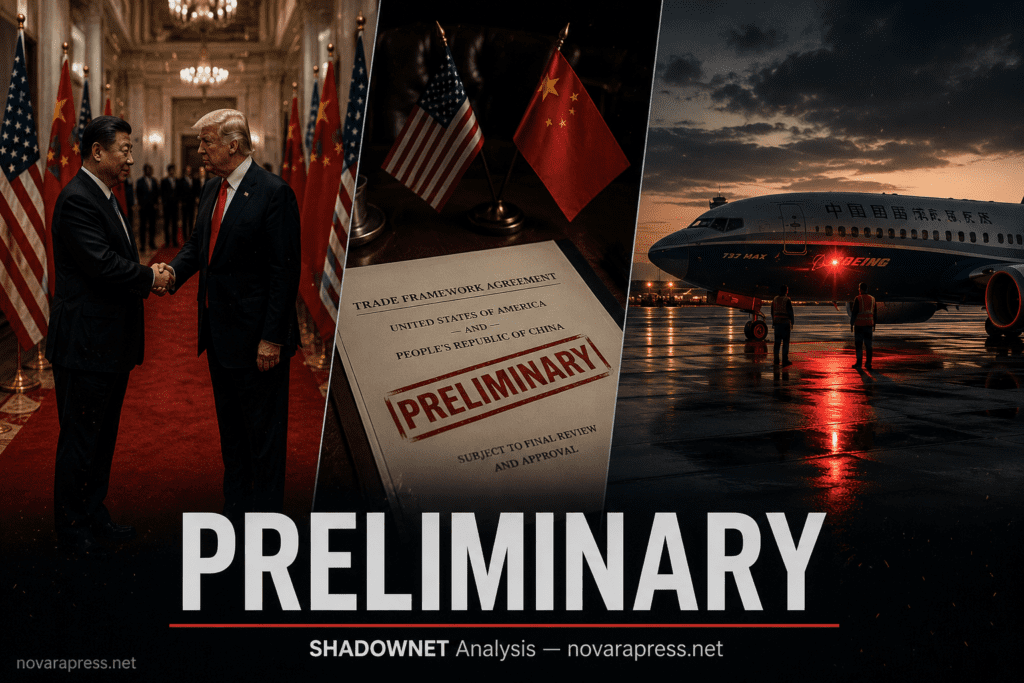
China’s commerce ministry called the summit’s trade outcomes “preliminary” — with no timelines, no volumes, no company names. The gap between Washington’s victory lap and Beijing’s paper trail deserves a careful reading.
The official version left Beijing quietly on a Saturday morning. China’s Ministry of Commerce posted a short statement on its website — no press conference, no English summary, no advance notice. It described the tariff, agricultural, and aircraft arrangements reached during Donald Trump’s two-day visit as “preliminary.” Discussions on details, the ministry noted, were continuing. Agreements would be “finalised as soon as possible.” That was it. No companies named. No volumes. No timelines. No dollar figures. Against the backdrop of Trump boarding Air Force One the day before and telling reporters he had secured “fantastic” deals and a “tremendous success,” the ministry’s language functioned less as confirmation and more as a quiet correction.
Saturday’s statement was the first official Chinese public characterisation of what the May 14–15 summit actually produced. Its understatement is the story.
What the Ministry Actually Confirmed
The commerce ministry statement did three specific things. First, it confirmed that both sides agreed to establish an investment board and a trade board — structural mechanisms to negotiate reciprocal, product-specific tariff reductions plus broader cuts on unspecified goods, including agricultural products. Second, it acknowledged arrangements covering Chinese purchases of U.S. aircraft and American assurances on the supply of aircraft engines and parts to China. Third, it noted that both sides would work to resolve non-tariff barriers and market access issues, including U.S. commitments to address China’s concerns over the automatic detention of dairy products and aquatic products at American ports, and China’s reciprocal commitments on American beef facility registrations and poultry meat export conditions.
The statement also mentioned U.S. efforts to secure recognition of Shandong province as free of bird flu — a designation that would unlock meaningful poultry trade volumes. None of this is trivial. But none of it is done, either. Beijing was describing the framework for negotiations, not their outcome.
The Boeing Arithmetic
The aircraft deal became the most scrutinised claim to emerge from the trip. Aboard Air Force One after departing Beijing, Trump said China had committed to purchasing 200 Boeing jets and had tentatively agreed to buy 750 more in the future. Markets had gone into the summit expecting a purchase order of approximately 500 aircraft. When the actual figure — 200, with no timeline attached — became clear, Boeing shares fell nearly 4 percent on Thursday, their steepest single-day drop in six months.
| Area | Trump’s Claim | Beijing’s Characterisation |
| Boeing Aircraft | 200 confirmed + 750 tentative | “Preliminary” — no timeline given |
| Agriculture | “Billions” in soybeans; double-digit billions in farm goods over 3 years | Non-tariff barriers “to be resolved” |
| Tariffs | “Didn’t discuss” | Investment + trade boards to negotiate reductions |
| Taiwan Arms Sale ($14B) | “No decision yet” | Xi: “most important issue” |
| Iran / Hormuz | Not mentioned publicly | No agreement announced |
The last confirmed Chinese purchase of American-made commercial aircraft was in 2017. Any Boeing order is commercially significant after a nine-year gap, regardless of its missing timeline. What the Chinese delegation did not do, at any point during or after the summit, was publicly confirm Trump’s specific figures. The commerce ministry’s language — “Chinese purchases of U.S. aircraft and U.S. assurances on the supply of aircraft engines and parts” — is careful to avoid any number entirely.
Agriculture and the Soybean Calculation
For American farm states, the agricultural component of the Beijing summit carried the most political weight. China, historically the world’s largest buyer of U.S. soybeans, stopped purchasing the crop entirely last year after Trump imposed sweeping tariffs across Chinese goods. The October 2025 Busan Summit produced a resumption — the White House reported that Beijing agreed at that meeting to purchase 13.2 million tons. U.S. Trade Representative Jamieson Greer has stated publicly that Washington expects “double-digit billions” in Chinese agricultural purchases over the next three years. Trump cited “billions of dollars” in soybeans to reporters on Air Force One.
Beijing re-approved export licences for hundreds of American slaughterhouses, which matters for beef market access more than any headline figure. The non-tariff barrier language in the ministry statement — covering dairy detention at U.S. ports, aquatic product inspection timelines, and bonsai growing-media classifications — reflects years of accumulated technical disputes that have blocked real trade volumes at the port level. Resolving them is operationally more important than a soybean pledge. It is also considerably less photogenic.
“Washington definitely got the headlines. But it’s very clear a new era in this relationship doesn’t mean the relationship is going to get any better.”
— Council on Foreign Relations Senior Analyst, May 15, 2026
Leverage and Its Limits
Two structural shifts define Trump’s negotiating position heading into the summer. First, in February 2026, the U.S. Supreme Court ruled that the International Emergency Economic Powers Act — IEEPA — did not authorise the sweeping tariffs Trump had imposed under it. Courts subsequently struck down his replacement levies as well. China currently faces a 10 percent global Section 122 tariff in addition to its Most Favored Nation rate, Section 232 global steel and aluminum duties, and lingering Section 301 measures dating to Trump’s first term and expanded under Biden. Two additional Section 301 investigations into forced labour and excess industrial capacity remain open. But IEEPA — the administration’s largest and most flexible tariff instrument — is gone.
Second, China’s rare earth leverage is unresolved. Beijing suspended its October 2025 export controls on rare earths and magnets following the Busan trade truce, but that suspension expires in early November 2026. Analysis from the EU Institute for Security Studies noted that China deployed the restrictions in April 2025 not as a full embargo but as a demonstration of the bottlenecks it could create in defence, energy, electronics and automotive supply chains. According to Washington sources cited in that analysis, Trump changed course on China within a single afternoon in May 2025 after acknowledging the extent of Beijing’s leverage. Whether November’s expiry becomes a pressure point or a renewal depends significantly on what the new trade and investment boards manage to deliver before then.
On Air Force One, Trump told reporters he did not discuss tariffs with Xi. He also said computer chips did not come up. This sits in some tension with the commerce ministry’s reference to boards specifically tasked with negotiating tariff reductions — and with USTR Greer’s public statements on agricultural volumes. Either the boards were agreed at working level without Trump’s direct involvement, or the president’s account was selective. Possibly both.
The Register of What Wasn’t Settled
The summit’s most significant outcomes may be its absences. Xi’s opening message on Day 1 was an explicit warning: Taiwan was “the most important issue in China-U.S. relations,” and Taiwan independence and peace in the Strait were “as irreconcilable as fire and water.” Beijing had signalled through interlocutors in the weeks before the summit that it wanted rhetorical shifts — the U.S. to explicitly oppose Taiwan independence, possibly endorsing the one-China principle. By the time Trump departed, he had told reporters he had not yet decided whether to proceed with a pending $14 billion arms sale to the island. That is not a concession to Beijing. It is also not a confirmation.
The Iran file produced nothing public. The Beijing summit had originally been scheduled for late March before the war in Iran forced a delay. China has repeatedly called for the conflict to end and the Strait of Hormuz to reopen. Iranian Foreign Minister Abbas Araghchi had been in Beijing the week before to meet with his Chinese counterpart. No joint statement on Iran emerged from the Trump-Xi talks. No agreement on Hormuz was announced. The International Energy Agency has described the ongoing energy disruption as the worst in history. Trump left without a deliverable on either.
On artificial intelligence, both sides confirmed discussions about possible guardrails aimed at keeping advanced models away from bad actors. The mechanism remains undefined. Lawyer and China analyst Gordon Chang, among others, has noted that accountability in this domain is technically unverifiable — a framework for AI governance between two competing superpowers faces the same structural problem as all arms control agreements: the party with the most to hide has the least incentive to comply. Beijing’s response was to confirm the discussions. That is all it confirmed.
Forward Scenarios: The Next 90 Days
Investment and trade boards convene before July. Boeing deal acquires a timeline tied to Xi’s planned September White House visit. Agricultural framework moves through technical channels. Deals become real but modest in headline scale. Requires sustained working-level follow-through that neither side has historically maintained — possible if both treat September as a hard deadline.
Boards are established but meet infrequently. Boeing deal stalls on engine supply chain assurances. Agricultural purchases continue at Busan-level volumes without the summit’s amplification. Xi’s September White House visit sets a new deadline but produces nothing structurally new. The word “preliminary” becomes the final description. This is the established pattern of U.S.-China summitry — probability: high.
Taiwan arms sale proceeds in full. Beijing uses it as justification to slow-walk all summit deliverables. Rare earth suspension is not renewed in November. Boeing deal collapses entirely. Xi cancels or delays his September visit. Trade friction resumes above the pre-summit baseline. Probability rises materially if the $14 billion arms package is confirmed before Q3.
Hormuz closure deepens through Q3. Washington blames Chinese non-cooperation on Iran. Section 301 investigations conclude with new tariff actions. November rare earth controls re-activate without renewal. The Beijing summit is retrospectively characterised as a tactical pause. Probability is low in the immediate term — but every structural condition for this scenario is already present.
The Beijing summit produced a framework, a handshake, and a state banquet. Xi called 2026 the opening of a new era in U.S.-China relations. Trump called it fantastic. Neither description specifies what happens when the investment board convenes for the first time and finds it cannot agree on which products qualify as “non-sensitive.” The commerce ministry’s single word — preliminary — is not pessimism. It is precision. Everything announced this week still has to become real. That is the work that begins now, away from the pageantry, in rooms the cameras did not follow.
Xi Jinping
US-China Trade
Boeing
Beijing Summit 2026
Tariffs
Geopolitics
Sources
1. Reuters — “China says Trump visit deals are ‘preliminary’,” May 16, 2026. Eduardo Baptista / Mark Potter.
2. CNBC — “Xi warns Trump: Mishandling Taiwan will put U.S.-China relationship in great jeopardy,” May 14, 2026.
3. NBC News — “Trump returns to Washington after leaving Beijing summit with few clear wins,” May 15, 2026.
4. Council on Foreign Relations — “Media Briefing: Making Sense of the Trump-Xi Summit,” May 15, 2026.
5. EU Institute for Security Studies — “Xi and Trump are heading for tactical stabilisation, not a reset,” May 13, 2026.
6. Brookings Institution — “What will happen when Trump meets Xi?” May 13, 2026.
7. Sourcing Journal / WWD — “Trump’s China Visit Yields Few Answers on Future of Trade,” May 15, 2026.