
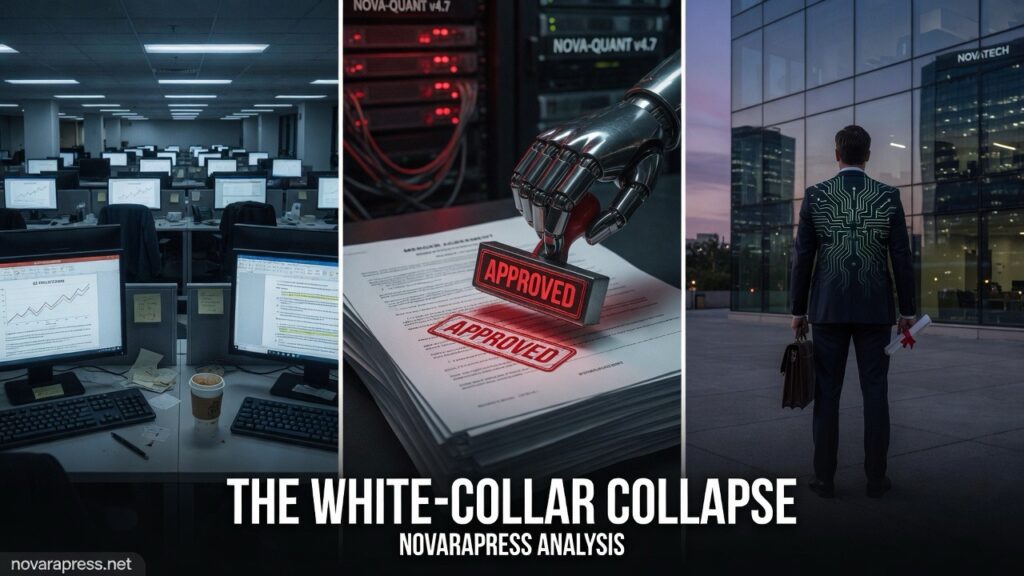
The White-Collar Collapse: How AI Agents Are Quietly Ending the Professional Middle Class
Lawyers. Analysts. Engineers. Accountants. The jobs that defined a generation of upward mobility are being automated — not in theory, but right now, in quarterly earnings calls and silent layoff emails.
Nobody Announced the End. It Just Happened.
In March 2025, a mid-sized law firm in Chicago quietly reduced its associate headcount by 40 percent. There was no press release. No dramatic announcement. Partners told remaining staff it was a “restructuring.” The real reason appeared three months later in a trade publication: the firm had deployed an AI legal research and drafting platform that handled the equivalent workload of eleven full-time associates at a fraction of the cost. One of those associates had passed the bar exam on her first attempt. She had student loan debt. She is currently working as a barista.
This story is not exceptional. It is the template. Across industries — law, finance, consulting, engineering, journalism, accounting, architecture — the same quiet arithmetic is playing out. AI systems are not replacing workers in dramatic robot-uprising fashion. They are simply making it economically irrational to hire as many humans as before. And the people losing that math are not factory workers. They are the college-educated professional class that was told, explicitly and repeatedly, that their credentials made them safe.
They were told wrong.
“The great irony of the AI revolution is that it did not come for the jobs economists predicted. It came for the ones that required degrees, licensing, and years of training — because those are the jobs with the highest information density, and information is exactly what AI processes best.”
Understanding what is actually happening — not the hype, not the panic, but the structural mechanics — is the difference between being blindsided and being positioned. This analysis is written for both the specialist who tracks labor economics and the reader who simply wants to understand why their industry feels different than it did three years ago.
// SECTION 02 — WHAT IS ACTUALLY HAPPENINGThe Anatomy of Professional Displacement
To understand the scale of this shift, it helps to separate the noise from the signal. The noise is the generic “AI will take all jobs” discourse that has been circulating since at least 2013. The signal is something far more specific and more immediately consequential: the emergence of AI agents capable of executing multi-step professional workflows autonomously.
There is a meaningful technical distinction here. Earlier AI tools — the ones that arrived between 2020 and 2023 — were primarily generative. They produced text, images, or code in response to a prompt, but a human still had to verify, structure, and integrate the output into a larger workflow. The economic disruption was real but limited. You needed fewer junior copywriters. You needed fewer entry-level coders to write boilerplate. But senior professionals who managed complexity remained largely untouched.
AI agents are categorically different. An agent does not wait for a prompt on each step. It is given a goal — “analyze these 200 contracts for liability exposure and flag the top 12 risks” — and it decomposes that goal into sub-tasks, executes them sequentially or in parallel, evaluates its own outputs, course-corrects, and delivers a structured result. What this does to professional labor economics is not marginal. It is transformational.
What changed between 2023 and 2026: The shift from AI as a writing tool to AI as a reasoning and execution system. The former competes with interns. The latter competes with experienced professionals who manage complex analytical workloads — the $80,000–$180,000 salary band that firms are now aggressively targeting for reduction.
Goldman Sachs published internal research in late 2024 estimating that 44 percent of legal tasks, 37 percent of financial analysis tasks, and 29 percent of software engineering tasks could be fully automated by AI agent systems within 24 to 36 months. Those estimates, considered alarming at the time, now look conservative. The timeline compressed.
// SECTION 03 — THE NUMBERSBy the Data: Who Is Already Feeling It
Abstract arguments about automation rarely land with the weight they deserve. The following data represents the concrete reality of 2025–2026.
| Sector | % Firms Using AI Agents | Headcount Change 2023–2026 | Primary Roles Affected |
|---|---|---|---|
| Legal Services | 61% | −18% | Research, drafting, due diligence |
| Financial Services | 74% | −22% | Equity research, credit analysis |
| Consulting | 68% | −14% | Market research, data modeling |
| Software Engineering | 81% | −11% | Code generation, QA, documentation |
| Accounting / Audit | 57% | −16% | Reconciliation, compliance, tax prep |
| Journalism / Media | 69% | −27% | Data journalism, SEO content, wire |
What these numbers do not capture is the more insidious effect on hiring pipelines. The professionals still employed are largely those hired before 2022. What has quietly collapsed is the entry-level funnel — the junior analyst positions, the first-year associate roles — that traditionally served as the training ground for the next generation of senior professionals. Firms are not firing their partners and directors. They are simply not replacing the people who leave.
“Firms are not firing their partners. They are simply not hiring your children.”
What the Spreadsheets Don’t Show
Data is essential. But any analysis of this moment that does not grapple with the human dimension is incomplete in a way that matters.
Consider what the professional middle class represents in social and psychological terms. For the generation that came of age in the 1980s, 1990s, and 2000s, the contract was explicit: invest in education, acquire credentials, enter a profession, and exchange your expertise for economic security, social status, and a meaningful identity. That contract was not just economic. It was existential. For many people, what they do is who they are.
When a lawyer is told that the research she spent twelve years learning to do can now be replicated in four minutes by a software system, the wound is not only financial. It is ontological. The skills she built, the late nights she spent, the identity she constructed — all of it is suddenly repositioned not as valuable human expertise, but as training data for a machine that does it better and cheaper.
This dynamic is producing psychological patterns that public health researchers are only beginning to document. The phenomenon sometimes called “credential grief” — a specific form of identity destabilization experienced by highly educated professionals whose expertise has been devalued — is showing up in therapist caseloads across the United States, United Kingdom, Australia, and Gulf states. It does not look like classic unemployment distress. It looks more like a loss of meaning, a slow erosion of professional confidence, a quiet crisis of purpose that has no adequate social script because it is new.
// SECTION 05 — THE GEOGRAPHY OF DISRUPTIONWhy This Hits the Global South Differently — And Harder
The professional displacement unfolding in New York, London, and Sydney is disruptive. The version playing out in Cairo, Lagos, Nairobi, Karachi, and Khartoum is potentially catastrophic — and it is receiving a fraction of the analytical attention it deserves.
In the Global North, professional labor markets are disrupted by AI agents, but the underlying economies have institutional buffers: robust social safety nets, diversified economic sectors, and the capacity to develop and deploy the AI tools themselves. There is at least a structural pathway, however unequal, through which some displaced professionals can transition into AI-adjacent roles.
In much of the Global South, the professional middle class is in an earlier stage of formation. The educated young people entering law, finance, and technology are the first generation in their families to hold university degrees. They represent not just individual ambition but intergenerational investment — decades of family sacrifice concentrated into one person’s career trajectory. And they are entering labor markets where Western firms that would have hired them are reducing headcount, and local firms are copying the same AI-adoption playbook without the resources to manage its social consequences.
For Sudan, for Nigeria, for Pakistan, for Egypt — countries with young, educated populations and fragile formal economies — the AI disruption of professional labor is not an abstract future risk. It is an arriving economic shock hitting populations with no institutional cushion to absorb it. The political consequences of a generation of credentialed, indebted, unemployed graduates who were promised upward mobility and received instead a chatbot that does their job — those consequences will not be quiet.
// SECTION 06 — WHAT SURVIVESThe Skills That AI Cannot Touch — Yet
This is the part most readers want, and the intellectual honesty it requires is this: every list of “AI-proof skills” published before 2023 has since been partially invalidated. Creativity was supposed to be safe. Design was supposed to be safe. Emotional intelligence in client-facing roles was supposed to be safe. Each of these has now been partially penetrated by AI systems that perform acceptably in ways that are economically sufficient for many employers.
With that caveat clearly stated, the evidence as of mid-2026 suggests that the following professional capabilities maintain durable human premium:
High-stakes ethical judgment in ambiguous contexts. AI systems can model legal or financial risk. They cannot bear professional and moral responsibility for the outcome of a judgment call that affects a real person’s life, freedom, or future. The accountability layer retains irreplaceable value precisely because accountability cannot be automated.
Relationship-dependent trust and contextual negotiation. Complex deals, political negotiations, institutional partnerships, and community-level problem solving all depend on trust that is built through sustained human relationship. AI can support these processes. It cannot replace the human presence that makes them function.
Cross-domain synthesis under genuine uncertainty. AI agents excel at tasks with reasonably well-defined parameters. The most valuable professional skill in an AI-saturated market is the capacity to operate effectively when the parameters themselves are unclear — when nobody knows what the question actually is, let alone the answer.
Physical presence with high professional stakes. Surgery. Structural engineering site inspection. Criminal defense advocacy. Diplomatic representation. The intersection of body, accountability, and consequence in real physical space is a domain AI cannot yet meaningfully enter.
// SECTION 07 — SCENARIOS // 18-MONTH FORWARD ASSESSMENTThree Possible Trajectories
Governments implement meaningful retraining programs at scale. Professional bodies negotiate AI governance frameworks. New hybrid roles emerge fast enough to absorb displaced workers. The transition is painful but contained.
Displacement continues at its current pace. Policy response lags years behind reality. A generation of professionals exists in permanent underemployment. Social resentment intensifies. Political instability rises in countries where the professional class is already precarious.
A synchronized economic contraction combines with structural professional unemployment to produce a 1930s-style credentialed unemployed class. Political consequences are severe: authoritarian populism, institutional delegitimization, breakdown of professional knowledge infrastructure.
What You Can Actually Do With This Information
Analysis without applicability is a luxury. The purpose of understanding this dynamic is to position yourself, your organization, or your institution ahead of a curve that is still being denied in most official narratives.
If you are a professional in a potentially disrupted field: The single most dangerous position is passive competence — being very good at tasks that AI can now perform adequately. The strategic priority is moving toward roles defined by accountability, relationships, and judgment rather than information processing. This often means pursuing seniority aggressively, developing genuine domain authority, and building the kind of professional network that makes you a node — not just a worker.
If you are advising institutions or policymakers: The entry-level professional pipeline collapse is the most underdiscussed crisis in labor economics right now. The professionals displaced today are visible. The professionals who were never hired — the law school graduates, the finance MBAs who entered a labor market with no place for them — are statistically invisible. Building policy responses around the displaced misses the larger structural problem.
If you are a parent, educator, or mentor: The credential alone is no longer a sufficient investment. The education that retains long-term value explicitly builds capacity for human judgment, contextual ambiguity, relational trust, and ethical reasoning — alongside technical fluency to work with AI systems rather than beside them.
If you are an investor or entrepreneur: The highest-value opportunity in the coming 24 months is not building AI tools — that market is consolidating. It is building the infrastructure for human-AI collaboration: accountability frameworks, quality assurance systems, governance structures, and institutional trust mechanisms that make AI outputs usable in high-stakes professional contexts.
// SHADOWNET ASSESSMENT — FINAL FRAME
The professional middle class is not being destroyed by artificial intelligence. It is being restructured by the economics of artificial intelligence — which is a more precise and more actionable way to understand what is happening. The destruction narrative produces paralysis. The restructuring narrative produces strategy.
What is ending is a specific model of professional value: the model in which a credential, applied to information processing tasks within an established institutional hierarchy, produces secure middle-class income and social status. That model served several generations well. It is not coming back.
What is beginning — chaotically, unequally, and faster than any policy apparatus can manage — is a different model: one in which human professional value is located in accountability, judgment, relationships, and presence. The transition between these two models is the defining economic event of the next decade.
The people who understand that transition clearly, while most of their peers are still waiting for it to pass, will be the ones who navigate it.
— SHADOWNET ANALYSIS // END OF TRANSMISSION //
// SOURCES & REFERENCES
- Goldman Sachs Global Investment Research, “The Potential Large Effects of Artificial Intelligence on Economic Growth,” 2024
- World Economic Forum, “Future of Jobs Report 2025,” Geneva: WEF Publications
- McKinsey Global Institute, “A New Future of Work: The Race to Deploy AI and Raise Skills,” 2025
- International Labour Organization, “AI and the Future of Work in Developing Economies,” ILO Working Paper, March 2026
- Bureau of Labor Statistics (US), Occupational Employment and Wage Statistics, Q1 2026
- American Bar Association, “Technology and the Future of Legal Employment,” 2025 Annual Survey
- Accenture Institute for High Performance, “AI Agent Adoption in Professional Services: 2026 Benchmark Study”
- MIT Work of the Future Task Force, “Automation and the Displaced,” 2025
- Financial Times, “The Disappearing Junior Banker,” March 14, 2026
- The Economist Intelligence Unit, “Professional Labor Markets in the AI Decade,” February 2026
— Related Intelligence