
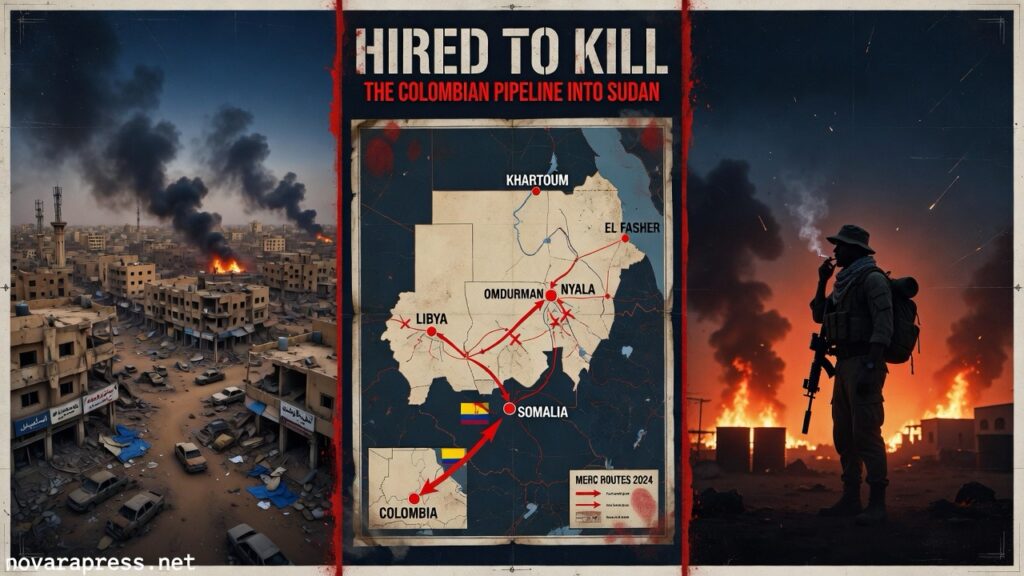
The US Treasury sanctioned a transnational recruiting network sending Colombian veterans to fight for Sudan’s RSF. The bigger story is who they left off the list.
On April 17, 2026, the US Treasury’s Office of Foreign Assets Control imposed sanctions on five companies and individuals accused of recruiting former Colombian military personnel to fight on behalf of Sudan’s Rapid Support Forces. The announcement described a sophisticated transnational network, named specific individuals and firms, and detailed atrocities committed with Colombian assistance — including the siege and fall of El Fasher. What it did not do was name the entity that made the entire operation possible: the United Arab Emirates.
What the Sanctions Actually Say
According to Treasury, the network has been operational since at least September 2024, when the first wave of Colombian veterans began arriving in Sudan. The official count from Sudan’s government — submitted in a formal letter to the UN Security Council — estimated between 350 and 380 Colombian mercenaries on the ground. Colombian investigative outlet La Silla Vacía puts the real number closer to 2,000.
The roles these fighters play are not peripheral. Treasury describes them as serving in infantry and artillery positions, operating drones, driving military vehicles, and — critically — training RSF recruits, including child soldiers. They have participated in major battles across Sudan: Khartoum, Omdurman, Kordofan, and most consequentially, El Fasher.
El Fasher, the capital of North Darfur, fell to the RSF on October 26, 2025 after an eighteen-month siege. Colombian fighters were present. What followed was documented by human rights organizations as mass killings of civilians, ethnically targeted torture, and systematic sexual violence. The State Department had already designated RSF conduct as genocide in January 2025. Colombian veterans were part of the force that carried it out.
The Network
The sanctions name several key nodes in the recruiting infrastructure. The central figure is Alvaro Andres Quijano Becerra, a retired Colombian military officer who holds dual Colombian-Italian nationality and is based — notably — in the United Arab Emirates. He co-founded International Services Agency, known as A4SI, a Bogotá-based firm that Treasury describes as the main recruiting node for Colombian fighters. His wife, Claudia Viviana Oliveros Forero, owned and managed the same company. Together they ran group chats and internal town halls to recruit drone operators, snipers, and translators for deployment to Sudan.
To obscure the financial trail, the network used a Panama-based shell company called Global Staffing — also known as Talent Bridge — to distance A4SI from the entity actually contracting the fighters. A separate Bogotá firm, Maine Global Corp, handled currency conversion to ensure mercenaries received payment. A fourth company, Comercializadora San Bendito, processed wire transfers. From 2024 to 2025, Treasury estimates those payments totaled millions of dollars.
The Name That Was Not Said
Here is where the sanctions announcement becomes a study in deliberate omission. According to documents obtained by La Silla Vacía, the Colombian firm A4SI was contracted not by the RSF directly, but by a UAE-registered company called Global Security Services Group — an entity that describes itself as the only armed private security services provider for the UAE government. That company does not appear anywhere in the Treasury sanctions list.
Sudan’s government has been explicit about this link. In its September 2025 letter to the UN Security Council, Khartoum accused the UAE of directly sponsoring the Colombian mercenary pipeline, presenting documents allegedly recovered from captured fighters. The UAE denied the allegations and called the evidence fabricated.
The US chose not to adjudicate that dispute in its sanctions announcement. It sanctioned the Colombian nodes while leaving the Emirati hub untouched. Treasury’s own statement acknowledged that Quijano — the central recruiter — is based in the UAE. The geographic origin of the contracting company was not mentioned.
The Routes
Getting Colombian fighters into Sudan requires logistics. Investigators have traced two primary pathways. The first runs through Benghazi in northern Libya, where contractors have reportedly confiscated fighters’ passports upon arrival, preventing return until the journey to Sudan is completed. The second moves through Spain to Ethiopia, then to the Somali port city of Bosaso, then to Chad’s capital N’Djamena, and finally into Nyala — an RSF-controlled city in Darfur that serves as the main entry point.
In August 2025, Sudan’s air force shot down an aircraft reportedly belonging to the UAE that was carrying forty Colombian mercenaries along with a shipment of arms and equipment. Middle East Eye obtained exclusive footage in October of dozens of Colombians disembarking at Bosaso airport and moving toward a nearby camp housing Colombian fighters.
What the Sanctions Do — and Don’t Do
The practical effect of OFAC designations is real: all US-held assets of the named individuals and companies are frozen, and American citizens and entities are prohibited from transacting with them. For a network that processes payments in dollars and relies on international financial infrastructure, this creates genuine friction.
But friction is not dismantlement. La Silla Vacía estimates that up to 2,000 Colombian fighters are already in Sudan. Their fate and continued presence are unaffected by sanctions on the recruiters who sent them. The pipeline’s financial backbone — if it runs through the UAE as documented — remains fully operational.
Treasury’s statement urged both the Sudanese Armed Forces and the RSF to accept a three-month humanitarian truce without preconditions. That call landed alongside sanctions that carefully avoided naming the RSF’s most significant state backer. The message that combination sends — to Khartoum, to Abu Dhabi, and to the fighters still on the ground in Darfur — is legible to anyone paying attention.
The Broader Picture
Sudan is now three years into what aid organizations consistently describe as the world’s worst humanitarian crisis. More than 1.5 billion euros in humanitarian pledges were raised at a recent international conference in Germany — a figure that represents a fraction of the cost of the war being fought with Colombian labor and, by documented accounts, Emirati financing.
The US sanctions are the most targeted action Washington has taken against the mercenary network to date. They are also a document that tells you as much by what it excludes as by what it names. In the geography of accountability for Sudan’s catastrophe, the map Washington drew on April 17 has a very deliberate blank space where the UAE should be.