
SHADOWNET Analysis | Gulf Operations | April 2026
The Incident That Changes Everything
On the night of March 7, 2026, a 32-year-old Emirates Airlines flight attendant named Sergey was jolted awake by an explosion. His room shook. He looked outside, saw smoke rising over Dubai, and did what any person would do — he pulled out his phone, took a photo, and sent it to a private WhatsApp group of colleagues asking one simple question: Is it safe to go to work?
He never posted it publicly. He never intended to cause alarm. He had just returned to Dubai after being stranded abroad due to flight disruptions and had not seen any official warnings about sharing images.
Two days later, he was arrested.
Dubai Police did not find his post on Twitter. They did not see it on Instagram. They did not receive a tip from a neighbor. According to the official police report, the image was detected through electronic monitoring operations.
A specialized team from the Electronic and Cybercrime Department was then formed to run a technical investigation, identify the account holder, track him down, and lure him to a meeting point under the pretense of a casual conversation. He was arrested on the spot. His case has since been escalated to State Security Prosecution on charges of publishing information deemed harmful to state interests.
He remains in custody at Al Qusais Police Station. His family fears he will be transferred to Abu Dhabi — a move that typically signals longer sentences.
End-to-End Encryption: The Lie You Were Sold
WhatsApp’s core promise — the one Meta has built its entire messaging brand around — is end-to-end encryption. The message leaves your phone encrypted, travels encrypted, and arrives encrypted. Only you and the recipient can read it. Not WhatsApp. Not Meta. Not any government.
Except that is clearly not what happened in Dubai.
The question SHADOWNET is asking is the one no major media outlet wants to answer directly: How did Dubai Police detect a photo shared only in a closed WhatsApp group?
There are three possible explanations — and none of them are reassuring.
Option 1: Pegasus. The UAE has an extensively documented history of deploying NSO Group’s Pegasus spyware. Pegasus does not break encryption — it bypasses it entirely by compromising the device itself, reading messages before they are encrypted and after they are decrypted. If Sergey’s device or a colleague’s device was infected, every message in that group was visible in plaintext.
Option 2: Telecom-level interception. The UAE government holds majority ownership stakes in both of the country’s major telecom operators — Etisalat (e&) and Du. That structural control gives security services the ability to monitor traffic at the network infrastructure level, independent of WhatsApp’s encryption layer.
Option 3: A human source inside the group. Someone in the WhatsApp group forwarded the image or reported it directly. Simpler than spyware, and equally devastating to the privacy assumption — because if a group of trusted colleagues is not safe, no group is.
Dubai Police have not clarified which method was used. They do not need to. The arrest itself is the message.
This Is Not an Isolated Case
Sergey is not alone. A British FlyDubai flight attendant was arrested weeks earlier under near-identical circumstances — sharing a video of the same drone strike at Dubai International Airport in a separate private WhatsApp group. He was eventually released and deported to the UK after intervention from the British government and the advocacy group Detained in Dubai. His release was not a sign of leniency. It was a function of passport privilege.
Radha Stirling, CEO of Detained in Dubai, has confirmed her organization continues to receive reports of similar cases — tourists, residents, and aviation crew detained for sending, receiving, or simply retaining content on their phones, even in cases with zero public dissemination.
The pattern is clear: Dubai is running systematic surveillance of private digital communications during periods of regional instability, and it is using cybercrime law as the legal wrapper.
The Musk Factor — And the Deleted Post
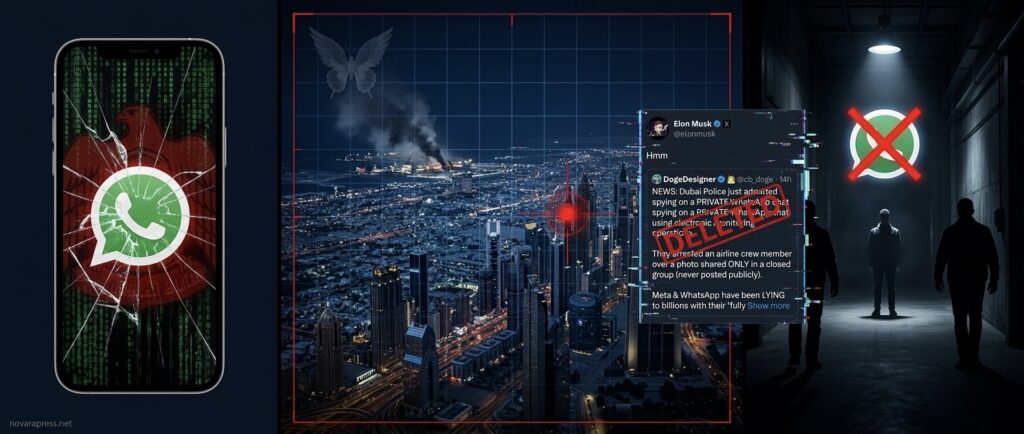
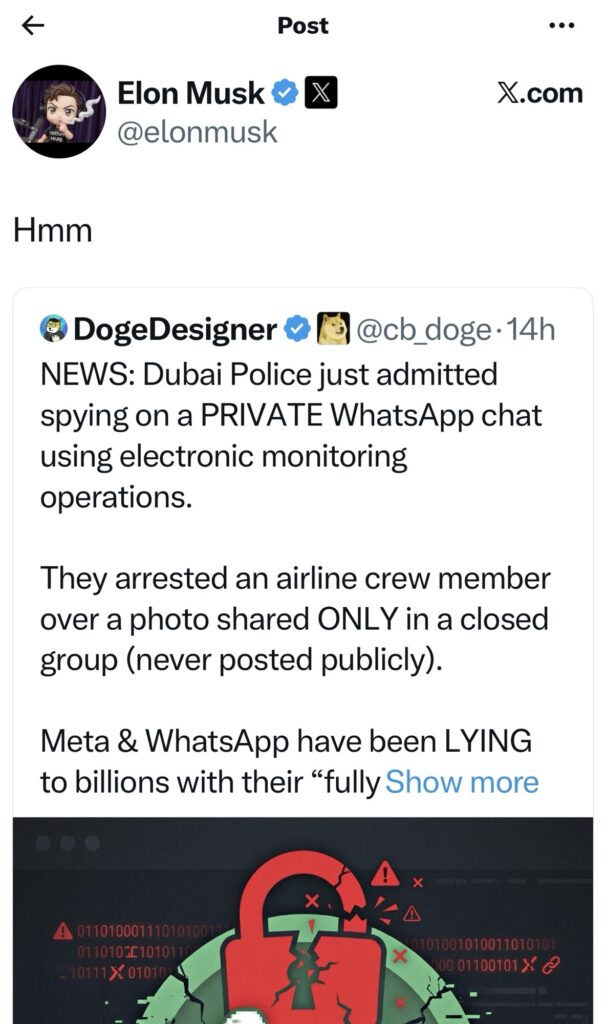
When the story broke on X, Elon Musk — the owner of the platform and a figure who regularly positions himself as a defender of free speech — reposted the original thread with a single word: Hmm.
Two minutes later, the post was gone.
There is no confirmed explanation. But the timing is notable. The UAE is one of the largest foreign investors in US tech, maintains close relationships with Silicon Valley leadership, and has significant leverage over American business interests across the Gulf. Whether the deletion was self-censorship, legal pressure, or something more deliberate is unknown.
What is known is this: the man who built a global brand around opposing censorship chose to erase his own comment on a story about a government surveilling private messages and imprisoning someone for it.
That silence is its own kind of data point.
What This Means For Everyone in the Region
This is not a story about one flight attendant. This is a proof-of-concept moment. Dubai Police have publicly confirmed — through their own official statements — that they possess and deploy technology capable of detecting private WhatsApp messages inside closed groups. They have demonstrated willingness to use it during active geopolitical events. And they have shown they will prosecute individuals who had no intent to harm anyone.
For the millions of expats, tourists, and transit passengers moving through the UAE every year, the operational implications are severe. Assume no messaging app is private within UAE borders. Assume your device may already be compromised if you have been in the country during any period of regional tension. Assume that group chats — however small, however trusted — are potentially monitored. Assume that leniency, if it comes, will be determined by your government’s willingness to intervene on your behalf.
Security experts recommend frequent phone reboots, keeping software updated, and enabling Lockdown Mode on iOS as partial mitigations against spyware like Pegasus. These are not guarantees. They are friction — and in a surveillance state, friction is the only tool available to civilians.
The Broader Architecture
Dubai’s surveillance infrastructure did not emerge in a vacuum. It is part of a deliberate and long-term investment in digital control tools by Gulf states — a trend that accelerated after the Arab Spring demonstrated the mobilizing power of encrypted communications. The UAE, Saudi Arabia, and Bahrain have all been documented purchasers of Pegasus. All three have used cybercrime laws that broadly criminalize content deemed harmful to national unity or the reputation of the state — language vague enough to encompass almost any message.
The Iran war escalation in March 2026 gave these governments a pretext to activate surveillance infrastructure at scale. The arrests are not accidents of overreach. They are intended to be visible. The goal is not just to punish individuals. The goal is to make every person in the country afraid to document what they see — even in private, even in the dark, even when their building is shaking.
That is what information control looks like when it is fully operationalized.
Bottom Line
Dubai Police have done something significant by admitting this publicly. They have confirmed a capability that governments usually prefer to keep deniable. Whether that admission was strategic — a deliberate message to the population — or an operational error matters less than the fact that it is now on record.
End-to-end encryption protects your messages from most threats. It does not protect you from a state that owns the pipes your messages travel through, deploys spyware directly onto your device, or has sources inside your most trusted circles.
The private WhatsApp group is no longer private. It never was. Dubai just said so officially.
SHADOWNET Analysis covers state surveillance, proxy conflict infrastructure, and information warfare. Follow novarapress.net for ongoing coverage of Gulf security operations and digital rights in conflict zones.