
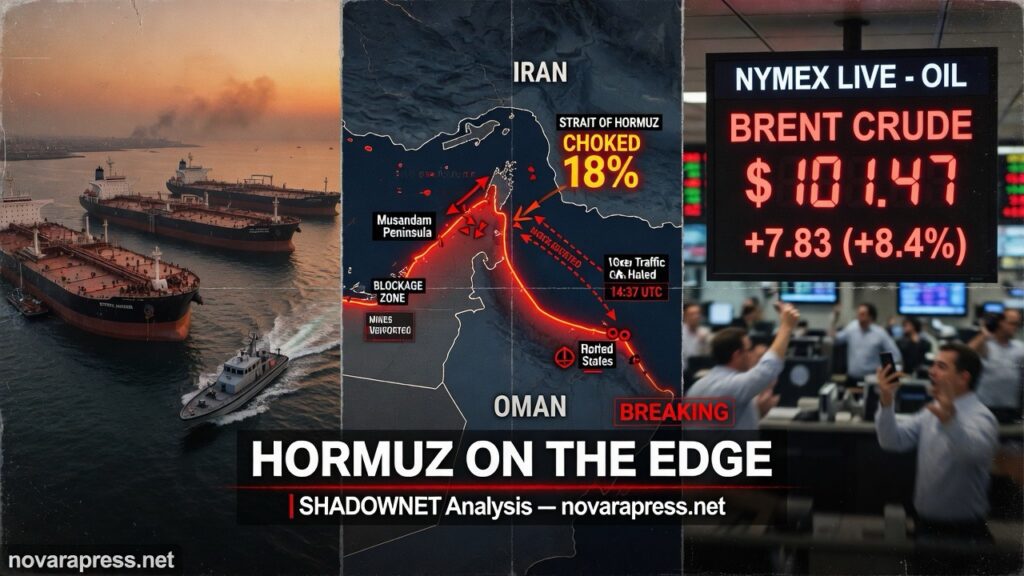
Strait of Hormuz Ceasefire 2026: Will the Truce Hold or Trigger a Global Oil Shock?
The Strait of Hormuz — the world’s most critical energy chokepoint — remains the epicenter of a fragile ceasefire that is simultaneously holding and unraveling.
As of early May 2026, roughly 1,550 commercial vessels carrying an estimated 22,500 mariners are still trapped in the Persian Gulf, while commercial traffic through the strait has collapsed to a small fraction of its pre-war average of approximately 138 vessels per day.
Brent crude hovers near $101 per barrel — volatile and elevated — after weeks of swings driven by every clash, pause, and diplomatic hint. The question now is no longer whether the April 8 ceasefire averted immediate catastrophe, but whether this uneasy truce can survive the summer, or whether its collapse will ignite the largest sustained global oil shock since the 1970s.
From Full Closure to Fragile Truce
The crisis erupted on February 28, 2026, when U.S. and Israeli forces launched Operation Epic Fury, striking Iranian nuclear and military sites and killing Supreme Leader Ali Khamenei. Iran responded by effectively closing the strait: mining approaches, harassing tankers with fast boats and drones, jamming navigation, and issuing VHF warnings that turned the 21-mile-wide waterway into a de facto war zone.
By mid-March, commercial transits had fallen more than 90%. GCC producers — Saudi Arabia, UAE, Iraq, Qatar, Kuwait — declared force majeure; some fields saw output drop 60% or more. Oil prices spiked above $126/barrel at peaks.
| Metric | Pre-Crisis | Peak Disruption | As of May 10, 2026 |
|---|---|---|---|
| Daily vessel transits | ~138 / day | ~14 / day (−90%) | Severely reduced |
| Brent crude price | ~$78/bbl | $126/bbl (peak) | ~$101/bbl |
| Stranded vessels | — | 1,700+ | ~1,550 |
| Mariners affected | — | ~22,500 | ~22,500 |
A Pakistan-mediated ceasefire took effect on April 8. Iran pledged safe passage during the truce window; the U.S. agreed to a temporary halt in major strikes. The strait saw limited reopenings — most notably around April 17 during a parallel Lebanon ceasefire — but Iran quickly reasserted “strict control,” charging tolls in some cases and prioritizing vessels from friendly nations including China, Russia, India, and select others.
The United States countered with a naval blockade of Iranian ports starting April 13 and, on May 4, launched “Project Freedom” — an escort operation to shepherd stranded ships out of the Gulf. That mission was paused within 48 hours amid reported diplomatic progress, only for fresh exchanges of fire to erupt in the strait on May 7–8. Both sides claim self-defense; President Trump has repeatedly insisted the ceasefire “remains in effect,” describing some U.S. actions as “just a love tap.”
Can This Truce Hold?
Short answer: It is under extreme stress and unlikely to endure in its current form without a broader political settlement. Competing incentive structures on both sides make the status quo inherently unstable.
Iran’s Incentives Tehran has converted a military setback into strategic leverage. By controlling the strait, Iran extracts diplomatic concessions, toll revenue, and political breathing room. Hardliners benefit from the narrative of successful resistance, though prolonged isolation is costly. | U.S. Incentives President Trump faces domestic pressure from elevated gasoline prices and allied complaints. A clean military victory has proven elusive. The administration wants Iranian nuclear limits and verifiable strait access — but without triggering a wider regional war or $150+ oil. |
The most dangerous dynamic is miscalculation under fog. Recent clashes show how quickly defensive actions are perceived as violations — triggering retaliation spirals that neither side can fully control.
— SHADOWNET Intelligence Assessment
Mutual vulnerabilities: Neither side can sustain the current standoff indefinitely. Iran cannot fully close the strait forever without devastating its own economy. The United States cannot maintain a high-tempo naval presence without significant political and budgetary costs mounting week by week.
The Oil Shock Risk Remains Acute
Even with the fragile truce in place, the global energy system is already in shock. The cascading effects extend far beyond oil prices:
Supply disruption — Approximately 20 million barrels per day (roughly 20–25% of seaborne oil trade) has been heavily disrupted for over two months.
Inventory draw — Global stocks are falling at rates not seen in decades, reducing buffer capacity against future shocks.
Price transmission — Brent has traded in a $95–$114 band since April, with sharp daily moves on every Hormuz headline.
Downstream effects — Fertilizer exports from the Gulf (30%+ of global trade) have been crippled, driving up food costs worldwide and threatening harvests in import-dependent nations.
A sudden, sustained closure would constitute the largest energy supply shock in modern history — larger in volume than the 1973–74 embargo and faster in onset than the 1990–91 Gulf War disruption.
Three Plausible Scenarios
The ceasefire holds in name but with periodic low-level clashes and Iranian “tolling.” Limited commercial traffic resumes under U.S. or multinational escort. Oil prices stabilize in the $95–$110 range through summer with high volatility.
U.S. and Iran reach a broader package — verifiable nuclear limits, sanctions relief phased in, full strait reopening. Traffic normalizes within 4–6 weeks. Prices ease toward $85–$95 by Q4 2026.
A major incident ends the ceasefire. Full Iranian closure plus intensified U.S. strikes. Oil spikes above $140, global recession risks rise sharply, and the conflict expands regionally. More likely if talks stall into June.
Strategic Implications
The Hormuz standoff has already reshaped perceptions of power. Iran has demonstrated that even a conventionally weaker actor can hold a global economic artery hostage for months. The United States has shown it can degrade Iranian capabilities from the air and sea but struggles to convert that into decisive political outcomes without paying a high economic price.
For the GCC, the crisis has exposed painful vulnerabilities. For China and India, it has accelerated diversification away from Gulf oil. For global shipping and insurance markets, war-risk premiums and rerouting costs will remain elevated for years regardless of how this episode ends.
The Window Is Narrow
As of May 10, 2026, the diplomatic track remains the only off-ramp that avoids catastrophe. Gulf states are urging UN Security Council action. France and others are floating compromise formulas. Iran is reportedly studying a U.S. proposal that ties strait reopening to a longer ceasefire and negotiations on nuclear and missile issues.
The coming 2–4 weeks will be decisive. Every day of stalled talks increases the probability of an accidental escalation that neither side wants but neither side can fully prevent.
THE BOTTOM LINE
The ceasefire has bought time, not safety. The Strait of Hormuz is still the single most dangerous economic chokepoint on the planet — and the clock is ticking.
- CENTCOM official press releases, February–May 2026
- International Maritime Organization (IMO) situation reports on Persian Gulf shipping
- Kpler / MarineTraffic vessel tracking data, aggregated through May 9, 2026
- OPEC+ emergency communiqués and force majeure declarations, March–April 2026
- Reuters wire reporting on ceasefire negotiations and strait incidents, April–May 2026
- Associated Press dispatch coverage of Project Freedom and naval blockade operations
- Al Jazeera English, reporting on Pakistan mediation and GCC diplomatic efforts
- The New York Times, analysis of Trump administration Iran policy, May 2026
All analysis represents the independent assessment of the SHADOWNET intelligence division. This is not financial advice.
— Related Intelligence