
Iran says tankers are striking mines in the Strait of Hormuz. Maritime monitors describe projectile strikes. The gap between the two stories tells us how the blockade war is now being fought.
- Iran’s Revolutionary Guards said three “violating” oil tankers hit naval mines in the Strait of Hormuz on November 23. No vessel has been named and the claim has not been independently confirmed.
- Recent UK Maritime Trade Operations (UKMTO) warnings near Khasab, Oman, described tankers struck by an “unknown projectile”, not mines.
- The claims follow a November 18 US Central Command advisory that widened the naval blockade of Iran to ship-to-ship oil transfers at sea.
- Brent crude fell to about $89 a barrel, its lowest since late August, as traders weighed supply growth against shipping risk.
What Iran Says Happened in the Strait of Hormuz
Iran’s Islamic Revolutionary Guard Corps (IRGC) said late on Monday, November 23, that three oil tankers suffered explosions and fires after striking naval mines in the Strait of Hormuz. According to the statement carried by Iran’s state news agency IRNA and reported by the Jerusalem Post, the IRGC described the ships as “violating” vessels that had used routes Tehran has not authorised.
The IRGC also said the tankers were moving with support from the US military, and argued that American escort “will not serve as a substitute” for following Iranian rules in the waterway. The Jerusalem Post reported that US Central Command had not responded to the claim at the time of publication.
Key details remain missing. The IRGC did not name the ships, their owners, their flags or their cargo, and no shipping company has publicly confirmed losses. Accounts also differ: a report relayed from Iran’s Mehr news agency spoke of two tankers on Monday and six across two days, while the IRGC statement cited by other outlets referred to three. Until owners, insurers or flag states speak, the incident should be treated as an Iranian claim.
Hormuz Mines or Missiles? Two Competing Accounts
The wording matters. In three warnings issued on November 20 and 21, UKMTO, the British naval body that collects incident reports from merchant ships, described outbound tankers hit near Khasab on Oman’s Musandam peninsula. According to a compilation of those notices, one tanker was struck on its port bow with a fire on board, a second on its stern and a third in its engine room. Each was attributed to an “unknown projectile”, and no casualties were reported.
For the same period, Iranian military statements said ships had “collided with naval mines” after entering prohibited areas. Earlier mine claims were rejected by US and maritime authorities, according to the same compilation.
Why would Tehran prefer the mine narrative? From a strategic point of view, a mine is a passive weapon. Presenting damage as the result of a ship straying into a mined zone frames the event as a navigation failure rather than a direct attack, and it reinforces Iran’s message that only routes it approves are safe. A projectile, by contrast, points to a shooter and invites a military response. The dispute over a single word is therefore part of the contest over who is responsible for the risk at sea.
Readers following the wider pattern of naval escalation may also see a link with recent attacks on Russian vessels, which we examined in our analysis of how the world’s wars are moving to the sea.
The US Naval Blockade Behind the Hormuz Mines Claims
The incidents sit inside a larger confrontation. The United States first imposed a naval blockade on Iranian ports on April 13, lifted it in June after a draft understanding, and reimposed it on July 14 when that deal collapsed, according to Reuters reporting carried by Arab News.
On November 18, Central Command issued an updated advisory. It said ships receiving cargo at sea from vessels loaded in Iran “may be considered to be evading the blockade,” even if they never enter Iranian waters. Such ships, the advisory said, may be stopped, boarded, diverted or captured. Al Jazeera described the move as an attempt to close a loophole that had let some Iranian petroleum products reach world markets.
The economic stakes for Iran are large. Before the war, Iran exported roughly 1.5 to 2 million barrels of crude a day, mostly to China, according to Al Jazeera. Crude exports have stayed “near a standstill for months,” Reuters reported, citing shipping sources. The IRGC now describes its actions at sea as a response to what it calls an illegal blockade, while Washington presents the blockade as pressure to bring Tehran back to negotiations.
This is a very different phase from the spring, when the main question was whether a truce would hold. For that earlier stage, see our scenarios for the Hormuz truce and the summer oil shock.
Counting the Attacks: Shipping Risk by the Numbers
Whatever the weapon, the trend in reported incidents is clear. According to figures cited by the Jerusalem Post and ABC News from UKMTO data, more than 30 attacks were reported in October, the highest monthly total since the war began in February. At least 22 were reported in November by November 22. The period from March to September saw about 53 in total.
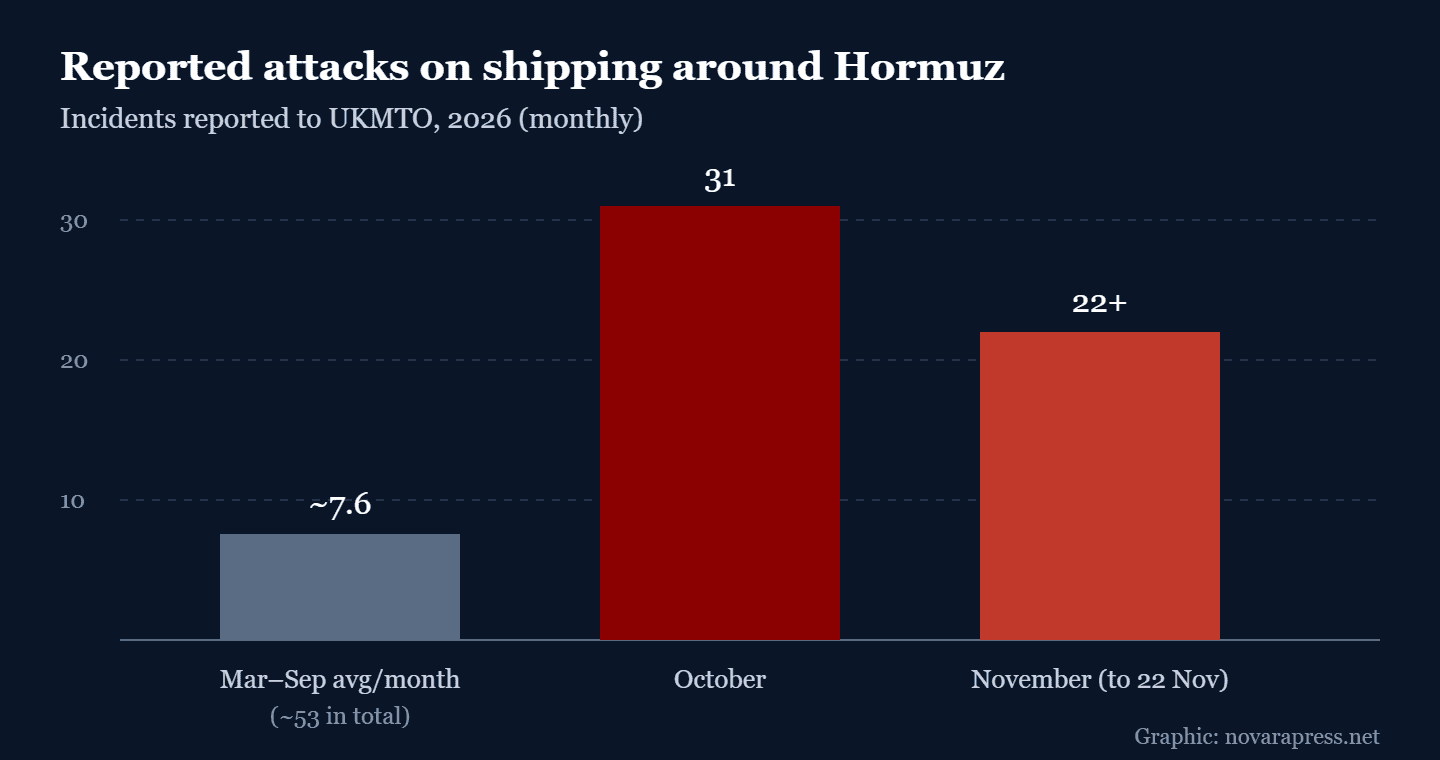
Source: UKMTO data as reported by the Jerusalem Post and ABC News. Graphic: novarapress.net
Martin Kelly of Orbital Risk Intelligence counted 15 attacks and piracy incidents in a single seven-day period, with two seafarers missing and 13 injured, according to the same incident compilation. The Joint Maritime Information Center, which advises merchant shipping in the region, has kept its threat level at “severe.” The Wall Street Journal, citing US officials, reported that Washington is also investigating whether Iran was involved in cyberattacks on as many as 50 energy tankers.
For shipowners, these numbers translate into higher war-risk insurance, longer routes and crews who refuse to sail. For governments, they raise a harder question: how to protect commercial traffic without turning every escort into a potential flashpoint.
Why Oil Is Falling Despite the Hormuz Mines Headlines
Markets reacted calmly. Brent crude slipped about 0.5% to $88.97 a barrel early on Tuesday, after Monday’s close marked its lowest level since August 31, Reuters reported. US WTI traded near $80. That compares with a peak of about $126 in March, in the first weeks of the war.
The reason is supply. A Deutsche Bank note cited by Reuters said observed oil inventories rose by 52 million barrels in October, implying a surplus of about 1.7 million barrels a day. Libya’s National Oil Corporation said its Sharara pipeline had reopened. Daniel Hynes of ANZ still warned that “the oil market remains under severe strain.”
“Iran can circumvent parts of the blockade, but it cannot break it militarily.”
— Andreas Krieg, King’s College London, speaking to Al Jazeera
In other words, traders are pricing a contained conflict rather than a full closure. Earlier this year we explored how US–Iran tensions put global oil markets on edge; the difference now is that spare supply elsewhere is absorbing much of the shock. Regional leaders are nonetheless worried. Qatar’s Prime Minister, Sheikh Mohammed bin Abdulrahman Al Thani, told Al Jazeera that the region cannot withstand another round of US–Iran escalation, a message that underlines the Gulf’s strong interest in de-escalation.
What Happens Next: Three Scenarios
Incidents continue at roughly the October–November pace, each side disputes the cause, and the blockade remains in place. Oil prices stay capped by surplus supply, while insurance costs keep commercial traffic thin. Quiet contacts through Oman, Qatar and other mediators continue without a breakthrough.
Mediators secure a limited arrangement, such as reduced enforcement on ship-to-ship transfers in exchange for safer passage for commercial tankers. This would echo the short-lived June understanding and could lower the incident count quickly, though trust on both sides is very low.
A named tanker sinks with casualties, or a US escort is directly hit, and Washington responds with strikes. In that case shipping through the strait could stall again and the market’s current calm would be tested.
The Hormuz mines claims are best read as messaging in a blockade war: Tehran is signalling that it can raise the cost of US enforcement without admitting to direct attacks. The facts that will decide the next phase are still missing.
Watch for three things: whether shipowners or flag states name the damaged tankers; whether UKMTO or CENTCOM confirm the cause; and whether any vessel tests the new ship-to-ship rule and is boarded. Also watch Brent: a sustained move back above $95 would signal that traders no longer see the risk as contained.
- Jerusalem Post — IRGC: Three tankers hit mines while transiting Hormuz (Nov 24, 2026)
- Al Jazeera — Iran war live: three ships catch fire after hitting Hormuz mines (Nov 24, 2026)
- Reuters (syndicated) — Oil holds near three-month low as rising supply offsets Hormuz threat (Nov 24, 2026)
- Reuters via Arab News — US tightens Iran blockade with curbs on oil transfers at sea (Nov 18, 2026)
- Al Jazeera — US targets Iran’s ship-to-ship transfers: can Tehran break the blockade? (Nov 20, 2026)
- UKMTO warnings 214–216 compiled by House of Saud (Nov 21–23, 2026)
- Just Security — Early Edition: November 23, 2026
- UK Maritime Trade Operations — official advisories
Editorial note: All claims in this briefing are attributed to their sources, and unconfirmed claims are labelled as such. This article will be updated as information develops.