
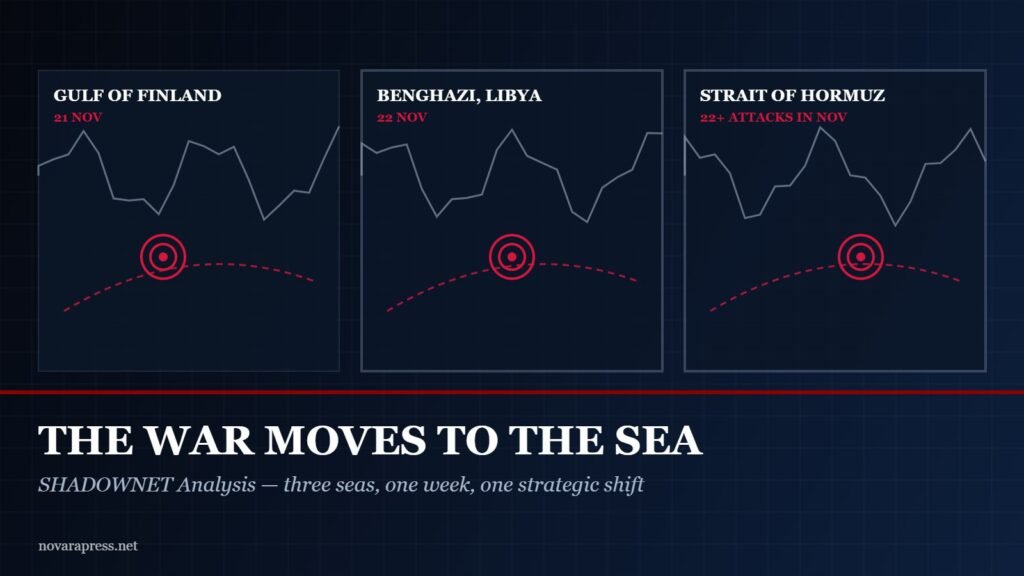
A Russian corvette capsized in a Libyan harbour, a cargo ship was hit near Finland, and attacks around Hormuz hit wartime highs. Read together, they describe one strategic shift: the world’s wars are moving onto the water.
- Ukraine says seven of its naval drones sank the Russian corvette Merkury at Benghazi on 22 November, about 1,500 miles from the front line.
- A day earlier, a drone hit the Russian cargo ship Sparta II in the Gulf of Finland.
- Reported attacks on shipping around Hormuz passed 30 in October for the first time, and November is close behind.
- The pattern points to a war over sea lanes, ports and insurance costs rather than territory alone.
What Happened in Benghazi
In the early hours of Sunday, 22 November, the Russian navy corvette Merkury was struck while moored at the naval base in Benghazi, eastern Libya. Ukrainian President Volodymyr Zelenskyy later said Ukraine had used seven domestically made naval drones in the operation. He said the strike also destroyed a Ka-27 helicopter on board and damaged the Russian cargo ship MV Angara, which Kyiv says was carrying weapons.
The accounts differ on the final damage. Kyiv says the ship sank. Libyan officials first described it as severely damaged, while satellite imagery taken the next day showed the corvette capsized inside the harbour. Libyan officials reported around ten people injured, mostly lightly, and said several drones were intercepted before reaching the base.
Ukraine’s Security Service (SBU) said the drones were launched from a mother ship and that both vessels were legitimate military targets. Benghazi sits roughly 1,500 miles from the front lines in Ukraine. That distance is the story.
Why Libya Matters to Moscow
For Russia, eastern Libya is not a random port of call. The forces of Khalifa Haftar, which control the east, are major recipients of Russian weapons, and Moscow uses Libya as a transit hub for its wider operations in Africa and as a foothold on the southern Mediterranean. According to analysis cited by Reuters, the Merkury had stopped in Benghazi to refuel and resupply while escorting Russian cargo ships.
That makes the strike a message about logistics, not only about one warship. A supply chain that runs from Russian Baltic ports, through the Mediterranean, into Libya and on to the Sahel depends on ships being safe in harbour. If a corvette is not safe at a friendly naval base, the cost of every voyage on that route goes up.
Libya’s divided politics added a second layer. The eastern government said the ship had docked under a cooperation agreement with Moscow, opened a joint investigation with Russia and asked the United Nations to look into the attack. The Tripoli government condemned the strike and said no foreign party had the right to conduct military operations on Libyan soil. The UN mission in Libya called for an independent and transparent investigation. Eastern officials have also alleged that the drones came from western Libya. That claim has not been independently confirmed.
An analyst at RUSI described the strikes as exceptionally brazen and provocative.Jalel Harchaoui, RUSI, as reported by IBTimes UK
The Baltic: The Same Logic, Closer to NATO
One day before Benghazi, on 21 November, a drone struck the Russian cargo ship Sparta II in the Gulf of Finland. Finnish officials said Ukraine had probably carried it out. Earlier in the month, Finland’s military said it had detected a strike on a Russian warship in the Baltic, while stressing the security situation remained stable.
Finnish Prime Minister Petteri Orpo summed up the mood in a short line on social media, warning that the war was spilling over into Finland’s immediate vicinity. For Baltic states that have spent two years worrying about damaged undersea cables and the so-called shadow fleet, the arrival of drone strikes on Russian vessels in their waters changes the risk calculation for ports, insurers and coast guards.
The strategic logic is the same as in Libya. Russia’s war economy depends on sea routes out of the Baltic. Making those routes slower, costlier and less predictable is a way to press on the economy without crossing a land border.
Hormuz: A Different War, the Same Pressure Point
Thousands of kilometres away, the Strait of Hormuz is under pressure from a separate conflict. Attacks on commercial shipping in and around the strait reached their highest monthly level in October since the US-Iran conflict began in late February, according to UK Maritime Trade Operations figures. More than 30 incidents were reported that month, compared with an average of roughly 10 per month before October. At least 22 more were recorded in November by 22 November, while traffic through the strait remained about 65 percent below pre-war levels.
The International Maritime Organization reported somewhat lower figures, confirming 34 attacks across October and November combined. The gap between the counts is normal in conflict reporting and worth keeping in mind. Either number describes a sharp rise.
Analysts quoted by CNN say Tehran appears to be trying to re-exert control over the waterway as oil prices fall. Financial Times data reported by Traders Union showed tanker numbers dropping from 52 to 37 in a single week to 18 November. A senior US Navy official claimed war-risk insurance for a single transit had reached $64 million, compared with about $54,000 before the war, though that figure has been questioned.
The Bigger Picture: A War on Logistics
Put the three theatres side by side and a pattern appears. None of these attacks is mainly about taking ground. Each one targets the movement of goods: fuel, weapons, crude oil and the ships that carry them. The tools are cheap and hard to defend against, from sea drones to missiles fired at tankers.
This matters to readers far from Libya, Finland or the Gulf. When shipping lanes become contested, the costs show up in insurance premiums, freight rates and, eventually, the price of fuel and goods. It also blurs the line between combatants and the countries whose ports and waters are being used. Libya now finds itself named in a war it did not choose.
Diplomacy is moving too, if slowly. A Qatari delegation visited Tehran for talks, according to Iranian officials, while Iran’s foreign minister said Tehran wanted diplomacy to end the war and US President Donald Trump said the terms on offer were unacceptable. Mediation channels exist. Whether they can move faster than the attacks at sea is the open question.
What Happens Next: Three Scenarios
Strikes continue at a steady pace, insurers raise premiums further, and navies expand escort missions. No direct clash between major powers, but shipping costs stay high into 2027.
Russia responds against Ukrainian interests abroad or pressures governments suspected of hosting drone teams. Libya becomes a more contested arena, with the UN investigation turning into a diplomatic battle.
A drone or missile hits a vessel or port of a country outside the conflicts, drawing in new actors and pushing shipping and energy markets into a sharper shock.
The Merkury strike will be remembered less for the ship than for the location. It shows that a mid-sized military can now reach a rival’s logistics thousands of miles from the front, at low cost. Add the Baltic incidents and the record pace of attacks around Hormuz, and the conclusion is clear: in 2026, control of sea lanes is becoming as decisive as control of land. Governments, insurers and shipping companies are already adjusting. Readers should watch three things next: the UN inquiry in Libya, insurance rates in the Gulf, and whether Baltic states change their rules for Russian-linked shipping.
- CNBC: Zelenskyy praises drone operation that sank Russian warship in a Libyan port
- RFE/RL: Zelenskyy confirms Ukraine struck Russian warship, cargo vessel near Benghazi
- CBS News: Russian warship struck at Benghazi naval base, Libyan officials say
- IBTimes UK: Ukraine’s war reaches Libya and sparks sovereignty dispute
- Just Security: Early Edition, 23 November 2026
- Anadolu via Express Tribune: Hormuz attacks hit wartime high in October
- YourNews: IMO and UKMTO attack figures
- Traders Union: Hormuz shipments fall as attacks disrupt tanker traffic
- FDD Overnight Brief, 23 November 2026
Editorial note: Claims by governments and armed forces are attributed to them and have not all been independently verified. Novarapress updates articles when new information becomes available.