
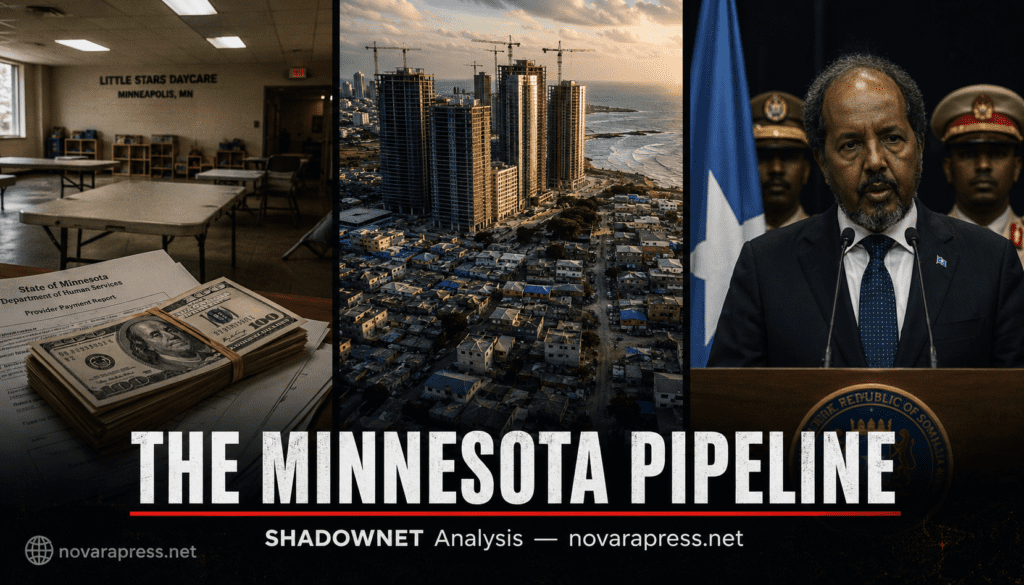
The Minnesota Pipeline: How U.S. Welfare Fraud Is Bankrolling a Somali President’s Authoritarian Grip
Hundreds of millions stolen from American taxpayers have traveled a documented arc — from Minneapolis daycare centers to Mogadishu high-rises — and the beneficiary at the end of that arc is a president now accused of treason by his own courts.
The Fraud Architecture Nobody Wants to Name
Federal prosecutors have already secured guilty pleas and convictions in what the Justice Department has called one of the largest pandemic-era fraud schemes in American history. The mechanism was elegant in its brutality: Somali-owned organizations in Minnesota — daycare centers, food distribution nonprofits, and child nutrition programs operating under the USDA’s Child and Adult Care Food Program (CACFP) — systematically fabricated enrollment records, inflated meal counts, and routed reimbursement funds out of the country within days of receipt.
At the center of the federal indictment is Feeding Our Future, a Minneapolis-based nonprofit that acted as a fiscal sponsor for dozens of subcontractors. Between 2020 and 2022, those entities claimed to have fed tens of millions of meals to low-income children. Federal investigators found that in many cases, the children did not exist, the meals were never prepared, and the facilities were empty warehouses or residential addresses. The fraud totaled over $250 million in documented losses — and prosecutors have stated publicly that the full figure likely exceeds that.
Congresswoman Ilhan Omar, whose district encompasses the epicenter of this network, co-sponsored the 2020 MEALS Act — legislation that significantly relaxed oversight and expanded eligibility thresholds for CACFP reimbursements during the pandemic. Critics, including the House Select Subcommittee on the Weaponization of the Federal Government, have argued the bill’s loosened verification requirements created the operational architecture that made the fraud structurally easy to execute at scale. Omar missed a Minnesota legislative committee deadline connected to the Feeding Our Future investigation without explanation. Her office has not addressed the conflict.
| Program | Documented Fraud Amount | Federal Status |
|---|---|---|
| Feeding Our Future (CACFP) | $250M+ confirmed | 47+ indicted; convictions ongoing |
| Daycare subsidy fraud (MN DHS) | $100M+ estimated | Ongoing state & federal review |
| Healthcare billing fraud (Medicaid) | $40M+ identified | Multiple indictments; active |
| Total estimated (all schemes) | $400M–$600M | Composite estimate, oversight bodies |
The Dahabshiil Pipeline and the Mogadishu Boom
Federal prosecutors have documented that a significant portion of the stolen funds moved out of the United States within weeks through hawalas and money-service businesses operating in the diaspora. The most prominent of these is Dahabshiil, the largest money remittance firm in the Horn of Africa, which processes an estimated $1.6 billion in annual transfers — much of it originating from the Somali diaspora in the United States, United Kingdom, and Scandinavia.
Dahabshiil has faced sustained regulatory pressure over its Know Your Customer (KYC) compliance standards. Barclays famously attempted to terminate its banking relationship with the firm in 2013, citing anti-money laundering concerns. That termination was blocked following an international campaign — a campaign that, according to confidential sources familiar with Somali government communications, received active diplomatic support from Hassan Sheikh Mohamud’s political circle, which was positioning itself for his first presidential term at the time. Mohamud has since publicly defended Dahabshiil on multiple occasions, framing regulatory scrutiny as an attack on the Somali people — an argument that has effectively shielded the firm from stricter oversight.
The downstream effect of these capital flows is visible from satellite imagery. Mogadishu’s real estate market has undergone a transformation that analysts at the Heritage Institute for Policy Studies in Nairobi have described as economically anomalous — a construction surge that does not align with Somalia’s GDP trajectory, foreign direct investment data, or remittance figures from legitimate sources. Approximately 9,000 to 11,000 new structures have been recorded across greater Mogadishu since 2018, including mixed-use towers in the Hodan and Waberi districts that rival construction standards in Nairobi or Addis Ababa.
Urban planning permissions for prestige developments in central Mogadishu have been routed through the Villa Somalia administrative apparatus. Recipients of fast-tracked permits have been documented making substantial contributions to foundations and political vehicles connected to the federal government’s inner circle. The pattern — diaspora capital flowing into luxury real estate, luxury real estate operators funding political patronage, political patronage protecting the remittance infrastructure — describes a self-sustaining loop.
A President Consolidating Power — and Avoiding Accountability
Hassan Sheikh Mohamud is no accidental political figure. He founded the Peace and Development Party (PDP) in 2011, an organization with documented organizational and financial ties to Al-Islah — Somalia’s formal affiliate of the Muslim Brotherhood’s global network. While Mohamud formally resigned from the PDP in 2016 and rebranded under the Union for Peace and Development Party, the ideological and personnel continuity between the two structures has been tracked extensively by researchers at the Africa Center for Strategic Studies.
Since reclaiming the presidency in May 2022, Mohamud has appointed a cluster of Al-Islah affiliated figures to senior executive positions — including within the ministries responsible for interior, justice, and social affairs. The appointments are not incidental. They represent a methodical consolidation of the administrative state around a network whose primary loyalty is factional, not national.
| Political Event | Date | Significance |
|---|---|---|
| Parliament votes to extend Mohamud’s term by 12 months | March 2025 | Elections delayed; opposition calls it authoritarian |
| Puntland severs ties with federal government | Jan 2024 | Regional fragmentation accelerating |
| South West State suspends federal engagement | Mid-2024 | Second major regional defection in 12 months |
| Kismayo court issues treason arrest warrant for Mohamud | Early 2025 | No precedent; federal legitimacy in active collapse |
This is not a functioning democracy in a period of democratic stress. This is a president who used a parliamentary supermajority — assembled through patronage politics — to rewrite the constitutional clock and eliminate an election that he was not certain he could win. Opposition leaders in Mogadishu have been explicit: Somalia is moving from a fragile federal republic toward a one-man consolidated state, financed in part by diaspora wealth that originated as stolen American tax dollars.
The Red Sea Dimension — Where Somalia Meets the Iran File
The United States currently maintains an active naval posture in the Red Sea corridor as part of Operation Prosperity Guardian — a multinational effort to counter Houthi drone and missile attacks on commercial shipping. What is less discussed is how Somalia’s northeast coastline functions as a logistical and intelligence waypoint in the broader threat architecture of that theater.
Somali piracy, which Western naval operations had effectively suppressed by 2016, has resurged in a structurally different form. The new piracy networks operating out of Puntland and the Mudug coast are not purely opportunistic criminal enterprises. Analysts at Stable Seas and the One Earth Future Foundation have documented financial and operational linkages between resurgent piracy syndicates and Houthi-aligned facilitation networks — sharing intelligence on vessel routing, coordinating disruption windows, and benefiting from the same degradation of commercial confidence that Houthi attacks generate.
Mohamud’s federal government has taken no documented enforcement action against these networks. Puntland, which controls the relevant coastline and has severed ties with Mogadishu, operates its own maritime authority — but without international backing, its capacity to interdict is limited. The net effect is an ungoverned maritime corridor along a stretch of ocean that the U.S. Navy is simultaneously trying to stabilize on the Houthi front. American counterterrorism resources in Somalia — which include drone basing agreements, intelligence-sharing arrangements, and AMISOM successor mission support — are being deployed in an environment where the nominal partner government is actively undermining the conditions those resources are meant to support.
Four Scenarios: What Happens Next
“`
Congress passes legislation tying Somalia aid disbursements to verifiable KYC enforcement at Dahabshiil and cessation of constitutional manipulation. Mohamud, facing domestic fragmentation and international pressure simultaneously, accepts a monitored electoral timeline and cooperates with Treasury’s anti-money laundering review. The fraud pipeline loses its political protection in Mogadishu. Probability: 15% — requires bipartisan will that does not currently exist in Washington.
The DOJ convictions proceed against mid-level operators while the capital flow infrastructure remains intact. Dahabshiil continues operating without enhanced oversight. Mohamud consolidates his one-year extension into a permanent arrangement. American aid continues flowing into Somalia under counterterrorism justifications, providing the regime ongoing legitimacy. The Red Sea corridor remains unstable. Probability: 55% — current trajectory.
Puntland and South West State’s defections trigger a cascade. Jubaland follows. The federal government’s writ shrinks to greater Mogadishu. Al-Shabaab exploits the governance vacuum in the south. U.S. counterterrorism basing arrangements collapse or must be renegotiated with fragmented regional authorities. The maritime corridor problem intensifies as no single authority governs the coastline. Probability: 25% — elevated by Mohamud’s accelerating constitutional overreach.
Treasury designates Dahabshiil under the Bank Secrecy Act or imposes correspondent banking restrictions. Mohamud, calculating that China or Gulf patrons can replace American support, expels U.S. military advisors and revokes basing agreements. The AFRICOM architecture in the Horn of Africa is significantly degraded. Al-Shabaab gains operational room. The Iran-Houthi-Somali piracy nexus operates without American interdiction capacity nearby. Probability: 5% — low but non-trivial given Mohamud’s demonstrated willingness to escalate.
“`
What the U.S. Actually Has — and Is Not Using
The United States is not without leverage. It is without the political will to use it.
American bilateral assistance to Somalia has averaged between $700 million and $1 billion annually over the past decade when security, humanitarian, and development streams are combined. The U.S. military maintains training relationships, intelligence-sharing frameworks, and historically has conducted drone strikes against Al-Shabaab targets with Mogadishu’s formal cooperation. That cooperation is not free — it is contingent on the federal government remaining the recognized authority interlocutor. Which means Washington has been, in effect, paying for a political arrangement that now enables a president to steal elections, protect money-laundering infrastructure, and facilitate a diaspora fraud network that looted American children’s nutrition programs.
The congressional tools to address this are not exotic. The Global Magnitsky Act authorizes Treasury and State to designate foreign officials for corruption and human rights abuses. The Foreign Assistance Act contains anti-corruption conditionality provisions that have been applied to far less egregious situations. The Bank Secrecy Act gives Treasury direct authority over correspondent banking relationships that sustain Dahabshiil’s dollar-clearing access. None of these have been meaningfully activated. The question is not whether the tools exist. The question is why they are sitting unused while hundreds of millions in American welfare funds circle back to reinforce the political survival of a Brotherhood-affiliated president who is burning down his own country’s constitutional order.
That question does not have a comfortable answer — and it is one that the Feeding Our Future prosecutions, however thorough, are not designed to ask.
The Minnesota fraud story is real, federally prosecuted, and moving through the courts. The Mogadishu real estate anomaly is satellite-verifiable. The Mohamud constitutional crisis is on record. The Dahabshiil regulatory history is documented. What connects them is not conspiracy — it is incentive structure. A remittance ecosystem with light KYC, a diaspora with money it cannot spend transparently in the U.S., a capital city rewarding politically connected builders, and a president who needs money and loyalty to survive. The United States is the primary fuel source for this system. It has the tools to stop fueling it. The decision not to use them is, at this point, a policy choice — and policy choices have authors.
Minnesota Fraud
Hassan Sheikh Mohamud
Feeding Our Future
Dahabshiil
Red Sea
Geopolitics
AFRICOM
- U.S. Department of Justice — United States v. Aimee Bock et al., D. Minn. 2022–2024 (Feeding Our Future indictments)
- U.S. Senate Committee on Homeland Security & Governmental Affairs — “Pandemic Fraud: Federal Government Remains Vulnerable,” March 2023
- Minnesota Department of Human Services — CACFP Provider Audit Reports, 2021–2023
- House Select Subcommittee on the Weaponization of the Federal Government — Hearing testimony, 2023–2024
- Heritage Institute for Policy Studies (Nairobi) — “Mogadishu Urban Development Index,” 2023
- Africa Center for Strategic Studies — “Al-Islah and Somalia’s Political Landscape,” 2022
- Stable Seas / One Earth Future Foundation — “State of Piracy Report: Horn of Africa,” 2024
- Financial Action Task Force (FATF) — Mutual Evaluation Report on Somalia, 2023
- U.S. AFRICOM — Somalia Operations Briefing Materials, declassified summary, 2024
- Reuters, AP, VOA Somali — Parliamentary extension reporting, March–April 2025
- Confidential sources with direct knowledge of Somali government financial networks — identities protected per editorial policy