
“`
Fragile Dawn: US Pauses Hormuz Escort Mission as Iran Peace Talks Gain Momentum Amid Gulf Strikes
Trump suspends Project Freedom citing “great progress” — while Iranian missiles still burn UAE oil facilities and a one-page memo inches toward history.
James Mercer — Senior Analyst
May 6, 2026
10 min read
“`
The Pivot No One Predicted
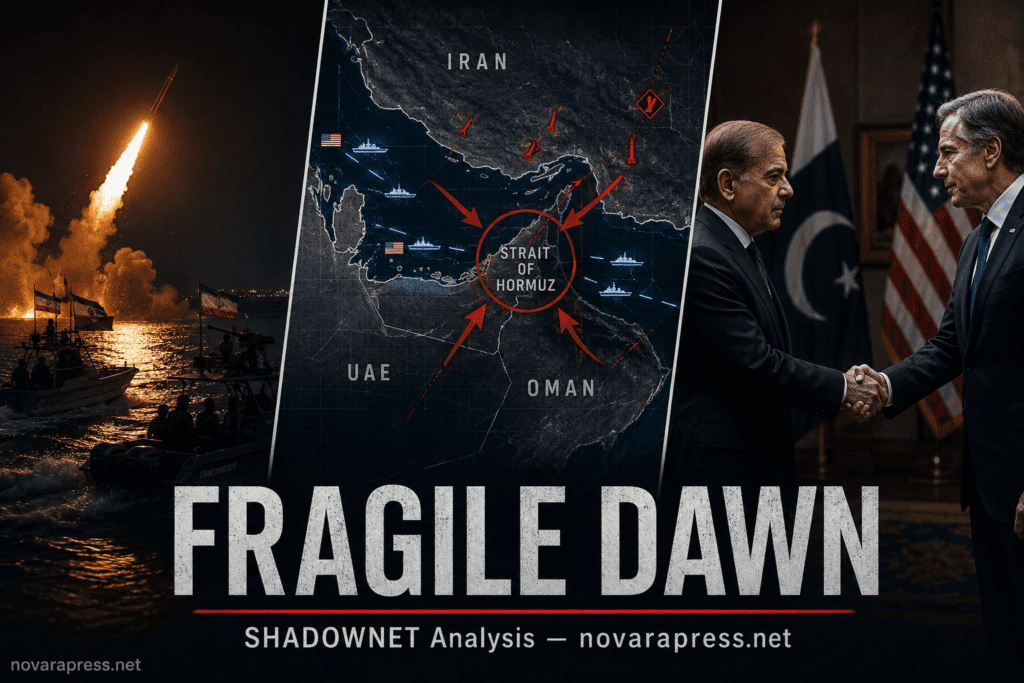
In a dramatic pivot that sent oil prices tumbling and global markets surging, US President Donald Trump announced on May 6, 2026, the temporary suspension of Project Freedom — the high-stakes naval operation designed to escort commercial vessels through the contested Strait of Hormuz. The move, framed publicly as a gesture to advance negotiations, arrives against a backdrop of fresh Iranian missile and drone attacks on the United Arab Emirates, active skirmishes involving IRGC fast boats, and a declared ceasefire that looks more aspirational than operational.
This development — unfolding over a compressed 12-hour window — marks a potential inflection point in the two-month-old Iran war that erupted on February 28 with joint US-Israeli strikes on Iranian targets. While no full resolution is imminent, sources close to Pakistan-mediated talks describe a one-page memorandum as nearly within reach: a document that could formally end hostilities and open the door to broader negotiations on sanctions relief, nuclear constraints, and unhindered shipping through the world’s most critical energy chokepoint.
Yet as explosions echo across the Gulf and Israeli evacuation orders fly in southern Lebanon, the region teeters on the razor’s edge between breakthrough and renewed catastrophe. This is not peace. This is the hour before the verdict.
Key Developments
The most immediate trigger for global attention was Trump’s Truth Social announcement pausing Project Freedom — launched only days prior to challenge Iran’s effective blockade of the strait. In the post, the president cited “great progress” toward a “complete and final agreement,” noting mutual agreement to halt ship escorts while maintaining the US naval blockade of Iranian ports. It is a surgical pause, not a withdrawal.
Simultaneously, reports emerged of a proposed 14-point memorandum under discussion via Pakistani intermediaries. This document would end the war outright, paving the way for follow-on negotiations covering the reopening of Hormuz, the lifting of US sanctions, and limits on Iran’s nuclear program. Notably absent from initial outlines are longstanding US demands on Iran’s ballistic missile capabilities and its support for regional proxy networks — a sequencing that aligns with Iranian preferences but tests American patience.
On the ground, the ceasefire remained a fiction in practice. Iran launched missiles and drones targeting UAE facilities, with at least one strike igniting a fire at an oil installation and wounding civilians. US forces responded by sinking several Iranian fast boats interfering with shipping lanes. A French container ship reported a projectile impact, injuring crew members.
| Actor | Action | Status | Impact |
|---|---|---|---|
| United States | Pauses Project Freedom | Diplomatic | Oil −8%, markets surge |
| Iran | Strikes UAE oil facility | Active | Fire, civilian casualties |
| IRGC Navy | Fast boat interdiction | Ongoing | Multiple vessels sunk by US |
| Pakistan | Mediates 14-pt memo | Pending | “Will close very soon” |
| China | Araghchi–Wang Yi talks | Diplomatic | Urges “swift” strait opening |
| Israel | Evacuates S. Lebanon villages | Escalating | Bekaa Valley strikes ongoing |
Timeline: The Last 12 Hours
“`
MAY 6
MAY 6
“`
Analysis
The pause in Project Freedom represents a calculated de-risking by the Trump administration. Launched amid Iran’s stranglehold on one of the world’s most critical chokepoints — through which roughly 20% of global oil supply passes daily — the operation aimed to restore freedom of navigation but instead provoked retaliatory strikes, deterred most commercial traffic, and drove insurance premiums to prohibitive levels. Washington blinked — but strategically.
By focusing first on ending active hostilities, the memorandum sidesteps the thornier issues of enrichment stockpiles and proxy networks. This is Iran’s preferred sequence — and Washington knows it.
Analysts note the memorandum’s deliberately limited scope as both its core strength and its critical vulnerability. By prioritizing an end to active hostilities and Hormuz access above all else, the document defers the questions that have defined US-Iranian antagonism for decades: enrichment stockpiles (Iran currently holds significant near-weapons-grade material), ballistic missile arsenals, and the network of proxy forces threading from Baghdad to Beirut. Trump’s own warning — resumed bombing at “much higher level and intensity” if no deal materializes — signals the knife’s edge on which this diplomacy rests.
Geopolitically, the involvement of Pakistan as primary mediator and China’s diplomatic engagement with Tehran signal an unmistakably multipolar dimension to what the US framed as a bilateral military campaign. Beijing, a major consumer of Iranian oil, has condemned US-Israeli actions as “illegitimate” while positioning itself as an indispensable broker. For Gulf states like the UAE — absorbing Iranian missile fire while nominally sheltered under American security guarantees — repeated strikes expose the hollow geometry of regional alliance architecture.
Domestically in Iran, the regime — having survived the initial US-Israeli onslaught that killed key figures in the security establishment — projects public defiance while absorbing private economic pain. Sanctions and disrupted oil exports create genuine pressure for accommodation. Yet Iranian President Masoud Pezeshkian and IRGC commanders frame substantive concessions as politically impossible without demonstrated trust — and they cite America’s 2018 withdrawal from the nuclear deal as Exhibit A.
Global Impact
“`
Markets reacted euphorically to de-escalation signals. Brent crude dropped sharply toward $100/bbl, easing inflationary pressures worldwide. Shipping stocks and Gulf equities rallied. Experts warn normalization of supply chains may take six months minimum even if a deal holds.
Prolonged closure has already spiked global energy costs, benefiting alternative producers while straining European and Asian importers. Any resumption under Iranian protocols could introduce new inspection regimes, permanently altering long-term trade dynamics.
The US maintains a massive carrier-group presence in the Gulf, yet officials insist the ceasefire holds despite active incidents. Israel’s expanded Lebanon operations and Hezbollah’s fiber-optic drone deployments reflect persistent hybrid threats across multiple theaters.
Civilian tolls mount across the UAE, Lebanon, and Iran. Foreign workers in Gulf states face heightened risk. Displacement orders in southern Lebanon echo patterns not seen since 2006. Infrastructure damage compounds an already strained regional humanitarian picture.
“`
Even a deal would require at least six months to normalize disrupted supply chains. Stranded vessels, rerouted traffic, and spiked insurance premiums do not disappear with a signature.
Four Scenarios for the Next 48 Hours
The next 48 hours are critical. The US awaits Iranian responses to key points in the proposed memorandum. Success could trigger 30 days of detailed talks on sanctions, nuclear limits, and regional security architecture. Failure risks rapid reversion to kinetic operations at an escalated intensity. SHADOWNET models four forward trajectories.
Probability: 25%
Both parties sign the memorandum, hostilities formally cease, and Hormuz reopens under mutually agreed protocols within two weeks. Oil falls below $90/bbl. Thirty-day clock begins on comprehensive negotiations covering sanctions relief and nuclear limits. Pakistan and China claim mediation credit. Markets stage sustained rally.
“`
Probability: 40%
Talks extend beyond 48 hours with partial consensus on ceasefire language but disputes over Hormuz access terms and nuclear sequencing. Low-level strikes continue. Project Freedom remains suspended but the blockade holds. Markets oscillate. Israel maintains independent operations. The crisis is frozen, not resolved — setting up the next provocation.
Probability: 25%
A significant Iranian attack — on US assets, a major shipping vessel, or an Israeli target — breaks the diplomatic window. Trump activates the threatened “much higher level” bombing campaign. Project Freedom relaunches with expanded rules of engagement. Oil spikes above $140/bbl. European and Asian economies face acute supply shock. Iranian proxies activated across multiple fronts.
Probability: 10%
Iran permanently mines or physically blocks Hormuz. Hezbollah launches large-scale northern front. Houthi activity resumes in full. Israel conducts direct strikes on Iranian territory. US-China tensions escalate over Beijing’s protective diplomatic posture. A multi-theater conflict exceeding the scale of the past two months, with no clear off-ramp. Global recession risk becomes acute.
“`
The pause offers cautious optimism — a breathing space in a conflict that has already reshaped alliances, energy markets, and global risk calculus. Yet in the Middle East, where ceasefires routinely prove illusory, vigilance remains the only rational posture. Diplomats, militaries, and markets alike are poised on the same uncertain fulcrum. Whether this leads to enduring peace or merely a prelude to renewed confrontation will be decided in the next 48 hours — and the signal, when it comes, will arrive first from Tehran.
This analysis draws from verified reporting by Reuters, BBC, Al Jazeera, AP, Axios, and other established outlets as of May 6, 2026. SHADOWNET does not represent any government, intelligence service, or institutional affiliation. All forward-looking scenarios represent analytical assessment, not prediction.
Iran War 2026
Strait of Hormuz
Project Freedom
Trump Iran Deal
Gulf War
Oil Markets
Middle East
- Reuters — “Trump pauses Hormuz escort mission, cites ‘great progress’ on Iran deal,” May 6, 2026
- Axios — “Inside the 14-point Iran memorandum: what’s in, what’s out,” May 6, 2026
- BBC News — “Iran strikes UAE oil facility as ceasefire holds on paper,” May 6, 2026
- Al Jazeera — “Araghchi meets Wang Yi in Beijing; China urges strait reopening,” May 6, 2026
- Associated Press — “US forces sink Iranian fast boats in Hormuz confrontation,” May 6, 2026
- Equinor Energy Security Analysis — “Six-month minimum for Hormuz supply chain normalization,” May 2026
- The Guardian — “Israel issues Lebanon evacuation orders; Bekaa Valley strikes reported,” May 6, 2026