
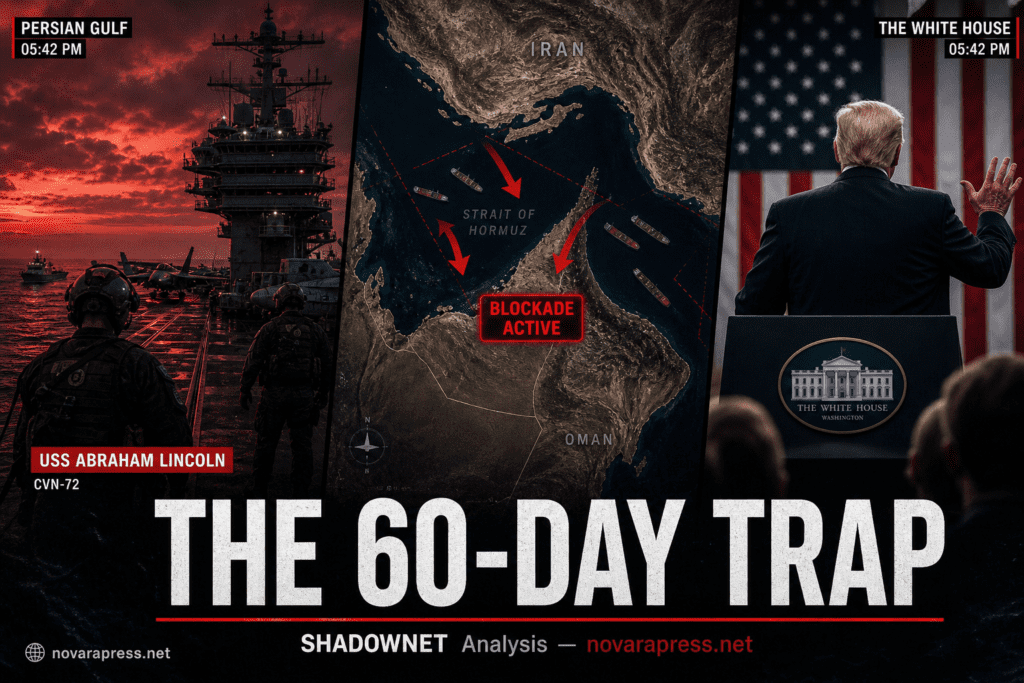
THE 60-DAY TRAP: TRUMP DECLARES WAR “TERMINATED” — WHILE THE BLOCKADE TIGHTENS AND IRAN SENDS A NEW PROPOSAL
Congress left town. Iran intercepted. The Strait still closed. And a deal described as “inches away” — keeps slipping further.
Friday, May 1, 2026. The clock ran out — or it didn’t. Depending on who you ask in Washington, the United States either ended its war on Iran the moment a ceasefire paused the guns on April 7, or it crossed a constitutional red line that has not been crossed since Vietnam. Either way, the Strait of Hormuz is still closed. Nearly 40 ships have been intercepted. Gas in America costs $4.30 a gallon. And Iran sent a new peace proposal to Pakistani mediators — a proposal that may already be heading toward rejection.
What follows is a SHADOWNET breakdown of every significant move in the last 24 hours — decoded.
| Event | Actor | Status |
|---|---|---|
| War Powers 60-Day Deadline | U.S. Congress / White House | BYPASSED |
| Naval Blockade — Hormuz | U.S. Navy | ACTIVE — ~40 ships seized |
| Iran Peace Proposal | Tehran → Pakistan mediators | SUBMITTED — under review |
| Ceasefire | US–Iran | EXTENDED — no end date |
| Iran Cyber Threat — USMC Families | IRGC-linked hackers | CONFIRMED by NCIS |
| U.S. Gas Price Average | U.S. domestic | $4.30 / gallon |
“The Hostilities Have Terminated” — While the Blockade Runs
Friday was supposed to be the day the clock expired. Under the War Powers Resolution of 1973, a president must obtain congressional authorization within 60 days of initiating military action — or stand down. The Iran war began February 28. That put the deadline at May 1, by most legal interpretations.
Instead, Trump sent a letter to House Speaker Mike Johnson and Senate President pro tempore Chuck Grassley declaring that “the hostilities that began on February 28, 2026, have terminated.” The same letter acknowledged, in the next sentence, that the Iranian threat “remains significant” and that the Defense Department will continue updating its force posture.
“There is no pause button in the Constitution, or the War Powers Act. The blockade alone is a continuing act of war.”
Defense Secretary Pete Hegseth made the administration’s argument explicit in congressional testimony Thursday: a ceasefire “pauses or stops” the 60-day clock. His argument found some Republican support — and sharp bipartisan resistance. Sen. Thom Tillis (R-NC) called for an Authorization for the Use of Military Force (AUMF) once Congress returns from recess May 11. A Democratic measure to halt the war failed its sixth consecutive Senate vote, though for the first time a Republican — Maine’s Susan Collins — crossed the aisle.
The administration left Washington for a week-long recess immediately after. The war’s constitutional clock is now a political football with no referee on the field.
40 Ships Seized, $4.30 Gas, and a President Who Called Himself a “Pirate”
The U.S. naval blockade of Iranian ports has now intercepted or redirected nearly 40 vessels attempting to enter or exit Iranian waters since it began April 13. Trump, describing a recent incident in which the Navy fired upon and seized an Iranian cargo ship, told reporters: “We’re sort of like pirates.”
Iran’s Foreign Minister Abbas Araghchi called the blockade an “act of war” and a direct violation of the ceasefire agreement, warning that Tehran “knows how to neutralize restrictions.” Iranian Parliament Speaker Mohammad Bagher Ghalibaf — the lead negotiator for Tehran — responded with a social media post mocking the blockade’s effectiveness, citing Iran’s 7,755 kilometers of total borders. He added a personal jibe to Hegseth: “P.S. For Pete Hegseth: 1 km = 0.62 mi.”
“The blockade is genius.”
The Strait of Hormuz — through which roughly 20 percent of the world’s oil supply passes — remains closed to normal commercial traffic. The U.S. average price for a gallon of gasoline hit $4.30 this week. Sources familiar with internal planning told CNN that the Trump administration is preparing to extend the blockade into a long-term economic pressure campaign. The White House is also lobbying allied governments to join a coalition backing “freedom of navigation” in the contested waterway — even as both sides maintain their parallel blockades.
Iran Sent a New Proposal. Trump Says He Might Not Want a Deal at All.
By Friday afternoon, Iranian mediators had submitted a fresh peace proposal to Pakistani negotiators in Islamabad. Analysts close to the process said mediators believe a fair agreement is within reach. Iran’s Foreign Minister previously stated that a deal was “just inches away” but blamed what he called “maximalist demands” from U.S. negotiators. The core deadlock: Washington demands that Iran halt all uranium enrichment; Tehran insists enrichment for peaceful purposes is a non-negotiable right.
Into this fragile opening, Trump dropped a statement that reframed the entire diplomatic picture: “Frankly, maybe we’re better off not making a deal at all.” He went further: “We can’t let this thing go on. Been going on too long.” — a statement that simultaneously expressed frustration with the pace of talks and signaled he is not committed to their success.
Sources familiar with the White House’s strategy told CNN that Trump’s preferred path, for now, is maximum economic pressure — not a new round of strikes. But military officials briefed him this week on strike options. The threat is being kept warm.
“This war hasn’t gone the way he expected from the very beginning, and Iran has discovered new leverage in its control of the Strait of Hormuz.”
IRGC-Linked Hackers Threaten U.S. Marines and Their Families by Text
Away from the diplomatic theater, a quieter front opened this week. The Naval Criminal Investigative Service (NCIS) confirmed Friday that several U.S. Marine Corps personnel, civilian employees, and family members received threatening text messages from a hacking group with confirmed links to Iranian intelligence. NCIS described the threats as “unsubstantiated” — but the targeting of families marks an escalation in Iran’s unconventional pressure campaign.
The operation fits a pattern: as conventional military options narrow under ceasefire constraints, both sides have expanded into grey-zone tactics — cyber harassment, naval seizures, economic choking. The war is not paused. It has changed frequency.
What Happens Next: Four Scenarios in 72 Hours
Tehran submits a revised proposal that partially satisfies U.S. nuclear demands. Islamabad mediators broker a third round of talks. The blockade lifts incrementally. Gas prices begin to ease. Congress returns May 11 to debate — not block — an AUMF. Probability: Low — but the proposal being submitted at all keeps this alive.
Iran’s proposal is rejected as insufficient. Talks stall a second time. The blockade extends indefinitely. Tehran escalates economically — limiting land border commerce, pressuring Iraq. IRGC cyber operations intensify against U.S. military personnel. Congress demands oversight but cannot agree on mechanism. Probability: High — this is the current trajectory.
Negotiations collapse publicly. Trump — already briefed on strike options and publicly stating he may prefer no deal — orders targeted strikes on Iranian infrastructure. Iran partially reopens the Strait as a warning signal, then closes it again. Global oil markets spike above $120/barrel. Congress reconvenes in emergency session. Probability: Moderate — military briefings are active.
An incident at sea — a seized vessel, a live-fire confrontation — triggers Iran to formally withdraw from the ceasefire. IRGC launches ballistic missiles. Israel re-enters the conflict over Lebanon. Mojtaba Khamenei issues a direct threat against Gulf Arab hosts of U.S. bases. The region crosses into uncharted territory. Probability: Low but not negligible — the IRGC has already threatened naval retaliation.
The Real Story: A War That Ended on Paper, Continues Everywhere Else
The 60-day deadline passing without congressional action is not a procedural footnote. It is a data point about the institutional collapse of oversight in wartime. Congress left town. The president declared war terminated while maintaining a naval siege. The Defense Secretary argued the law does not apply. And the American public is paying $4.30 per gallon to fund a conflict whose legal basis is now openly contested by both parties.
Iran, for its part, has found an asymmetric lever that no amount of B-2 bombers can resolve: the Strait of Hormuz. As long as Tehran controls that chokepoint, it controls the price of every negotiation. A nation whose military infrastructure was systematically degraded has turned geography into its most potent weapon.
The new Iranian proposal is the most important variable in the next 72 hours. If Washington reads it as a genuine concession on enrichment, talks resume. If it is dismissed as another stall — the path to Scenario C opens fast. Watch the proposal language. Watch whether Pakistan keeps its role as mediator. And watch whether Trump’s own ambivalence about wanting a deal at all becomes official policy.
The war is not over. It changed form on April 7. It is changing form again now.
SHADOWNET is an independent geopolitical intelligence desk. Analysis is based on open-source reporting, primary documents, and named officials. This assessment reflects conditions as of 06:00 UTC, May 2, 2026.
novarapress.net — SHADOWNET Analysis Division
Iran War 2026
Strait of Hormuz
War Powers Resolution
Naval Blockade
Trump Iran Deal
Pakistan Mediation
IRGC Cyber
- CNN Live Updates — Iran War, May 1–2, 2026 (cnn.com)
- PBS NewsHour — “Trump Says Deadline for Congress Doesn’t Apply,” May 1, 2026
- Washington Post — “What Does the War Powers Act Say,” May 1, 2026
- Al Jazeera — “US-Iran War Updates: Trump Not Satisfied with Proposal,” May 1, 2026
- CNN — “Ceasefire Hangs in Balance as Iran Sends New Proposal,” May 1, 2026
- Al Jazeera — “Trump Announces Ceasefire Extension but Blockade Remains,” April 21, 2026
- Wikipedia — 2026 Iran War (en.wikipedia.org) — updated May 2, 2026
- UK Parliament House of Commons Library — “US-Iran Ceasefire and Nuclear Talks 2026,” May 1, 2026