
SHADOWNET Analysis
Iran War · Geopolitics · Intelligence
The Narrow Path to a US-Iran Deal
From B-2 strikes on nuclear sites to a shattered ceasefire in Islamabad — a complete SHADOWNET map of the endgame between Washington and Tehran.
NOVARAPRESS · April 24, 2026 · 10 min read
“`
The world’s most consequential diplomatic marathon is playing out in real time, shuttled through the corridors of Islamabad and mediated by a Pakistan that has quietly become the indispensable middleman in the most dangerous military confrontation of the post-Cold War era. After months of strikes, counter-strikes, a historic twelve-day Israeli operation, a fragile two-week truce, and 21 hours of exhausting direct talks, the United States and Iran have not yet reached a deal — but for the first time since the 1979 Islamic Revolution, the two nations sat across a table and attempted to bridge a gulf that has defined Middle Eastern geopolitics for nearly five decades.
This is not a story about a deal that is close. It is a story about a deal that is structurally difficult, politically fraught, and militarily urgent — but not impossible. SHADOWNET maps every layer: the war that forced diplomacy, the ceasefire that barely holds, the Islamabad talks that collapsed without agreement, and the three paths forward from here.
How the War Began: The Long Fuse from 2018 to 2026
The story does not begin in February 2026. It begins in May 2018, when Donald Trump tore up the Joint Comprehensive Plan of Action — the 2015 nuclear deal brokered by the Obama administration after years of painstaking multilateral diplomacy. Trump called it “the worst deal ever.” Iran, having honored its commitments under the accord, watched Washington walk away. From that moment, Tehran began methodically rebuilding leverage it had previously traded away.
By December 2024, the consequences were stark. The IAEA reported that Iran had accumulated an unprecedented stockpile of uranium enriched to 60 percent purity — far beyond any credible civilian justification, sitting just below the 90 percent threshold required for weapons-grade material. The watchdog verified over 440 kilograms of 60-percent enriched uranium in Iranian storage. Experts calculated that Iran possessed the fissile material to produce several nuclear devices within weeks, if the political decision were made. That decision, crucially, had not yet been made — the US intelligence community continued to assess, as late as March 2025, that Iran was not actively building a nuclear weapon.
In February 2025, the Trump administration reinstated maximum pressure sanctions and vowed to reduce Iranian oil exports to zero. In March 2025, Trump wrote directly to Supreme Leader Ali Khamenei offering negotiation — with an implicit military threat attached. Indirect talks opened in Muscat, Oman, on February 6, 2026, mediated by Oman’s Foreign Minister Badr bin Hamad Al Busaidi, who emerged from those sessions expressing confidence that a peace deal was “within our reach.” That optimism proved premature by about three weeks.
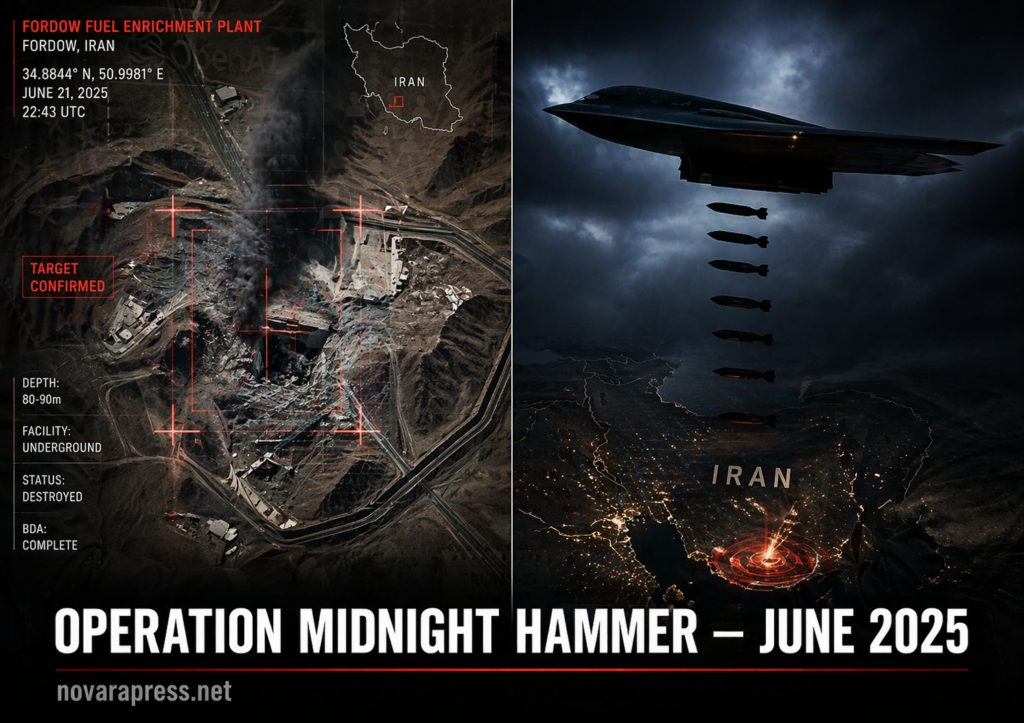
On February 28, 2026, the United States and Israel launched what Trump would describe as “major combat operations” against Iran. The 12-day campaign that had preceded this moment — Israel’s Operation Midnight Hammer in June 2025 — had already struck three of Iran’s critical nuclear facilities, killing nuclear scientists and IRGC commanders. The February 2026 campaign went further, striking military and regime infrastructure and, in its course, killing Supreme Leader Ali Khamenei. The Islamic Republic had lost its most powerful figure and was now fighting for survival.
The Ceasefire Architecture: How Pakistan Engineered a Pause
War does not pause easily. It required weeks of multilateral pressure, the exhaustion of both parties, and the emergence of a previously underestimated diplomatic actor: Pakistan. In late March 2026, Pakistani officials delivered a 15-point US proposal to Tehran, laying out Washington’s terms — the complete end of Iran’s nuclear program, limits on its ballistic missile capabilities, reopening of the Strait of Hormuz, an end to funding for regional armed groups including Hezbollah and the Houthis, and conditional sanctions relief.
Iran rejected the proposal outright. An anonymous Iranian official told Press TV that “Iran will end the war when it decides to do so and when its own conditions are met.” Tehran issued a five-point counter-proposal: an end to US-Israeli attacks, security guarantees against future aggression, war reparations, international recognition of Iranian sovereignty over the Strait of Hormuz, and the release of $6 billion in frozen assets. The gap between the two positions was oceanic.
“After 21 hours of negotiations, the Iranians chose the pursuit of a nuclear weapon over peace.”
— White House spokesperson Olivia Wales, April 2026
On April 5, Pakistan introduced a 45-day two-phase ceasefire framework. Iran rejected it and submitted its own 10-point peace plan demanding solutions to all regional conflicts. The diplomatic back-and-forth produced an unlikely result. On April 7-8, Trump announced on Truth Social that a two-week ceasefire had been agreed. Iran’s Foreign Minister Abbas Araghchi confirmed the arrangement hours later. JD Vance immediately described it as a “fragile truce.”
The Islamabad Talks: 21 Hours That Changed Nothing — and Everything
The Islamabad Talks of April 11-12, 2026 were unprecedented in modern US-Iran relations. For the first time since 1979, American and Iranian officials sat together in direct, face-to-face sessions. The 300-member American delegation was led by Vice President JD Vance, accompanied by special envoy Steve Witkoff and Jared Kushner. The 70-member Iranian delegation was led by parliamentary speaker Mohammad Bagher Ghalibaf, alongside Foreign Minister Abbas Araghchi. Pakistan’s team — Prime Minister Shehbaz Sharif, Field Marshal Asim Munir, and Foreign Minister Ishaq Dar — sat between them as host mediators.
Three rounds of talks unfolded: the first indirect, the second and third direct. The sessions lasted twenty-one hours before both delegations departed Islamabad without agreement. The main unresolved issues were Iran’s nuclear program and the status of the Strait of Hormuz — the narrow waterway through which roughly 20 percent of global oil supplies pass, which Iran had mined and effectively closed. Secondary disputes included the scope of sanctions relief, frozen assets, war reparations, and Iran’s demand that any deal encompass a ceasefire across the region including Lebanon.
The single most revealing moment was the enrichment gap. US negotiators proposed a 20-year suspension of Iranian uranium enrichment, with the United States paying for Iran’s civilian nuclear fuel. Iran countered with a five-year suspension. The two sides could not bridge the fifteen-year difference. Vance told Fox News that Iranian negotiators “moved in our direction… but they didn’t move far enough.” He acknowledged: “There really is a grand deal to be had here, but it’s up to the Iranians to take the next step.” Iran’s foreign ministry said no one had expected an agreement in a single session.
The Core Sticking Points: What Makes a Deal So Hard
Understanding why this negotiation is so difficult requires mapping the structural incompatibilities — not just between negotiating positions, but between strategic worldviews.
| Issue | US Position | Iran Position | Gap |
|---|---|---|---|
| Nuclear Enrichment | Zero / 20-year halt | Sovereign right; offered 5 years | Critical |
| Uranium Stockpile | Transfer 440kg to US | Will not transfer abroad | Critical |
| Strait of Hormuz | Immediate reopening | Demands sovereignty recognition | Very High |
| Ballistic Missiles | Major restrictions | “Not up for negotiation” | Critical |
| Sanctions Relief | Phased, compliance-linked | Comprehensive and immediate | High |
| Frozen Assets | Conditional release | $6bn as precondition | Medium |
| Lebanon / Hezbollah | Separate track; not included | Any deal must include Lebanon | High |
On the nuclear file, the fundamental problem is trust. Iran has watched the United States withdraw from one nuclear agreement it fully honored. Tehran’s position — that it must retain enrichment capability as a sovereign right and as insurance against future American policy reversals — has its own internal logic. Former senior US diplomat Alan Eyre, who helped negotiate the 2015 JCPOA, noted that American negotiators may be at a disadvantage facing Iran’s experienced delegation, professionals who “know their portfolios,” while the US side lacks comparable institutional expertise after years of diplomatic distance.
The Strait of Hormuz adds a dimension of economic hostage-taking without precedent in recent diplomatic history. Iran planted mines in the waterway — then reportedly lost track of some of them, making reopening even more complex. The US Navy has begun its own mine-clearing operations. Global oil markets have been shaken throughout the conflict, with gold prices rising and energy costs spiking in ways that are creating serious political problems inside the United States itself.
The Mediators: Pakistan’s Historic Moment
No actor has played a more consequential diplomatic role in this conflict than Pakistan. Islamabad delivered the US 15-point proposal to Tehran. It introduced its own five-point peace initiative. It hosted the first direct US-Iran talks since the Islamic Revolution, deploying its prime minister, army chief, and foreign minister simultaneously to the same table. Pakistan’s air force provided an unprecedented military escort for the Iranian diplomatic delegation — JF-17s and J-10Cs flying alongside Iranian aircraft with transponders switched off, covering the delegation from Iranian airspace to Islamabad under PAF’s protective shield. This was not routine diplomatic hospitality. It was a security architecture built from scratch for a situation without precedent.
China’s role, while quieter, is also significant. White House spokeswoman Caroline Leavitt confirmed Chinese involvement in truce negotiations, and Pakistan’s Foreign Minister Ishaq Dar met with the Chinese ambassador in Islamabad while seeking a ceasefire extension. Beijing has interests in Iranian oil, in Gulf shipping stability, and in preventing a nuclear-armed Iran that could trigger regional proliferation cascades. Russia has also renewed its standing offer to accept Iranian enriched uranium as part of any settlement — removing the dangerous stockpile from Iranian territory without requiring its destruction. Oman, Turkey, Egypt, and Qatar played bridging roles in the pre-war period, giving this diplomatic infrastructure a width and depth that raw headline numbers obscure.
Where It Goes From Here: Three Scenarios
The View From April 24, 2026: A Deal Not Yet Born
As of today, the ceasefire — which was supposed to last two weeks from April 8 — has been extended by Trump to allow Iran time to submit a formal proposal, at Pakistan’s request. Both sides have accused the other of violations. The IRGC has declared that any US military vessel approaching the Strait constitutes a breach of the truce. The US Navy has boarded at least two Iranian-flagged vessels under its blockade. Trump told CNBC that he is “unlikely to extend the ceasefire” and that Iran “has to negotiate.” Iran’s parliamentary speaker said Washington was “imposing a siege” while attempting to turn negotiations into “a table of surrender.”
The structural obstacles are real and deep. But several dynamics cut in favor of an eventual settlement. The war is broadly unpopular with the American public and is driving up consumer prices. Trump officials are reportedly not keen to resume large-scale operations. Iran, having lost its supreme leader, a significant portion of its nuclear infrastructure, and thousands of military personnel, is in no position to absorb another sustained campaign. The regional mediators — Pakistan, Oman, Qatar, China — have invested political capital in preventing a definitive catastrophe.
What a deal would look like, if it comes: a formula short of zero enrichment but with a significant time-limited cap, Iran’s 60-percent enriched stockpile transferred to Russia, a phased Hormuz reopening coordinated with sanctions relief, and a side arrangement on Lebanon that gives Iran political cover. That path is narrow. It requires political courage on both sides and intense diplomatic choreography from mediators. It has not been walked yet. But the alternative — a war without a diplomatic floor — is something that even the most hawkish actors in this drama are quietly trying to avoid.
“There really is a grand deal to be had here — but it’s up to the Iranians to take the next step.”
— US Vice President JD Vance, Islamabad, April 12, 2026
SHADOWNET will continue tracking this story. The next critical window is the 72–96 hours following Trump’s latest extension announcement on April 21. Either a second round of Islamabad talks is confirmed by both parties — or the guns restart.
Sources & References
- Wikipedia — 2025–2026 Iran–United States Negotiations, updated April 24, 2026.
- Wikipedia — 2026 Iran War Ceasefire, updated April 24, 2026.
- Wikipedia — Islamabad Talks, updated April 24, 2026.
- NPR — US Military to Blockade Iranian Ports as Peace Talks Collapse, April 12, 2026.
- CNBC — New Cards on the Battlefield: US-Iran Ratchet Up Rhetoric, April 21, 2026.
- TIME — Officials Considering Second Round of US-Iran Talks, April 14, 2026.
- Al Jazeera — US and Iran Fail to Reach a Deal After Marathon Talks in Pakistan, April 12, 2026.
- Al Jazeera — What Was the Iran Nuclear Deal Trump Dumped?, April 21, 2026.
- PBS NewsHour — US Delays New Round of Negotiations as Ceasefire Deadline Nears, April 22, 2026.
- House of Commons Library — US-Iran Ceasefire and Nuclear Talks in 2026, April 2026.
- Arms Control Association — US Negotiators Were Ill-Prepared for Nuclear Talks, March 11, 2026.
- Britannica — Iran Nuclear Deal Negotiations 2025–26, March 2026.
- IAEA — Iran Nuclear Programme: Safeguards Reports 2025.
“`
SHADOWNET Analysis
Intelligence-grade geopolitical analysis
novarapress.net · April 24, 2026
© 2026 Novarapress · SHADOWNET Analysis · All Rights Reserved