
April 2025 · Intelligence Brief
Middle East · Iran · Strategic Analysis
In 72 Hours, Iran Could Trigger a Global Economic Collapse — Here’s Exactly How
From the 1979 Revolution to nuclear brinkmanship — a full intelligence breakdown of the Iran–U.S. confrontation, the Strait of Hormuz chokepoint, and the three scenarios defining 2025.
Novarapress Analysis · April 24, 2025 · 15-min read
Something is happening in the Middle East that the mainstream media is not explaining clearly. This is not a skirmish. This is not a proxy exchange. What is unfolding between the United States and Iran is a direct confrontation building for over four decades — and it is now closer to open war than at any point in modern history. The sequence of events is documented, verified, and demands full attention.
▶ Watch: Full Video Breakdown — SHADOWNET Analysis
Section 01
The Architecture of Resistance: How Iran Built a 45-Year Trap
To understand the present moment, the analyst must return to 1979. The Iranian Revolution did not simply remove a government — it created a state whose entire ideological architecture was constructed around permanent opposition to American power in the region. The Supreme Leader is not a ceremonial figure. He is a generational strategist operating on a timeline that Western policymakers have consistently failed to take seriously.
Over four decades, Tehran assembled what regional analysts call the Axis of Resistance: Hezbollah embedded in Lebanese politics and military infrastructure, Hamas governing Gaza, the Houthi movement controlling northern Yemen and its coastline, and a dense network of Shia militias operating across Iraq and Syria. Each node was a forward operating base. Each was legally deniable. Each gave Iran the capacity to bleed American and Israeli interests across five simultaneous fronts without a single missile ever leaving Iranian territory.
“Iran spent four decades building a network that could apply pressure across an entire region while Tehran’s hands remained technically clean. October 7 ended that fiction permanently.”
That architecture of deniability collapsed on October 7, 2023. When Hamas launched its assault on southern Israel, Iran’s entire network activated in a coordinated sequence that was neither spontaneous nor accidental. The Houthis immediately began targeting international shipping in the Red Sea. Hezbollah opened a sustained campaign against northern Israel. Iraqi militias launched over 170 documented attacks against American military installations in a single year. The fiction of Iranian non-involvement became impossible to maintain.
Section 02
The Escalation Ladder: Sequence of a Crisis That Did Not Arrive Overnight
What brought the world to this threshold was not a single event but a compressed sequence of escalations, each one raising the floor of acceptable risk for both parties. The analyst who understands the ladder understands the logic — and the danger — of what comes next.
| Date | Event | Strategic Significance |
|---|---|---|
| Oct 7, 2023 | Hamas assault on Israel | Full Axis of Resistance activation |
| Nov 2023–present | Houthi Red Sea campaign | 100+ vessels targeted, $200B rerouting cost |
| April 1, 2024 | Israeli strike, Iranian consulate Damascus | Direct attack on Iranian sovereign territory |
| April 13, 2024 | Iran fires 300+ drones & missiles at Israel | First direct Iran–Israel military confrontation in history |
| April 19, 2024 | Israeli precision strike near Isfahan | Signal: Iranian nuclear sites within reach |
| Early 2025 | 500+ US strikes on Yemen | Houthis adapt, operations continue |
| January 2025 | Trump administration returns | Maximum Pressure 2.0 — back channel closed |
| 2025 | Enrichment reaches 60% purity | One technical step from weapons-grade |
In April 2024, Iran launched over 300 drones and ballistic missiles directly at Israeli territory — the first direct military strike by Iran against Israel in history. Israel, with American destroyers and Jordanian interceptors providing coalition cover, neutralized the overwhelming majority. Israel then responded with a precision strike near Isfahan — a message engineered to communicate one thing: the path to your nuclear facilities is open.
“The Isfahan strike was not an attack. It was a demonstration. Israel was telling Tehran: we have already solved the targeting problem. The only remaining question is the decision.”
By early 2025, American forces had conducted over 500 strikes against Houthi infrastructure in Yemen — tactically impressive, strategically inconclusive. The Houthis moved underground and continued maritime operations. Over 100 commercial vessels were attacked. The cost to global trade exceeded $200 billion in rerouting through the Cape of Good Hope. Meanwhile, Iran continued advancing enrichment to 60 percent purity — one technical procedure away from weapons-grade material.
Section 03
The Trump Variable: When Unpredictability Becomes the Strategy
When Donald Trump returned to the presidency in January 2025, the strategic environment shifted overnight. In his first term, Trump ordered the targeted killing of General Qassem Soleimani — the most operationally significant Iranian military commander since 1979. Tehran’s response was theatrical: ballistic missiles at Iraqi bases, followed by abrupt silence. Iran understood something that many Western analysts underweight — unpredictable leaders carry disproportionate deterrent value precisely because they cannot be war-gamed.
Maximum Pressure 2.0 began immediately. Sanctions enforcement reached its highest intensity. Iranian oil export interdiction was reactivated at scale. The back-channel diplomatic contact that the Biden administration had quietly maintained — the thread functioning as the primary mechanism for miscalculation prevention — was severed. Iran was presented with a binary it had spent years deferring: capitulate or confront.
“The Supreme Leader chose a third option: escalate through proxies while accelerating the nuclear program as a deterrent. It was a sophisticated calculation. It was also a miscalculation.”
Section 04
The Strait of Hormuz: 33 Kilometers That Hold the Global Economy Hostage
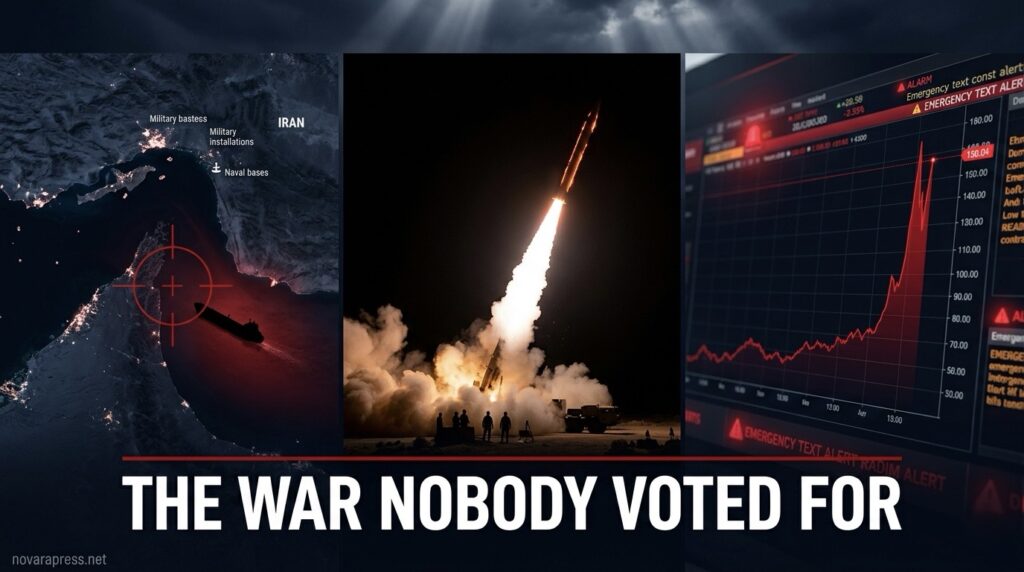
No analysis of the Iran confrontation is complete without confronting the geographic reality that makes this crisis categorically different from every other regional conflict. The Strait of Hormuz — the narrow passage between Iran and Oman — carries approximately 20 million barrels of oil every single day. That is 20 percent of all oil traded globally. Every barrel of Saudi crude bound for Asia, every LNG tanker departing Qatar, every UAE petroleum export passes through 33 kilometers of water that Iranian coastal installations can observe directly with the naked eye.
| Asset | Daily Volume Through Strait | Global Share |
|---|---|---|
| Crude oil | ~17 million barrels/day | ~17% of global supply |
| Liquefied Natural Gas | ~3.5 billion cubic feet/day | ~25% of global LNG trade |
| Petroleum products | ~3 million barrels/day | Critical for Asian refiners |
| Total value at risk | $1.2B+ per day | Closure = immediate global crisis |
Over the past decade, the IRGC Navy has systematically built an asymmetric maritime warfare capability engineered for strait interdiction: fast attack boat swarms, submarine drones, anti-ship ballistic missiles, naval mines, and coastal defense batteries buried inside mountain terrain that American airpower cannot easily neutralize without a sustained escalatory campaign.
“A full closure of the Strait of Hormuz would push oil above $150 per barrel within 72 hours, trigger a synchronized global recession, and cause immediate political crises across Europe, Japan, South Korea, and India simultaneously.”
Section 05
The Three Scenarios: Probability Assessment for the Next 90 Days
Three trajectories are currently viable. The probabilities below reflect a synthesis of open-source intelligence, historical precedent, and the structural incentives currently operating on both parties.
Scenario 01 — The Deal · Probability: 25%
Iran and the United States reach a new nuclear framework. Iran freezes enrichment below weapons-grade in exchange for partial sanctions relief. The Houthi campaign winds down. Red Sea shipping normalizes. This scenario requires Iran’s Supreme Leader — 85 years old, 35 years in power, his entire legacy constructed on resistance to American pressure — to accept terms that will read as strategic surrender. The probability exists. It is constrained by the depth of ideological commitment on both sides and the absence of any functioning diplomatic channel.
Scenario 02 — Controlled Escalation · Probability: 50%
Neither party wants full-scale war. Both continue probing limits. Iran crosses a definable threshold — a mass-casualty attack on American personnel, a nuclear test, or a partial Hormuz interdiction. The United States responds with targeted strikes. Iran retaliates through proxies. A cycle of managed violence repeats, calibrated by both parties to remain below the existential threshold. Oil markets remain volatile. The global economy absorbs sustained structural damage. This is the most probable near-term trajectory.
Scenario 03 — Direct War · Probability: 25%
Iran advances to weapons-grade enrichment or conducts a nuclear test. Israel launches a comprehensive preemptive strike on Iranian nuclear infrastructure. The United States is drawn in operationally. Iran simultaneously activates every proxy node — Hezbollah, Iraqi militias, Houthis, Hamas. The Strait closes. Oil reaches $200. A regional war with nuclear dimensions begins. Low probability — but not zero. The civilizational scale of its consequences demands it be treated as a primary contingency, not a tail risk.
Section 06
Three Indicators That Will Tell You What Happens Next
The Iran crisis is not a story about religion or ideology. It is a story about power — specifically, about who controls the physical infrastructure through which the global economy operates. Iran holds instruments of genuine strategic leverage: the strait, the proxy network, and an accelerating nuclear program. The United States holds instruments of overwhelming structural power: the most capable military force in history, control of the dollar-denominated financial system, and demonstrated willingness to impose existential economic pressure.
| Indicator | What to Monitor | Threshold That Changes Everything |
|---|---|---|
| The Strait | IRGC naval activity, tanker seizures, mine reports | Any partial interdiction of commercial traffic |
| Enrichment Level | IAEA monthly verification reports | Crossing 90% purity or IAEA access denied |
| Carrier Positioning | US Navy strike group locations | Two carrier groups simultaneously in Gulf |
Watch the strait. Watch the enrichment numbers. Watch whether American carrier strike groups move from the Arabian Sea into the Persian Gulf. These three data points will tell the informed analyst more about the trajectory of this confrontation than any statement from any government. The next 90 days will be determinative.
This briefing was produced by SHADOWNET DESK, the intelligence analysis unit of Novarapress Analysis. All assessments are independent. No editorial position is funded by government, corporate, or partisan interests.
If this analysis reached you through a shared link — that share is the only distribution mechanism that works. Platform algorithms are not optimized for accuracy. Independent geopolitical analysis is structurally disadvantaged in that environment. Your share changes that calculus.
novarapress.net · SHADOWNET Analysis · April 2025
Sources & References
- International Atomic Energy Agency (IAEA) — Iran Nuclear Safeguards Reports, 2024–2025
- U.S. Central Command (CENTCOM) — Yemen Operations Public Briefings, 2025
- U.S. Energy Information Administration — Strait of Hormuz Energy Flow Analysis
- UNCTAD — Red Sea Disruption Impact Report, 2024
- Council on Foreign Relations — Iran’s Axis of Resistance: Origins and Capabilities
- Carnegie Endowment for International Peace — Iran Nuclear Escalation Scenarios, 2025
- Reuters — Iran April 2024 Drone and Missile Attack: Full Coverage
- Associated Press — Trump Maximum Pressure 2.0: Policy Analysis, January 2025
- Lloyd’s of London — Red Sea Shipping Risk Assessment, 2024
- Institute for the Study of War (ISW) — Iran Proxy Network Tracker, 2023–2025
novarapress.net