
SHADOWNET Analysis
Intelligence · US Military · Prediction Markets
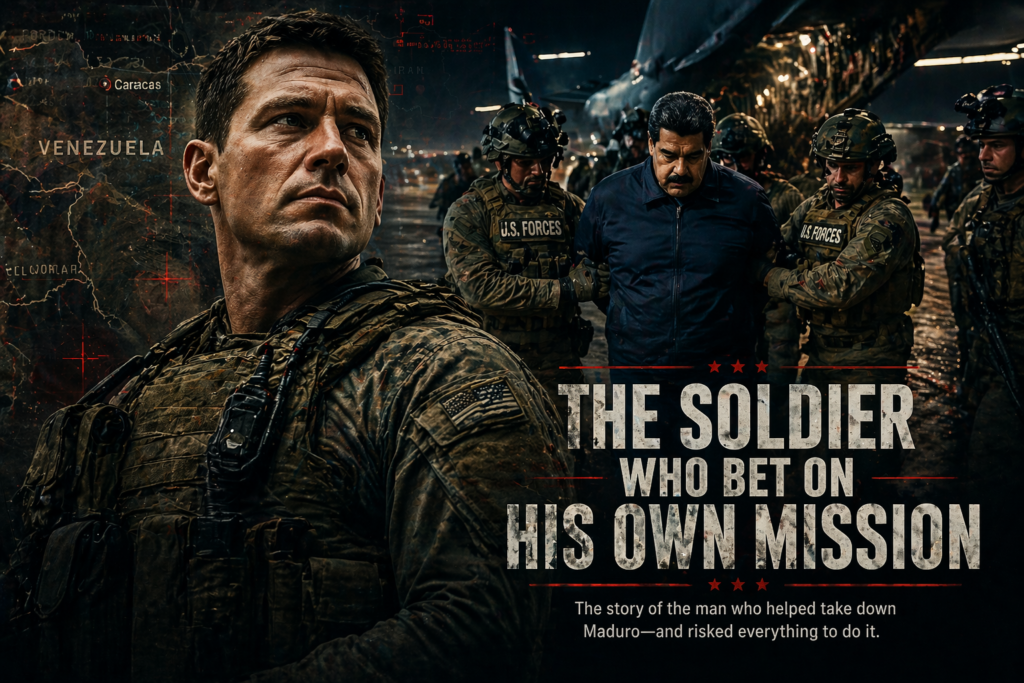
The Soldier Who Bet on His Own Mission
A US Army Master Sergeant helped capture Nicolás Maduro — then placed a $33,000 bet on the operation and walked away with $409,000. The first criminal case of its kind just blew open the prediction market industry.
NOVARAPRESS · April 24, 2026 · 8 min read
“`
On December 26, 2025 — eight days before the world knew anything — a US Army Master Sergeant logged onto Polymarket and opened an account using his personal email address. Over the next seven days, he placed thirteen separate bets totaling $33,934, all of them wagering that Venezuelan President Nicolás Maduro would be removed from power before January 31, 2026. It was, at the time, a long-shot bet. Maduro had survived every previous attempt to dislodge him. The odds were not favorable. But Gannon Ken Van Dyke, 38, stationed at Fort Liberty in North Carolina and assigned to the Joint Special Operations Command, was not gambling on uncertainty. He was betting on a mission he had personally helped plan and execute.
In the early hours of January 3, 2026, US special forces struck Caracas. Operation Absolute Resolve ended with Maduro and his wife Cilia Flores in handcuffs, transferred to the USS Iwo Jima, and flown to Stewart Air National Guard Base before being arraigned in Manhattan federal court on narcoterrorism and drug trafficking charges. Within hours of Trump’s Truth Social announcement, Van Dyke cashed out his Polymarket positions. He had turned $33,934 into $409,000 — an 1,100 percent return on classified intelligence.
On April 23, 2026, a federal grand jury in the Southern District of New York unsealed an indictment charging Van Dyke with wire fraud, commodities fraud, unlawful use of confidential government information for personal gain, theft of nonpublic government information, and engaging in monetary transactions derived from unlawful activity. The Commodity Futures Trading Commission filed parallel civil charges. It is the first time in US history that criminal charges have been brought against someone for insider trading on a prediction market. The case has shaken the prediction market industry — and raised fundamental questions about what happens when the world’s most sensitive classified operations collide with a billion-dollar global betting platform.

Who Is Gannon Ken Van Dyke?
Van Dyke is not a peripheral figure. According to the indictment, he was a communications specialist directly supporting the Joint Special Operations Command — the secretive umbrella unit that oversees Delta Force, SEAL Team Six, and the most sensitive Tier 1 operations in the US military. He had been on active duty since 2008, reached the rank of Master Sergeant in 2023, and was stationed at Fort Liberty, North Carolina — the headquarters of JSOC. The indictment states that he participated in the planning and execution of Operation Absolute Resolve and that a photograph uploaded to his Google account depicts him on the deck of a ship at sea, at sunrise, in US military fatigues, carrying a rifle, alongside three other individuals similarly uniformed. He had signed multiple non-disclosure agreements binding him never to reveal classified or sensitive operational information.
The mechanics of what he did were simple, almost reckless. He funded a cryptocurrency exchange account with $35,000 from his personal bank account on December 26, 2025 — a week before the operation. He created a Polymarket account using his personal email address. He placed 13 trades on Maduro-related and Venezuela-related contracts between December 27 and January 2. On the morning of January 3, after Trump’s announcement, he sold his positions, transferred the proceeds to a foreign cryptocurrency vault, and withdrew the funds the same day. Days later, after online commentators and journalists began scrutinizing the anomalously large Maduro bets, Van Dyke contacted Polymarket requesting his account be deleted and claiming he had lost access to the email he used to register. Polymarket referred the matter to the DOJ and cooperated fully with the investigation. The digital trail Van Dyke left was not subtle. He had used his real email, his real bank account, and left a photograph on his own Google account of himself on the ship where Maduro was held.
“That’s like Pete Rose betting on his own team.”
— President Donald Trump, responding to a reporter’s question, Oval Office, April 23, 2026
The Charges: A Legal Landmark
The indictment, unsealed in Manhattan federal court, marks a watershed moment in the legal history of prediction markets. Van Dyke faces five counts. Wire fraud and commodities fraud carry penalties of up to 20 years each. The charge of unlawful use of confidential government information for personal gain is a newer statute increasingly being applied to national security leaks with financial dimensions. The monetary transactions charge adds additional exposure. Taken together, prosecutors are treating this as straightforward insider trading — the same crime that has sent Wall Street executives to prison — applied for the first time to the prediction market context.
US Attorney Jay Clayton for the Southern District of New York stated: “Prediction markets are not a haven for using misappropriated confidential or classified information for personal gain.” Acting Attorney General Todd Blanche added: “Our men and women in uniform are trusted with classified information to accomplish their mission safely and effectively, and are prohibited from using this highly sensitive information for personal financial gain.” The Department of Justice and the Commodity Futures Trading Commission coordinated the criminal and civil actions simultaneously — signaling a whole-of-government approach to prediction market oversight.
| Count | Charge | Max Penalty |
|---|---|---|
| 1 | Wire Fraud | 20 years |
| 2 | Commodities Fraud | 10 years |
| 3 | Unlawful Use of Confidential Gov. Information | 5 years |
| 4 | Theft of Nonpublic Government Information | 5 years |
| 5 | Monetary Transactions from Unlawful Activity | 10 years |
| Total Maximum Exposure | 50+ years | |
Van Dyke Was Not Alone: The Israeli Precedent
Van Dyke’s case did not emerge in a vacuum. In February 2026, Israeli authorities arrested several individuals and charged two on suspicion of using classified military information to place bets on Polymarket related to Israeli military operations in Iran. The Israeli cases preceded the American one and helped establish the prosecutorial theory that prediction market insider trading — using state secrets for financial gain — constitutes a serious crime, not a regulatory gray area. The pattern across two democracies in two months suggests a structural vulnerability: anywhere classified military operations intersect with a betting market that offers large returns, there will be people tempted to exploit that intersection.
The scale of the problem is larger than either prosecution reveals. In March 2026, Polymarket users who had placed large bets on Iranian missile strike markets allegedly harassed and threatened Israeli journalist Emanuel Fabian of The Times of Israel in an attempt to pressure him to alter his reporting and influence the outcome. Polymarket banned those users and condemned the behavior, but the incident drew formal condemnation from Reporters Without Borders. The platform’s own CEO had told Axios in November 2025 that it was “super cool” that his platform “creates this financial incentive for people to go and divulge the information to the market.” That remark, now immortalized alongside an indictment, will follow the company for years.

Polymarket: A $9 Billion Platform in the Crossfire
Polymarket’s response to the Van Dyke arrest was swift and strategically calibrated. The company posted on X: “When we identified a user trading on classified government information, we referred the matter to the DOJ and cooperated with their investigation. Insider trading has no place on Polymarket. Today’s arrest is proof the system works.” Chief Legal Officer Neal Kumar reinforced the message: “It’s not anonymous — you will be found just like this guy.” The framing was deliberate — the arrest as validation rather than indictment of the platform’s integrity.
But the structural facts complicate that narrative considerably. Polymarket’s most popular exchange is registered in Panama, operating outside US regulatory reach. Americans technically access it through VPNs, circumventing the geographic restrictions that followed the 2022 CFTC settlement. The platform was valued at $8 billion after a $2 billion investment from Intercontinental Exchange in October 2025, reaching $9 billion by February 2026. Donald Trump Jr. serves as an advisor to both Polymarket and its competitor Kalshi, after his firm 1789 Capital invested in the platform. The intersection of prediction markets, political connections at the highest level, and intelligence community insider trading is not a theoretical risk. It has now been charged in federal court.
The CFTC’s parallel civil action against Van Dyke seeks restitution, disgorgement, civil monetary penalties, trading and registration bans, and a permanent injunction against further violations of the Commodity Exchange Act. The combined criminal and civil approach effectively closes every financial exit — Van Dyke cannot keep the money, cannot trade again, and faces decades in prison if convicted on all counts. The message to the intelligence community is intended to be unmistakable.
“Prediction markets are not a haven for using misappropriated confidential or classified information for personal gain.”
— US Attorney Jay Clayton, Southern District of New York, April 23, 2026
The Bigger Question: Are Prediction Markets a National Security Threat?
The Van Dyke case forces a reckoning that the prediction market industry has avoided for years. The platforms have always argued that insider knowledge flowing into markets is, in theory, beneficial — it makes prices more accurate, it aggregates information efficiently, it creates incentives for truthful forecasting. Polymarket’s own CEO articulated this view publicly as recently as November 2025. But what happens when the “insider” is a special forces soldier with access to classified kill/capture orders? What happens when the “information” is the operational timeline of a clandestine raid on a foreign head of state?
The intelligence implications go beyond the profit motive. A classified operation with large anomalous bets attached to it creates a visible signal in the market. Anyone monitoring Polymarket’s Venezuela contracts in late December 2025 could have seen the unusual betting activity. In theory, hostile intelligence services watching prediction markets could detect the signature of an impending operation before it occurs. The Van Dyke case demonstrates that this is not a theoretical concern — the bets were large enough that online sleuths and media reports drew attention to them almost immediately after the raid. Van Dyke’s own profits were noticed and investigated. The question the intelligence community now has to answer is whether the market signal preceded public knowledge — and whether anyone was watching.
Representative Mike Levin and other lawmakers have used the Van Dyke case to advance legislation restricting betting on war-related events. Nevada’s Gaming Control Board has already filed civil action against Polymarket. The Massachusetts courts found comparable contracts illegal under state gambling law. The regulatory environment that allowed Polymarket to flourish during the Trump administration’s deregulatory wave is now being pulled in multiple directions simultaneously — by federal prosecutors, state regulators, and a Congress that suddenly finds the intersection of classified military operations and offshore betting platforms impossible to ignore.
The Political Fault Lines
The case lands in uniquely complicated political terrain. At least one Republican lawmaker has already called for a pardon for Van Dyke, framing the charges as an overreach against a soldier who helped execute a mission that Trump himself celebrated as a triumph. Trump’s reaction at the Oval Office — comparing Van Dyke to Pete Rose — was disapproving but notably restrained. He said he would “look into it.” The administration that eased regulations on Polymarket, whose son advises Polymarket, and who championed the Maduro raid as a historic victory now faces the awkward task of prosecuting a soldier for profiting from it.
Acting Attorney General Todd Blanche and FBI Director Kash Patel both issued firm statements supporting the prosecution, signaling that the Department of Justice intends to see this through regardless of political noise. “This FBI will do whatever it takes to defend the homeland and safeguard our nation’s secrets,” Patel said. But in a political environment where pardons flow easily and the line between institutional loyalty and presidential favor is constantly renegotiated, the outcome of this prosecution is far from certain. Van Dyke’s defense attorney has not yet been publicly identified. The next court appearance has not been scheduled.
What Comes Next: Three Scenarios
Whatever the outcome for Van Dyke personally, the structural issue will not disappear. There are thousands of personnel with access to the most sensitive military operations in the world. There is a $9 billion prediction market platform — and dozens of competitors — offering large returns on geopolitical outcomes. The financial incentive structure is permanent. The human temptation is permanent. And as Van Dyke himself demonstrated, the digital trail is harder to erase than the money is to move. The only question now is whether the law can move faster than the next soldier who decides to bet on a mission before the world finds out it happened.
Sources & References
- NBC News — US Special Forces Soldier Charged with Betting on Maduro Raid, April 23, 2026.
- NPR — US Soldier Charged with Using Classified Information to Bet on Maduro’s Removal, April 23, 2026.
- CBS News — US Special Forces Won $409K on Maduro Raid Bet, April 24, 2026.
- CNN — US Special Forces Soldier Arrested After Winning $400,000 on Maduro Raid, April 23, 2026.
- TIME — Soldier Charged with Insider Trading on Polymarket, April 24, 2026.
- Washington Post — US Soldier Charged for Bets on Maduro Capture, April 23, 2026.
- Al Jazeera — US Soldier Charged with Using Polymarket to Bet on Maduro Abduction, April 23, 2026.
- Newsweek — Republican Calls for Pardon of Soldier in Maduro Raid Betting Case, April 23, 2026.
- Wikipedia — Polymarket, updated April 24, 2026.
- Wikipedia — Prosecution of Nicolás Maduro and Cilia Flores, updated April 24, 2026.
- Department of Justice Press Release — Indictment: United States v. Gannon Ken Van Dyke, SDNY, April 23, 2026.
- CFTC — Parallel Civil Complaint Against Van Dyke, April 23, 2026.
- Image Credit: US Department of State reward poster for Nicolás Maduro et al. — Public Domain (US Government Work) via Wikimedia Commons.
- Image Credit: US Army Special Forces Graduation, Fort Liberty NC, June 6, 2024 — Public Domain (US Government Work), photo by K. Kassens via DVIDSHUB.
“`
SHADOWNET Analysis
Intelligence-grade geopolitical analysis
novarapress.net · April 24, 2026
All analysis reflects open-source intelligence compiled as of publication date. Images sourced from public domain US Government works.
© 2026 Novarapress · SHADOWNET Analysis · All Rights Reserved