
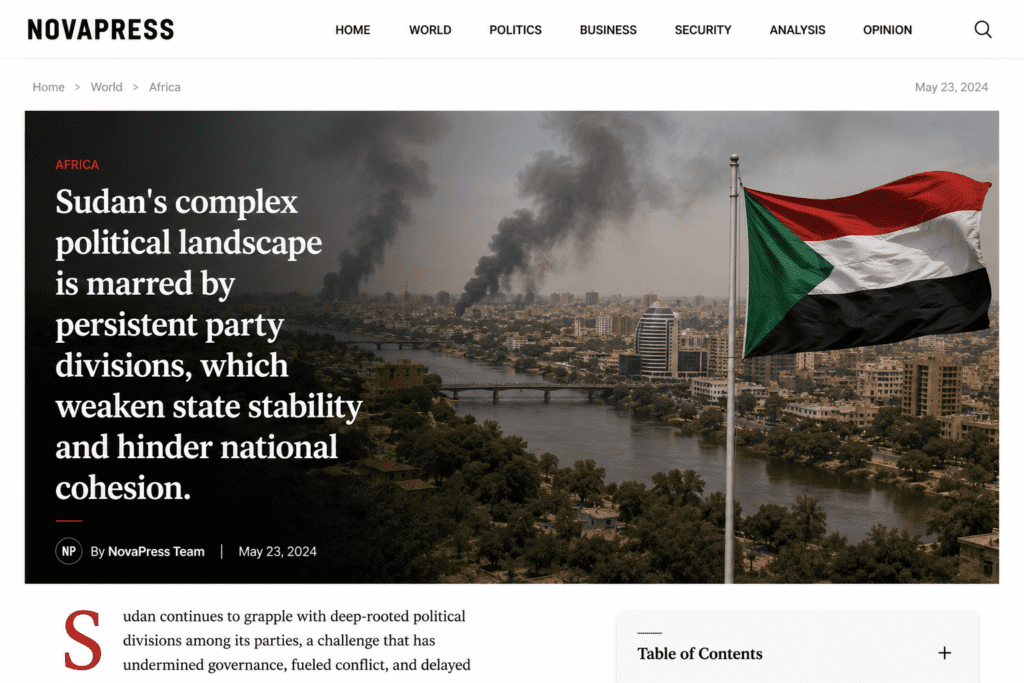
Persistent Party Divisions Undermine Sudan’s State Stability
*Sudan’s political landscape remains fraught with party divisions, hindering national unity and state-building efforts.*
S ince gaining independence in 1956, Sudan has been embroiled in a complex web of political, social, and economic crises. Central to these issues are the persistent party divisions that have continually obstructed the path to building a cohesive national state. Rather than being mere differences in political programs, these divisions have morphed into structural dilemmas that drain state institutions and deepen national divides. This has left Sudan in a state of perpetual political fragility, unable to effectively address its myriad challenges.
Historical Party Fragmentation
The roots of Sudan’s party fragmentation trace back to the post-colonial era. The political elite failed to establish a stable social contract, resulting in fragile and often temporary constitutions. Many constitutions have been subject to frequent amendments or total overhauls following shifts in party power dynamics. This instability has been exacerbated by major parties prioritizing ideological and doctrinal loyalties over a unifying national project.
The exclusionary policies adopted by dominant parties further entrenched these divisions. Large parties, particularly those with strong ideological leanings, often pursued strategies of exclusion and consolidation, sidelining opposition forces. This approach drove marginalized groups to seek alternative, often undemocratic, means to gain power, including military coups and armed resistance.
State Institutions Under Strain
One of the most damaging effects of party divisions in Sudan is the politicization of key state institutions. The civil service, meant to function as a neutral professional entity, has often been subjected to purges and partisan appointments with each political transition. This has severely eroded administrative efficiency and depleted institutional expertise.
Moreover, the military has not been immune to these divides. Historically, political parties have sought to embed their influence within the armed forces, transforming the military into a participant in political struggles rather than a defender of the constitution. This politicization has paved the way for repeated military coups, disrupting Sudan’s democratic transitions.
Internal Challenges and External Vulnerabilities
The entrenched party divisions have left Sudan in a state of chronic vulnerability, unable to confront existential challenges. A significant issue has been the failure to manage the country’s cultural and geographical diversity. Political parties have historically maintained a centralist approach, which has been ineffective in accommodating Sudan’s complex ethnic and regional dynamics. This centralism has fueled civil wars and separatist movements, which are reactions against a divided and dominant central authority.
Additionally, the allocation of national resources has been skewed towards political and military conflicts fueled by party divisions, resulting in a persistent economic downturn. Instead of channeling resources towards development, significant state efforts are expended on internal power struggles.
Erosion of Popular Trust and Internationalization
The relentless party strife has led to widespread public disillusionment with political processes. Many Sudanese citizens have lost faith in party politics and the democratic process, viewing political parties as more concerned with power struggles than with addressing fundamental issues such as food security, safety, and public services.
This erosion of internal cohesion has left Sudan exposed to external influences. Regional and international actors have capitalized on these divisions to further their agendas, undermining Sudan’s sovereignty and independent decision-making capabilities.
“The exclusionary policies adopted by dominant parties further entrenched divisions, driving marginalized groups to seek alternative means to gain power.”
James Mercer, Geopolitical Risk Analyst
Continued Political Instability
Without significant reform, Sudan’s political landscape is expected to remain unstable, with ongoing party divisions undermining national cohesion.
70%
Regional Interference Escalates
Persistent internal divisions may invite increased regional and international intervention, further complicating Sudan’s sovereignty.
60%
Sudan’s political landscape remains brittle, characterized by party divisions that weaken the state apparatus and inhibit effective governance. These divisions have historical roots but continue to evolve, shaping the national dialogue and impacting policy implementation.
A genuine transition towards inclusive governance is imperative. This requires a shift from exclusionary politics to a framework that values consensus and national responsibility. Without such change, Sudan risks perpetuating its cycle of instability and structural weakness.
SOURCES
- 1. International Crisis Group — https://www.crisisgroup.org/africa/horn-africa/sudan
- 2. BBC News — https://www.bbc.com/news/world-africa-14094995
- 3. Al Jazeera — https://www.aljazeera.com/news/africa/2019/12/sudan
- 4. The Guardian — https://www.theguardian.com/world/sudan