
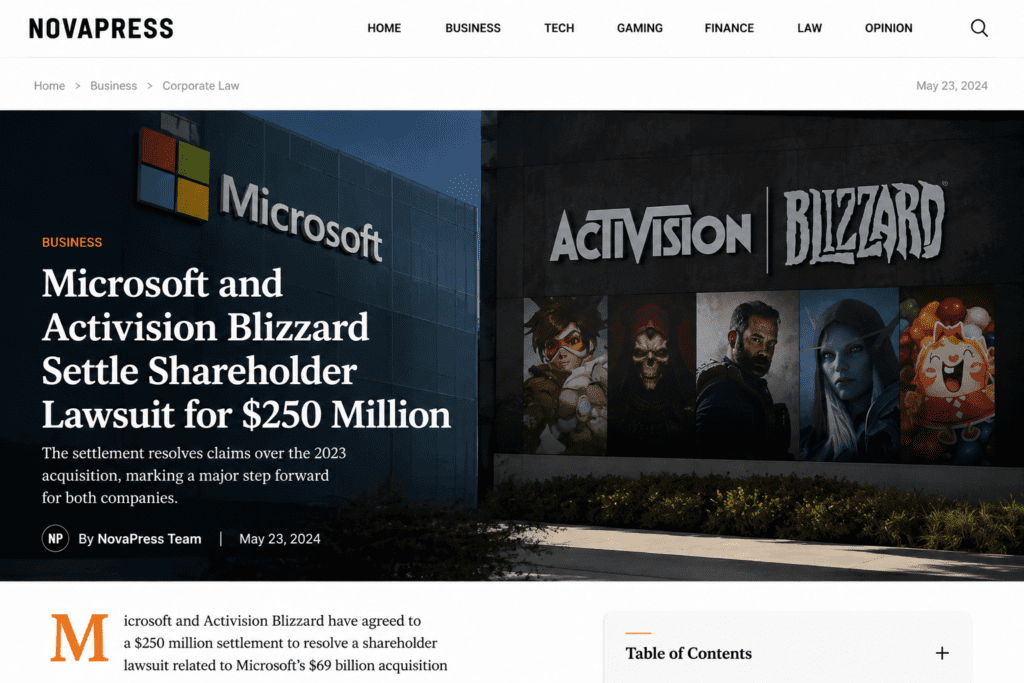
Activision Blizzard Shareholders Reach $250 Million Settlement Over Microsoft Buyout
The landmark settlement shows how Microsoft’s biggest gaming deal continues to reshape the business, legal, and competitive future of the video game industry.
SHADOWNET DESK | NovaraPress Analysis
SECTION 01 | The Deal That Changed Gaming Forever
The Microsoft acquisition of Activision Blizzard was supposed to mark a new era for the gaming industry. Instead, years after the announcement shook Wall Street and the global gaming market, the deal is still generating legal pressure, shareholder anger, and serious questions about who will control the future of interactive entertainment.
Now, Activision Blizzard shareholders have reached a $250 million settlement tied to the Microsoft buyout, closing one of the most closely watched investor lawsuits in modern gaming history.
SECTION 02 | Why the Buyout Was So Important
In January 2022, Microsoft announced plans to acquire Activision Blizzard in a deal worth nearly $69 billion. The acquisition later became one of the largest completed transactions in the history of gaming and technology.
Microsoft was not simply buying a game publisher. It was buying access to some of the strongest entertainment franchises in the world, including Call of Duty, Warcraft, Diablo, Overwatch, and Candy Crush.
The strategy was clear. Microsoft wanted to expand Xbox, strengthen Game Pass, grow cloud gaming, enter deeper into mobile gaming, and position itself for the next generation of AI-driven digital entertainment.
SECTION 03 | Why Shareholders Sued
The controversy centered on accusations that Activision executives, including former CEO Bobby Kotick, rushed the sale and failed to secure the highest possible value for shareholders.
Investors argued that Activision may have been worth more than the agreed sale price. They also claimed that shareholders were not fully protected during the negotiation process.
The lawsuit was led by Swedish pension fund Sjunde AP-Fonden, which argued that investors deserved stronger transparency and better financial outcomes from one of the most important gaming deals ever made.
SECTION 04 | Why the $250 Million Settlement Matters
The settlement matters because it is not only about money. It reflects a wider shift in the technology industry, where investors are becoming more willing to challenge mega-mergers, board decisions, and executive conduct.
Shareholders now expect clearer disclosure, stronger corporate governance, better negotiation accountability, and stronger protection against insider advantage.
This case sends a direct message to Silicon Valley and the gaming industry: even the world’s largest technology deals can face serious legal scrutiny long after they are announced.
SECTION 05 | Microsoft’s Growing Power in Gaming
Although Microsoft completed the acquisition in 2023, the company faced heavy resistance from regulators in the United States, Europe, and the United Kingdom.
Regulators raised concerns about gaming monopolies, cloud gaming dominance, subscription market control, exclusive content, and long-term competition risks.
Sony also strongly opposed the deal, warning that Microsoft could use franchises such as Call of Duty to weaken rival platforms.
SECTION 06 | The Bigger Story Behind the Lawsuit
This lawsuit represents something larger than one corporate settlement. Gaming is no longer just entertainment. It has become a strategic battlefield involving artificial intelligence, cloud infrastructure, subscription economies, data ecosystems, and digital platform control.
Technology giants increasingly see gaming companies as strategic assets rather than simple media businesses.
The industry is moving away from standalone game publishing and toward massive connected ecosystems controlled by a smaller number of powerful corporations.
SECTION 07 | What This Means for Gamers
For players, the long-term effects remain uncertain.
Supporters argue that Microsoft’s ownership could bring wider Game Pass access, better cloud gaming innovation, stronger cross-platform services, and larger development budgets.
Critics fear reduced competition, rising subscription dependency, exclusive platform lock-ins, and greater corporate control over gaming culture.
The real debate is simple: will consolidation create better access for players, or will it place too much power in the hands of too few companies?
SECTION 08 | The Future After the Activision Settlement
The Activision Blizzard settlement may close one legal chapter, but it also shows how unstable and politically sensitive the gaming industry has become.
Future mega-acquisitions will likely face stronger regulatory review, more shareholder lawsuits, greater antitrust pressure, and deeper public skepticism over corporate consolidation.
As AI, cloud computing, and digital ecosystems reshape entertainment, gaming is becoming one of the most strategic industries in the global economy.
SECTION 09 | Final Analysis
The Microsoft-Activision deal may ultimately be remembered as more than a corporate acquisition. It could be remembered as the moment the modern technology power struggle fully entered the gaming universe.
The $250 million settlement is not just the end of a lawsuit. It is a warning sign for every major company planning the next great digital takeover.