
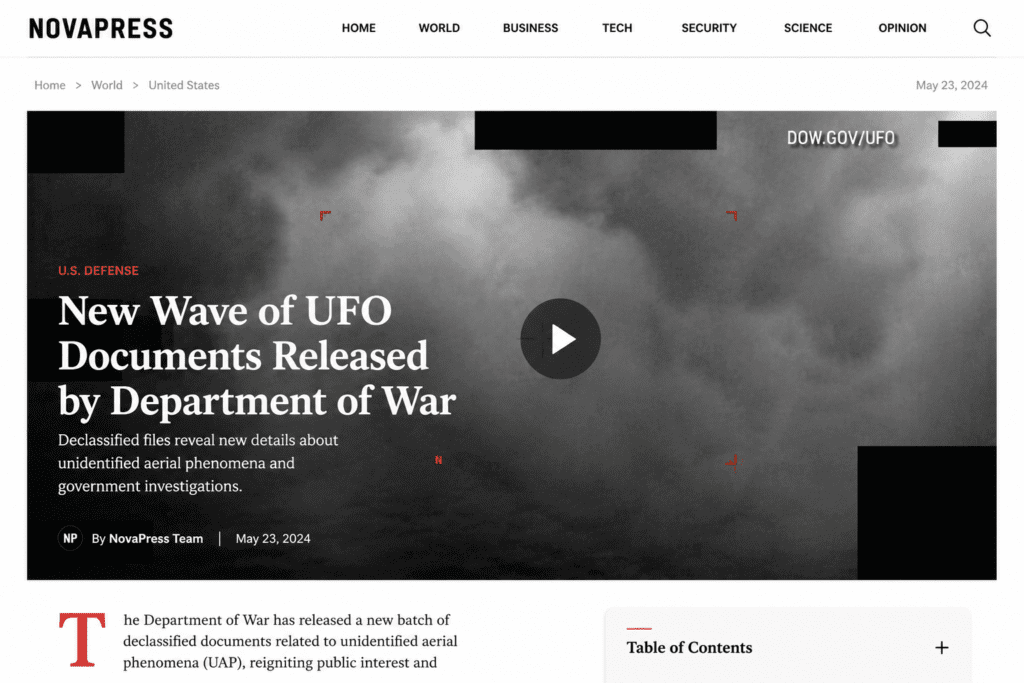
The Pentagon’s UAP Disclosure Is Real — And What’s Missing Is More Alarming Than What Was Released
162 declassified files, cockpit videos from the Strait of Hormuz, and a rolling disclosure process that lawmakers say is still hiding the most critical material.
|
May 28, 2026
On May 8, 2026, the United States Department of War — formerly the Pentagon, rebranded by the Trump administration — quietly launched a government website and uploaded 162 files onto it. No press conference. No prime-time address. Just a link, a black-background portal with white typewriter font, and a dataset spanning eight decades of encounters that the U.S. government had spent generations classifying, compartmentalizing, and denying. The program has a name that reads like a Cold War acronym engineered in a Langley basement: PURSUE — Presidential Unsealing and Reporting System for UAP Encounters. What it contains is real. What it doesn’t contain may be the more important story.
The PURSUE Release: What 162 Files Actually Contain
The first tranche — released three weeks ago after a February 19 directive from President Trump — comprises 120 declassified PDF documents, 28 videos totaling 41 minutes of footage, and 14 photographs sourced from the FBI, the Department of War, NASA, and the U.S. State Department. The files span 1947 to early 2026, touching every major theater of U.S. military operations and several corners of the world where American forces have no acknowledged presence.
The historical anchor is the 1947 Roswell FBI memo — a Dallas field office teletype in which an agent relays a call from a U.S. Air Force major reporting “an object purporting to be a flying disc was recovered near Roswell, New Mexico.” The memo describes an object hexagonal in shape, suspended from a balloon. That document alone has circulated in UFO research communities for decades. Its official release changes the evidentiary status from “leaked” to “confirmed declassified government record.”
The modern content, however, is operationally more significant. Incident reports from service members describe encounters over Iraq (2022), Syria (2024), Greece (2023), and Africa (2025). A pilot’s account from Greece describes a triangular, metallic object at 25,000 feet over the Mediterranean. A December 2025 infrared still image shows an unidentified object over the western United States. Apollo 12 and Apollo 17 lunar photographs — never previously published — depict bright objects in formation above the lunar surface. State Department diplomatic cables from 1985 through late 2025 document UAP reports submitted by foreign officials across Papua New Guinea, Kazakhstan, Turkmenistan, Georgia, and Mexico.
“These files detail unresolved cases — meaning the government is unable to make a definitive determination on the nature of the observed phenomena.”
The Strategic Geography of UAP Sightings
SHADOWNET analysts note a pattern in the geographic distribution of reported incidents that should not be overlooked: the highest concentration of modern sightings in the PURSUE release occurs in active U.S. military theaters — specifically the Persian Gulf, the Strait of Hormuz, the Gulf of Aden, Iraq, and Syria. This is not coincidence. These are zones of maximum electromagnetic activity: radar saturation, electronic warfare systems, drone swarm operations, and experimental weapons testing. They are also zones where adversaries — Iran, Russia, China — maintain persistent surveillance of U.S. force positioning.
The Strait of Hormuz carries particular weight in the current operational context. As of April 2026, the U.S. military is actively engaged in a campaign to keep the strait open, deploying A-10 Thunderbolt IIs against Iranian fast-attack watercraft and AH-64 Apache gunships to neutralize one-way attack drones. The same corridor now appears in PURSUE files as a zone of recurring UAP encounters — including cockpit videos from military pilots who could not identify what they were tracking. Whether these objects represent Iranian drone technology, advanced foreign surveillance platforms, or something genuinely uncharacterized, their concentration in a hot military corridor is a signal, not background noise.
| Region | Year | Description |
|---|---|---|
| Greece / Mediterranean | 2023 | Triangular metallic UAP at 25,000 ft, corroborated by pilot report |
| Iraq | 2022 | Internal military memos describing “one possible small UAP” |
| Syria | 2024 | “Multiple glares or light from unknown origin” — unresolved |
| Western United States | Dec 2025 | Infrared still image of unidentified object, U.S. military system |
| Strait of Hormuz / Persian Gulf | 2020–2026 | Cockpit videos, infrared footage, recurring fast-moving objects |
AARO, NDAA, and the Institutional Architecture of Non-Disclosure
The All-domain Anomaly Resolution Office — AARO — was established in July 2022 as part of the FY2022 National Defense Authorization Act, designed to be the central node for collecting, tracking, and investigating UAP reports across the U.S. military and intelligence community. It achieved full operational capacity in 2024. Its 2024 report to Congress stated plainly: “AARO has discovered no evidence of extraterrestrial beings, activity, or technology.” It also noted that the majority of reported sightings are attributable to birds, balloons, satellites, and drones.
Yet Congress remains unsatisfied. The FY2026 NDAA — signed into law in December 2025 — added three new UAP-specific mandates directly targeting AARO’s transparency gap. Section 1555 requires NORAD and U.S. Northern Command to brief lawmakers on UAP intercepts since 2004. Section 1556 mandates a consolidated security classification matrix for all UAP-related programs. A third provision requires expanded reporting on UAP incidents near nuclear and critical infrastructure facilities. The legislative pressure reflects a bipartisan consensus that AARO has been selectively transparent — providing Congress with summaries while retaining operational detail at classification levels that elected officials cannot access without individual security clearances.
Multiple lawmakers who have reviewed classified briefings have publicly stated that the disclosures do not appear complete. This is an extraordinary statement. It means elected representatives of the U.S. government, with access to classified material, are signaling to the public that even the secret version of this story is being withheld.
The Whistleblowers: What They Said Under Oath
In September 2025, current and former U.S. military officials testified before the House Oversight Committee’s Task Force on the Declassification of Federal Secrets. The witnesses included Air Force veterans. Their accounts described encounters with objects exhibiting capabilities that “appeared to eclipse existing weapons and technology” — specifically orb-like craft that a U.S. missile struck and bounced off of, recorded on video and subsequently released by a Republican congressman in 2025. A former Navy pilot testified about repeated sightings of fast-moving objects in restricted airspace. These are not anonymous internet sources. These are credentialed military personnel speaking under oath before a congressional committee.
The 2025 documentary “The Age of Disclosure” featured 34 current and former U.S. government, military, and intelligence officials speaking on record. Participants included Secretary of State Marco Rubio and Senator Kirsten Gillibrand — a bipartisan cast of senior officials whose institutional credibility makes the content impossible to dismiss as fringe speculation. Christopher Mellon, former deputy assistant secretary of defense for intelligence, stated publicly that “more can — and should — always be done” on UAP transparency. The witnesses and the political architecture surrounding them represent something the PURSUE files alone do not provide: a human chain of evidence that points toward a body of knowledge the government is managing rather than simply investigating.
“The American people deserve maximum transparency from the federal government on sightings, acquisitions, and examinations.”
Three Scenarios: What PURSUE Is Actually For
Managed public normalization. The Trump administration uses PURSUE to systematically normalize the UAP topic before a larger classified acknowledgment — whether of advanced adversary technology or something more significant. The rolling release strategy keeps public attention calibrated without triggering panic. Each tranche tests the information environment. The next tranche, expected in June 2026, will be the stronger indicator of what this process is ultimately building toward.
Adversary technology cover story. A significant portion of the unresolved sightings — particularly those concentrated over the Persian Gulf, Strait of Hormuz, and U.S. nuclear facilities — represent foreign surveillance and weapons systems operating at capabilities the U.S. does not want to publicly acknowledge are beyond current countermeasures. Classifying these as “unidentified” provides strategic ambiguity. Disclosing them as “unresolved UAP” is less damaging than admitting that an adversary’s drone swarms or hypersonic platforms are operating freely in restricted airspace.
Non-human technology acknowledgment is being staged. The testimony of 34 senior officials, the whistleblower video of a missile bouncing off a target, the Apollo lunar formation photographs, and the concentrated congressional pressure on AARO’s classification matrix all point to a body of knowledge that operates above standard compartmentalization. PURSUE may be the first phase of an acknowledgment process that the U.S. government has been planning, and resisting, for decades. The “War Department” rebrand, the Tulsi Gabbard ODNI coordination, and the Trump Truth Social directive are not the behavior of an administration that stumbled onto this issue — they are the behavior of one that was briefed on it.
The Disclosure Has Begun. The Question Is What It’s Disclosing.
The PURSUE release is historically unprecedented in scope: 162 files, publicly accessible, from agencies that spent decades denying the evidentiary basis for their own classified investigations. The Roswell memo is now official. The Apollo photographs are public. The Persian Gulf cockpit videos are real. No responsible analyst can continue to treat U.S. government UAP evidence as the province of conspiracy theory.
What SHADOWNET assesses with high confidence: the PURSUE program is a managed disclosure process, not a spontaneous transparency initiative. Its geographic concentration in active military theaters — particularly the Strait of Hormuz and the Persian Gulf during a period of active kinetic engagement — is operationally significant and demands scrutiny beyond the UFO frame. Whether the objects in those corridors represent adversary technology, uncharacterized atmospheric phenomena, or something that has no current category in public scientific literature, they are objects operating in contested airspace that U.S. forces cannot definitively identify, track, or neutralize. That is a national security statement regardless of origin.
The next tranche, projected for June 2026, will define whether PURSUE is genuine institutional reform or controlled release. If it contains operational detail on NORAD intercepts — as the FY2026 NDAA now requires — the picture changes significantly. If it contains more Apollo-era archival material and fuzzy infrared blobs, the gap between what is being disclosed and what legislators say exists in the classified record will have widened, not closed. Watch that gap.
- Wikipedia — United States UFO Files: en.wikipedia.org/wiki/United_States_UAP_files
- Al Jazeera — Pentagon Releases First Tranche of UFO Files: aljazeera.com
- CBS News — Pentagon Begins Releasing New UFO Files: cbsnews.com
- DefenseScoop — Military Whistleblowers Share New Evidence at UAP Hearing: defensescoop.com
- MeriTalk — Pentagon UAP Briefings Added in NDAA: meritalk.com
- NPR — Trump Directs Government to Release UFO Files: npr.org
- Aerotime — US Releases UFO Files in UAP Transparency Push: aerotime.aero
- UFOReleaseFiles.com — All 162 Pentagon UAP Documents: uforeleasefiles.com