
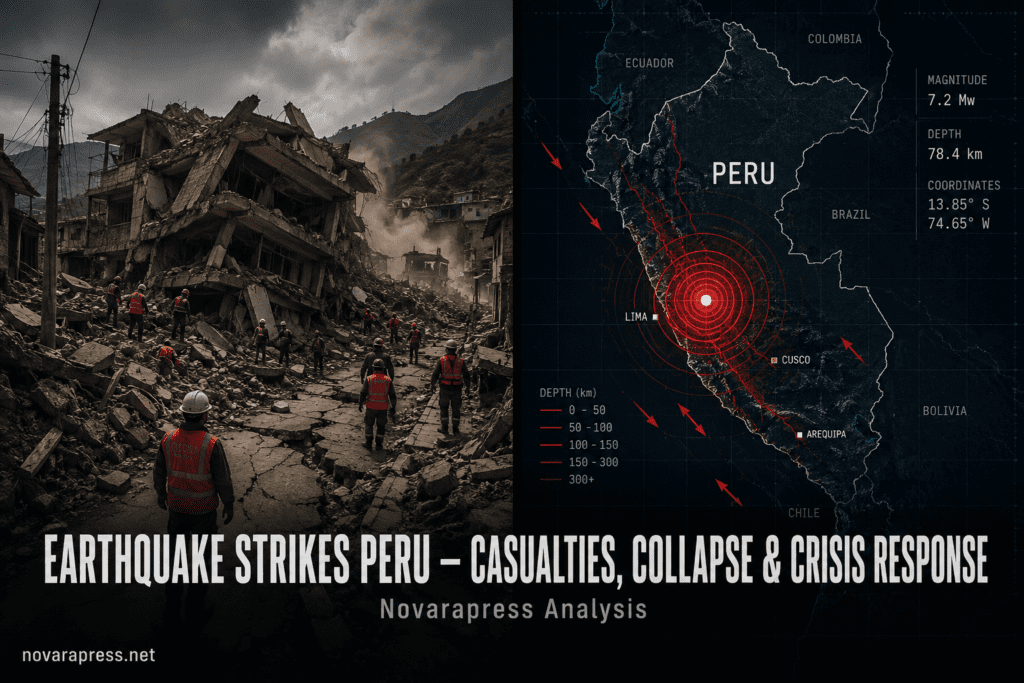
Analyzing the Impact and Response to the Recent Earthquake in Peru
*Examining the seismic event and its geopolitical and socio-economic repercussions*
Tensions are escalating in Peru following a significant earthquake that struck the nation, producing widespread damage and sowing chaos in various regions. This seismic activity, with a magnitude of 7.5 centered in the northern Peruvian Amazon, has not only challenged the country’s emergency response capabilities but also its political stability and economic resilience. As authorities scramble to address the immediate aftermath, questions about infrastructure, governance, and international aid are coming to the forefront.
Seismic Overview and Immediate Impacts
The earthquake struck Peru on November 28, 2023, at 5:52 AM local time, with its epicenter located approximately 42 kilometers north-northwest of the town of Barranca, deep within the Amazon rainforest. With a depth of 112 kilometers, the tremor was felt as far away as Lima and parts of Brazil, Ecuador, and Colombia. This event, while not unprecedented in a region prone to seismic activity, represents one of the most powerful earthquakes to hit Peru in the past decade.
Initial reports from the National Institute of Civil Defense (INDECI) indicate significant damage to infrastructure, including homes, roads, and public buildings, particularly in the regions of Amazonas, Loreto, and Cajamarca. Power outages and communication disruptions have compounded the challenges faced by emergency responders attempting to assess and manage the situation. While the death toll remains unconfirmed, dozens of injuries have been reported, and the full extent of the damage is still being evaluated.
Government Response and Challenges
The Peruvian government, led by President Dina Boluarte, swiftly declared a state of emergency in the affected regions, mobilizing national and regional resources to aid in rescue and recovery efforts. However, the response has been met with criticism due to perceived delays and a lack of coordination. Local authorities, overwhelmed by the scale of the disaster, have called for increased federal support and international assistance.
The military has been deployed to assist in relief operations, providing vital resources such as food, water, and medical aid to isolated communities. Nonetheless, logistical hurdles, including damaged roads and limited access to remote areas, have hampered these efforts. The quake has exposed vulnerabilities in Peru’s disaster preparedness infrastructure, raising serious concerns about the country’s ability to effectively manage natural disasters.
International Aid and Geopolitical Implications
In the wake of the earthquake, several countries and international organizations have pledged support, including the United States, which has offered technical assistance and humanitarian aid. The European Union has also committed to providing financial assistance to aid in recovery efforts.
This influx of international support highlights Peru’s strategic geopolitical position in South America, as well as the broader implications of such natural disasters on regional stability. The earthquake’s impact on key infrastructure, such as roads and ports, could have ripple effects on Peru’s economy, particularly affecting its mining and agricultural sectors, which are critical to both the national economy and global supply chains.
Socio-Economic Consequences and Reconstruction
The socio-economic impact of the earthquake is expected to be profound, exacerbating existing challenges faced by the Peruvian government. With thousands potentially displaced and critical infrastructure damaged, the cost of reconstruction is likely to be substantial. The government has announced initial measures focusing on rebuilding efforts, but securing the necessary funding will require significant domestic and international investment.
Moreover, the disaster has intensified discussions about climate change and its role in increasing the frequency and intensity of natural disasters in the region. As Peru begins the long road to recovery, the government will need to not only address immediate needs but also develop long-term strategies to enhance resilience to such events.
“The quake has exposed vulnerabilities in Peru’s disaster preparedness infrastructure.”
SHADOWNET Analysis
| Region | Impact |
|---|---|
| Amazonas | Severe damage, communication outages |
| Loreto | Infrastructure collapse, isolated communities |
| Cajamarca | Significant structural damage, power outages |
Increased International Aid
Given the scale of destruction, Peru is expected to receive substantial international aid, which will aid in immediate relief and long-term rebuilding efforts.
85%
Political Stability Threatened
Despite criticism of the government’s response, it is unlikely that the earthquake will directly lead to significant political instability.
30%
The earthquake in Peru has laid bare the country’s vulnerabilities in handling large-scale natural disasters. While the immediate focus is on relief and recovery, there is an urgent need to reassess and strengthen Peru’s disaster response frameworks. International support will be crucial in the coming months, both for immediate humanitarian needs and for long-term reconstruction projects.
Additionally, the event serves as a catalyst for broader discussions on climate resilience and infrastructure development in seismic regions. As Peru navigates these challenges, the government’s ability to effectively implement reconstruction efforts will be closely watched, both domestically and by the international community.
SOURCES
- 1. Reuters — https://www.reuters.com/world/americas/strong-earthquake-hits-peru-2023-11-28/
- 2. BBC News — https://www.bbc.com/news/world-latin-america-2023-11-28
- 3. The Guardian — https://www.theguardian.com/world/2023/nov/28/peru-earthquake-damage
- 4. Al Jazeera — https://www.aljazeera.com/news/2023/11/28/peru-earthquake-impact