
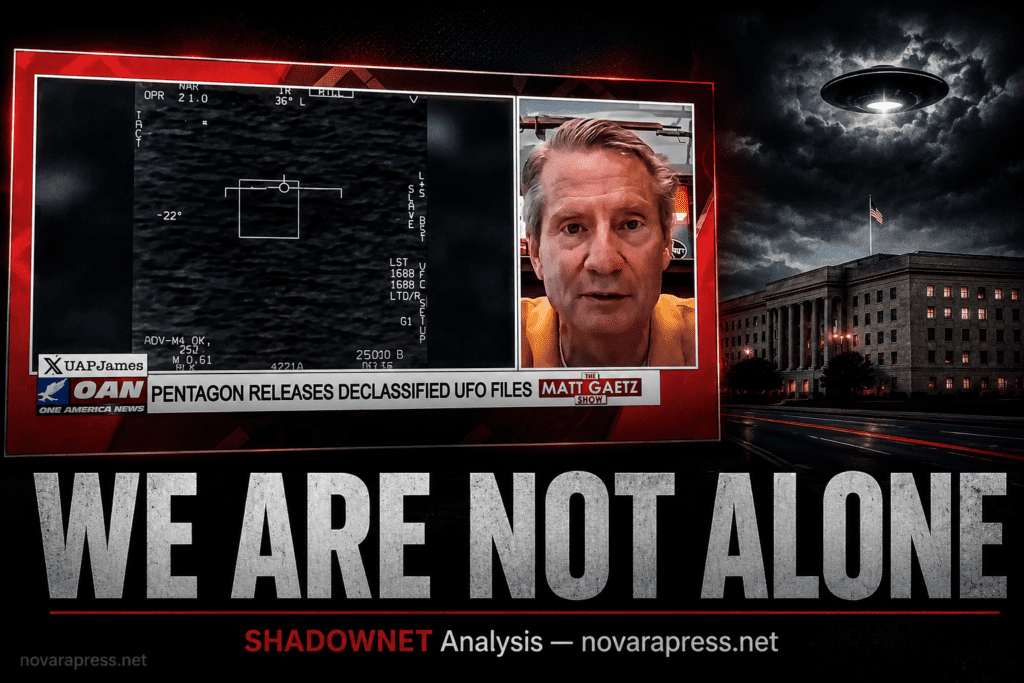
A Congressional Leader Showed Him Classified UFO Footage. Now Burchett Says the World Isn’t Ready for What He Saw.
As the Pentagon rolls out its first public UFO files under the PURSUE system, a Tennessee congressman says the sanitized release barely scratches what’s locked behind classified doors — and a senior colleague just showed him proof.
May 17, 2026
The briefing did not happen in public. It happened in a SCIF — a Sensitive Compartmented Information Facility, the kind of room where mobile phones stay outside and the walls are swept for listening devices. Somewhere inside one of those rooms on Capitol Hill, a member of congressional leadership sat across from Rep. Tim Burchett of Tennessee and showed him footage. Classified footage. The kind the American public has never seen, and may never see.
What Burchett said after he walked out of that room: “We are not alone.” And then, more deliberately: “There is something else in the universe.” When pressed on the nature of what he had seen — on the technology, the behavior, the physics of it — he stopped. “The capabilities of these beings,” he said, “cannot be described.”
That statement, made weeks after the Trump administration’s Pentagon released its first public tranche of declassified UAP files on May 8, 2026, frames the central tension in what has become one of the most consequential disclosure debates in American political history. The government released 162 files. Burchett says there are 30 to 40 videos far clearer than anything in that public drop that Congress hasn’t even been allowed to see yet.
What the Pentagon Actually Released — and What It Means
On May 8, the Department of War launched the Presidential Unsealing and Reporting System for UAP Encounters — PURSUE — a dedicated government portal housed at war.gov/UFO. The initial drop included military memos, FBI eyewitness compilations dating back to 1947, pilot accounts, photographs from U.S. space missions, and 20 videos. Defense Secretary Pete Hegseth described the objective as “maximum transparency.” The portal’s own language was more hedged: these were “unresolved cases.”
The public reaction split immediately. Scientists urged caution. The UAP research community was underwhelmed. Former Rep. Marjorie Taylor Greene posted that unless the government produced “live aliens and test demo UFOs,” she had better things to do. What the files did not contain was conclusive evidence of extraterrestrial contact, recovered non-human technology, or any confirmation of what pilots and military operators have been describing in classified settings for decades.
The included imagery was notable in parts — a 2025 Africa-region military UAP report showing an unresolved aerial object, Apollo 17 archival photographs with unexplained light sources above the lunar surface, accounts of metallic spheres tracked over Iraq in 2022 and Syria in 2024. But even sympathetic observers conceded that most of the material had circulated in some form through previous agency releases or FOIA disclosures. The gap between what PURSUE published and what sources like Burchett claim exists was the real story.
“There are 30 or 40 videos that we need to see that we know that they have that we have not seen that are much clearer. And we don’t know what we don’t know.”
— Rep. Tim Burchett (R-TN), Ruthless Podcast, May 2026
Inside the Briefing Architecture: Who Knows What
Understanding what Burchett is claiming requires understanding how UAP information flows through the U.S. government — and where it stops. The All-domain Anomaly Resolution Office (AARO), established by Congress in 2022, serves as the official investigative body. Its 2024 report acknowledged hundreds of new UAP incidents while maintaining that none had been confirmed as extraterrestrial. But AARO operates with a defined classification ceiling. What sits above that ceiling is accessed only through separate, compartmentalized channels — the kind Burchett has been tapping.
In February 2026, a classified briefing attended by Burchett and several colleagues — including Reps. Luna, Mace, and Ogles — included video footage that Rep. Eric Burlison of Missouri subsequently described as showing “objects moving at speeds that defy physics.” Burlison was careful to separate the claim from assertions about extraterrestrial origin. What he could not explain was the physics. Whistleblower Matthew Brown has been working alongside these lawmakers to map exactly where within the federal system UAP-related records are warehoused — a process Burlison described as still underway.
Burchett’s most recent disclosure goes further. A congressional leadership member — he has not named the individual — granted him access to footage in a secure facility within the past two weeks. The congressman described the capabilities of the craft or entities depicted as beyond description. He has been consistent on one point across multiple interviews: “I’ve seen pictures and video of things that defy any reason that we have.” His follow-on logic is equally consistent — if the technology belonged to China, Beijing would own the world. If it were Russian, Moscow wouldn’t be bogged down in a grinding land war.
The Missing General and the Pattern of Silence
Burchett has a habit of prefacing sensitive statements with a specific disclaimer: “For the record, I’m not suicidal, and I don’t take risks.” The phrase, deployed in public interviews, is not rhetorical flair. It maps directly to a pattern he and other disclosure advocates have repeatedly raised — the unexplained deaths and disappearances of individuals with documented ties to classified aerospace and defense research.
The most concrete case in the current cycle is that of retired Air Force Maj. Gen. William “Neil” McCasland, 68, who disappeared in late February 2026. McCasland previously commanded the Air Force Research Laboratory at Wright-Patterson Air Force Base in Ohio — a facility that has circulated in UAP lore since the Roswell incident of 1947, when military personnel reportedly transported debris and possibly biological material to the base. McCasland’s name has appeared in researcher discussions connecting classified aerospace programs to UAP retrieval operations. Search efforts continued weeks after his disappearance with no determination of cause. No body was recovered. No official explanation was offered beyond the absence of confirmed foul play.
Burchett has noted that nearly a dozen researchers or individuals with aerospace and defense connections have died or vanished under circumstances he considers suspicious. He has explicitly linked this pattern to the suppression of UAP information, while stopping short of accusing any specific agency or actor. Former Navy Rear Admiral Timothy Gallaudet, who has testified before Congress on UAP transparency, has gone further in public statements — claiming awareness of classified Pentagon and intelligence community videos of UAP that are, in his assessment, “clearly objects of nonhuman origin due to their structure and performance characteristics.” Gallaudet’s position: if those videos appear in PURSUE’s public releases, it will confirm genuine transparency. If they don’t, it will confirm the opposite.
Why Disclosure Is Happening Now — and Why It’s Structured This Way
The timing of the PURSUE rollout is not arbitrary. It sits at the intersection of at least three converging pressures. First, a sustained congressional campaign dating back to the 2022 National Defense Authorization Act, which mandated AARO’s creation and began compelling agencies to centralize and categorize UAP records. Second, the political utility of disclosure for the Trump administration — a high-interest, low-cost transparency play that generates significant public engagement at a moment when other policy narratives are contested. Third, and less discussed, the genuine institutional anxiety within segments of the defense and intelligence community about adversarial exploitation of the UAP information environment. If foreign actors can successfully model U.S. UAP-related sensor behavior by studying public reaction to sightings, the classification calculus changes.
A YouGov poll from September 2024 found 53 percent of Americans believe aliens “definitely or probably exist.” That number represents a public baseline that governments have historically managed through careful information architecture — releasing enough to appear transparent, withholding enough to maintain operational security and institutional control. What Burchett’s recent statements suggest is that the gap between managed transparency and actual knowledge may be significantly wider than the PURSUE release implies.
There is also the question of jurisdiction. Burchett has noted in multiple interviews that he has been told by unelected bureaucrats that “the president is on a need-to-know basis” regarding certain UAP programs. If accurate, that claim describes a classification architecture that operates outside normal executive oversight — a shadow bureaucracy that reports to no elected official and that predates the Trump, Biden, Obama, and Bush administrations. The institutional inertia of such a structure would explain both the glacial pace of release and the resistance that disclosure advocates describe at every level of government.
Forward Analysis: Four Trajectories for U.S. UAP Disclosure
The PURSUE system will continue releasing files on a rolling basis. What those files contain — and what they conspicuously omit — will define public and congressional response over the coming months. SHADOWNET maps four credible trajectories.
PURSUE releases progressively clearer footage over 12–18 months. Congress is satisfied. No non-human confirmation. Public interest peaks then declines. Classification architecture remains intact. The “30-40 clearer videos” Burchett references are released in degraded or cropped form.
Burchett and allied members push legislation forcing direct congressional access to the highest-tier classified UAP files. The effort succeeds partially — select committee members gain access but cannot speak publicly. Briefings intensify without public disclosure. Institutional pressure builds.
A future PURSUE release includes footage that independent physicists and aerospace engineers cannot explain using known human or adversarial technology. Government confirms “non-human origin” of specific objects while declining to speculate on nature. Global institutional response begins. Markets and religious institutions react unpredictably.
The compartmentalized bureaucracy that Burchett describes — one that controls access even from the president — successfully limits PURSUE to sanitized historical material. The clearest footage never surfaces. Pressure from disclosure advocates plateaus. The McCasland disappearance goes officially unresolved. The architecture holds.
What Burchett is describing — a congressional leadership member granting him access to footage that confirms non-human presence in a secured facility — is either the most significant disclosure event in the history of U.S. governance, or a chain of sincere but unverifiable accounts that have accumulated enough institutional credibility to reach the highest levels of Congress. Neither interpretation is comfortable.
The PURSUE system’s first release did not resolve the fundamental question. It demonstrated the government’s capacity to release historical material without revealing anything operationally sensitive or paradigm-altering. That was, by design, a calibrated move. The real test comes in subsequent tranches — and in whether the footage Burchett has now seen twice in classified settings ever reaches a format that independent verification can assess.
Until then, the space between “we are not alone” and “this is what we found” remains the most consequential unresolved gap in modern American public life.
UAP Disclosure
PURSUE
Pentagon UFO Files
Congress UFO Briefing
Non-Human Intelligence
Sources
- Rep. Eric Burlison, statement on UAP classified briefing, reported by Cybernews — February 3, 2026
- Rep. Tim Burchett, interview with Ruthless Podcast — May 2026. Reported by Fox News.
- Rep. Tim Burchett, interview with Stephen A. Smith, reported by Newsweek — April 10, 2026
- Department of War / Pentagon, PURSUE first release announcement and war.gov/UFO portal — May 8, 2026
- NBC News report on Pentagon PURSUE files release — May 8, 2026
- DefenseScoop analysis: “Data alone is not disclosure” — May 14, 2026
- United States UAP Files, Wikipedia — updated May 17, 2026
- USA Herald, Tim Burchett classified UAP briefing report — May 2026
- YouGov poll on public belief in extraterrestrial life — September 2024