
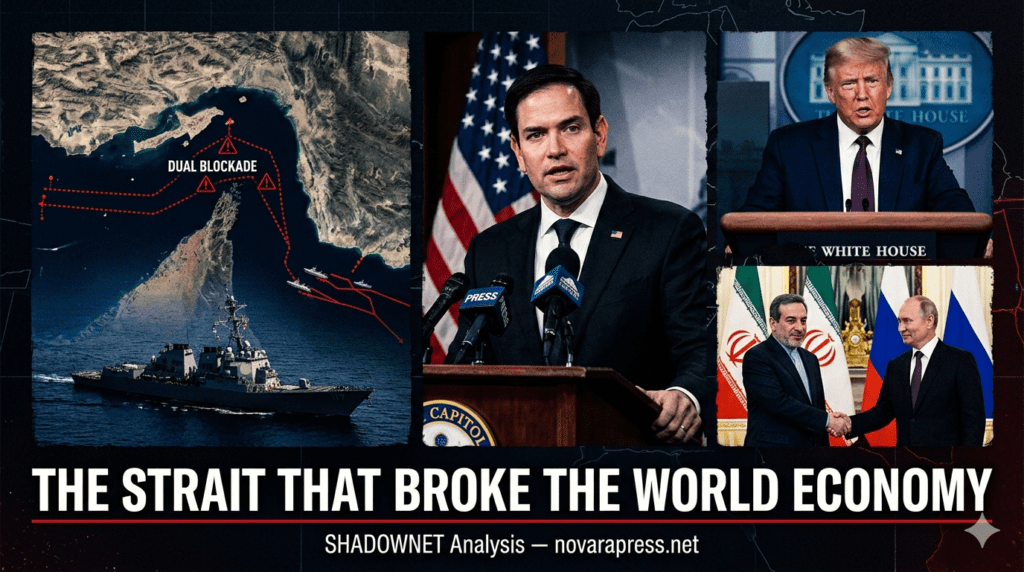
On February 28, 2026, the United States and Israel launched a coordinated air campaign against Iran and assassinated Supreme Leader Ali Khamenei. Within hours, the Iranian Revolutionary Guard Corps did what it had threatened for decades: it closed the Strait of Hormuz. What followed was not a crisis that would resolve itself in days. Two months later, the strait — a 21-mile-wide chokepoint through which 25% of the world’s seaborne oil and 20% of its liquefied natural gas once flowed freely — remains the most dangerous body of water on the planet.
Nobody expected it to last this long. The working assumption in Washington, in the Gulf capitals, and in the trading floors of London and Singapore was that Iran would blink within weeks — that economic pressure, military degradation, and diplomatic isolation would force Tehran to reopen the lane. That assumption was wrong. Iran did not blink. Instead, it adapted, improvised, and turned the strait into a battlefield of attrition — charging ships over a million dollars per passage through its own northern channel, mining the southern lane, and daring the U.S. Navy to escalate. It did.
The current standoff has no modern precedent. Iran has blocked shipping traffic through the Strait of Hormuz since February 28 — issuing IRGC warnings forbidding passage, boarding and attacking merchant vessels, and laying sea mines across the southern lane. On April 13, the United States responded in kind: the U.S. Navy initiated a blockade of Iranian ports, creating what analysts are now calling a “dual blockade” — Iran blockading the Gulf, America blockading Iran.
The consequences have been immediate and severe. Oil prices have spiraled, driving up gasoline costs across the United States. The closure of the strait and damage to critical energy facilities have raised the prospect of a full-scale global energy crisis if hostilities continue. Markets that absorbed the shock of COVID, the Ukraine war, and the tariff battles of 2025 are now staring at a scenario none of their models fully priced in: a prolonged physical blockade of the world’s most critical maritime chokepoint.
“Iran leverages the Strait of Hormuz to raise global costs while betting it can outlast U.S. political will. This is a war of endurance, not firepower.” — CSIS, April 21, 2026
| Date | Event |
|---|---|
| Feb 28 | U.S. & Israel launch air war on Iran. Khamenei assassinated. IRGC closes Hormuz. |
| Mar 9 | Trump falsely claims Iran’s military “destroyed” and strait re-opened. |
| Mar 15 | Trump demands NATO and China help reopen the strait. |
| Apr 1 | IRGC drones strike Kuwaiti oil tanker at Port of Dubai. QatarEnergy tanker hit north of Doha. |
| Apr 8 | Temporary ceasefire agreed — Iran begins charging $1M+ tolls per ship through its own channel. |
| Apr 12 | Islamabad Talks collapse. JD Vance announces failure. U.S. initiates full naval blockade of Iranian ports. |
| Apr 13 | “Dual Blockade” begins. U.S. Navy and Iran each blockade the other. |
| Apr 20 | U.S. forces fire on Iranian vessel M/V Touska attempting to breach blockade. |
| Apr 27 | Iran offers to reopen strait in exchange for U.S. lifting blockade. Rubio rejects offer. Oil hits $108/barrel. |
Oil prices climbed to $108 a barrel on April 27 — after a second round of U.S.-Iran talks collapsed before it began. The IMF, in its April 2026 World Economic Outlook, had already revised its projections downward. Under the assumption of a limited conflict, global growth is projected at just 3.1 percent in 2026 — well below pre-pandemic averages — while global inflation is expected to tick upward for the first time in three years.
Those projections assume the conflict stays contained. In an adverse scenario — a sharper rise in energy prices coupled with tightening financial conditions — global growth could fall to 2.5 percent while inflation surges to 5.4 percent. The worst-case model the IMF runs, a severe scenario where energy supply disruptions extend into 2027, projects global growth collapsing to 2 percent with inflation exceeding 6 percent. Nobody is officially forecasting that scenario. But nobody ruled it out two months ago either.
“China and Russia can exploit an Iran war by letting the U.S. bear the costs. They gain influence and advance strategic aims while avoiding direct conflict.” — Foreign Affairs / Jon Alterman & Ali Vaez, April 23, 2026
While Western attention fixes on the naval standoff, three actors are quietly repositioning. Russia — whose war chest has been replenished by spiking oil prices — is absorbing a revenue windfall even as its battlefield position in Ukraine deteriorates. Beijing is allowing ships bound for China and India to pass through Iran’s northern toll channel, effectively paying Iran in Chinese yuan while Washington’s blockade tightens. And on April 27, Iranian Foreign Minister Araghchi landed in Moscow — hours after Tehran’s strait offer was rejected by Rubio — signaling that Iran is actively consolidating its diplomatic rear while the military standoff holds.
Pakistan’s attempt to mediate the conflict is a high-stakes reflection of evolving middle-power dynamics. Success would elevate Islamabad’s regional status. Failure — which appears increasingly likely — risks pulling Pakistan into the very conflict it sought to prevent. The Islamabad Talks collapsed on April 12. Pakistan is now caught between a diplomatic implosion and a volatile eastern neighbor.
SHADOWNET assesses Scenario B as the dominant trajectory heading into May 2026. The diplomatic window has not fully closed — Trump’s mention of a “much better offer” from Iran on April 27 leaves a narrow opening. But Rubio’s public rejection and the cancellation of the Kushner-Witkoff mission to Pakistan suggest the administration is not yet prepared to trade its blockade for Iran’s strait access. The world economy is, for now, learning to function with a permanently elevated risk premium built into every barrel of oil shipped east of Suez.
SHADOWNET Closing Assessment
The Strait of Hormuz crisis is no longer a Middle East story. It is a global economic stress test — one that the world is failing in slow motion. The dual blockade has proven that neither the United States nor Iran calculated correctly. Washington assumed military superiority would force a rapid capitulation. Tehran assumed economic pain would break American political will. Both sides are now locked in a war of attrition over 21 miles of water that neither can afford to lose — and neither knows how to end.
The next critical window: whether back-channel communications between Washington and Tehran — reportedly involving Omani intermediaries — can produce a framework before U.S. domestic political pressure in an election year forces Trump’s hand.
Strait of Hormuz
Iran War
US Navy
Oil Prices
Global Economy
IRGC
Middle East
Geopolitics
Verified Sources
- Wikipedia — “2026 Strait of Hormuz Crisis” — Updated April 27, 2026 — wikipedia.org
- CNBC — “Trump Discussed Iran’s Hormuz Proposal with Top Aides” — April 27, 2026 — cnbc.com
- NBC News / ms.now — “Rubio Calls Iran’s Deal Unacceptable” — April 27, 2026 — ms.now
- CSIS — “Latest Analysis: War with Iran” — April 21–27, 2026 — csis.org
- IMF World Economic Outlook — “Global Economy in the Shadow of War” — April 2026 — imf.org
- S&P Global — “Geopolitical Risk Brief: April 2026” — April 2026 — spglobal.com
- Geopolitical Monitor — “Pakistan’s Mediation of the Iran War” — April 16, 2026 — geopoliticalmonitor.com