
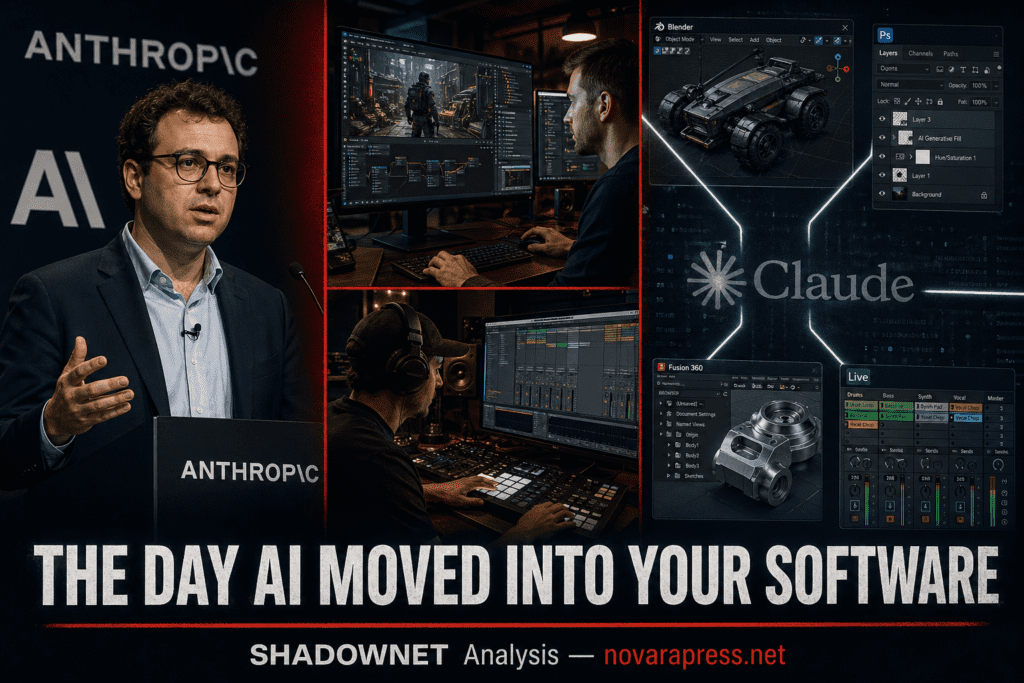
On April 28, 2026, Anthropic — the AI safety company behind Claude — announced a landmark integration that signals a fundamental shift in how artificial intelligence enters professional creative workflows. In partnership with Blender, Autodesk, Adobe, Ableton, Splice, Canva’s Affinity, SketchUp, and Resolume, Anthropic launched a suite of connectors that embed Claude directly inside the tools that designers, engineers, musicians, architects, and visual artists use every day. This is not another AI chatbot announcing that it “supports creativity.” This is Claude becoming a native collaborator inside the software stack of the global creative industry.
The announcement arrives at a critical inflection point. For two years, the creative technology sector has debated whether AI tools would displace professionals or augment them. The “Claude for Creative Work” initiative answers that question with a clear architectural choice: integration over replacement. Rather than building standalone AI creative tools that compete with industry-standard software, Anthropic has chosen to wire Claude into the existing ecosystem — making it a layer of intelligence that professionals can invoke inside the environments they already know, not a parallel universe they must migrate to.
The Full Connector Map: What Connects to What and How
The connectors announced today span five distinct creative domains: 3D modeling and animation, audio production, graphic design, architectural visualization, and live visual performance. Each connector is built on the Model Context Protocol (MCP) — an open standard that allows Claude to communicate with external tools, read their state, and execute actions within them. Here is a comprehensive breakdown:
| Tool | Domain | What Claude Can Do |
|---|---|---|
| Blender | 3D / Animation | Debug scenes, batch-apply changes, build custom scripts via Python API, add new tools to Blender’s interface |
| Autodesk Fusion | 3D / Engineering | Create and modify 3D models through natural language conversation — no manual CAD input required |
| Adobe Creative Cloud | Design / Video | Bring images, videos, and designs to life across 50+ tools — Photoshop, Premiere, Express, and more |
| Affinity by Canva | Design | Automate batch image adjustments, layer renaming, file export, and generate custom features directly in-app |
| Ableton | Music Production | Grounds Claude’s answers in official documentation for Live and Push — precision support for producers |
| Splice | Music / Samples | Search Splice’s royalty-free sample catalog directly from within Claude — no tab-switching required |
| SketchUp | Architecture / 3D | Describe a room, furniture piece, or site concept in natural language — Claude builds the starting 3D model |
| Resolume Arena / Wire | Live Visual / VJ | Control Arena, Avenue, and Wire in real time through natural language for live AV performance |
“Claude can’t replace taste or imagination, but it can open up new ways of working — faster and more ambitious ideation, a more expansive skill set, and the ability for creatives to take on larger-scale projects.” — Anthropic, April 28, 2026
The Blender Partnership: Why Open Source Matters Here
Of all the partnerships announced today, the Blender connector carries the most strategic significance — and not just for 3D artists. Blender is a free, open-source 3D creation suite used across industries, from indie game development and motion graphics to architectural visualization and film production. It is the backbone of independent creative production worldwide, used by studios that cannot afford proprietary software licenses and by professional artists who value its extensibility.
Anthropic has joined the Blender Development Fund as a patron to support the Blender project as they continue to develop their Python API, which makes integrations like this possible. This is a meaningful commitment: it is Anthropic putting financial weight behind an open-source ecosystem rather than simply extracting value from it. The connector itself is built on MCP — meaning it is accessible to other LLMs in addition to Claude, a deliberate nod to Blender’s commitment to open-source interoperability.
For practitioners, the implications are immediate and practical. 3D artists can use the Blender connector to analyze and debug entire Blender scenes, or build custom scripts to batch-apply changes to objects in a scene. And using Blender’s Python API, the connector lets Claude add new tools directly to Blender’s interface. A task that previously required hours of manual scripting can now be described in plain language.
Five Use Cases That Change Professional Workflows
Anthropic has identified five core workflow transformations that the new connectors enable. Each addresses a genuine friction point that creative professionals encounter daily:
① Learning and Mastering Tools
Claude becomes an on-demand tutor for complex software — explaining modifier stacks in Blender, walking through synthesis techniques in Ableton, or demonstrating unfamiliar features in Fusion. The barrier to mastering deep professional software drops significantly when a knowledgeable assistant is embedded directly inside the interface.
② Extending Tools with Code
Claude Code can write scripts, plugins, and generative systems for the software you already use — custom shaders, procedural animations, or parametric models — producing documented code you can reuse and modify. This democratizes plugin development, previously the domain of engineers, and opens it to any creative professional who can articulate what they need.
③ Bridging Tools Across Pipelines
Claude can translate formats, restructure data, and keep assets in sync across a project that spans multiple applications, so you can move work between design, 3D, and audio tools without manual handoffs. The multi-application pipeline — one of the most time-consuming aspects of professional production — becomes significantly more fluid.
④ Rapid Exploration and Handoff
Claude Design — a new product from Anthropic Labs — can be used to explore ideas for software experiences, visualize options, iterate based on feedback, and export results to other tools, starting with Canva. It is a concept-to-production accelerator built directly into the design chain.
⑤ Eliminating Repetitive Production Work
Claude can handle multi-step tasks like batch-processing assets, setting up project scaffolding, or applying procedural changes across a scene — the category of work that consumes disproportionate time without requiring creative judgment. Automating this layer returns hours to the creative process itself.
The Education Dimension: RISD, Ringling, and Goldsmiths
A frequently overlooked component of today’s announcement is its academic dimension. Anthropic is working with art and design programs to support curricula that involve creative computation. The first three such programs are Art and Computation at Rhode Island School of Design, Fundamentals of AI for Creatives at Ringling College of Art and Design, and the MA/MFA Computational Arts program at Goldsmiths, University of London.
This matters beyond the headline. RISD, Ringling, and Goldsmiths are not peripheral institutions. They are among the most influential art and design schools in the English-speaking world — factories of the next generation of creative professionals. By embedding Claude and its connectors into their curricula now, Anthropic is shaping the professional intuitions of the cohort that will define the creative industry in the 2030s. Students and faculty will get access to Claude and the new connectors, and their feedback will help understand what creative practitioners need from these tools.
“The question is no longer whether AI will enter professional creative workflows. It already has. The question now is who controls the architecture of that entry — and whether it serves the professional or supplants them.” — SHADOWNET Analysis
Strategic Reading: What This Move Means for the AI Industry
Anthropic’s creative connector initiative must be read in the context of a broader AI platform war. OpenAI has pursued a direct-to-consumer creative strategy through DALL-E, Sora, and GPT integrations. Google’s Gemini is embedded in Google Workspace. Microsoft’s Copilot targets enterprise productivity. Each major AI player is staking territory in a different vertical. Anthropic, with today’s announcement, is claiming the professional creative sector — not through flashy generative outputs, but through deep process integration.
The MCP foundation of these connectors is significant. By building on an open protocol, Anthropic has positioned Claude not as a proprietary lock-in — a risk that creative professionals are acutely sensitive to after decades of Adobe subscription controversies — but as an interoperable layer. The Blender connector’s explicit openness to other LLMs reinforces this positioning. The message to creative professionals is: this is infrastructure, not a cage.
SHADOWNET Closing Assessment
The “Claude for Creative Work” initiative is the most coherent AI-in-professional-tools announcement since Microsoft embedded Copilot in Office. Its coherence comes not from the scale of the partner list — though that scale is significant — but from its architectural clarity. Anthropic has chosen depth over disruption: meet professionals inside their existing tools, build on open protocols, invest in the open-source ecosystem, and let the education pipeline do the long-term positioning work. Whether this strategy produces the market share gains Anthropic needs in a brutally competitive AI sector remains to be seen. But as a design philosophy for how AI should enter high-stakes professional practice, it is the most defensible position any major AI company has taken.
The connectors are available now through Claude’s connector directory at claude.ai. Anthropic has indicated the education program will expand to additional institutions in future phases.
Claude AI
Anthropic
Blender
Adobe
Autodesk
Creative AI
MCP
AI Tools
Verified Sources
- Anthropic — “Claude for Creative Work” — April 28, 2026 — anthropic.com
- Anthropic — Claude Connector Directory — claude.ai
- Model Context Protocol — Official Documentation — modelcontextprotocol.io
- Blender Development Fund — fund.blender.org
- Anthropic — “Claude Design” (Anthropic Labs) — April 2026 — anthropic.com
- Rhode Island School of Design — Art and Computation Program — risd.edu
- Goldsmiths University of London — MA/MFA Computational Arts — gold.ac.uk