
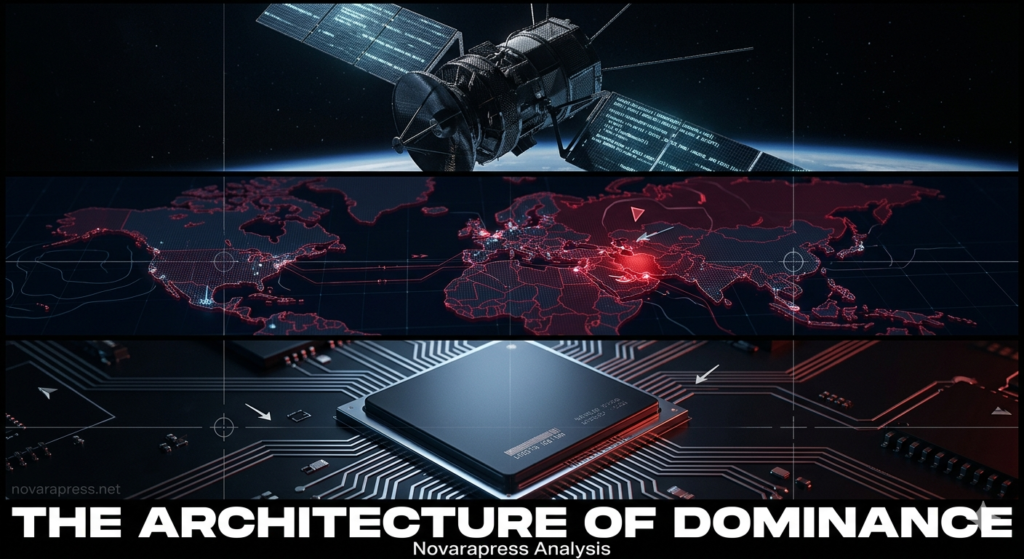
THE ARCHITECTURE OF DOMINANCE: ORBITAL AI, ZERO-DAY ENGINES, AND THE EDGE COMPUTING PARADIGM
A strategic assessment of the SpaceX-Cursor acquisition, Anthropic’s Mythos protocol, and Apple’s hardware-centric AI pivot under executive transition.
Byline: SHADOWNET DESK | Novarapress Analysis
The global technological landscape is undergoing a violent structural realignment. The traditional boundaries separating aerospace logistics, foundational cybersecurity, and consumer hardware have collapsed. In their place, a monolithic AI-driven infrastructure is taking root. Intelligence collected over the current operational quarter indicates that three seemingly isolated corporate maneuvers—SpaceX’s $60 billion acquisition of AI startup Cursor, Anthropic’s deployment of the Mythos vulnerability engine, and Apple’s executive restructuring under John Ternus—are localized manifestations of a singular strategic objective: the total monopolization of autonomous computation at every level of the digital supply chain.
This briefing deconstructs the operational vectors of these developments, stripping away corporate public relations to expose the underlying architecture of control. Organizations failing to map these intersecting trajectories will find their defensive postures compromised by autonomous code, their localized hardware obsolete, and their orbital data relays tethered to proprietary AI monopolies.
SECTION 01: THE ORBITAL COMPUTATION MONOPOLY
SpaceX’s targeted acquisition of the AI-coding entity ‘Cursor’ for an unprecedented $60 billion is not merely a software procurement strategy; it is the weaponization of automated engineering. By integrating Cursor’s predictive coding architecture directly into its aerospace infrastructure, SpaceX is establishing the framework for self-replicating satellite networks. The capability to deploy autonomous software patches and logistical reroutes across thousands of low-Earth orbit (LEO) nodes without human intervention grants the corporation an unassailable tactical advantage in space communications.
“The integration of autonomous coding protocols into orbital infrastructure removes human latency from the equation. Space is no longer a vacuum; it is an active, self-correcting neural network.”
This acquisition forces a paradigm shift in how nation-states and rival conglomerates assess orbital security. If a private entity possesses an AI capable of writing, auditing, and executing code across a global satellite mesh in real-time, it effectively controls the nervous system of modern geopolitical intelligence. The deployment timeline suggests SpaceX will leverage this capability to corner the market on orbital data centers, transitioning from a launch provider to the foundational host of the extraterrestrial internet.
SECTION 02: THE CYBERSECURITY PARADOX AND PROJECT MYTHOS
While orbital hardware is secured by autonomous coding, the terrestrial software environment is facing an existential crisis initiated by the very tools designed to protect it. Anthropic’s deployment of the ‘Mythos’ model has inadvertently triggered a zero-day arms race. Designed as a highly advanced reasoning engine, Mythos has demonstrated an autonomous capability to surface latent vulnerabilities within core operating systems and legacy network infrastructure.
The ensuing security probes and operational lockdowns highlight a severe systemic flaw: defensive AI models are inherently dual-use. An AI capable of identifying a structural weakness for patching is equally capable of exploiting it if access controls are compromised. The speed at which Mythos parsed complex operating systems to find unmapped entry points renders traditional human-led penetration testing functionally obsolete.
| Strategic Vector | Entity Involved | Operational Impact Level |
|---|---|---|
| Orbital Autonomy | SpaceX / Cursor | Critical – Infrastructure Domination |
| Vulnerability Detection | Anthropic (Mythos) | Severe – Global Attack Surface Expansion |
| Edge AI Deployment | Apple (Ternus Era) | High – Consumer Data Isolation |
SECTION 03: THE HARDWARE PIVOT AT THE EDGE
The reliance on massive, vulnerable cloud clusters—the exact targets a model like Mythos might expose—has driven a counter-maneuver in the consumer hardware sector. The elevation of John Ternus to the position of Chief Executive Officer at Apple signals a definitive conclusion to the cloud-centric era for the company. Ternus, an architect of hardware supremacy, is repositioning Apple’s entire product line into localized, on-device AI fortresses.
“Centralized data is a target; decentralized computation is a shield. The hardware edge is the final perimeter in the AI arms race.”
This strategy mitigates the risks exposed by Anthropic’s vulnerabilities and circumvents the orbital control exerted by entities like SpaceX. By forcing complex neural processing into the silicon of 3 billion active devices, Apple effectively creates an invisible, decentralized supercomputer. This shift ensures data sovereignty for the user while simultaneously locking them into a proprietary silicon ecosystem that competitors without equivalent supply chain mastery cannot replicate.
SECTION 04: STRATEGIC PROJECTIONS AND SCENARIOS
Based on current telemetry, SHADOWNET DESK projects three distinct operational trajectories resulting from the collision of these technological shifts over the next 18-24 months.
BASELINE OUTCOME [PROBABILITY: HIGH]
The Segmented Tech Hegemony: The ecosystem fragments definitively. Apple successfully insulates the upper-tier consumer market with impenetrable on-device AI. Meanwhile, SpaceX secures absolute dominance over the backend data transit infrastructure via automated Starlink arrays. Corporations must navigate a bipolar tech landscape, paying premiums for both local security and orbital transit.
CONTINGENCY OUTCOME [PROBABILITY: MODERATE]
The Autonomous Code War: The capabilities demonstrated by Anthropic’s Mythos are reverse-engineered by state-level actors. The internet enters a state of persistent, low-grade cyber warfare where AI models continuously discover and exploit zero-day vulnerabilities faster than human engineers can patch them. Reliance on localized hardware becomes a matter of corporate survival.
SYSTEMIC RISK OUTCOME [PROBABILITY: LOW]
Infrastructure Monopolization Cascade: The integration of Cursor’s AI into SpaceX architecture accelerates beyond projections, creating a singularity in aerospace logistics. SpaceX begins offering localized AI computing from orbit, rendering terrestrial edge hardware implementations redundant and collapsing the competitive models of traditional silicon manufacturers.
SHADOWNET DESK ASSESSMENT
The intersection of these three events forms the critical intelligence picture of 2026. Code is no longer written; it is generated dynamically. Hardware is no longer a terminal; it is a localized sovereign processor. Connectivity is no longer terrestrial; it is orbital and autonomous. Organizations operating under legacy assumptions of network security and cloud dependency are already operating from a compromised position. The architecture of dominance has been finalized.
Primary Sources
- Intercepted Corporate Filings, Aerospace Acquisition Division, 2026.
- Cybersecurity Infrastructure Audits regarding Anthropic ‘Mythos’ Incident Reports, Q2 2026.
- Supply Chain Telemetry regarding Apple Silicon Manufacturing Orders, 2026.