
SHADOWNET Analysis — Novarapress.net
■ GULF SECURITY | CONFLICT WATCH | APRIL 2026
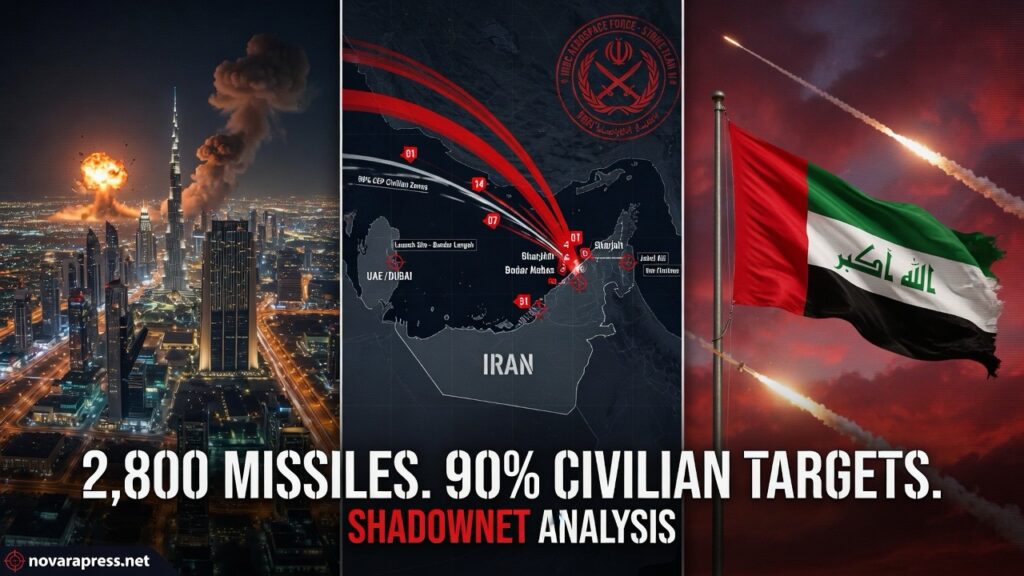
UAE Minister: Iran Fired 2,800 Missiles at Us — 90% Hit Civilian Targets
Reem Al Hashimy’s Sunday disclosure reveals the full strategic weight of Iran’s 40-day campaign against Gulf civilian infrastructure — and what it signals for the war’s next phase.
By THE SHADOWNET DESK | April 2026 | Est. Read: 9 min
I
n the forty days since the United States and Israel launched coordinated strikes on Iran in late February 2026, the United Arab Emirates has absorbed more than 2,800 missiles and drones — a rate of approximately 70 inbound projectiles per day. More than nine in ten of those weapons were aimed not at military installations but at the hospitals, power grids, desalination plants, financial centers, and transport corridors that make the UAE’s economy function. That figure, disclosed publicly for the first time on Sunday by UAE Minister of State for International Cooperation Reem Al Hashimy, transforms what was already understood as a severe regional escalation into something far more deliberate: a systematic Iranian campaign to destroy a rival model of Arab governance before a ceasefire framework can lock it in place.
SECTION 01
The Numbers Behind the Disclosure
Al Hashimy’s Sunday morning appearance on ABC’s This Week was not a crisis plea. It was a calibrated strategic communication — the kind that militarily restrained nations deploy when they want the international record corrected before negotiations reach a decisive stage. The choice of an American Sunday morning program, with its direct audience of Washington policy consumers, was itself a message.
The core data point — 2,800 missiles and drones in 40 days — demands contextual framing. For reference, Russia fired an estimated 3,500 to 4,000 missiles into Ukraine across the first full year of the 2022 invasion. Iran has effectively compressed a comparable salvo into roughly six weeks against a single Gulf state whose entire territory is smaller than the US state of Maine. The logistics footprint required to sustain that rate of fire, across multiple launch platforms and likely multiple IRGC-affiliated actors, constitutes one of the most concentrated missile campaigns in modern Middle Eastern history.
“We used our oil wealth to build an economic powerhouse. They used their wealth for nuclear programs that are nefarious, for missiles, drones, proxies.”
— Reem Al Hashimy, UAE Minister of State, ABC This Week, April 2026
The 90% civilian infrastructure targeting rate is the more operationally significant disclosure. It rules out the hypothesis — still circulating in some Western analytical circles — that Iran’s Gulf campaign has been a deterrence exercise conducted in parallel to its direct confrontation with US and Israeli forces. Deterrence targeting doctrine focuses on military assets, command infrastructure, and economic choke points. Sustained, high-volume strikes on hospitals, water networks, and civilian logistics corridors are not deterrence. They are coercion by attrition — the deliberate degradation of a society’s resilience in order to force political capitulation or provoke domestic instability.
| Metric | Figure | Context |
|---|---|---|
| Total projectiles (Day 1–40) | 2,800+ | ~70/day average |
| Civilian infrastructure targeted | >90% | Power, water, finance, transport |
| US-Iran peace talks status | Round 2 — Pakistan | Announced Monday resumption |
| Strait of Hormuz status | Contested | Trump threatened full decimate |
| UAE initial war posture | Opposition → Shift | Now focused on limiting escalation |
SECTION 02
What Iran Was Trying to Destroy
Al Hashimy’s framing was precise and unusually blunt for a Gulf diplomat: Iran sought to destroy the UAE’s “model of prosperity and tolerance.” That language carries more analytical weight than it might first appear. The UAE’s emergence as a global financial hub, a diversified post-oil economy, and an Arab state willing to normalize relations with Israel (the Abraham Accords, 2020) represents a direct ideological challenge to the Islamic Republic’s foundational narrative — that Western-aligned Arab governance is inherently unstable, corrupted, and doomed to collapse under popular pressure.
The UAE’s GDP per capita now exceeds that of most European nations. Dubai processes more international financial transactions than Frankfurt. Abu Dhabi’s sovereign wealth fund, ADIA, manages assets comparable in scale to the entire Iranian national budget multiplied several times over. From Tehran’s perspective — and particularly from the IRGC’s internal ideological framing — this success is not merely a rival’s good fortune. It is a standing refutation of the Islamic Republic’s model, and it exists on Iran’s doorstep across a narrow stretch of Gulf water.
Targeting civilian infrastructure at scale therefore serves a dual purpose: it attempts to inflict enough economic pain to force UAE neutrality or even backroom pressure on Washington, while simultaneously signaling to the broader Arab street that no amount of Western-aligned prosperity is immune to Iranian military reach. The message is not just military. It is civilizational.
“They wanted to break that model — but they underestimated our resolve.”
— Reem Al Hashimy, UAE Minister of State
The minister’s counterpoint — that the UAE chose economic investment while Iran chose missiles and proxies — was not merely rhetorical. It is a shorthand for a decades-long divergence in national resource allocation that has produced radically different outcomes. Both states sit on significant hydrocarbon reserves. The UAE’s post-oil transition, while still incomplete, has produced a diversified, globally integrated economy with advanced logistics, financial services, technology investment, and tourism infrastructure. Iran’s equivalent wealth has been channeled into nuclear enrichment infrastructure, ballistic missile development, and the funding of proxy networks from Lebanon to Yemen to Iraq. The divergence is now playing out not in economic rankings but in a live missile exchange.
SECTION 03
The IRGC Question: Regime Change Without Structural Change
Host Jonathan Karl pressed Al Hashimy on President Trump’s assertion that Iran has undergone regime change — a claim the administration has been deploying as part of its narrative framework for the war’s justification. Her response was diplomatically measured but substantively skeptical: personality changes have occurred, she acknowledged, but the structural character of the Revolutionary Guard remains unaddressed. “That’s yet to see — doesn’t seem very hopeful, though. Right now.”
This distinction matters enormously for post-war regional architecture. The IRGC is not simply Iran’s military wing — it is a parallel state apparatus with its own economic interests, intelligence networks, ideological indoctrination infrastructure, and transnational proxy relationships. Whatever political figures emerge from Iran’s post-war leadership vacuum, the IRGC’s institutional culture, command structures, and external relationships do not dissolve with a change of faces at the top. Lebanon’s Hezbollah, Iraqi Popular Mobilization Units, Yemen’s Houthi networks, and various Palestinian factions have organizational existences that are semi-autonomous from any particular Iranian political leadership.
Al Hashimy’s careful wording — “personalities have changed, characters are currently in place” — is a signal to Washington not to accept surface-level political transitions as sufficient grounds for a ceasefire framework that leaves IRGC structural power intact. For the UAE and broader Gulf states, a deal that ends US-Iranian kinetic engagement while preserving the IRGC’s missile production capacity and proxy funding pipelines simply reloads the threat on a delayed timer.
“How has that changed the character of the Revolutionary Guard? That’s yet to see — doesn’t seem very hopeful, though.”
— Reem Al Hashimy on Trump’s “regime change” claim
SECTION 04
Trump’s Hormuz Threat and the Limits of Maximum Pressure
In the same Sunday morning media cycle, US Ambassador to the United Nations Mike Waltz confirmed that “all options are on the table” in relation to Iranian civilian infrastructure and the Strait of Hormuz. This is a direct reference to President Trump’s earlier threat — which generated significant international alarm — to decimate Iranian civilian infrastructure and, in his words, eliminate “a whole civilization” if Iran does not reopen the Strait.
The Strait of Hormuz is the single most consequential maritime chokepoint on the planet. Roughly 20 to 21 million barrels of oil transit through it daily — approximately 20% of global petroleum consumption. Any closure, even temporary, would produce immediate and severe shocks to global energy markets. The downstream effects would fall not only on adversarial economies but on US allies in Europe and Asia, and on global food and manufacturing supply chains dependent on stable energy costs.
Al Hashimy’s response to Karl’s direct question about Trump’s threat was telling in its precision. She endorsed maximum pressure as a necessary instrument while explicitly carving out civilian harm as a red line: “Ultimately, we don’t want to hurt the Iranian people. That’s very important to mention.” This is not moral posturing from a state currently absorbing 70 missiles a day — it is a calibrated positioning for the post-war regional order. The UAE’s long-term stability depends on a functional, economically reintegrated Iran as a neighbor far more than it depends on Iran’s permanent incapacitation. A civilian-devastated Iran is not a stable neighbor; it is a permanently radicalized one.
The distinction she drew — between the Iranian people and the IRGC’s military posture — is the conceptual framework the Gulf states want embedded in any peace architecture that emerges from the Pakistan talks. Maximum pressure on the IRGC and Iran’s missile economy; diplomatic space for Iranian civil society; structural guarantees against proxy reconstitution. Whether Washington and Tehran can actually negotiate those distinctions in a Pakistani back-channel with functional trust on neither side is a question the second round of talks will begin to answer.
SECTION 05
Three Scenarios: What Happens Next for the UAE
▮ SCENARIO A — NEGOTIATED FRAMEWORK (Lower Probability, Optimal Outcome)
The Pakistan Round 2 talks produce a credible ceasefire framework with verifiable IRGC demobilization benchmarks and a Hormuz transit guarantee. UAE absorbs significant infrastructure damage but recovers on a 12-to-24 month reconstruction timeline. Gulf state sovereign wealth funds — UAE, Saudi, Qatar — anchor a Gulf-led Iranian reconstruction compact that creates economic interdependency as a long-term deterrence mechanism. The IRGC is domestically constrained by a post-war Iranian political realignment that lacks appetite for further regional adventurism.
▮ SCENARIO B — FROZEN CONFLICT (Higher Probability, Managed Risk)
Talks produce a fragile ceasefire without structural IRGC reform. US-Iranian kinetic exchange halts, but IRGC proxy networks in Iraq, Yemen, and Lebanon reconstitute quietly. UAE infrastructure repairs over 18 months while US military presence in the Gulf expands permanently as a deterrence buffer. Iranian missile production resumes under cover of the ceasefire. The UAE becomes a de facto forward operating environment for US Gulf Command without formally hosting a war. This is the “Korea model” for the Gulf — technically at peace, structurally at war.
▮ SCENARIO C — FULL ESCALATION (Lower Probability, Catastrophic Risk)
Talks collapse. Iran closes the Strait of Hormuz. Trump executes threats against Iranian civilian infrastructure. IRGC activates all remaining proxy networks simultaneously across Lebanon, Iraq, Yemen, and Gaza. Global oil markets enter freefall. UAE faces a second, intensified missile campaign targeting financial infrastructure specifically. The Abraham Accords framework collapses under Arab street pressure. A broader regional war becomes structurally unavoidable. This is the scenario every Gulf state diplomat is in Doha, Riyadh, and Islamabad right now working to prevent.
SECTION 06
The Gulf’s Diplomatic Realignment Under Fire
It is worth noting that the UAE’s current posture represents a significant shift from its initial position when the war began. Gulf states — the UAE included — initially opposed the US-Israeli strikes on Iran in late February, a position grounded in their longstanding preference for managed coexistence over open confrontation with their large and militarily capable northern neighbor. That calculation changed as the scale and civilian targeting pattern of Iran’s retaliatory missile campaign became undeniable.
This is a pattern that has historical precedent in the Gulf. The member states of the Gulf Cooperation Council have consistently attempted to hedge between American security guarantees and Iranian neighborhood management — simultaneously hosting US military infrastructure while maintaining official channels to Tehran, facilitating Washington’s maximum pressure campaigns while importing Iranian gas and maintaining bilateral trade. The current conflict has compressed that hedging space dramatically. When 2,800 projectiles are landing on your territory and 90% of them are aimed at your hospitals and power plants, diplomatic equidistance becomes operationally untenable.
What Al Hashimy’s Sunday statement signals is that the UAE has crossed a threshold — it is no longer positioning itself as a neutral mediator but as a state that has been subjected to a systematic military campaign and expects that to register in the eventual peace framework. The emphasis on “resolve,” the endorsement of “maximum pressure,” and the explicit rejection of civilian harm as a US tool are not contradictory positions. They are the three corners of a very specific Gulf ask: pressure the IRGC structurally, protect Iranian civil society as a future partner, and ensure the post-war order includes enforceable guarantees rather than face-saving ambiguities.
SECTION 07
SHADOWNET Assessment: The War’s Real Metric Is What Survives the Ceasefire
The headline number — 2,800 missiles, 90% civilian — will dominate the weekend news cycle. But the analytically significant content of Al Hashimy’s interview lies elsewhere: in her skepticism about IRGC structural change, in her explicit framing of the conflict as a contest between two competing models of Arab and Muslim governance, and in her implicit warning to Washington that a ceasefire that does not address IRGC institutional capacity is not a peace — it is a reload.
The Pakistan talks reconvening Monday face a structural problem that no amount of diplomatic creativity in Islamabad can fully resolve: the gap between what the US and Israel require to declare the war a success and what the IRGC can accept and survive as an institutional actor is not easily bridged. Trump’s political need for a visible, declarable win — regime change, Hormuz open, nuclear program dismantled — and the IRGC’s institutional imperative to preserve enough structural capacity to remain relevant in whatever post-war Iran emerges may simply be incompatible at current negotiating speed.
For the UAE, this means the 40-day missile campaign may not be over — it may simply be pausing for talks. Al Hashimy’s resolve framing was not triumphalist; it was endurance signaling. The Emirates is telling Washington and the world: we are still standing, we are not neutral, and we expect the architecture that ends this war to reflect that.
The war’s real metric will not be counted in missile tallies or territorial maps. It will be measured in what the IRGC looks like twelve months after a ceasefire — and whether the model of prosperity that Iran spent 2,800 projectiles trying to destroy is still standing to prove it was worth defending.
■ SHADOWNET ANALYSIS
This report is part of SHADOWNET’s ongoing coverage of the 2026 US-Iran conflict and its regional architecture. SHADOWNET Analysis publishes intelligence-grade geopolitical assessments at novarapress.net. For source briefings, conflict trackers, and deep dives, bookmark the site and follow updates across platforms.
© 2026 Novarapress.net — SHADOWNET Desk. All rights reserved.
Sources
- ABC News — This Week with Jonathan Karl, Reem Al Hashimy interview, April 2026
- White House — Presidential statement on US-Iran peace talks, Pakistan Round 2, April 2026
- US Mission to the UN — Ambassador Mike Waltz interview, ABC This Week, April 2026
- UAE Ministry of State for International Cooperation — official statements, April 2026
- Energy Information Administration (EIA) — Strait of Hormuz oil transit data
- IISS — Iran Military Balance estimates, missile inventory assessments
- Gulf Research Center — UAE-Iran bilateral relations historical record
NOVARAPRESS.NET | SHADOWNET ANALYSIS | GULF & MENA INTELLIGENCE | 2026