
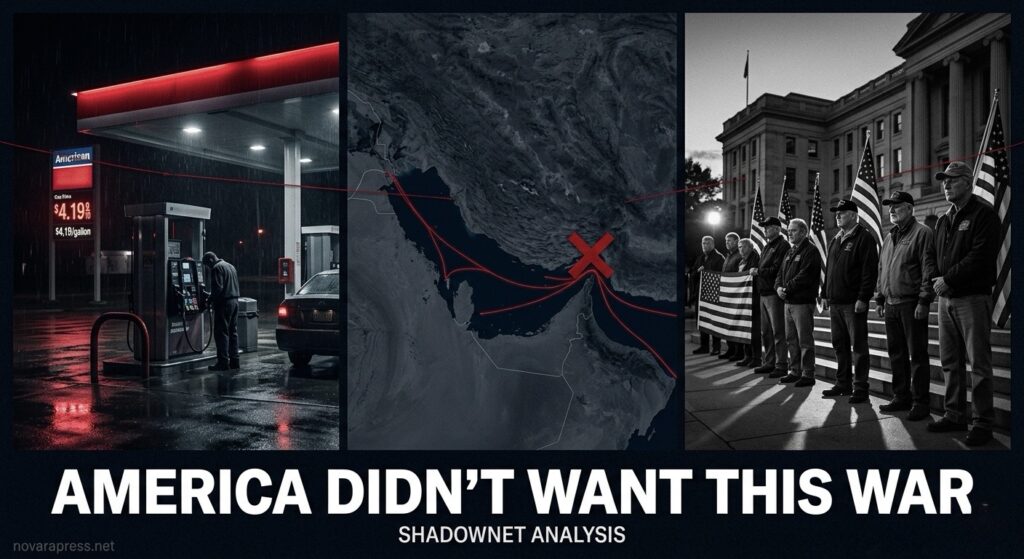
America Didn’t Want This War — The Data Proves It
From Quinnipiac to Pew, from Capitol Hill to the pump — a clear, consistent majority of Americans rejected the Iran conflict. This is the record they don’t want you to circulate.
There is a version of the Iran war told from the top down — from Truth Social posts and Pentagon briefings, from Oval Office proclamations and airstrike footage set to pop music. Then there is the version the data tells: from thousands of polling respondents, from protest lines on Capitol Hill, from veterans in handcuffs demanding a vote that Congress refused to take. That second version tells a different story. A majority of Americans — across nearly every major poll conducted since Operation Epic Fury began on February 28 — has rejected this war. Not with reluctance. With clarity.
This is not opinion. It is documentation. The numbers come from Pew Research, Quinnipiac University, Ipsos, PBS/NPR/Marist, the Associated Press, and Fox News. The same verdict appears across different methodologies, different sample sizes, different political contexts: most Americans did not ask for this war, do not support this war, and are now paying for it.
The Polling Wall: A Supermajority Nobody Is Reporting
Before the first bomb dropped on Tehran, the data was unambiguous. A January 14, 2026 Quinnipiac national poll found 70 percent of registered voters opposed any U.S. military action against Iran — including 80 percent of independents, 79 percent of Democrats, and 53 percent of Republicans. The same poll found 70 percent believe a president must seek Congressional approval before taking military action against another country.
The war launched anyway — without a Congressional vote, without a formal declaration, without anything resembling a public mandate.
By February 5–9, 2026, the University of Maryland Critical Issues Poll found only 21 percent of Americans favored initiating an attack on Iran. Forty-nine percent opposed it. Thirty percent said they didn’t know — a figure that signals absence of consent, not presence of support. Even among Republicans, just 40 percent were in favor. Among independents: 21 percent.
Once Operation Epic Fury launched, opposition solidified. The table below tracks disapproval across six independent polling organizations in the weeks that followed.
| Pollster | Field Dates | Oppose / Disapprove | Support / Approve |
|---|---|---|---|
| Quinnipiac University | March 7–9 | 53% | 40% |
| PBS News / NPR / Marist | March 2–4 | 56% | 44% |
| Ipsos / Reuters | March 13–15 | 58% | 38% |
| Pew Research Center | March 16–22 | 59% (wrong decision) | 38% |
| Fox News | Mid-March | 58% | — |
| Reuters / Ipsos | Late March | 61% | — |
| Quinnipiac University | March 25 | 59% (Trump handling) | 34% |
| AP–NORC | Late March | 6 in 10 say “gone too far” | — |
These are not outliers. When Fox News and Pew Research arrive at the same conclusion, that is not a partisan story. It is a national verdict.
The war option is clearly not popular among Americans, including among Republicans.
— University of Maryland Critical Issues Poll, February 2026
The Voice of the Street: What Americans Are Actually Saying
Numbers do not capture rage. They do not capture the mother in Ohio watching the gas meter cross five dollars. They do not capture the veteran who walked into the Cannon House Office Building on April 21, 2026 — ready to be arrested rather than stay silent. These are the voices that fill the space between the data points.
The Price at the Pump: How the War Came Home
On February 26 — two days before the first U.S. strikes on Tehran — the national average for gasoline was $2.98 per gallon. By late March it had crossed $4 for the first time since Russia’s invasion of Ukraine. By early April, the AAA recorded a national average of $4.11 — a 38 percent increase in five weeks. Diesel reached $5.62, a 49 percent spike. In Los Angeles, drivers stared at signs past $6.
The mechanism was direct. Iran’s closure of the Strait of Hormuz — through which roughly 20 percent of the world’s seaborne oil supply transits — sent global crude markets into structural shock. The International Energy Agency called it the greatest global energy security challenge in history. West Texas Intermediate climbed to $115.48 per barrel by April 6.
The cascade was immediate. Amazon added a fuel surcharge to e-commerce deliveries. JetBlue raised fares. Mortgage rates climbed to a seven-month high. Small business owners saw fuel costs double from 3–5 percent of revenue to 6–10 percent — with no ability to pass the increase to customers. Consumer visits to restaurants, entertainment venues, and escape rooms dropped consistently on a year-over-year basis from mid-February onward, tracked by foot traffic analytics firm Placer.ai.
Federal Reserve Chair Jerome Powell appeared before Congress and stated plainly: nobody knows how large the economic effects will be. That is not wartime confidence. That is institutional uncertainty in the face of an elective conflict.
Pew Research found in late March that 69 percent of Americans were worried about higher gas prices as a direct result of the Iran war. The same survey found 64 percent of Americans have little or no confidence in President Trump’s ability to make sound decisions about Iran — with only 35 percent expressing confidence overall.
This is headed toward sustained, compounding cost pressure across every industry that touches fuel — which is effectively every industry.
— Herman Nieuwoudt, President, IFS Energy & Resources — via CNBC
The War That Was Never Declared: A Constitutional Breakdown
The U.S. Constitution vests the power to declare war in Congress — not the executive. Article I, Section 8 is explicit. Operation Epic Fury was launched without a declaration, without an Authorization for Use of Military Force, and without a single vote in either chamber.
Bipartisan war powers resolutions were introduced in both chambers — Khanna-Massie in the House and Kaine-Paul in the Senate. Both were defeated largely on party lines. The Senate vote was 53–47 against. Rand Paul was the only Republican to vote yes. In the House, 219–212 blocked even consideration — Massie and Representative Warren Davidson of Ohio the only Republicans who crossed over.
A Middle East expert quoted by PBS News put it without softening: the only thing that will cause President Trump to reconsider is adverse domestic political pressure. Congress is inert and is not exercising in any appreciable way the responsibilities assigned to it under the Constitution.
The Friends Committee on National Legislation documented that the Pentagon was already seeking $200 billion to fund a conflict that had killed at least 2,076 civilians and displaced up to 3.2 million people — without a single authorization vote on record.
Making America Less Safe: What the Public Actually Believes
The stated justification for striking Iran was the elimination of a threat to U.S. security. The American public has reached a different conclusion about what this war has done to their safety.
The March 9 Quinnipiac poll found 76 percent of voters believed U.S. military action against Iran would likely result in a terrorist attack on U.S. soil. The March 25 Quinnipiac survey found 42 percent believe the war makes the world less safe, against 35 percent who say it makes the world safer. Among independents — the bloc that decides elections — 49 percent said less safe, 25 percent said safer.
Pew Research’s March 16–22 survey found that by nearly two to one, more Americans say the military action makes the U.S. less safe. Fifty-four percent believed the conflict would last at least six more months — including 68 percent of Democrats, 40 percent of whom expected it to still be ongoing a year from now.
About 6 in 10 disapprove of Trump’s handling of Iran. As many say the decision to use force was wrong.
— Pew Research Center · March 25, 2026
Three Trajectories: What Happens to Public Opinion From Here
🟢 Scenario A — Swift Resolution
If the conflict ends quickly, a partial rally-around-the-flag effect is possible among Republicans. But the economic damage is already embedded. Gas prices, mortgage rates, and consumer confidence do not reverse overnight. The public memory of costs is likely to persist into the midterms regardless of outcome.
🟠 Scenario B — Prolonged Stalemate
54 percent of Americans already expect the war to last at least six more months. A drawn-out conflict with continued economic pressure and rising casualties historically accelerates opposition. Vietnam and Iraq suggest approval could fall below 30 percent within a year. The midterm map becomes a referendum on the war.
🔴 Scenario C — Escalation to Ground Troops
74 percent of Americans already oppose ground troops — including 52 percent of Republicans. Any ground escalation triggers the most severe backlash scenario in the data set. Historical precedent from Iraq 2007 and Vietnam 1968 shows this kind of public rejection does not recover. It defines a political generation.
On the Ground: Veterans, Families, and the Movement Nobody Is Covering
On April 21, 2026, military veterans and family members organized by About Face, Veterans for Peace, Common Defense, and Military Families Speak Out walked into the Cannon House Office Building. They were demanding a meeting with House Speaker Mike Johnson. They were willing to be arrested. At least 62 people were taken into custody — including elderly and disabled activists.
These were not protesters. These were people who had worn the uniform. Army veteran Christina Sarson of Pennsylvania spoke for many: “I personally am here for my sons. As a veteran, I know the harm that wars do to civilian populations, but also to our soldiers. I’m talking about the loss of life. I’m talking about injuries and lives changed forever. I’m talking about PTSD and moral injury. And that’s why I’m here today.”
These are not the voices that trend on Truth Social. They are the voices that endure.
SHADOWNET Assessment
The evidence is not ambiguous. Before the war began, a supermajority of Americans opposed it. After it began, that opposition held — and in several polls, deepened. The war was not sold to the American people. It was launched over them. The Constitutional mechanism for democratic accountability — a Congressional vote — was blocked on party-line margins. The economic consequences are now landing in every gas tank, every grocery receipt, every small business payroll that cannot absorb $5 diesel.
There is a majority in this country that opposed this war before the first bomb fell on Tehran, that opposes it now, and that is watching the bill arrive. This document is their record. The polls are public. The votes are on file. What happens with this information — in November, in primary races, in town halls — is a question only the American public can answer.
The data does not lie. The question is whether anyone in power is listening.
Sources & References
- University of Maryland Critical Issues Poll — “Do Americans Favor Attacking Iran?” — Feb. 5–9, 2026 — criticalissues.umd.edu
- Quinnipiac University National Poll — January 14, 2026 — poll.qu.edu
- Quinnipiac University National Poll — “Over Half Of Voters Oppose It” — March 9, 2026 — poll.qu.edu
- Quinnipiac University National Poll — “War With Iran Will Make The World Less Safe” — March 25, 2026 — poll.qu.edu
- Pew Research Center — “Americans Broadly Disapprove of U.S. Military Action in Iran” — March 16–22, 2026 — pewresearch.org
- Pew Research Center — “Gas Prices Are Americans’ Top Iran War Concern” — March 23–29, 2026 — pewresearch.org
- PBS News / NPR / Marist Poll — “Majority of Americans Oppose Military Action in Iran” — March 2–4, 2026 — pbs.org
- PBS News — “Polls Show What Americans Think About the War in Iran” — March 10, 2026 — pbs.org
- Ipsos — “The Iran Conflict: Global Poll Roundup” — March 13–15, 2026 — ipsos.com
- TIME — “Latest Polls Show Americans Continue to Disapprove of U.S.-Iran War” — March 26, 2026 — time.com
- Council on Foreign Relations — “Congress Declines to Demand a Say in the Iran War” — March 6, 2026 — cfr.org
- CNN Politics — “How Each Senator Voted on War Powers Resolution” — March 5, 2026 — cnn.com
- Friends Committee on National Legislation — “Congress Must Reclaim War Powers” — March 2026 — fcnl.org
- Democracy Now! — “Military Veterans Arrested at Capitol Hill Protest Against Iran War” — April 21, 2026 — democracynow.org
- TIME — “How High Could Gas Prices Go?” — March 31, 2026 — time.com
- CNBC — “U.S.-Iran War Tax Begins to Hit American Businesses” — April 4, 2026 — cnbc.com
- CNBC — “No Escape: $4 Gas Has Taken the Fun Out of Consumer Spending” — April 22, 2026 — cnbc.com
- NBC News — “Iran War Already Hit Gas Prices — What It’s Coming for Next” — March 22, 2026 — nbcnews.com
- Washington Post — “The War’s Economic Impact Could Get Worse for Americans” — April 4, 2026 — washingtonpost.com
- Wikipedia — “Economic Impact of the 2026 Iran War” — en.wikipedia.org