
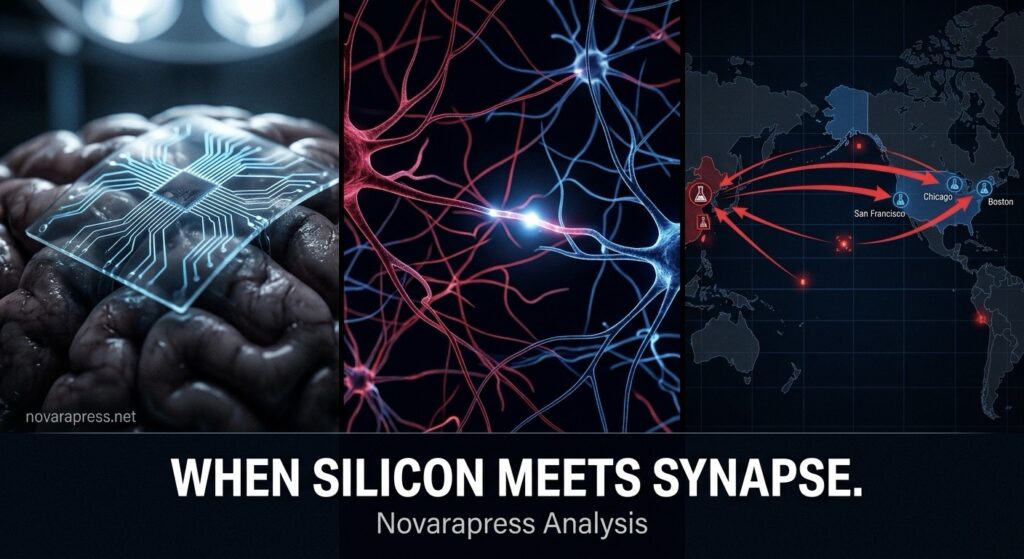
WHEN SILICON MEETS SYNAPSE: THE PRINTED NEURON BREAKTHROUGH THAT CHANGES EVERYTHING
Northwestern University’s artificial neurons just spoke to living brain cells — and the brain answered. This is not a laboratory curiosity. It is the opening shot in the most consequential technological race of the century.
SHADOWNET DESK | Novarapress Analysis | April 22, 2026
SECTION 01 — THE SIGNAL THAT CHANGED THE EQUATION
On April 15, 2026, a team of engineers at Northwestern University published findings in Nature Nanotechnology that collapsed the boundary between machine and brain. They printed artificial neurons from nanoscale flakes of molybdenum disulfide and graphene onto flexible polymer substrates — and those neurons, when placed against slices of living mouse cerebellum, triggered real biological responses. Not approximations. Not noise. Precise, timed, biologically coherent responses. The living tissue answered.
This is not a headline to be buried between stock reports and semiconductor earnings calls. Every major power in the world — the United States, China, and the European bloc — has been pouring billions into brain-machine interface research for years. The assumption was that meaningful brain-electronics integration was a problem for the 2030s. Northwestern’s Mark C. Hersam and his team just moved the clock forward by half a decade.
The implications cut across four strategic domains simultaneously: artificial intelligence architecture, military human augmentation, neuroprosthetics as a healthcare industry, and the raw geopolitics of who controls the first commercially deployable brain-interface platform. Any government still treating this as a science story is already behind.
“The brain is five orders of magnitude more energy-efficient than a digital computer. When you can print that efficiency onto a polymer and have it talk to living tissue — the architecture of everything changes.”
— Prof. Mark C. Hersam, Northwestern University, Nature Nanotechnology, 2026
SECTION 02 — WHAT THEY ACTUALLY BUILT, AND WHY IT WORKS
Every previous attempt at an artificial neuron ran into the same wall: biological realism. Earlier devices produced simplified electrical pulses — basic on/off spikes that approximated neural firing without capturing its complexity. The brain does not communicate in binary. It communicates in rhythms: single spikes, sustained firing patterns, burst sequences that encode context, urgency, and modulation all at once. Simulating that complexity using rigid silicon required enormous arrays of devices, which meant enormous energy consumption. The efficiency gain vanished before it could be harvested.
Hersam’s team broke the problem from a materials angle. The electronic ink — composed of nanoscale molybdenum disulfide (MoS₂) flakes acting as semiconductor and graphene acting as conductor — behaves differently from rigid silicon. When deposited by aerosol jet printing onto flexible polymer, the ink’s stabilizing polymer was not burned away as previous researchers had done. Instead, it was retained. That retained polymer creates a narrow, localized conduction pathway that generates a sudden, neuron-like threshold response. The device becomes a memristive spiking neuron — one that can produce single spikes, continuous firing, and burst patterns from a single compact unit.
| Parameter | Previous Artificial Neurons | Northwestern MoS₂ Neuron |
|---|---|---|
| Signal fidelity | Single simplified spike | Multi-order: spikes, bursts, continuous |
| Material substrate | Rigid silicon / metal oxide | Flexible polymer + graphene ink |
| Biological response | No confirmed live tissue activation | Confirmed: mouse cerebellum activation |
| Energy efficiency vs digital CPU | Marginal gain | Pathway to 5-orders-of-magnitude improvement |
| Fabrication cost | High — silicon fab required | Low — printable, scalable |
The test that validated everything came when Hersam’s team collaborated with neurobiology professor Indira M. Raman, feeding artificial voltage spikes into slices of mouse cerebellum. The spikes matched biological neurons in both timing and waveform shape. The living tissue fired back. Not randomly — it activated neural circuits in the same structured patterns that natural signals would have triggered. The bridge held.
“We are within a temporal range that was not previously demonstrated for artificial neurons. You can see the living neurons respond to our artificial neuron.”
— Prof. Mark C. Hersam, Northwestern University
SECTION 03 — THE AI ENERGY CRISIS AND WHY THIS IS THE SOLUTION EVERYONE IS CHASING
The timing of this breakthrough is not incidental. The global AI industry is grinding toward a power consumption crisis that no solar farm or gas turbine will resolve on schedule. The largest language models require training runs that consume hundreds of gigawatt-hours per cycle. Inference — simply running the models — is now demanding dedicated nuclear reactor contracts. Microsoft, Amazon, and Google have all signed or announced agreements to bring dormant or new nuclear capacity online specifically to power data centers. This is not a sustainable trajectory. It is a brute-force solution to a fundamental architectural problem: silicon is not the right substrate for intelligent computation at scale.
The human brain runs its entire operation on approximately 20 watts. A high-end GPU cluster running a comparable inference workload burns megawatts. The gap is not a matter of optimization — it is a gap of five orders of magnitude, rooted in how computation is physically structured. Biological neural tissue uses sparse, asynchronous, analog signaling. Silicon uses dense, synchronous, digital switching. Neuromorphic computing — hardware that mimics neural architecture — has been the theoretical answer for thirty years. The persistent problem has been that no artificial neuron could produce signals complex enough to operate at the precision biological systems demand. Until now.
Northwestern’s MoS₂ spiking neuron does not just reduce component count — it demonstrates that a single printed device can encode the information complexity that previously required networks of dozens. That is a direct attack on the energy scaling problem. The path from this proof-of-concept to a manufacturable neuromorphic chip is not short, but the critical variable — biological signal fidelity — has been validated. The gate is open.
SECTION 04 — THE MILITARY AND INTELLIGENCE DIMENSION
The U.S. Government Accountability Office published its second periodic emerging technology report on April 2, 2026 — two weeks before the Northwestern paper dropped. It listed neural implants for human augmentation as one of three transformative technology vectors on the ten-year horizon, specifically noting the potential for direct brain-to-brain communication, accelerated learning, and hands-free computer control in operational contexts. The GAO report also flagged the privacy and security risks of neural implants in plain language. The juxtaposition of timing is notable: the policy framework is arriving precisely as the technical capability makes its first confirmed leap.
DARPA’s neural interface programs have operated under varying classification levels for over a decade. The N3 program — Non-Invasive Neural Interfaces — aimed to create read/write interfaces without surgical implantation. Those efforts have been constrained by the same signal fidelity problem Northwestern just cracked. The ability to generate biologically compatible electrical signals from a flexible, printable, low-cost substrate is precisely the capability gap that has kept non-invasive brain-computer interfaces in the prototype stage. A soldier wearing a lightweight flexible neural band that can transmit command signals with biological precision is no longer a science fiction scenario — it is a development program waiting for this exact materials proof-of-concept.
China’s position in this race is not speculative. Beijing has invested heavily in Brain-Computer Interface research under its national science and technology programs, including through the Chinese Academy of Sciences’ Institute of Neuroscience in Shanghai. Chinese researchers have published extensively in neuromorphic computing and soft bioelectronics. The Northwestern breakthrough is published open-access in Nature Nanotechnology — Beijing’s research teams have the paper. The race to translate this materials approach into a deployable system is now fully active on both sides.
The soldier who can interface with a battlefield AI system at the speed of thought — not the speed of voice command or hand gesture — holds a reaction-time advantage that no conventional training can neutralize.
SECTION 05 — NEUROPROSTHETICS AND THE HUMANITARIAN SURFACE
The most immediate and publicly defensible application domain is neuroprosthetics. Cochlear implants, retinal prosthetics, and motor cortex interfaces for paralyzed patients all share the same engineering constraint: the interface between the electronic device and the biological nerve must be biocompatible, precise, and durable. Current clinical devices use rigid electrode arrays that cause scarring and signal degradation over months of implantation. The brain’s tissue is soft, three-dimensional, and dynamic. Rigid electrodes are a foreign body the brain’s immune response works to isolate.
Northwestern’s flexible polymer substrate changes the mechanical equation. A device that can conform to tissue contours, generate biologically accurate signals, and be manufactured at low cost eliminates three simultaneous barriers to clinical deployment. Improved hearing implants, restored vision for patients with degenerative retinal conditions, movement recovery for spinal injury patients — all of these become substantially more achievable when the interface between the device and the nerve is no longer a source of biological rejection and signal distortion.
The global neuroprosthetics market was valued at approximately $12 billion in 2024 and is projected to exceed $22 billion by 2030. Northwestern’s approach, if it scales, does not merely compete in that market — it restructures the cost and performance baseline. That creates an immediate commercial incentive that runs parallel to the military application race and the neuromorphic computing race. Three separate industrial ecosystems now have strategic interest in translating this materials breakthrough into products.
SECTION 06 — STRATEGIC PROJECTIONS: THREE TRAJECTORIES
▮ SCENARIO A — LIKELY (2026–2030)
Staged Clinical Translation + Neuromorphic Hardware Race
Northwestern’s MoS₂ platform attracts significant DARPA and NIH funding within 12–18 months. A commercial neuroprosthetics partnership forms with a major medical device firm. Simultaneously, chip manufacturers begin licensing the materials approach for neuromorphic computing R&D. China accelerates its own soft-materials BCI program in direct response. The competitive dynamic mirrors the early semiconductor race — parallel development, no clear governance framework, and escalating defense-adjacent investment on both sides. No human trials within this window, but animal model trials across three species by 2028.
▮ SCENARIO B — CONTINGENCY (2027–2031)
Accelerated Military Deployment Ahead of Regulatory Framework
Under persistent geopolitical pressure — particularly following any escalation in the Taiwan Strait or renewed pressure on US cyber dominance — DARPA fast-tracks a classified derivative of the Northwestern platform under existing military research exemptions. The result: the first neural-augmented operational capability reaches field testing before any regulatory body has defined the legal status of a soldier with a brain interface. The GAO’s April 2026 warnings about privacy and security of neural implants prove prescient but insufficiently actionable. An allied nation — likely South Korea or Israel — deploys a non-invasive BCI-assisted targeting system within the same window, forcing the US hand on doctrine.
▮ SCENARIO C — WORST CASE (2028+)
Asymmetric Neural Exploitation and the Weaponization of Interface Vulnerabilities
The same property that makes the MoS₂ artificial neuron valuable — its ability to activate living neurons with external electrical signals — is also the property that defines its attack surface. A device that can trigger neural circuits can, in principle, be used to disrupt them. As brain-interface devices proliferate in medical and military contexts, state-sponsored actors develop the capability to identify, locate, and interfere with implanted or wearable neural devices. The first confirmed neural-interface cyberattack does not affect a soldier — it affects a medical patient. The legal and political fallout triggers emergency legislation that overreacts by banning entire technology categories, halting legitimate research for years. Meanwhile, non-signatory states continue development unconstrained.
SECTION 07 — THE GOVERNANCE GAP AND THE CLOCK RUNNING OUT
There is no international treaty governing neural interface technology. There is no WHO framework for brain-computer interface safety standards. There is no agreed definition, in any legal jurisdiction, of what constitutes a violation of neural integrity under international humanitarian law. The GAO’s April 2026 report identifies this gap in policy terms. The Northwestern paper opens it wide in technical terms.
The precedent from genomic technology is instructive and grim. CRISPR gene editing was published in 2012. The first edited human babies were born in 2018 — six years, before any governance consensus had formed, before any international agreement existed, before the scientific community had finished debating whether the capability was ready. The researcher involved, He Jiankui, operated in a regulatory vacuum that the scientific establishment created by moving faster than its own ethical frameworks. Neural interface technology is structurally identical: a powerful, dual-use, biologically intimate capability with a market incentive on one side, a military incentive on the other, and a governance architecture that does not yet exist.
The question of who owns the data generated by a brain-interface device — the thoughts, intentions, and neural patterns captured during operation — has no settled legal answer anywhere in the world. Scientific American’s 2026 editorial agenda explicitly flags comprehensive data privacy legislation as an urgent priority, noting that existing state-level patchworks are insufficient for managing the rights of users whose health-metric devices are recording increasingly granular biological data. Extend that problem to a device reading neural signals and the inadequacy of current frameworks becomes immediately obvious.
Who owns the signal between your neurons and the machine that reads them? Right now, nobody knows. That is the most dangerous sentence in emerging technology today.
SHADOWNET ASSESSMENT
The Northwestern printed-neuron breakthrough is not a medical footnote. It is a strategic event. In a single publication, it advances three simultaneous races: the neuromorphic computing competition, the military human-augmentation program, and the neuroprosthetics commercial market. It does so with a materials approach that is printable, flexible, and low-cost — meaning it does not require the industrial infrastructure that has historically bottlenecked advanced hardware development.
The governance gap is not a future problem. It is a current one. Every month that passes without a legal definition of neural data ownership, without an international framework for dual-use brain-interface research, and without agreed norms for military BCI deployment is a month that bad actors — state and corporate — accumulate structural advantage.
The brain answered the machine’s signal on April 15, 2026. The world has not yet answered back.
Analysis by SHADOWNET DESK. All assessments represent analytical inference based on open-source intelligence and published scientific literature. This article does not represent the editorial positions of any government body or affiliated institution.
SOURCES
- Hadke, S. S., et al. “Printed MoS₂ memristive nanosheet networks for spiking neurons with multi-order complexity.” Nature Nanotechnology, April 15, 2026. DOI: 10.1038/s41565-026-02149-6
- Northwestern University News. “Printed neurons communicate with living brain cells.” Northwestern Now, April 15, 2026. news.northwestern.edu
- ScienceDaily. “Artificial neurons successfully communicate with living brain cells.” April 18, 2026. sciencedaily.com
- McCormick School of Engineering, Northwestern University. “Printed Neurons Communicate with Living Brain Cells.” Northwestern Engineering News, April 2026. mccormick.northwestern.edu
- TechXplore. “Printed neurons communicate with living brain cells.” April 15, 2026. techxplore.com
- Singularity Hub. “Printed Neurons That Mimic Brain Cells Could Slash AI’s Energy Bill.” April 20, 2026. singularityhub.com
- U.S. Government Accountability Office. “On the Horizon: Three Science and Technology Trends That Could Affect Society.” GAO-26-108079, April 2, 2026. gao.gov
- MIT Technology Review. “10 Breakthrough Technologies 2026.” January 12, 2026. technologyreview.com
- Scientific American. “Science Carries On: Our Top Topics for 2026.” December 16, 2025. scientificamerican.com
- Nature. “From quantum computing to mRNA therapeutics: seven technologies to watch in 2026.” January 21, 2026. nature.com
- CAS Science Team. “Scientific breakthroughs: 2026 emerging trends to watch.” March 5, 2026. cas.org
© 2026 Novarapress Analysis — novarapress.net
SHADOWNET DESK