
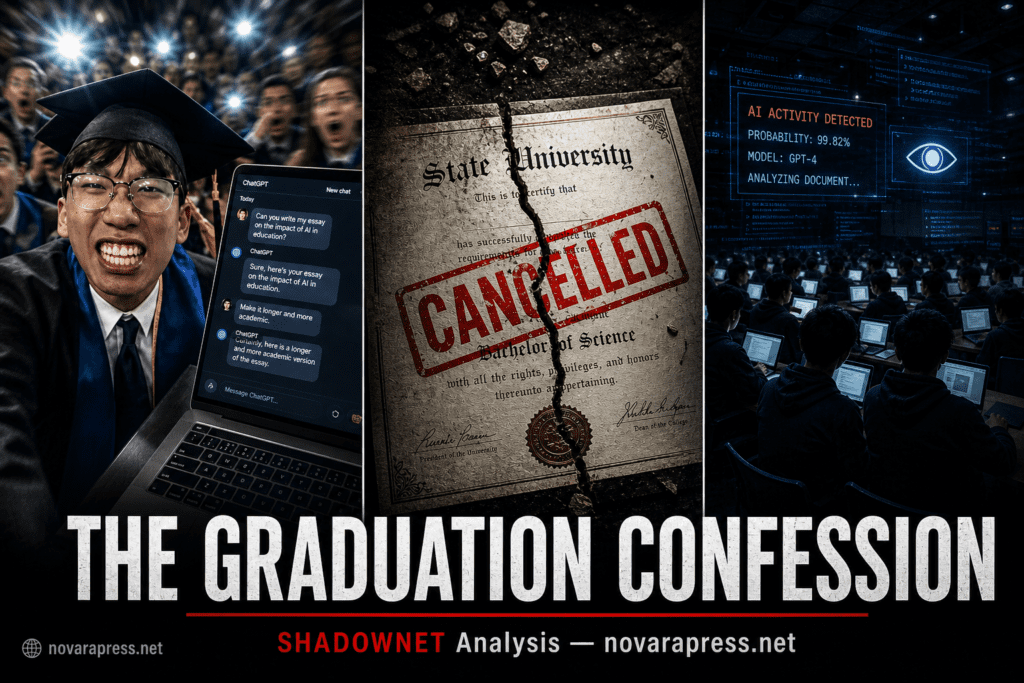
The Graduation Confession: How AI Cheating Became the Silent Crisis Reshaping Global Education
A student’s viral moment at a graduation ceremony exposed what academic institutions have spent years trying to deny — the AI cheating epidemic is not coming. It is already here.
The Moment That Could Not Be Unseen
It lasted less than thirty seconds. A graduating student, caught in the celebratory chaos of a commencement ceremony, held his phone toward a camera — his ChatGPT conversation history visible on screen. The thread was unmistakable: exam questions fed directly into the AI, responses copied wholesale into answer sheets. Two hours later, the degree was cancelled. By the following morning, the clip had circled the globe. What the moment captured was not a single student’s recklessness. It was an accidental audit of a system under profound stress.
The student almost certainly believed he was celebrating. The gesture — phone up, history visible — read more like pride than confession. That detail matters. It suggests a generational gap not merely in technology use but in moral framing: for a significant cohort of current students, leveraging AI on assessments does not register as cheating. It registers as competence.
The institutional response was swift and severe. The degree cancellation followed published policy. But the punishment could not erase the larger question it placed on the table: how many students in that same auditorium had done exactly the same thing — and simply kept their phones in their pockets?
| METRIC | DATA POINT | SOURCE |
|---|---|---|
| Students admitting AI use on assessed work | 43% globally (2025) | ICAI / Turnitin Survey |
| Students who consider AI use “cheating” | Only 29% | Stanford Digital Education Lab, 2025 |
| Increase in academic misconduct cases (2022–2025) | +312% | UK Office for Students |
| AI-generated submissions detected by Turnitin (2024) | 22 million documents | Turnitin Annual Report |
| Estimated undetected AI submissions | 3–5× detected volume | MIT Academic Integrity Lab, 2025 |
How Many Are Still Hidden
The viral clip functions as a data point in a much larger dataset that institutions are only beginning to assemble. The International Center for Academic Integrity estimated in its 2025 benchmark study that roughly one in four students had submitted AI-generated content as their own work at least once during the preceding academic year. That figure, already alarming, is almost certainly an undercount. Survey-based data on misconduct systematically underrepresents behavior that carries social stigma — and for much of the student population, AI use carries no stigma at all.
Detection technologies have advanced, but they remain structurally outpaced. Turnitin’s AI detection engine, deployed across thousands of institutions, carries a documented false positive rate of approximately 4 percent — meaning that out of every hundred flagged submissions, four belong to students who did not cheat. At scale, across millions of assessments, this produces thousands of wrongful accusations annually. The inverse problem is worse: newer AI models, particularly those using paraphrasing layers or post-processing tools, routinely evade existing detectors. The tool and the countermeasure are locked in an arms race that the tool is currently winning.
Geography complicates the picture further. In institutions across South and Southeast Asia, sub-Saharan Africa, and parts of Latin America, where access to tutors and academic support infrastructure is unequal, AI tools have been adopted not as shortcuts but as equalizers. Students in these contexts frequently describe ChatGPT or similar tools as the only reliable academic support available to them. That framing does not make unauthorized use permissible under institutional rules. But it reveals that the misconduct conversation, as framed by elite Western universities, is missing a significant portion of its own subject matter.
| REGION | AI ACADEMIC USE RATE | PRIMARY DRIVER |
|---|---|---|
| North America | 41% | Convenience / GPA pressure |
| Western Europe | 38% | Workload / language barriers |
| South & Southeast Asia | 57% | Support access / cost savings |
| Sub-Saharan Africa | 61% | Infrastructure gap |
| MENA Region | 49% | Competitive employment markets |
Why Students Cross the Line — and Why the Line Keeps Moving
Explaining the AI cheating surge requires engaging with the structural conditions that produced it. Three forces operate in combination. The first is assessment design that has not kept pace with technological change. When a professor assigns a 1,500-word analytical essay with a two-week deadline, submits it to a general-purpose plagiarism checker, and grades primarily on surface-level argument construction, the assessment was not designed for an era in which sophisticated language models can produce plausible academic prose in under thirty seconds. The flaw precedes the student’s decision.
The second force is credential inflation combined with employment precarity. In labor markets where a degree is a minimum entry requirement but no longer a differentiating signal, GPA becomes the only lever students can control. The pressure to perform academically has intensified precisely as the intrinsic meaning of academic performance has been diluted. Students who cheat are not, in most cases, lazy. They are frequently operating under financial stress, working part-time jobs, managing mental health challenges without adequate institutional support, and calculating that the risk of detection is lower than the cost of failure.
The third force is definitional ambiguity. No coherent global standard exists for what constitutes permissible AI assistance. Using an AI to brainstorm an essay outline: permitted or prohibited? Having an AI check grammar: acceptable. Asking an AI to rephrase paragraphs: grey zone. Asking an AI to write paragraphs with minimal editing: misconduct. The boundaries are drawn differently by each institution, each department, and often each individual instructor — and students know it. Ambiguity functions as permission.
The Detection Problem: An Arms Race With No Clear Winner
Current detection infrastructure rests on three pillars, each carrying structural weaknesses. Automated AI detectors — Turnitin, GPTZero, Copyleaks — analyze sentence construction patterns, perplexity scores, and burstiness metrics to flag likely AI-generated text. They work reasonably well against unmodified AI output. Against output that has been paraphrased, translated, or processed through humanization tools, detection rates fall sharply. One 2025 peer-reviewed study found that paraphrasing AI output through a secondary tool reduced detection accuracy from 86 percent to below 40 percent.
Oral examination as a verification mechanism is gaining traction as a response, but it scales poorly. Requiring students to defend submitted work in a brief oral interrogation can rapidly distinguish genuine understanding from borrowed text — but most institutions lack the staffing or scheduling infrastructure to apply this at scale across hundreds of assessments per semester.
Behavioral biometric tracking — logging keystroke patterns, mouse movement, and writing cadence during assessments — represents the most technically promising detection pathway but raises serious data privacy objections under GDPR and equivalent frameworks. Several European institutions that piloted these systems in 2024 faced legal challenges before full deployment.
Four Trajectories: What Happens Next
The graduation ceremony incident is a pressure point, not an endpoint. Institutional responses will diverge across four plausible trajectories over the next 36 months.
“`
Leading universities pivot to process-based assessment — portfolio submissions, documented research trails, oral defenses, project-based learning. AI use is permitted and logged. The credential reflects not what a student produced but how they think. Technically demanding and costly to implement. Viable only where institutional will and budget align.
Institutions invest heavily in proctoring technology and behavioral biometrics. AI detectors are mandated. Penalties increase. The arms race intensifies, producing a compliance culture in which students focus on evading detection rather than engaging with learning. Inequality deepens as well-resourced students access superior circumvention tools. High systemic cost, low educational benefit.
Institutional inaction or inadequate response allows AI-generated credentials to proliferate unchecked. Employers, aware of the problem, shift hiring toward skills-based assessments, portfolio reviews, and direct competency testing. The degree devalues not through policy but through market signal failure. Already visible in technology sector hiring trends in the United States and United Kingdom.
Governments respond to credential integrity concerns with legislative frameworks mandating AI disclosure on academic work, standardized assessment protocols, and liability frameworks for institutions that fail to uphold academic standards. Already foreshadowed in proposed EU Digital Education legislation and UK Higher Education regulatory review. Blunt instrument with significant unintended consequences.
“`
Building Students Who Do Not Need to Cheat
The most durable response to AI-driven academic misconduct is not better detection. It is assessment design that makes the shortcut irrelevant. When a final exam requires a student to analyze a primary source they have not seen before, defend a methodology under questioning from two examiners, or demonstrate a laboratory skill in real time, ChatGPT becomes structurally useless. The investment required is in human time and institutional infrastructure — neither of which is cheap, but both of which produce educational outcomes that detection technology cannot.
AI literacy as a formal curricular requirement addresses the definitional ambiguity problem directly. Teaching students explicitly where the line sits — not through vague honor code language but through practical case studies, worked examples, and clear institutional policy — reduces the grey zone that functions as permission. Institutions that have implemented explicit AI use policies with graduated guidance, rather than blanket prohibitions, report higher rates of transparent AI disclosure and lower rates of concealed use.
The case for integrating AI as a learning tool rather than treating it as an adversarial technology is gaining traction among educators who argue that the prohibition instinct misses the actual challenge. In professional life, every graduate will be expected to work effectively alongside AI systems. An education that produces graduates with no developed capacity for AI collaboration is producing graduates misaligned with the labor market they are entering. The goal is not to keep AI out of education. The goal is to build students who bring something to the table that AI cannot replicate: judgment, ethics, contextual reasoning, and the willingness to stake their name on a conclusion.
The graduation ceremony incident will be forgotten by the news cycle within weeks. The structural conditions it exposed will not disappear with it. Forty-three percent of students globally have used AI on assessed work. Three to five times that number have done so without being caught. Every one of those students will graduate, enter a profession, and carry the gap between their certified competence and their actual competence into workplaces, hospitals, courtrooms, and engineering projects. That gap is not an academic integrity problem anymore. It is a public safety variable.
The AI cheating crisis is a symptoms story. The disease is an education system that was never designed to produce independent thinkers — only credentialed ones. Until assessment architecture changes to reward process, judgment, and real-world competency over reproducible written output, every new generation of AI tools will find a student population ready to use them. The graduation ceremony will keep producing confessions. Most of them will stay in the pocket.
Academic Integrity
ChatGPT Cheating
Higher Education
Technology Ethics
Credential Crisis
- International Center for Academic Integrity — Academic Integrity Benchmark Report 2025
- Turnitin — AI Writing Detection Annual Report 2024, turnitin.com
- Stanford Digital Education Lab — Student Perceptions of AI Academic Assistance, 2025
- UK Office for Students — Academic Misconduct Trends in Higher Education 2022–2025
- MIT Academic Integrity Lab — Detection Gaps and Undetected AI Submission Estimates, 2025
- Chalmers, S. et al. — Paraphrasing and AI Detection Evasion, Journal of Educational Technology, Vol. 44, 2025
- Torres, M. — Assessment Architecture for the Post-GPT University, Columbia University Press, 2025
- European Commission — Draft Digital Education Act: Academic Integrity Provisions, 2026