
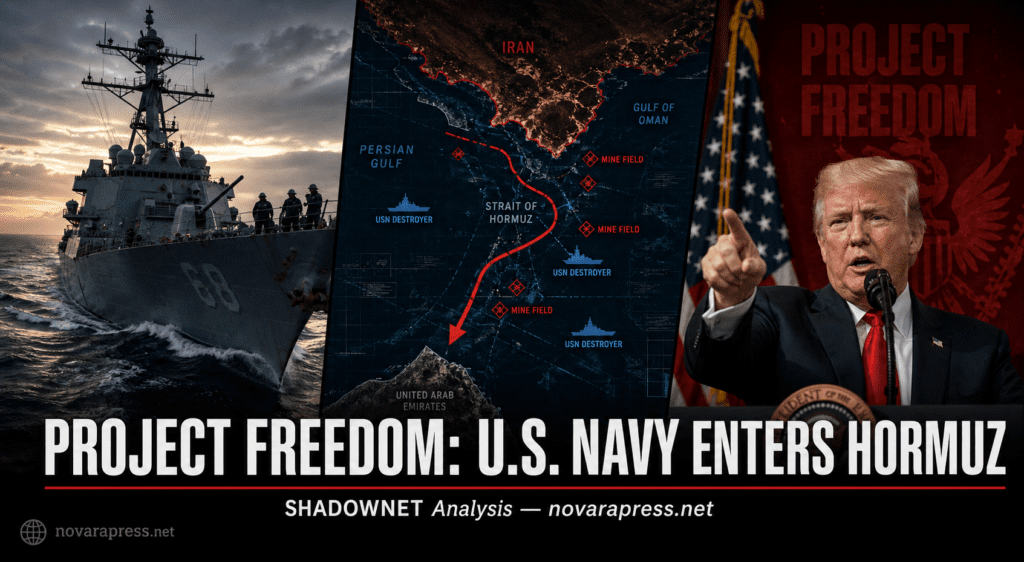
Project Freedom: Trump Orders U.S. Navy Into the Strait of Hormuz — Forcing a Confrontation Tehran Cannot Ignore
With 20,000 seafarers stranded and global oil prices at a 15-year high, Trump’s Monday escort operation marks the most direct U.S. military challenge to Iran’s Hormuz blockade since the war began — and forces Tehran into an impossible choice.
Trump Pulls the Trigger: “Project Freedom” Begins Monday
I
t is Sunday, May 3, 2026. President Donald Trump posts to Truth Social. Within minutes, every naval operations center in the Persian Gulf region lights up. The message is unambiguous: the United States Navy will begin escorting foreign vessels through the Strait of Hormuz — by force if necessary — starting Monday morning, Middle East time. Trump has named the operation Project Freedom.
The announcement lands at the most combustible moment of the three-month-old conflict. Iran has controlled passage through the strait since February 28, 2026, the day U.S. and Israeli forces launched their air campaign and Tehran responded by shutting the world’s most critical oil chokepoint. Since then, the standoff has produced a dual blockade: Iran enforcing control over Hormuz from its side; the United States blockading Iranian ports from the sea. And in the middle of that gridlock sit approximately 20,000 seafarers — stranded, running low on supplies, waiting for a war they had no part in to resolve.
“Countries from all over the World, almost all of which are not involved in the Middle Eastern dispute going on so visibly, and violently, for all to see, have asked the United States if we could help free up their Ships, which are locked up in the Strait of Hormuz — They are merely neutral and innocent bystanders!”
— President Donald Trump, Truth Social, May 3, 2026
The framing is deliberate. Trump is not, at least rhetorically, declaring a push to reopen the strait for U.S. commercial interests. He is casting the operation as a rescue mission — humanitarian cover for what is, in operational terms, the most direct challenge his administration has made to Tehran’s blockade authority since the war began. The word “forcefully” appears only once in his Truth Social post. But it is the only word that matters in Tehran.
Trump’s Words, Verbatim: What the Statement Actually Says
The Truth Social post — reproduced in full below across its key passages — contains four distinct message layers that must be read separately to understand the administration’s full strategic posture.
“Countries from all over the World, almost all of which are not involved in the Middle Eastern dispute going on so visibly, and violently, for all to see, have asked the United States if we could help free up their Ships, which are locked up in the Strait of Hormuz, on something which they have absolutely nothing to do with — They are merely neutral and innocent bystanders!”
“For the good of Iran, the Middle East, and the United States, we have told these Countries that we will guide their Ships safely out of these restricted Waterways, so that they can freely and ably get on with their business.”
“I have told my Representatives to inform them that we will use our best efforts to get their Ships and Crews safely out of the Strait. In all cases, they said they will not be returning until the area becomes safe for navigation and everything else.”
“This process, Project Freedom, will begin Monday morning, Middle East time.”
“I am fully aware that my Representatives are having very positive discussions with the Country of Iran, and that these discussions could lead to something very positive for all.”
“The Ship movement is merely meant to free up people, companies, and Countries that have done absolutely nothing wrong — They are victims of circumstance. This is a Humanitarian gesture on behalf of the United States, Middle Eastern Countries but, in particular, the Country of Iran.”
“Many of these Ships are running low on food, and everything else necessary for large-scale crews to stay on board in a healthy and sanitary manner.”
“If, in any way, this Humanitarian process is interfered with, that interference will, unfortunately, have to be dealt with forcefully.”
The four layers: (1) a humanitarian justification built around neutral third-party nations; (2) an assertion that the operation benefits Iran itself — a rhetorical device designed to strip Tehran of a moral counter-narrative; (3) an explicit acknowledgment that peace talks are ongoing, signaling this is leverage, not an end-game military move; and (4) a direct threat of force against interference, delivered inside the language of a mercy mission.
The Numbers Behind the Crisis: What the Strait Looks Like Right Now
Before Project Freedom can be evaluated as strategy, the physical reality of the Strait of Hormuz crisis needs to be understood in full. The numbers, assembled from CENTCOM, the UK Royal Navy, the International Chamber of Shipping, and market data, paint a picture of compounding damage that grows more severe every day the waterway remains effectively closed.
The humanitarian case Trump is invoking is real. Captain Istique Alam, who commands an Emirati oil tanker stranded off the coast of Oman for over two months, told CNN’s Isobel Yeung: “Ceasefire is not for seafarers. Ceasefire is for normal people.” The ceasefire between U.S. and Iranian forces, in place since early April, has done nothing to relieve the maritime gridlock. Ships from countries that have no stake in the conflict — their crews slowly exhausting food supplies, their owners hemorrhaging money — are caught in a war they never signed up for.
Iran’s Answer: Any Escort Is a Ceasefire Violation
Tehran’s response to Project Freedom came swiftly and in multiple registers. Officially, Iranian authorities warned that any U.S. military escort operation inside the strait would constitute a violation of the ceasefire — a framing that hands Iran a diplomatic justification for whatever response it chooses to deploy.
“Tehran will not back down from our position on the Strait of Hormuz, and it will not return to its prewar conditions.”
— Ali Nikzad, Deputy Speaker, Iranian Parliament, May 3, 2026
That statement from Deputy Parliament Speaker Ali Nikzad is not diplomatic noise. It is a structural position: Iran is not merely protesting this specific operation, it is asserting that any return to pre-war Hormuz conditions — open, uncontrolled passage — is off the table as a unilateral concession. The strait, in Tehran’s calculus, is now a permanent bargaining chip. It will only reopen as part of a comprehensive settlement, not as a goodwill gesture.
Negar Mortazavi, a senior fellow at the Center for International Policy, summarized the Iranian read of the operation precisely: Washington’s escort mission, however humanitarian its framing, will not be received as such in Tehran. From the IRGC’s operational perspective, a U.S. Navy warship guiding a commercial vessel through the Strait of Hormuz is a direct contest of the blockade authority Iran has staked enormous political capital defending.
At the same time, Iranian Foreign Ministry spokesperson Esmaeil Baghaei confirmed that Tehran received the U.S. response to its latest peace proposal — transmitted via Pakistan — and is reviewing Washington’s reply. The diplomatic channel is alive. Project Freedom is being launched simultaneously with active negotiations, a combination that is either masterful pressure or a recipe for accident.
Anatomy of the Dual Blockade: How the Standoff Was Built
Understanding Project Freedom requires understanding the layered standoff that preceded it. The current situation did not emerge from a single decision — it is the product of escalation steps stretching back to the first days of the war.
February 28: The U.S.-Israeli air campaign begins. Iran closes the Strait of Hormuz. The IRGC forbids passage, boards vessels, and begins laying sea mines — a move the Joint Chiefs had warned Trump about before the strikes began. Trump had dismissed the possibility, reportedly telling advisers that Iran would capitulate rather than close the strait. They were wrong on the timing; he had to recalibrate.
March–April: Iran begins selectively permitting passage for ships from “friendly” nations — China, Russia, India, Iraq, Pakistan — while blocking Western-affiliated vessels. It charges transit tolls exceeding $1 million per ship for others, directly violating international freedom of navigation law. The U.S. warns shipping companies they face sanctions for paying those tolls.
April 8: A temporary ceasefire is agreed. Iran announces Hormuz will be open to commercial shipping during the truce. The announcement proves largely nominal — Iran maintains control, attacks continue, tolls are still enforced.
April 13: After the Islamabad talks collapse, Trump declares a U.S. naval blockade of Iranian ports. CENTCOM clarifies the blockade applies to Iranian coastal shipping, not freedom of navigation through Hormuz itself. A “dual blockade” is now in effect: each side is choking the other. In 20 days, 49 Iranian commercial vessels have been turned away by U.S. naval forces.
May 3: Trump announces Project Freedom. The first U.S.-escorted convoy will enter the strait on Monday. The dual blockade now has a third variable: a direct U.S. military presence inside the zone Iran has claimed as its own.
Why Monday. Why Now. The Pressure Points Trump Is Pulling
The timing of Project Freedom is not incidental. Multiple converging pressures have narrowed the window in which Trump can act without congressional interference and with maximum leverage over Tehran.
First, the War Powers Act clock. The 60-day limit on unauthorized military force is in active dispute. Trump told congressional leaders on Friday that “hostilities” with Iran have “terminated,” citing the ceasefire. His administration’s position is that the clock stopped when direct fire exchanges ended on April 7. Democrats and several Republicans disagree. Launching Project Freedom now — framed as a humanitarian escort, not a combat operation — strengthens the administration’s claim that no new authorization is required.
Second, domestic economic pain. Gas at $4.45 per gallon — up 50 percent since February 28 — is generating measurable political drag. Trump’s approval ratings have reached new lows in recent weeks, with polls showing energy costs are the primary driver of public discontent with the war. An operation framed as rescuing stranded crews and resuming trade flows gives the administration a visible deliverable that addresses the economic narrative directly.
Third, the Iranian proposal. Iran has submitted a 14-point framework for ending the war. Its three-stage structure calls for: a permanent ceasefire within 30 days, a mutual non-aggression pledge covering the U.S., Iran, Israel, and regional actors, and a gradual reopening of Hormuz tied to a phased lifting of the U.S. naval blockade on Iranian ports. Tehran is simultaneously reviewing Washington’s counter-draft, transmitted via Pakistan. Both sides are negotiating. Project Freedom, launched into that negotiating space, functions as maximum-pressure leverage — proof that the U.S. will not wait indefinitely for a diplomatic solution while Iran’s economy is cushioned by toll revenue and its political position on the strait remains unchallenged.
“If, in any way, this Humanitarian process is interfered with, that interference will, unfortunately, have to be dealt with forcefully.”
— President Donald Trump, Truth Social, May 3, 2026
The phrase “unfortunately, have to be dealt with forcefully” is Trump’s characteristic construction for a military threat he wants to issue while preserving deniability about intent. It signals willingness to escalate while leaving the rhetorical door open to claim the other side forced his hand. The IRGC Naval Command has already stated that any military vessel entering the strait area would be considered a ceasefire violation meeting a “severe response.”
That is not a rhetorical position. It is an operational standing order. What happens when a U.S. destroyer enters those waters on Monday morning is the question that no analyst can answer with confidence.
The Four-Scenario Matrix: What Happens After Monday Morning
Project Freedom creates a binary decision point for Tehran: allow the convoy to pass, or contest it. Each path branches into further sub-scenarios depending on the status of negotiations. Here is the forward matrix as it currently stands:
Tehran allows the U.S.-escorted convoy to transit without incident — interpreting the operation as a face-saving off-ramp given that the ships are officially from neutral nations. Peace negotiations accelerate. Iran’s “gradual reopening” framework becomes the basis for a deal. This is the scenario both sides’ diplomatic channels are quietly working toward. Probability: Moderate, conditional on back-channel coordination that has not been publicly confirmed.
IRGC naval units shadow the convoy, issue warnings, conduct close-approach maneuvers, or intercept non-escorted vessels in the vicinity. Tensions escalate without triggering the “forcefully” threshold. Both sides manage the confrontation through back channels. Negotiations continue but slow. This preserves Iranian political face domestically while avoiding full re-escalation. Most likely near-term scenario based on current posture.
An IRGC unit intercepts a vessel from the convoy — not the U.S. warship itself. A minor exchange occurs. The U.S. responds with a targeted, proportional strike on an IRGC naval asset. Iran retaliates against a Gulf state installation. Both sides step back from the brink. The ceasefire, which was already nominal, collapses formally. Negotiations freeze for weeks. Global oil prices spike sharply. Probability increases significantly if the convoy encounters Iran’s mine-cleared but still unstable corridor.
A miscalculation — a mine strike, a drone engagement, a command-level decision by IRGC hardliners acting without Rouhani-faction authorization — triggers a direct exchange between U.S. and Iranian naval forces. The ceasefire ends. Air operations resume. The strait becomes an active combat zone. Global energy markets enter a sustained shock phase. This is the outcome both sides’ diplomatic tracks are designed to prevent — but the history of the past 65 days shows how quickly unintended incidents occur in this waterway. Low probability on Day 1. Rising probability with each subsequent convoy run.
The Indicators That Will Tell You Which Scenario Is Unfolding
Analysts tracking Monday’s operation should watch the following real-time indicators in priority order:
1. UKMTO maritime reports from 06:00–10:00 Gulf time Monday. Any incident report from the Strait of Hormuz corridor — attack, interception, vessel stoppage — in that window will be the first signal of Iranian intent.
2. CENTCOM’s official confirmation or silence. If U.S. Central Command issues a statement confirming a successful first transit, that confirms Scenario A or B. Complete silence through Monday’s business hours suggests either a delay or an active incident being managed out of public view.
3. Iranian state media tone. IRNA and Press TV framing of the operation will indicate whether Tehran is treating it as a provocation requiring response or as a matter to be managed through diplomatic language. Aggressive early framing is a Scenario C/D indicator.
4. Global oil price movement by Monday afternoon New York time. Markets have priced in significant Hormuz risk. A calm transit will push prices down. Any incident will spike them within minutes. The market is, at this point, the fastest leading indicator available to the public.
5. Pakistan channel communications. Iran’s 14-point proposal is moving through Pakistani intermediaries. If Pakistan’s foreign ministry issues any statement about accelerated communications or requests for emergency consultations, that indicates back-channel coordination around Project Freedom is either working or breaking down.
Project Freedom is the most consequential U.S. military move in the Strait of Hormuz since the war began. It is also the most carefully worded. Trump has constructed a rhetorical frame that simultaneously positions the United States as humanitarian actor, maximum-pressure strategist, and willing combatant — all in a single Truth Social post. Whether that precision translates into operational reality on Monday morning depends on decisions being made right now inside IRGC naval command centers that no analyst outside Tehran can fully read.
The strait was closed by a war that wasn’t supposed to close it. It will reopen — the only question is whether Project Freedom is the mechanism that unlocks it, or the trigger that makes the next phase of the war inevitable.
SHADOWNET Analysis is produced by the editorial desk of novarapress.net. All source citations are listed below.
Strait of Hormuz
Project Freedom
Iran US War 2026
US Navy
Trump Iran
Oil Markets
IRGC
Persian Gulf
- Trump, Donald. Truth Social post announcing Project Freedom. May 3, 2026. Via Axios, Bloomberg, CNN.
- Axios: “Trump says U.S. Navy will escort ships out of the Strait of Hormuz from Monday.” May 3, 2026.
- Bloomberg: “Trump Says US to Help Some Ships Leave Hormuz Starting Monday.” May 3, 2026.
- CNN: “Live updates: Trump says US will start escorting ships through Strait of Hormuz.” May 3–4, 2026.
- Al Jazeera: “Trump says US will ‘help free up’ ships stuck in Hormuz Strait.” May 3, 2026.
- Associated Press / Washington Post: “Trump says the US will ‘guide’ stranded ships from the Strait of Hormuz.” May 3, 2026.
- Gulf News: “Trump announces Project Freedom — Iran ‘reviewing’ US response to 14-point proposal.” May 3, 2026.
- CBS News Live: “Iran war — Trump, Strait of Hormuz, Israel-Lebanon ceasefire.” May 3–4, 2026.
- Wikipedia: “2026 Strait of Hormuz Crisis.” Updated May 4, 2026.
- U.S. Central Command (CENTCOM): Official statements on blockade enforcement and Iranian ship interceptions, April–May 2026.
- UK Royal Navy / UKMTO: Maritime trade operations reports, Strait of Hormuz, February–May 2026.
- International Chamber of Shipping: Seafarer stranding estimates, May 2026.
- Nikzad, Ali. Statement on Iranian parliamentary position on Strait of Hormuz. May 3, 2026. Via AP.
- Mortazavi, Negar. Senior Fellow, Center for International Policy. Commentary on Project Freedom framing. Via Al Jazeera, May 3, 2026.