
NOVARAPRESS.NET
TWO YEARS OF WAR · APRIL 22, 2026
Sudan’s war is now in its third year. The Sudanese Armed Forces were written off by every analyst in April 2023. They weren’t. This is the story the Western press hasn’t told you — of an army that endured, a militia sustained by foreign gold, and the politicians who chose the wrong side of history.
|
April 22, 2026
|
15 min read
On April 15, 2023, Sudan woke up to the sound of explosions over Khartoum. By noon, the presidential palace was in militia hands. By evening, international media had written the obituary of the Sudanese state. The Rapid Support Forces — a paramilitary force born in the killing fields of Darfur — had struck the capital with stunning speed. Analysts gave the Sudanese Armed Forces weeks, perhaps days.
They were wrong. More than two years later, the SAF has recaptured Khartoum. It has broken a two-year siege of El-Obeid. It expelled militia fighters from Omdurman. It took back the oil refinery north of the capital. It restored the presidential palace. And it has done all of this while fighting not only a heavily armed paramilitary force — but also a sophisticated information war, a hostile political class, and a foreign supply chain that runs through luxury towers thousands of miles from any battlefield.
This is not the story most Western readers have been told. The dominant narrative — fed in large part by a network of exiled politicians with skin in the game — frames the war as a clash between two equivalent military monsters. That framing is not analysis. It is advocacy. And understanding who benefits from it is essential to understanding Sudan’s war.
SECTION 01
TWO YEARS, THREE PHASES: HOW LONG THIS WAR HAS LASTED AND WHAT IT COST
The war has now entered its third year. It began on April 15, 2023 — not by accident, but by design. The RSF launched simultaneous attacks on the Khartoum International Airport, the Republican Palace, and SAF military bases. The timing was chosen. The RSF’s leader, Mohamed Hamdan Dagalo — known as Hemedti — had been positioning his forces for months, infiltrating Khartoum’s residential neighborhoods and government districts under the guise of the political transition process.
The first phase, from April to December 2023, saw the RSF establish dominance over most of Khartoum, Omdurman, and large swaths of Darfur. The humanitarian toll was immediate and catastrophic. More than 12 million people were displaced in the conflict’s first two years — 9 million internally, and 3.5 million who fled the country as refugees, making it one of the largest displacement crises anywhere on earth.
The second phase, through 2024, was one of grinding attrition. The SAF, dismissed and underestimated, began rebuilding its command structure, securing external military support, and methodically degrading RSF supply lines. Civilian resistance networks — the Popular Resistance — emerged organically in every state the RSF entered, providing the SAF with intelligence and local coordination that no foreign briefing could replicate.
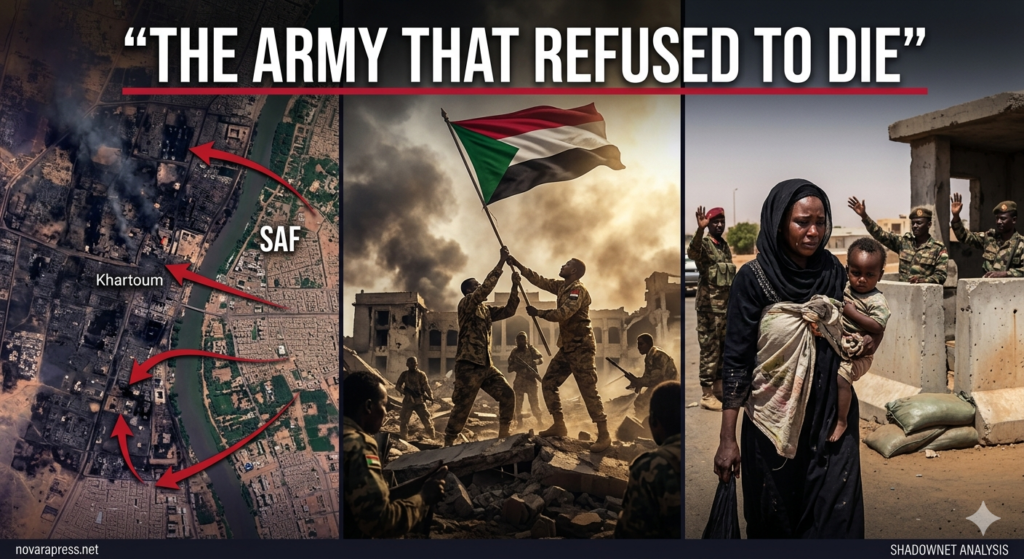
The third phase — 2025 — became the SAF’s year of reclamation. In January 2025, the SAF expelled RSF forces from Omdurman and recaptured a major oil refinery north of the capital. In February, it regained near-total control of Bahri, north of Khartoum, and broke the RSF’s two-year siege of El-Obeid. In March 2025, the SAF claimed victory after expelling RSF forces from most of Khartoum, including the airport and the presidential palace.
| Date | Milestone |
|---|---|
| Apr 15, 2023 | War begins. RSF strikes Khartoum airport, palace, and SAF bases simultaneously. |
| Jun 2023 | West Darfur governor Khamis Abakar assassinated — likely by RSF — after accusing them of genocide. |
| Jan 7, 2025 | U.S. formally designates RSF as having committed genocide. Sanctions imposed on Hemedti. |
| Jan 2025 | SAF recaptures Omdurman, Wad Madani (Gezira capital), and northern oil refinery. |
| Feb 2025 | SAF breaks two-year RSF siege of El-Obeid. RSF signs parallel “Sudan Founding Charter” in Nairobi with 23 political factions. |
| Mar 26, 2025 | SAF declares Khartoum liberated — presidential palace, airport, and government HQ restored. |
| Apr 15, 2025 | RSF declares rival “Government of Peace and Unity” in Nyala — backed by 23 political factions. |
SECTION 02
THE ARMY THAT REFUSED TO DIE: HOW THE SAF HELD AND RECOVERED
The SAF’s survival defied every early assessment. In April 2023, RSF fighters surrounded General Abdel Fattah al-Burhan’s own residence. His bodyguards fought back. One account from a surviving bodyguard described Burhan himself picking up a Kalashnikov and returning fire as RSF fighters stormed his home. Over 30 of his bodyguards were killed. He escaped. That story was not widely reported in the Western press. But it explains something about what kind of institution the SAF has proven itself to be under pressure.
What followed was a methodical, grinding campaign. The SAF relocated its command structure to Port Sudan, on the Red Sea coast — outside RSF reach. It consolidated logistics, secured airspace over the east, and began coordinating with tribal resistance movements, community fighters, and regular citizens who had picked up arms not out of ideology but out of a basic refusal to watch their homes burned and their daughters taken.
The SAF’s capture of the Republican Palace in March 2025 signaled a significant strategic and symbolic achievement. Along with taking control of the armed forces headquarters and substantial territory in Omdurman and Bahri, it is now widely seen as a turning point in the conflict. The SAF also consolidated control over El Manshiya Bridge and Soba Bridge — both vital for movement across the Nile — effectively restricting RSF mobility and cutting supply lines that had sustained militia operations in central Sudan.
“Every analyst wrote the SAF’s obituary in April 2023. By March 2025, the SAF had its flag back over the presidential palace. The institution survived because the Sudanese people decided they would rather fight than surrender.”
— SHADOWNET ANALYSIS
SECTION 03
THE FOREIGN HAND: GOLD, WEAPONS, AND THE GULF STATE THAT CHOSE THE MILITIA
No war in modern Africa sustains itself purely on ideology. Sudan’s conflict has been fueled by one of the most transparent and least-reported foreign interference operations of the past decade. A wealthy Gulf state — whose skyscrapers are partly built on African gold — made a strategic calculation early in the conflict: Hemedti’s RSF, brutal and controllable, was preferable to a stable Sudanese national army that might resist its commercial and political ambitions in the region.
The United Arab Emirates is the primary destination for Sudan’s militia gold smuggling, which is then channeled into global markets. In exchange, the UAE has supplied the RSF with weapons transferred to Sudan via Chad and Libya. This is not conspiracy — it has been documented by UN Panel of Experts reports, corroborated by U.S. Treasury sanctions findings, and confirmed by flight-tracking investigators who traced military cargo planes to RSF-controlled airports.
In January 2025, the SAF claimed it shot down an aircraft carrying Colombian mercenaries as it landed at Nyala Airport, killing 40 people. The Gulf state in question denied the accusation. Investigators and flight logs told a different story. Observers noted an increase in military cargo flights to RSF-controlled airports, with the RSF deploying sophisticated Chinese-made drones as well as foreign mercenaries — flights investigators tracked directly to the UAE.
The road to ending Sudan’s war runs through the Gulf. At the heart of the regional dimension is a fierce rivalry between competing Gulf powers over who will dominate as the power broker across the Arabian Peninsula and Red Sea corridor — a competition now playing out simultaneously in Libya, Sudan, Syria, and the Horn of Africa. Sudan, with its gold, its fertile land, its Red Sea coastline, and its strategic position between the Sahel and the Horn, is the prize. The RSF is the instrument.
“The RSF primarily funds its operations through gold exports to the Gulf. The Gulf funds the RSF with weapons. Sudanese civilians pay the price. And the gold ends up in luxury markets with no questions asked.”
— SHADOWNET ANALYSIS
SECTION 04
THE POLITICAL DEFECTION: HOW DEMOCRACY’S BANNER-HOLDERS ENDED UP IN THE MILITIA’S CORNER
To understand this part of Sudan’s story, you must understand what the Forces of Freedom and Change were supposed to be. Born from the 2018–2019 revolution that toppled Omar al-Bashir, the FFC was the civilian coalition that gave the Sudanese uprising its political identity. Doctors, lawyers, teachers, activists — they marched and bled for a democratic Sudan. For a brief, brilliant moment in 2019, they seemed to be winning.
But the transition was fragile. Power-sharing between the FFC, the SAF, and the RSF produced paralysis rather than progress. The October 2021 coup ended the experiment. General al-Burhan dissolved the transitional government and detained more than 100 ministers, advisers, and party leaders. The FFC splintered. By the time war broke out in April 2023, the coalition had fractured into competing factions with irreconcilable positions — and two of them made choices that would define their legacy.
The FFC’s Central Council — FFC-CC — is accused by observers and analysts of having aligned itself with the RSF’s political agenda. “The FFC-CC denies that they have any sort of political alliance with the RSF, but through their actions, statements and dealings we can deduce the existence of their relationship,” said Mohanad Elbalal, a British-Sudanese political commentator. The alignment ran deeper than opportunism: the FFC-CC and the RSF shared hostility toward Sudan’s political Islamists and recycled identical talking points during the post-2021 negotiations and throughout the war.
Then came February 2025 — the most explicit political rupture of the war. In Nairobi, Kenya, the RSF convened a signing ceremony at the Edge Convention Centre in which 23 political factions — including major party figures from the National Umma Party, the Original Democratic Unionist Party, and the Sudan Revolutionary Front — formally endorsed a “Sudan Founding Charter” alongside Hemedti’s forces, laying the groundwork for a rival government. These were not fringe actors. These were the faces of Sudan’s democracy movement — now lending their names to a document drafted by the commanders of the Janjaweed.
| Political Bloc | Position | Key Action |
|---|---|---|
| FFC-CC (Central Council) | De facto RSF alignment | Equivocating on RSF atrocities; obstructing SAF legitimacy internationally |
| Taqaddum Alliance | Split — partially RSF-aligned | Signed Nairobi charter with RSF; fractured after SAF Khartoum victories |
| National Umma Party (faction) | RSF charter signatory | Signed Sudan Founding Charter at Nairobi ceremony, Feb 2025 |
| FFC-DB (Democratic Bloc) | SAF-aligned | Supports SAF-led transition; rejected RSF Nairobi charter |
| SPLM-N (al-Hilu) | Full RSF alliance | Formally signed RSF founding charter in Feb 2025 after years claiming neutrality |
SECTION 05
THE NARRATIVE WAR: CRIMINALIZING THE ARMY, WHITEWASHING THE MILITIA
In parallel with the fighting on the ground, a quieter campaign has been waged in think-tank corridors, UN briefing rooms, and Western newsrooms. Its objective: to create a moral equivalence between the Sudanese Armed Forces — a national institution under international law — and the RSF, a paramilitary that the United States government has formally determined committed genocide.
The mechanics of this campaign are worth examining. A network of political figures, many based outside Sudan, with connections to the Gulf state backing the RSF, has systematically amplified every SAF military action as a “war crime” while contextualizing or minimizing RSF massacres as “consequences of a political dispute.” International advocacy organizations — some funded through channels that deserve scrutiny — have produced reports that treat SAF airstrikes on RSF positions and RSF ethnic cleansing of entire communities as morally equivalent acts.
Meanwhile, the U.S. determination of genocide — issued in January 2025, applying specifically to the RSF — received a fraction of the international attention of any SAF military operation. Calls for international accountability have focused overwhelmingly on ending arms supplies to the RSF, particularly those coming from the United Arab Emirates. Yet the same voices that invoke international law when discussing the SAF go conspicuously quiet when the subject is RSF gold flows or Nairobi signing ceremonies.
What motivates this selective outrage? In some cases, genuine ideological commitment to civilian governance — a legitimate concern in any discussion of Sudan’s future. But in many cases, the trail leads back to political figures who calculated, rightly or wrongly, that the RSF’s victory offered them a faster path to power than a SAF-led transition. Their advocacy is not humanitarian. It is political. And the Sudanese people — the actual civilians living under militia rule — know the difference.
SECTION 06
TWO DIFFERENT SUDANS: WHAT LIBERATION LOOKS LIKE ON THE GROUND
There is a test more reliable than any political statement for understanding this war. It is the test of the village.
When the RSF enters a town, the population leaves. Not some of it — all of it. Families who have farmed the same land for generations pack what they can carry and walk. The pattern is consistent across Gezira, Kordofan, and Darfur: markets close, wells are polluted or destroyed, homes are stripped and burned, and the only living things that remain in many RSF-controlled villages are the dogs and the cats, left behind in the evacuation. Aid organizations have documented this phenomenon in meticulous detail — and the numbers confirm it. Civilian displacement follows RSF presence with near-statistical certainty.
When the SAF liberates a town, something different happens. People come back. Sometimes within hours. Markets reopen. Pharmacies unlock their doors. Children reappear in the streets. The scenes from Omdurman in January 2025, and from Khartoum neighborhoods recaptured in the months following, tell a story that no political briefing paper can: civilians running toward the army, not away from it. Men and women weeping at checkpoints, kissing soldiers’ hands — not from coercion but from relief at the end of a siege that had lasted months or years.
This is the ground truth that the narrative war attempts to suppress. The RSF controls territory. The SAF liberates it. That distinction — visible in the behavior of ordinary Sudanese people — is the most honest assessment of this war available.
“When the RSF enters a village, the entire population evacuates. When the SAF liberates it, the population returns — sometimes within hours. You do not need a political analysis to read that signal. You need only to watch the people.”
— SHADOWNET ANALYSIS
SECTION 07
THE STATE RETURNS: KHARTOUM AIRPORT, PORT SUDAN, AND THE SLOW REBIRTH
The recapture of Khartoum is not merely a military achievement. It is the beginning of a state reconstitution. The airport — seized by the RSF on the war’s first day and rendered nonfunctional — is being restored to operation. The ministries are being reoccupied. Government services, suspended for two years, are beginning the long process of reconnection with the citizens they serve.
Port Sudan, the Red Sea city that became Sudan’s wartime capital, has functioned as the administrative and logistical heart of the SAF-led government throughout the conflict. It has maintained international communications, hosted diplomatic missions, coordinated humanitarian corridors, and served as the anchor point from which the military’s eastward recovery was staged. It is from Port Sudan that the government’s legitimacy has been projected internationally — and increasingly, that legitimacy is being recognized.
The Sudanese diaspora — millions scattered across Egypt, Chad, Ethiopia, and further afield — is watching these developments with cautious hope. Families who fled Khartoum in April 2023 with only what they could carry are beginning to ask the question that seemed impossible two years ago: when can we go home? The question itself is a form of political verdict. It reflects a reading of the situation on the ground that no amount of think-tank equivocation can counteract.
SECTION 08
WHAT COMES NEXT: THREE PATHS FOR SUDAN
PATH ONE · MOST LIKELY
SAF Consolidation — A Fragmented but Functional State
The SAF holds the east, the center, and an expanding corridor toward the west. The RSF retains parts of Darfur and Kordofan but loses strategic depth. A negotiated settlement — not between equal parties, but between a winning military and a degraded militia — eventually produces a transitional framework. The political class that signed Nairobi is marginalized. Civilian governance, imperfect and contested, resumes.
PATH TWO · MODERATE PROBABILITY
Prolonged Partition — Two Sudans, No Peace
The RSF, sustained by continued external resupply, holds western Sudan indefinitely. A de facto partition emerges — a functioning state in the east and a militia-controlled zone in the west, hemorrhaging gold and refugees. This is the outcome the RSF’s foreign backers prefer: not victory, but permanent instability that keeps Sudan dependent, extractable, and unable to assert sovereignty over its own resources.
PATH THREE · LOW PROBABILITY — HIGH CONSEQUENCE
Regional Spillover — The Horn of Africa Fractures
An uncontrolled collapse of the RSF triggers mass movement of armed fighters into Chad, Central African Republic, and South Sudan — all already fragile. The Red Sea becomes a contested corridor between competing foreign powers. Sudan’s war becomes Africa’s war. The international community, which ignored Sudan for two years, scrambles to respond to a crisis that now threatens three continents worth of supply chains.
SHADOWNET ASSESSMENT
Sudan’s war is not a story of two equivalent forces destroying a country together. It is the story of a national army that survived an ambush, held its ground without the world’s attention, and began — slowly, painfully — to reclaim what was taken from it. It is also the story of a militia kept alive by foreign gold and political cover from people who once claimed to speak for the Sudanese revolution.
The Sudanese people have already rendered their verdict. They return to the cities the army liberates. They flee the territory the militia holds. When the international community finally listens — not to the exiles in European capitals, but to the families walking back into Khartoum — it will find that the story was never as complicated as it was made to appear.
Sudan chose to survive. That choice deserves to be seen clearly.
SOURCES & REFERENCES
- Wikipedia — “Sudanese civil war (2023–present)” — Updated April 2026
- Arab Center Washington DC — “Sudan’s War: The Failure of Mediation and the Struggle for Civilian Rule” — November 2025
- Council on Foreign Relations — “Civil War in Sudan” — Global Conflict Tracker, April 2026
- Wikipedia — “Battle of Khartoum (2023–2025)” — Updated April 2026
- The Soufan Center — “Is the Conflict in Sudan Approaching a Tipping Point?” — March 26, 2025
- Foreign Affairs — “The War That Outgrew Sudan” — January 2026
- Freedom House — “Freedom in the World 2025 — Sudan Country Report” — 2025
- Al Jazeera — “Analysis: Can Sudan’s civilian leaders save their country from collapse?” — September 2023
- Wikipedia — “Sudan Founding Alliance” — Updated February 2026
- Congress.gov / CRS — “The War and Humanitarian Crisis in Sudan” — 2025
- Wikipedia — “Timeline of the Sudanese civil war (2025)” — Updated April 2026
- U.S. Department of State — Genocide Determination regarding RSF — January 7, 2025
SHADOWNET ANALYSIS