
SHADOWNET DESK | TECHNOLOGY & AI
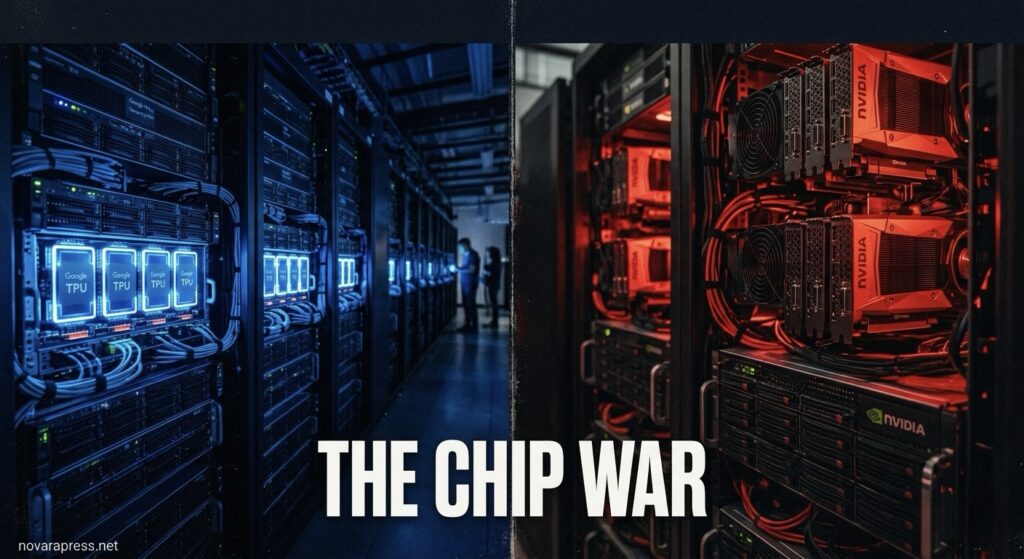
Google is coming for Nvidia’s crown — and the entire global economy may hinge on who wins.
By JAMES MERCER | Novarapress Analysis | April 22, 2026
For three years, one company controlled the oxygen supply of the artificial intelligence economy. Every major lab — OpenAI, Meta, Anthropic, Google itself — lined up to buy Nvidia’s chips. Waitlists stretched for months. Prices were eye-watering. Nvidia’s market cap crossed $3 trillion. That era is ending. The challenger is Google. And the implications reach far beyond Silicon Valley.
SECTION 01
The Chip That Became the Most Wanted Object in Tech
Google’s Tensor Processing Units — TPUs — were originally built for internal use. They powered Google Search, Google Translate, and DeepMind’s AlphaFold. Nobody outside the company could touch them. That changed in 2025, and by early 2026 the reversal was complete: Meta signed a multibillion-dollar deal to lease Google’s TPU infrastructure. Anthropic followed. Rivals of Google are now paying Google to power their AI.
This week at Google Cloud Next in Las Vegas, the company announced its next TPU generation while revealing talks with Marvell Technology on two new co-developed chips — a memory processing unit and an inference-dedicated TPU. Simultaneously, separate reports confirmed ongoing collaboration with MediaTek for a TPU-class data center chip, with TSMC expected to handle fabrication and mass production targeted for late 2026.
“In a matter of months, Google’s AI chips have become one of the hottest commodities in the tech sector — stocked up by leading AI developers including some of Google’s biggest rivals.”
— Bloomberg, April 2026
SECTION 02
Training vs. Inference — Why the Distinction Matters More Than You Think
Most coverage of the AI chip war treats it as a single race. It is not. There are two distinct phases of AI compute — and they require fundamentally different hardware.
Training is the process of building an AI model — exposing it to vast datasets, adjusting billions of parameters, and producing a finished system. This is computationally brutal, takes weeks or months, and happens once or a few times per model. Nvidia’s H100 and B200 GPUs dominate this phase. The CUDA software ecosystem — built over 15 years — creates a switching cost so high that most labs simply will not abandon it.
Inference is what happens after training — when a deployed model answers your question, generates your image, or completes your code. This happens billions of times per day across every major AI product. It is where the majority of ongoing compute costs accumulate. It is the phase where Google believes it can win — and where its TPUs are already proving their value.
The strategic logic is clear: Nvidia may build the factory that creates AI. Google wants to own the highway that runs it.
SECTION 03
The CUDA Problem — and Why Google Is Quietly Solving It
For any serious AI researcher or engineer, the word CUDA carries enormous weight. It is Nvidia’s proprietary software framework — the layer between AI code and GPU hardware. Over 15 years, the entire AI development ecosystem built itself on top of CUDA. PyTorch, TensorFlow, JAX — all optimized primarily for Nvidia hardware.
This is the real moat. Not the hardware itself — but the software gravity surrounding it. Moving to a competitor’s chip historically meant rewriting significant portions of model training code. That barrier alone has preserved Nvidia’s dominance more than any technical advantage.
Google’s answer is TorchTPU — an initiative to make TPUs fully compatible with PyTorch, the dominant framework used by researchers worldwide. If successful, a researcher could run their existing PyTorch code on Google’s TPUs without modification. The CUDA lock-in dissolves. The switching cost drops toward zero.
This is not a hardware story. It is a software portability story — and it is the most underreported dimension of the entire chip war.
FOR RESEARCHERS & STUDENTS
If you are learning AI development today, PyTorch fluency is non-negotiable. But the hardware layer beneath it is shifting. Understanding how to profile and port models across TPU and GPU architectures is becoming a distinct and valuable skill. Google’s JAX framework — optimized for TPUs — is worth learning in parallel. The engineers who speak both hardware languages will be the most sought-after in the next hiring cycle.
SECTION 04
Where This Is Heading — An Honest Forward Look
The trajectory of the AI chip market over the next 24 months points in one direction: fragmentation followed by consolidation around two poles. The era of Nvidia as the sole viable option is already over in practice — even if it has not ended in perception.
What replaces it is a multi-architecture world — where enterprises, research institutions, and governments will run different workloads on different hardware depending on cost, latency, and geopolitical supply availability. This creates three concrete shifts worth tracking:
First — cloud-first compute. The “buy chips, build your own cluster” model is giving way to “rent TPU or GPU time from a hyperscaler.” Most organizations — including well-funded research labs — will run AI on leased infrastructure rather than owned hardware within five years. Google, Amazon, and Microsoft are all positioning for this shift. Nvidia is the one company that profits most from the old model.
Second — energy becomes the hidden constraint. Inference at scale is a power consumption problem as much as a silicon problem. Data centers running continuous AI inference are already straining regional power grids. The companies that secure long-term energy contracts — or invest in dedicated nuclear and renewable capacity for AI infrastructure — will have a structural cost advantage that no chip breakthrough can overcome.
Third — geopolitics will redraw the supply chain. TSMC fabricates chips for Google, Nvidia, Apple, and AMD. Its facilities sit in Taiwan. Every scenario involving conflict in the Taiwan Strait produces a global AI capacity shock within 18 months. No major AI company has fully solved this exposure. The US CHIPS Act and parallel European initiatives are attempts at mitigation — but domestic fabrication capacity at the leading edge remains years away from meaningful scale.
SECTION 05
The Five Signals Worth Watching in 2026
For anyone tracking this space seriously — whether as an investor, researcher, policymaker, or developer — these are the indicators that will determine how the chip war resolves:
① TorchTPU adoption rate. If major open-source model releases begin shipping with native TPU support, the software moat around Nvidia weakens structurally. Watch for this in Hugging Face model cards and PyTorch release notes.
② Google Cloud revenue from TPU leasing. Alphabet’s quarterly earnings will begin breaking out TPU-specific cloud revenue. A consistent quarterly growth line above 30% signals that the commercial transition is real and durable.
③ Nvidia’s inference chip performance benchmarks. The Groq-based inference chip Nvidia released last month has not yet been independently benchmarked at scale. Those results — expected in Q2 2026 — will either validate or undermine Google’s inference advantage claims.
④ US export control expansion. Any extension of chip export restrictions to additional countries — beyond the current China limitations — will compress global AI capacity and accelerate domestic chip programs in the EU, India, and the Gulf states.
⑤ TSMC capacity announcements. If TSMC confirms expanded Arizona or Japan fabrication timelines, it signals that the geopolitical risk premium in the chip supply chain is being actively priced and hedged. If announcements are delayed, the Taiwan concentration risk remains unaddressed.
SHADOWNET FINAL ASSESSMENT
The AI chip war is not a story about corporate rivalry. It is a story about who builds the infrastructure layer of the next 50 years of human productivity — and who gets to charge rent for using it. Google has made its most consequential bet. Nvidia is not defeated. But for the first time, the outcome is genuinely uncertain. That uncertainty is itself the most important development in technology in 2026.
The year of the chatbot is over. The year of the chip has begun.
— SHADOWNET DESK | Novarapress Analysis | April 22, 2026
SOURCES
- Bloomberg — “Google Eyes New Chips to Speed Up AI Results, Challenging Nvidia” — April 20, 2026
- The Information — Google-Marvell chip development talks — April 2026
- Benzinga — “Google Teams Up With Marvell Technology To Build New AI Chips” — April 2026
- BusinessToday — “How Google is quietly planning to take on Nvidia” — April 2026
- Let’s Data Science — “Google Challenges Nvidia’s AI Chip Market Dominance” — April 2026
- Crypto.news — “Google looks to scale AI chip ecosystem with Marvell” — April 20, 2026
Novarapress.net | SHADOWNET Analysis | Independent Geopolitical & Technology Intelligence