
NOVARAPRESS.NET
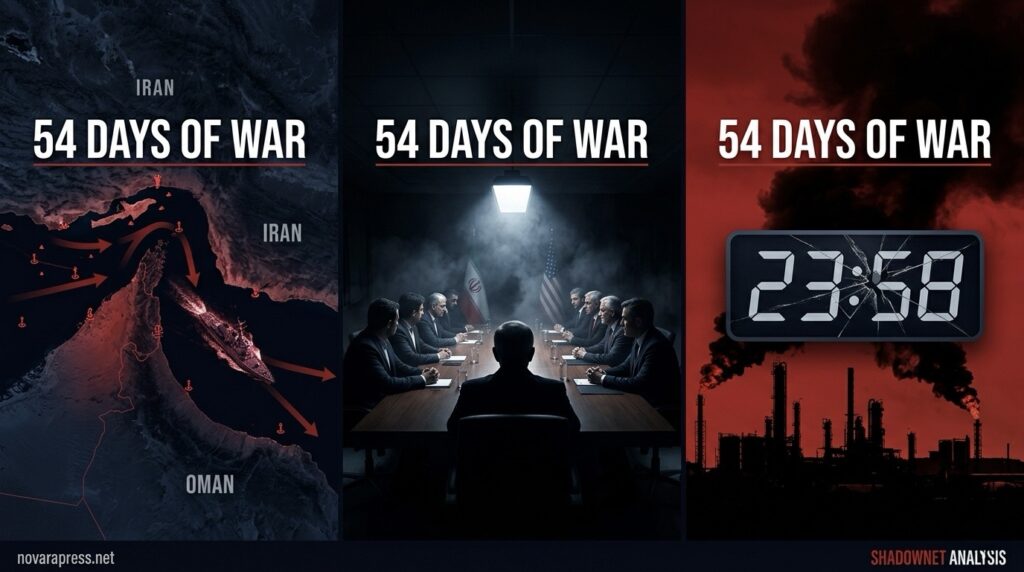
54 DAYS OF WAR · APRIL 22, 2026
A cold-eyed analysis of the Iran–U.S. war: from the opening strikes to the crumbling ceasefire, Trump’s Truth Social ultimatums, the Islamabad deadlock — and three scenarios that will define the Middle East for a generation.
|
April 22, 2026
|
13 min read
Iran has never been a regional actor with local ambitions. Washington has never treated Tehran as an equal in strategic calculus. But what began on February 28, 2026 shattered every rule in the playbook — and planted in the heart of the Middle East a degree of uncertainty the region has not seen in decades.
This is a real war. Not Twitter threats. Missiles hit nuclear facilities. American submarines patrol Gulf waters. The commander of Iran’s Revolutionary Guard was killed in the opening weeks. And the Strait of Hormuz — through which nearly a fifth of the world’s oil flows — became a chessboard where the pieces move in real blood. The question haunting every analyst today: is the fragile ceasefire Trump extended at the last moment a genuine path to peace, or merely a breath before a fiercer round?
SECTION 01
HOW THE WAR NOBODY WANTED — OFFICIALLY — BEGAN
On February 28, 2026, the United States and Israel launched coordinated airstrikes on Iran, killing the Supreme Leader and numerous senior officials while destroying wide swathes of military and nuclear infrastructure. The timing surprised; the context did not. A month of failed diplomacy had preceded it — Washington demanding full dismantlement of Iran’s nuclear program, ballistic missile restrictions, and a severance of support for armed groups in Lebanon, Yemen, and Iraq. Tehran refused every point.
To understand the deep roots: in 2018, Trump withdrew from the JCPOA nuclear accord, labeling it “the worst deal ever made.” He returned in his second term demanding harder terms. Iran did not wait. It accelerated enrichment, stockpiled uranium — and sources revealed it held enough 60%-enriched material to produce eleven nuclear weapons.
“Washington demanded unconditional surrender of the nuclear program. Tehran responded by accelerating enrichment, not halting it.”
— SHADOWNET ANALYSIS
SECTION 02
THE CRISIS TIMELINE — FROM FIRST STRIKE TO EXTENSION
| Date | Event |
|---|---|
| Feb 28, 2026 | U.S.–Israeli coordinated strikes on Iran. Supreme Leader and senior commanders killed. Nuclear sites destroyed. |
| Mar 25, 2026 | Pakistan delivers U.S. 15-point ceasefire proposal to Iran. Tehran rejects it and submits a 5-point counter. |
| Apr 7, 2026 | Trump on Truth Social: “A whole civilization will die tonight, never to be brought back.” White House denies nuclear weapon plans. |
| Apr 8, 2026 | Two-week ceasefire brokered by Pakistan. Iran rejects initial framework, offers 10-point counter-proposal. |
| Apr 11–12, 2026 | First Islamabad talks: Vance, Witkoff, Kushner vs. Araghchi and Ghalibaf. 21 hours of negotiations — no deal. |
| Apr 19, 2026 | U.S. destroyer fires on and seizes Iranian-flagged cargo ship in Gulf of Oman. Tehran declares ceasefire violated. |
| Apr 21, 2026 | Trump extends ceasefire hours before expiry at Pakistan’s request. Duration unspecified. Blockade continues. |
SECTION 03
THE STRAIT OF HORMUZ: WHEN A SHIPPING LANE BECOMES A WEAPON
From day one, Tehran recognized that its conventional military cards had been largely compromised by the opening strikes. So it played the most consequential card available: closing the Strait of Hormuz, the narrow channel through which roughly 20% of global oil and natural gas transits in normal times.
The result was immediate. Brent crude surged past $90 a barrel, triggering alarm across global markets. Washington retaliated with a naval blockade of Iranian ports. Trump took to Truth Social to boast the blockade was “absolutely destroying Iran” — and vowed it would not lift until a deal was signed. The bitter irony: both sides claim victory. Both sides are bleeding. Iran suffers the blockade and the strikes; the American economy strains under fuel prices that have turned the war deeply unpopular at home.
SECTION 04
THE “FINAL” ULTIMATUM THAT WASN’T FINAL
On April 7, Trump reached for apocalyptic language, writing on Truth Social: “A whole civilization will die tonight, never to be brought back again.” When Press Secretary Karoline Leavitt was asked whether the president would use nuclear weapons, her answer was telling: “Only the President knows where things stand and what he will do.”
The civilization did not die. On April 8, a two-week ceasefire was brokered by Pakistan. Then came Islamabad — the highest-level direct U.S.–Iran engagement since the 1979 Revolution. Vice President Vance, envoy Steve Witkoff, and Jared Kushner faced Iranian Foreign Minister Araghchi and Parliamentary Speaker Ghalibaf across a table for 21 consecutive hours. They left without a deal. The first round broke down, Vance said later, because Iran refused to make an affirmative commitment not to seek a nuclear weapon.
“Trump told PBS that ‘lots of bombs start going off’ if no deal is reached — and on the same day, the U.S. delegation was packing for Islamabad. War and diplomacy running on parallel tracks.”
— SHADOWNET ANALYSIS
SECTION 05
THE FAULT LINES: WHAT SEPARATES WAR FROM PEACE
| Issue | U.S. Position | Iran Position |
|---|---|---|
| Nuclear Program | Full, unconditional dismantlement | Hard refusal — “an inalienable right” |
| Strait of Hormuz | Immediate reopening to all shipping | Only within a comprehensive settlement |
| Naval Blockade | Leverage — will not lift before a deal | Precondition for serious talks |
| Lebanon / Hezbollah | Not included in any Iran deal (Israel’s demand) | Halt attacks on Lebanon — non-negotiable |
| Security Guarantees | Not included in any U.S. proposal | International guarantees + war reparations required |
SECTION 06
THE LAST-MINUTE EXTENSION: DIPLOMATIC WIN OR MORE DRIFT?
On April 21 — hours before the ceasefire expired — Trump announced an extension at Pakistan’s request, giving Tehran more time to submit a “unified proposal.” Prime Minister Shehbaz Sharif had worked intensively to keep both delegations at the table, and Pakistani officials expressed confidence Iran would send a team to Islamabad for a second round.
Tehran’s response was loaded with contempt. Parliamentary adviser Mahdi Mohammadi posted on X: “Trump’s ceasefire extension means nothing. The losing side cannot dictate terms.” Meanwhile Trump clarified that the U.S. military would maintain the naval blockade in full readiness throughout the extension — and that he expected to resume bombing because that was “the best attitude going into negotiations.”
SECTION 07
THREE SCENARIOS FOR A REGION HOLDING ITS BREATH
SCENARIO ONE · MOST LIKELY
The Framework Agreement — Buying Time
The most realistic outcome according to analysts. A framework freezes hostilities and opens a long-term negotiating track on the nuclear file — without an immediate final settlement. Geopolitical analyst Cornelia Meyer noted that “expecting a real peace settlement is going too far,” pointing out that the JCPOA itself took over two years to finalize.
SCENARIO TWO · MODERATE PROBABILITY
Limited Escalation — Controlled Strikes
If Islamabad fails without a new extension, a limited strike campaign targeting Iranian infrastructure — power plants, bridges — without a full-scale ground war. The danger: Iran’s proxies in Iraq, Yemen and Lebanon are unlikely to absorb another round quietly, and proxy retaliation could drag the entire region in.
SCENARIO THREE · LOW PROBABILITY — CATASTROPHIC IMPACT
Total Collapse — Global Energy Crisis
Iran’s Revolutionary Guard threatened to strike neighboring oil facilities if attacks resume from their territory. A full collapse of negotiations triggering that threat would ignite an unprecedented global energy crisis, force direct Chinese and Russian intervention, and potentially end the era of U.S. Gulf dominance in a single week.
SECTION 08
THE SHADOW PLAYERS: WHO GAINS, WHO BLEEDS
Pakistan has emerged from this crisis with diplomatic stature it rarely commands. Brokering the April ceasefire gave Islamabad a rare dual channel — trusted by both Washington and Tehran — at a moment when it desperately needs international footing.
China was never absent. The White House press secretary confirmed Beijing’s involvement in ceasefire negotiations — a signal of quiet Chinese diplomatic expansion as confidence in Western mediation erodes globally.
Gulf states watch with deep unease. Any deal reshaping the nuclear balance of the Middle East touches them directly. And a closed Strait of Hormuz hits their economies before anyone else’s.
What is happening is not merely a nuclear crisis. It is a reorganization of the entire Middle Eastern power equation. Iran has proven it can wound the global economy without owning a single nuclear bomb. America has demonstrated its military reach — yet failed to translate firepower into a political settlement. The distance between war and peace at this moment is not ideology.
It is a deal. And that deal is being written — or buried — in Islamabad.
SOURCES & REFERENCES
- CNN Politics — “A deal to end the Iran war seemed close. Then Trump started posting on social media” — April 20, 2026
- CNBC — “Trump threatens Iran again as ceasefire deadline looms” — April 20, 2026
- The Washington Times — “Trump says deal with Iran is still possible as ceasefire deadline nears” — April 20, 2026
- NPR — “Trump extends U.S. ceasefire with Iran at Pakistan’s request” — April 21, 2026
- PBS NewsHour — “U.S. delays new round of negotiations with Iran as ceasefire deadline nears” — April 21, 2026
- CNBC — “‘New cards on the battlefield’: U.S., Iran ratchet up rhetoric with peace talks in limbo” — April 21, 2026
- Al Jazeera — “What was the Iran nuclear deal Trump dumped in search of better terms?” — April 21, 2026
- Wikipedia — “2025–2026 Iran–United States negotiations” — Updated April 2026
- Wikipedia — “2026 Iran war ceasefire” — Updated April 2026
SHADOWNET ANALYSIS