
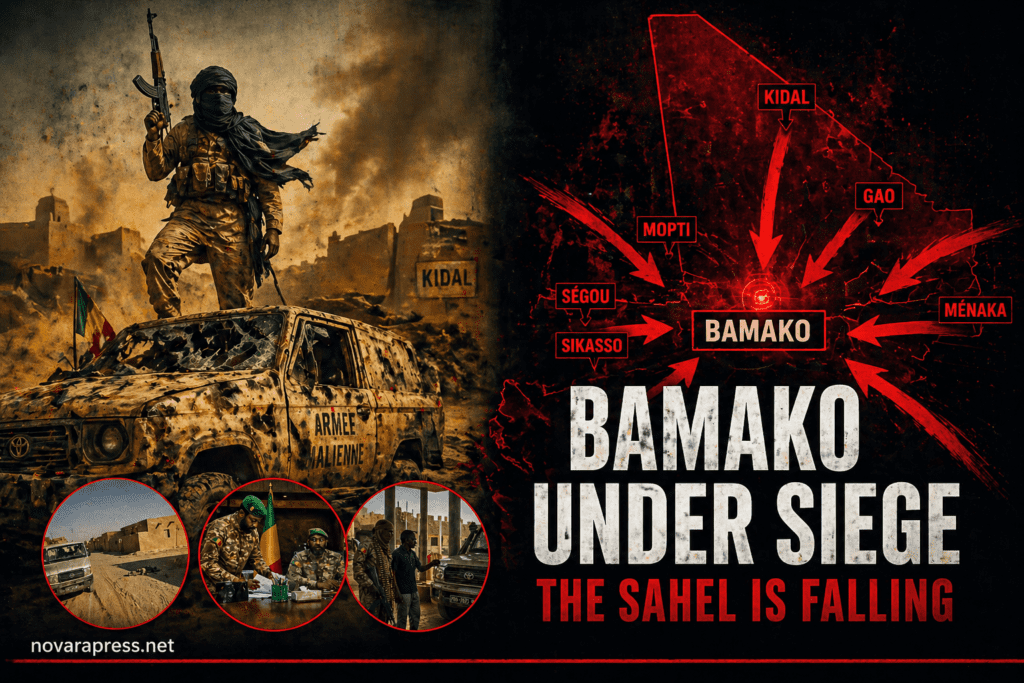
West Africa · Breaking Intelligence
On the morning of April 25, 2026, the Azawad Liberation Front and JNIM launched the most sweeping, coordinated military offensive Mali has seen in over a decade — simultaneously striking Bamako’s suburbs, Kidal, Gao, Mopti, and Sévaré. The junta’s Russian-backed order now faces its most existential test.
By SHADOWNET DESK
April 25, 2026 | Updated: Live
Section 01
Before Dawn: How the Offensive Began
Shortly before 6:00 AM GMT on Saturday, April 25, 2026, two loud explosions tore through the pre-dawn silence outside Kati — Mali’s main military base and the private residence of junta leader General Assimi Goïta, located roughly 15 kilometres north of the capital Bamako. Within the same hour, gunfire erupted at Bamako’s Modibo Keïta International Airport, in the northern cities of Kidal and Gao, and in the central town of Sévaré. Mali was simultaneously at war in every corner of its territory.
The attacks were not random or spontaneous. They were the product of a previously unprecedented operational alliance between two forces that had, until recently, operated along parallel but distinct tracks: the Azawad Liberation Front (FLA), a Tuareg-dominated rebel coalition pursuing northern Malian separatism, and Jama’at Nusrat al-Islam wal-Muslimin (JNIM), the Sahel’s most capable al-Qaeda affiliate. By striking simultaneously at five distinct geographic nodes — including the capital’s military nerve centre — they demonstrated a degree of coordination that no previous Sahelian insurgent operation had managed.
A UN security note confirmed what witnesses were already reporting on the ground: “simultaneous complex attacks” were underway in Kati, near Bamako’s airport, and in the cities of Mopti, Gao, and Kidal. The United States Embassy immediately issued a shelter-in-place advisory to American citizens. The streets of Bamako emptied. Army helicopters circled above the airport and the Kati base as sporadic explosions continued through the morning.
⬤ SHADOWNET Field Assessment — 25 April 2026
Simultaneous five-node assault with confirmed coordination between FLA and JNIM elements. Targets selected for maximum symbolic and operational disruption: Kati (junta command), Bamako Airport/Base 101 (air power and Russian garrison), Kidal (territorial reclamation), Gao (northern logistics hub), and Sévaré (central Mali gateway). Assessment: This is not harassment. This is a campaign-opening strike.
Section 02
Kidal Falls: The North Reclaimed
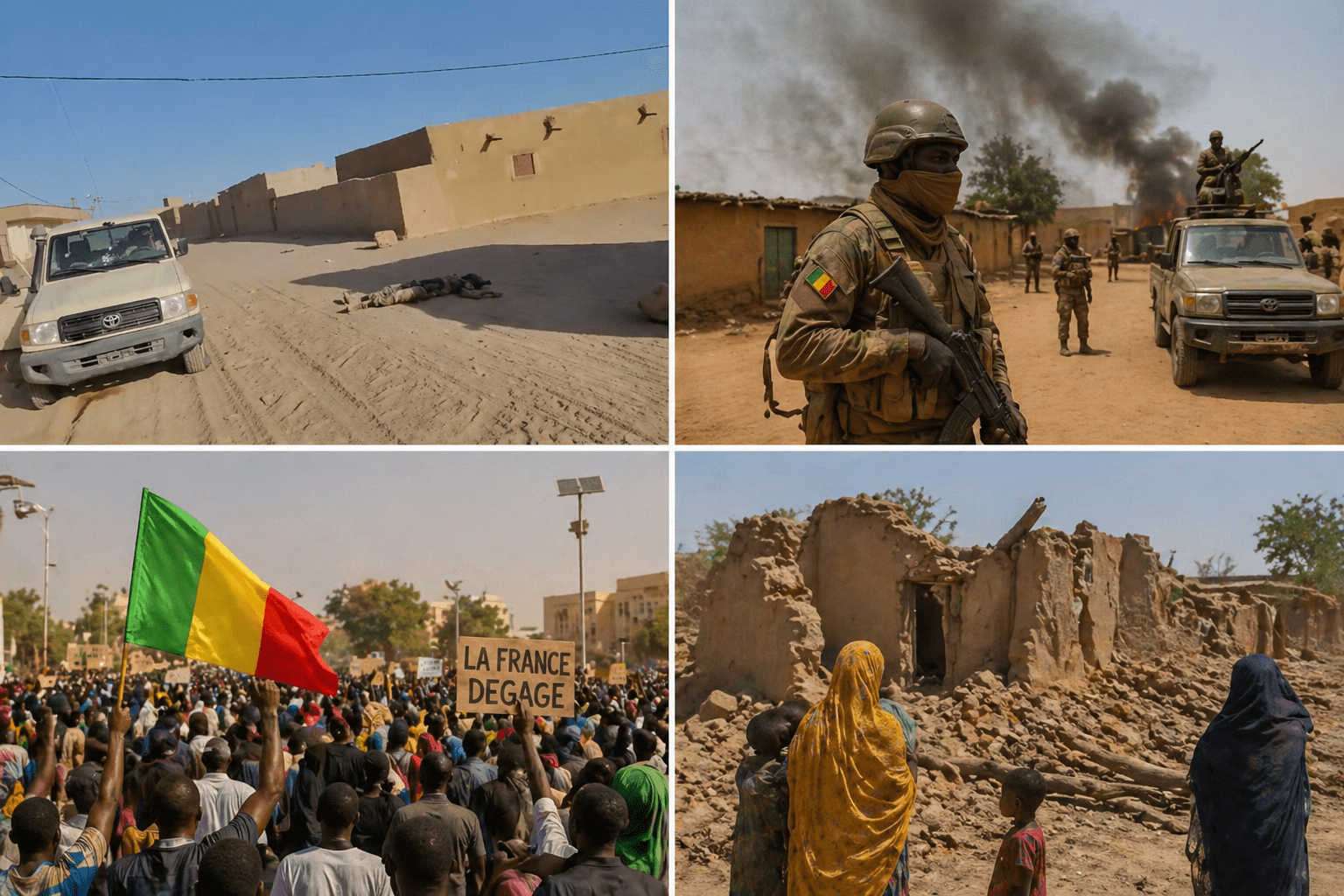
The most symbolically charged development of the day came from northern Mali’s historic desert city of Kidal. Mohamed Elmaouloud Ramadane, an official spokesperson for the Azawad Liberation Front, confirmed via social media that FLA forces had seized control of Kidal — a city the Malian army and its Russian Africa Corps partners had retaken from rebels with considerable difficulty in November 2023. According to Ramadane, FLA troops now controlled the bulk of the city. The provincial governor, along with his staff, had taken refuge inside the former MINUSMA compound — the base of the United Nations peacekeeping mission that Mali’s junta controversially expelled in December 2023.
The FLA also claimed simultaneous positions in Gao — Mali’s largest northern city and the region’s most critical logistics hub. Social media footage, assessed by multiple open-source intelligence monitors as consistent with Gao’s geography, purportedly showed FLA and JNIM fighters seizing a Malian Armed Forces camp in the city. A military helicopter was reported shot down over Gao — a detail that, if confirmed, would represent a significant degradation of Mali’s airpower capabilities in the north.
“Kidal is not just a city. It is the psychological capital of the Azawad movement, the place where the separatist dream has always been kept alive. Its loss — twice — tells you everything about the limits of junta-era counter-insurgency.”
— SHADOWNET Analyst Note
The recapture of Kidal is not merely an operational victory for the FLA. It is a narrative catastrophe for the Malian junta. The 2023 retaking of Kidal was celebrated by Goïta’s government as proof that the Russian partnership — and the expulsion of French forces — had delivered results where Western-backed approaches had failed. That narrative now lies in rubble. The Russia-Mali security model has suffered its most visible and humiliating reversal since its inception.
Section 03
Kati and Bamako: The War Comes Home
While Kidal captures the attention of analysts who follow Sahelian territorial dynamics, the true strategic significance of April 25 lies in what happened at Kati and around Bamako. Kati is not simply a military base. It is the physical and symbolic heart of Malian junta power. It was from Kati that the 2020 and 2021 coups were launched. It is where General Goïta maintains his personal residence. And it is where Mali’s most senior military and intelligence officials are headquartered.
Residents of Kati woke to what they described as sustained, deafening gunfire and explosions shaking the doors and windows of their homes. Images and videos shared on social media showed residential structures destroyed — including, according to multiple security and media sources, the private home of Defence Minister General Sadio Camara. “We are holed up in Kati,” one resident told AFP. “We can hear the airstrikes from inside our houses.” Another witness described jihadist fighters having surrounded the camp with sustained exchanges of fire continuing well into the late morning hours.
At Base 101 — the Senou military complex adjacent to Bamako’s international airport, which also houses Africa Corps personnel — gunfire and explosions erupted from before dawn. An Associated Press journalist on the ground in Bamako reported hearing sustained heavy weapons fire and automatic rifle gunfire from the direction of the airport, approximately 15 kilometres from the city centre. Army helicopters were observed conducting operations above the facility.
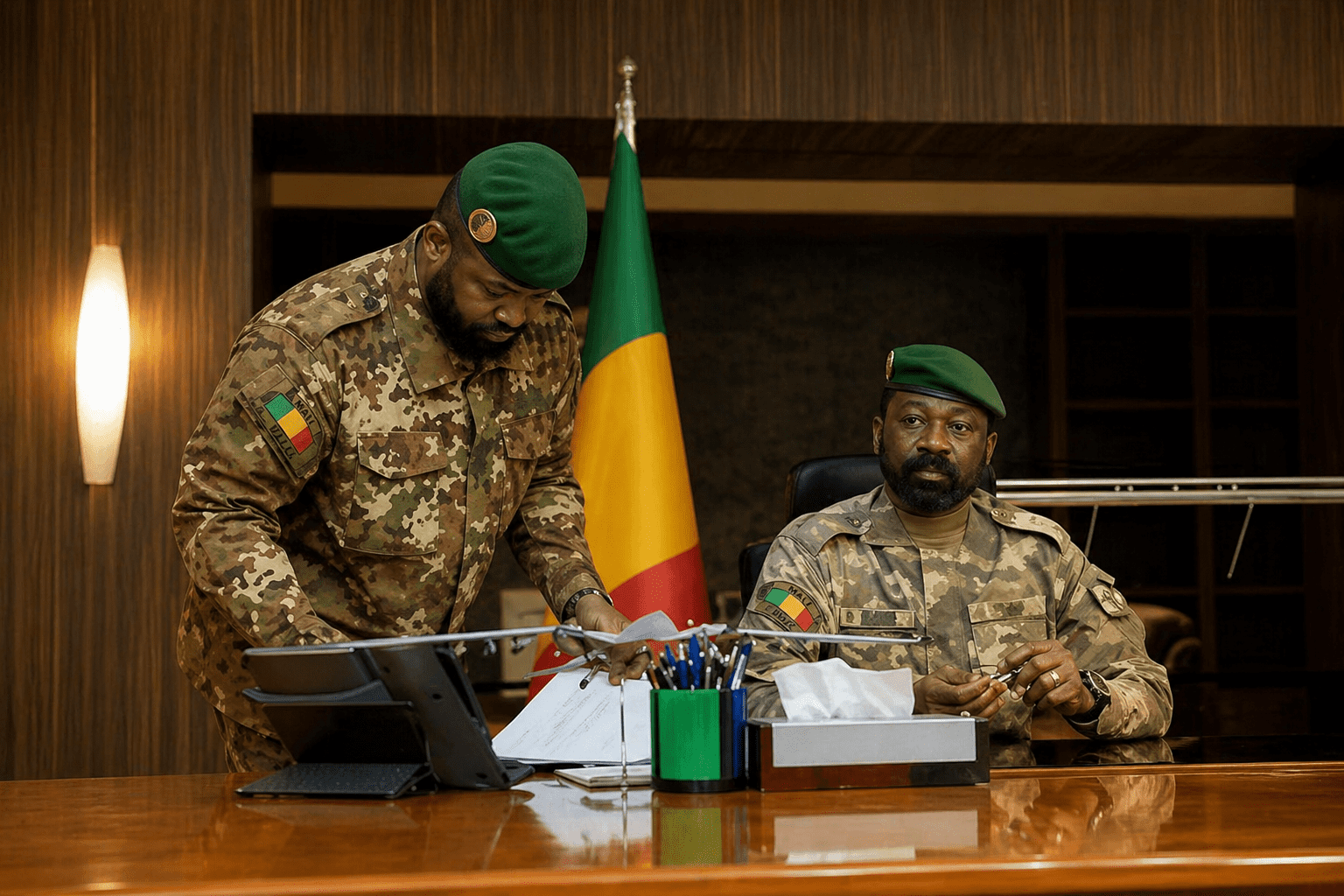
Perhaps most significant in terms of internal intelligence and regime continuity: uncertainty immediately emerged about the whereabouts and safety of several of Mali’s most senior officials. Multiple reporting streams noted that the fates of the defence minister, the director of intelligence, and junta leader Goïta himself were not publicly confirmed in the immediate aftermath of the assault.
| Location | Status (25 Apr, Midday) | Strategic Significance |
|---|---|---|
| Kidal | FLA claims majority control. Governor sheltered in MINUSMA compound. | Symbolic capital of Azawad; reverses 2023 junta gain |
| Gao | Ongoing fighting. FAMa camp reportedly seized. Helicopter allegedly downed. | Largest northern city; critical supply hub; Africa Corps presence |
| Kati | Heavy fighting. Homes destroyed. Goïta residence area under fire. | Main military base; junta command HQ; site of 2020 and 2021 coups |
| Bamako Airport / Base 101 | Gunfire and explosions. Helicopters deployed. Streets deserted. | Air force and Africa Corps garrison; gateway to capital |
| Sévaré / Mopti | Ongoing exchanges. Witnesses sheltering indoors. | Central Mali gateway; blocks north-south military reinforcement |
Section 04
The Alliance That Was Not Supposed to Happen
The most analytically consequential element of April 25 is not the geography of the attacks — it is the identity of those conducting them together. For years, the FLA and JNIM operated as distinct and theoretically incompatible forces. The FLA and its predecessor movements drew their legitimacy from Tuareg ethno-nationalist aspirations for an independent Azawad state in northern Mali. They were secular, at least in political orientation, and had at various points cooperated with international partners including France. JNIM, by contrast, is an ideological franchise of al-Qaeda, governed by a Salafi-jihadist worldview antithetical to the ethnic nationalism of the Tuareg cause.
Yet the junta’s brutal approach to the north — combining indiscriminate Africa Corps operations, documented mass atrocity incidents against Tuareg and Fulani communities, and the wholesale rejection of any political process — appears to have driven a pragmatic convergence. Observers had been noting for months that JNIM was actively courting the FLA. What April 25 confirmed is that this courtship produced operational integration at an unprecedented scale — a combined arms campaign striking simultaneously across 1,500 kilometres of Malian territory.
“When a jihadist network and a separatist rebel movement fight side by side against a common enemy, it is never purely ideological. It is always the state that creates the conditions. Mali’s junta created these conditions.”
— SHADOWNET Geopolitical Assessment
The implications of this alliance extend far beyond Mali’s borders. The Sahel’s three junta states — Mali, Burkina Faso, and Niger — have presented themselves as the vanguard of a new African sovereignty model: anti-Western, Russia-backed, capable of solving security problems that French-led multilateralism had failed to resolve. April 25 does not merely challenge that narrative in Mali. It delivers it a potentially fatal blow, visible to every intelligence service, every insurgent network, and every wavering civilian population from Ouagadougou to Niamey.
Section 05
Russia’s Credibility Test
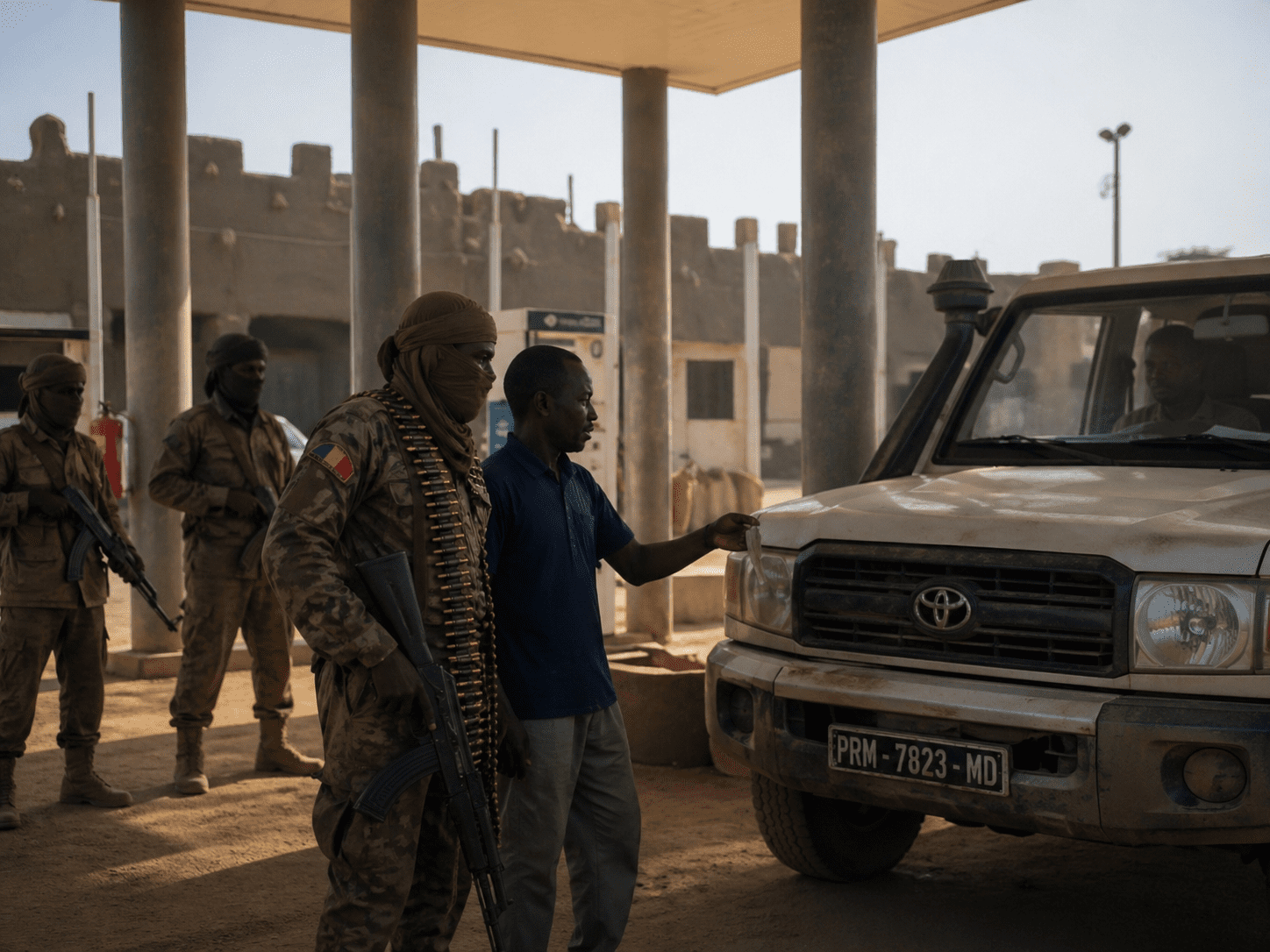
Africa Corps — the successor to the Wagner Group, now under the direct authority of the Russian Ministry of Defence following Wagner’s formal dissolution in June 2025 — was deployed in Mali precisely to prevent scenarios like April 25. Russian mercenary forces arrived in December 2021, at the explicit invitation of the junta, to bolster the Malian Armed Forces against jihadist insurgency and Tuareg rebellion. They participated in the retaking of Kidal in November 2023. They have been stationed at Base 101 near Bamako’s airport. They have accompanied FAMa units on operations across the Mopti and Ségou regions.
On Saturday morning, gunfire was reported at a military camp adjacent to Bamako’s airport that residents identified as housing Russian forces. Whether Africa Corps elements engaged the attackers, sustained casualties, or were effectively bypassed remains unclear. What is clear is that their presence failed to deter an assault on the very installation they were meant to protect — let alone the simultaneous collapse of military positions across five cities.
For Moscow, the stakes are significant. The Russia-Africa security partnership has been one of the Kremlin’s primary instruments for projecting influence and displacing Western presence across the continent. Mali was its flagship. If the Malian junta collapses, Russia loses its most prominent African security success story. The precedent effects — on Burkina Faso’s relationship with Moscow, on the AES bloc’s cohesion, on African governments currently evaluating Russian security partnerships — would be severe.
⬤ Russia Factor — Key Variables
Africa Corps’ operational response to the April 25 attacks will be a defining indicator. A vigorous and effective Russian counter-response could stabilise the junta in the short term. A visible failure — particularly if Base 101 or Kati were penetrated — would constitute the most significant operational humiliation for Russian para-military forces in Africa to date, with cascading consequences for Moscow’s regional credibility.
Section 06
The Slow Siege Before the Storm
April 25 did not emerge from a vacuum. It was the kinetic culmination of an 18-month campaign of escalating pressure that should have alarmed any serious observer of Sahelian security. The warning signs were structural, sequential, and largely ignored by international actors who had already disengaged from Mali’s crisis.
From September 2025 onward, JNIM escalated its economic warfare strategy by systematically targeting fuel tanker convoys on the main supply routes into Bamako. The blockade reached its peak in October 2025, bringing the capital to a near standstill. Long queues at petrol stations, power disruptions, and mounting civilian frustration exposed the junta’s inability to secure even its own supply lines. A brief diesel shortage returned as recently as March 2026, indicating that JNIM had not abandoned its stranglehold over the capital’s logistics — it had merely recalibrated it.
In parallel, the FLA had been reconstituting its forces in the Azawad desert following the 2023 loss of Kidal. Diplomatic contacts between the FLA and JNIM intensified through late 2025. The offensive was not a surprise. It was a scheduled accounting.
Section 07
Regional and International Dimensions
The reverberations of April 25 will extend well beyond Mali’s borders. The Alliance of Sahel States — the self-proclaimed sovereign bloc comprising Mali, Burkina Faso, and Niger — presented itself as a new model for African security independence. If that model’s founding member fractures under a coordinated insurgent offensive, the entire framework loses its foundational premise.
Burkina Faso, which is facing its own severe JNIM pressure and has similarly expelled French forces in favour of Russian support, will be watching Bamako with acute anxiety. Niger, the third AES member, retains more stable military control of its territory but shares the same structural vulnerabilities. A domino scenario in which the AES bloc’s narrative of security sovereignty unravels in sequence is not implausible — though it remains a projection rather than a current reality.
For France, there is no satisfaction to extract from this crisis — only the strategic cost of its disengagement. French Barkhane forces spent nearly a decade fighting precisely the kind of offensive that materialised on April 25. Their expulsion by the juntas, followed by the withdrawal of MINUSMA, created the operational vacuum that JNIM and the FLA have now moved to fill.
Washington’s posture is particularly interesting. The Trump administration had been conducting discreet diplomatic outreach to all three AES juntas, seeking pragmatic engagement that bypassed ideological friction over Russia. A junta collapse in Bamako would complicate that strategy significantly — creating a potential ungoverned space in West Africa’s geographic centre at a moment when American attention and resources are stretched globally. The African Union issued a formal condemnation. Togo, which had been quietly acting as an intermediary between AES juntas and Western governments, suddenly finds itself holding a very precarious brief.
Section 08
Scenario Projections: What Happens Next
Three principal trajectories present themselves in the hours and days following April 25. The outcome will be shaped by the operational status of General Goïta, the speed of Africa Corps’ military response, JNIM’s decision on claiming the attacks, and whether the FLA can consolidate Kidal and Gao before a FAMa counter-offensive is organised.
▲ Scenario Alpha — Contained The Junta Survives Africa Corps and FAMa mount an effective counter-offensive within 72 hours. Kati and the airport zone are secured. Bamako holds. The junta retains command and launches airstrikes on FLA positions in Kidal. Mali loses the north but Goïta survives politically — weakened but intact. Probability: Moderate, dependent on Russian response speed. | ◆ Scenario Beta — Prolonged Crisis Fragmented Stalemate The junta retains Bamako but loses the north permanently. Kidal and Gao become FLA-administered. JNIM maintains pressure on Mopti and supply routes. Mali effectively partitions into three zones. Africa Corps shifts focus to capital protection. The AES bloc fractures politically. Probability: High if junta survives the initial shock. | ▼ Scenario Gamma — Regime Collapse Bamako Falls FAMa command-and-control collapses within days. Goïta’s fate is confirmed as catastrophic. Africa Corps retreats to defensive perimeters. A power vacuum emerges in Bamako. Massive civilian displacement toward Senegal, Mauritania, and Ivory Coast. The Sahel’s most severe crisis since 2012 begins. Probability: Low but rising with every hour command uncertainty persists. |
Section 09
The Architecture of a Failed Order
To understand April 25 fully, one must understand what was assembled — and then systematically dismantled — across the preceding decade. The 2012 Tuareg rebellion that first fractured Mali created the structural openings that JNIM and the FLA have now exploited. But the specific catastrophe of April 25 is the product of the post-2020 era: the coups, the Russian pivot, the French expulsion, and the MINUSMA withdrawal.
Each of these decisions was individually presented as a sovereignty assertion — Mali reclaiming its security architecture from neo-colonial dependency. In retrospect, they were acts of strategic self-blinding. France, whatever its failures and contradictions, maintained a persistent counter-insurgency pressure that prevented JNIM from reaching the gates of Bamako. MINUSMA, for all its limitations, provided an information and stabilisation layer in the north. Both were expelled. Both vacuums were filled by the insurgents they had been restraining.
The junta’s political strategy compounded the military vulnerability. In July 2025, General Goïta granted himself a five-year presidential mandate renewable indefinitely — without elections. Political parties were banned. Independent media was suppressed. This eliminated the domestic political mechanisms through which grievances could be channelled into manageable pressure. When there is no political valve, the pressure finds military outlets.
“Mali’s junta did not lose control of its territory on April 25, 2026. It began losing it the day it decided that guns and mercenaries were a substitute for governance.”
— SHADOWNET Strategic Assessment
The fuel blockade strategy JNIM employed from September 2025 was itself a masterclass in insurgent pressure: it required no military confrontation with Africa Corps, no pitched battle against FAMa’s most capable units. It simply choked the capital’s economic oxygen supply, demonstrating to Bamako’s own population that the junta could not protect their daily lives. April 25 followed the fuel blockade’s logical trajectory — from economic warfare to kinetic offensive, timed for maximum psychological impact.
Intelligence Assessment: The Clock Is Running
What happens in the next 72 hours in Mali will determine whether April 25 is recorded as the day the junta’s order broke — or the day it was tested and held. Three variables will be decisive.
First: the operational fate of General Goïta. Junta continuity requires a visible, functioning head of state. Prolonged uncertainty about his whereabouts will accelerate military and political fragmentation faster than any battlefield outcome.
Second: the Africa Corps response. Russia cannot afford to be seen as having failed its most prominent African partner. A visible, effective Russian counter-operation would be the single most stabilising action available. Its absence would be the most damaging signal Moscow could send across the continent.
Third: JNIM’s claim decision. The group has not yet formally claimed responsibility. When and how it does — and what political demands it attaches — will define whether this transitions into a negotiation dynamic or an unconstrained campaign of regime destruction.
What is not in question is this: April 25, 2026 marks the beginning of the end of the post-coup security order in Mali. The only uncertainty is what replaces it — and how much blood is spilled in the interval.
SHADOWNET is monitoring all developing channels. Updates will follow as intelligence is confirmed.
Verified Sources
- France 24 Live Blog — Mali attacks, April 25, 2026
- Al Jazeera Live Blog — Mali coordinated attacks, April 25, 2026
- The Africa Report — Mali: Heavy fighting erupts in Bamako as rebels seize Kidal, April 25, 2026
- Reuters / AP — Gunmen stage simultaneous attacks in and outside Mali capital, April 25, 2026
- AFP / Daily Sabah — Coordinated attacks hit Mali as army battles terrorist groups, April 25, 2026
- RTE News — Gunfire in Mali as army battles terrorist groups, April 25, 2026
- Jeune Afrique — Mali: ce que l’on sait de l’offensive coordonnée du FLA et du JNIM, April 25, 2026
- Thomas Van Linge — Open-source OSINT assessment, April 25, 2026
- UN Security Note — Simultaneous complex attacks confirmation, April 25, 2026
- US Embassy Mali — Shelter-in-place advisory, April 25, 2026
- African Union — Statement condemning attacks, April 25, 2026
- Wassim Nasr / France 24 — JNIM field footage verification, April 25, 2026