
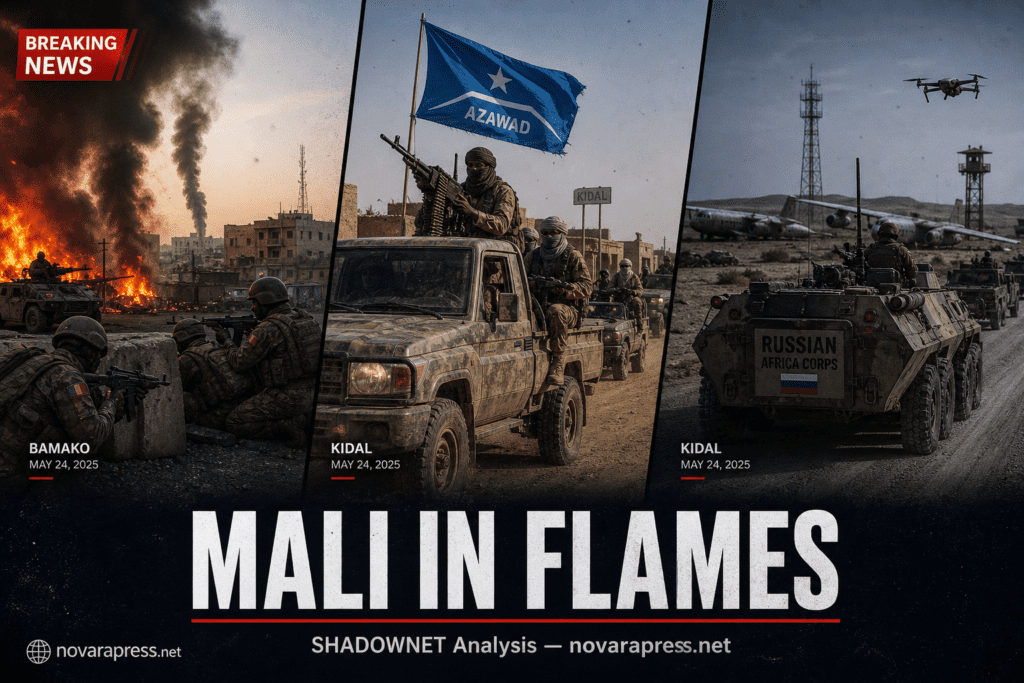
Mali in Flames: The April 2026 Offensive That Shook the Sahel and Exposed the Limits of Junta Power
A coordinated assault by Tuareg separatists and al-Qaeda-linked jihadists has turned Mali’s civil war into its most dangerous chapter since 2012 — killing a minister, humiliating Russia’s mercenary force, and leaving a capital under siege.
At precisely 5:20 in the morning on Saturday, April 25, 2026, the long silence of Bamako’s pre-dawn hours was shattered by two massive explosions. The blasts came from Kati — the garrison city that sits twelve kilometers from the capital, home to Mali’s main military base, and, more importantly, the residence of General Assimi Goïta, the military ruler who has governed Mali since his second coup in 2021. Within minutes, gunfire erupted near the Modibo Keïta International Airport. Smoke columns rose above the neighborhoods of Mamaribougou. And a suicide vehicle packed with explosives detonated at the gates of the residence of Defense Minister Sadio Camara, killing him, his second wife, and two of his grandchildren.
What followed over the next 72 hours would constitute the largest and most coordinated insurgent offensive in Mali’s fourteen-year civil war — a war that has already outlasted three governments, expelled French troops, eliminated a United Nations peacekeeping mission, swallowed thousands of lives, and transformed the Sahel into the world’s deadliest terrorism theater. By the time the dust began to settle, Kidal had fallen. Africa Corps mercenaries had retreated in humiliation. The intelligence chief had been shot. The president had vanished from public view for three days. And an alliance between Tuareg separatists and jihadists — a partnership once considered impossible — had announced itself to the world with a coordinated strike spanning 1,500 kilometers of desert and savanna.
This SHADOWNET analysis provides a complete accounting of the April 2026 offensive: who carried it out, how it unfolded, what it reveals about the structural failures of Mali’s junta strategy, the deeper historical and geopolitical roots of the insurgency, and what — if anything — can be done to prevent the collapse of a state that sits at the heart of an already destabilized region.
Hour by Hour: The Day Mali’s Capital Burned
The assault was not a single event. It was a synchronized operation executed across at least eight locations simultaneously, stretching from Bamako in the southwest to Kidal in the northeast — a geographic spread that, in itself, tells the story of the insurgency’s extraordinary operational maturity. The Jama’at Nusrat al-Islam wal-Muslimin (JNIM), the al-Qaeda-affiliated jihadist coalition active across Mali, Burkina Faso, and Niger, coordinated with the Azawad Liberation Front (FLA), the Tuareg separatist movement formed in November 2024 from remnants of the Coordination of Azawad Movements. For the first time since 2012, these two forces — one Islamist and transnational, the other secular and ethnic-nationalist — acknowledged a formal operational alliance.
| TIME (UTC) | LOCATION | EVENT | ACTOR |
|---|---|---|---|
| 05:20 | Kati (Bamako suburbs) | Dual explosions near main military base; Goïta’s compound targeted | JNIM |
| 05:30 | Kati — Camara residence | Suicide car bomb destroys defense minister’s home; Camara, wife, and two grandchildren killed | JNIM |
| 06:00 | Bamako — Senou Airport | Sustained gunfire; all flights cancelled; Africa Corps helicopters deployed | JNIM / FAMa response |
| 06:15 | Kidal (northeast) | FLA checkpoints change hands within first hour; city falls to rebels | FLA |
| 06:30 | Gao, Sévaré, Mopti | Simultaneous gunfire and explosions in three provincial capitals | JNIM / FLA |
| 08:00 | Bamako | Malian army confirms “unidentified armed terrorist groups” attacking barracks across the country | Government statement |
| April 26 | Kidal | Africa Corps negotiates humiliating withdrawal; leaves equipment including drone station and armored vehicles | Africa Corps retreat |
| April 28 | Bamako | Goïta makes first public appearance; meets Russian ambassador; declares situation “under control” | Government |
| April 29 | Paris (FLA statement) | FLA spokesman declares intent to capture Gao, Timbuktu, and Ménaka; says “the regime will fall, sooner or later” | FLA |
The targeting logic of the April 25 offensive was surgical in its ambition. JNIM did not simply attack checkpoints or rural outposts — the pattern that had defined the group’s operations for years. Instead, it struck the architecture of the Malian state itself: the defense minister’s home, the military ruler’s garrison, the intelligence headquarters, the international airport, and the nerve centers of multiple provincial capitals. Africa Center for Strategic Studies noted the attacks demonstrated JNIM’s capacity to operate across distances of roughly 1,500 kilometers in a synchronized manner, marking a qualitative leap in insurgent operational planning.
“The coordination between JNIM and the FLA is a reminder of the fluidity of alliances in the Sahel — and the growing capacity of insurgent networks to strike at the heart of power rather than its periphery.”
— Alex Vines, Africa Director, European Council on Foreign Relations
The death toll figures remain contested. The Malian military claimed over 200 attackers were “neutralized.” Africa Corps posted on X claiming between 10,000 and 12,000 fighters participated, with over 1,000 insurgents killed — figures that most independent analysts dismissed as dramatically inflated propaganda. The Russian Ministry of Defence released footage of airstrikes on April 28, claiming at least 305 militants killed. Meanwhile, reliable casualty assessments from the civilian population remain impossible due to information restrictions and the ongoing nature of the conflict. What is not disputed is the symbolic weight of the day: the defense minister was dead. The capital had been attacked. Kidal — recaptured from Tuareg rebels in a celebrated 2023 offensive with Wagner Group support — had fallen again.
The Alliance That Was Never Supposed to Exist: FLA and JNIM
To understand the full significance of what happened on April 25, one must understand why the FLA-JNIM alliance represents such a profound strategic rupture. For most of the past decade, these two forces operated in parallel rather than in concert. The Tuareg independence movement — ethnic, secular, and rooted in a specific northern territorial claim — had historically been hostile to the Islamist agenda of groups like JNIM. In 2012, their brief tactical cooperation fell apart precisely because of ideological incompatibilities: Tuareg rebels of the MNLA found their revolution hijacked by jihadist factions whose imposition of Sharia law alienated the local population and brought French military intervention.
The FLA emerged in November 2024 from the dissolution of the Coordination of Azawad Movements (CSP-DPA). Its predecessor had signed the 2015 Algiers Accords, which promised a degree of autonomy and reconciliation. But after the junta abrogated those accords in January 2024 and resumed offensive operations — backed by Africa Corps — the coalition formally dissolved and reconstituted itself as a militant force demanding independence. Led by Alghabass Ag Intalla, the FLA combines the remnants of multiple rebel factions and draws fighters from the Tuareg and Arab communities of northern Mali who have faced displacement, targeting by Russian mercenaries, and the systematic erasure of their political gains since 2015.
JNIM, meanwhile, was formed in 2017 through the merger of four al-Qaeda-linked groups: Ansar Dine, Al-Qaeda in the Islamic Maghreb (AQIM), Katibat Macina, and al-Mourabitoun. Led by Ag Ghaly — himself a former Tuareg rebel commander who converted to Salafi jihadism — the group has grown to an estimated 10,000 fighters operating across the tri-border area of Mali, Burkina Faso, and Niger. It is funded through a combination of gold smuggling, kidnapping ransoms, narcotics trafficking, and taxation of local populations in territories it controls. Unlike classic territorial insurgencies, JNIM has historically prioritized influence over governance, embedding itself within rural communities by providing dispute resolution, security, and economic access that the state cannot or will not provide.
The April 2026 alliance was formalized at a significant cost to the FLA: the separatists agreed to enforce Sharia law — albeit in a reportedly more moderate form — in territories under their control, a concession to their jihadist partner that signals just how desperate and determined both sides are to see the Bamako junta fall. The FLA explicitly called on Russia to stay out of the conflict, framing its fight as a domestic Malian matter rather than an anti-Moscow operation. Whether this pragmatic truce can survive the contradictions between a secular independence movement and an Islamist insurgency remains the central uncertainty of the post-April landscape.
Sixty Years of Betrayal: The Deep Roots of the Malian Insurgency
The events of April 25, 2026 did not emerge from a vacuum. They are the latest eruption in a conflict that stretches back not merely to 2012 — the year most Western analysts began paying attention — but to the very moment of Malian independence from France in 1960. Understanding why Mali burns requires understanding the geography of exclusion that has defined this country since its founding.
The Tuareg people are a Berber pastoralist ethnic group spread across the Sahara and Sahel, whose historical territories and trade routes were sliced apart by colonial borders that had no relation to their way of life. When France departed and drew the borders of modern Mali, the Tuaregs of the north found themselves citizens of a state whose cultural, political, and economic center of gravity lay hundreds of kilometers to the south, in Bamako’s riverside communities. The Bambara-dominated central government that inherited French colonialism proceeded to crush traditional power structures, restrict pastoral movements, and neglect the infrastructure of the north. By 1962, just two years after independence, the first Tuareg rebellion had begun.
What followed was a cycle of rebellion, suppression, negotiated accords, and broken promises that repeated itself with brutal regularity in 1990, 2006, and 2012. Each cycle left deeper grievances. The 2012 rebellion was the most consequential: Tuareg fighters who had returned from Libya after the collapse of the Gaddafi regime — many of them veterans of Libyan army units and armed with weapons from Gaddafi’s looted arsenals — joined with jihadist groups to capture Kidal, Gao, and Timbuktu within weeks. The MNLA declared the independent State of Azawad. France launched Operation Serval to prevent the fall of Bamako, and while French forces succeeded in reversing the territorial gains, they could not address the underlying political vacuum.
The 2015 Algiers Accords were the most serious attempt at a negotiated settlement. They provided for Tuareg political representation, local governance reforms, and the integration of rebel fighters into the national army. They were never implemented. The Malian government, regardless of who led it, treated the accords as a temporary arrangement to be delayed indefinitely. Successive presidents — including Ibrahim Boubacar Keïta, elected in 2013 on promises of reform — failed to decentralize power, disarm militias, or deliver the economic development that would have given northern communities a stake in the Malian state. In the vacuum of governance, jihadist groups offering justice, employment, and identity filled the space.
“Since 2023, civilian fatalities linked to security forces and allied militias in Mali and Burkina Faso have exceeded those attributed to jihadist groups. JNIM has capitalized on junta violence against civilians to expand its appeal and local influence.”
— Africa Center for Strategic Studies, April 2026
The coups of August 2020 and May 2021 — which brought Assimi Goïta to power — were presented as a fresh start. The junta promised to end corruption, defeat the insurgency, and restore dignity after what it characterized as French neocolonial subjugation. It expelled French forces in 2022, terminated the UN peacekeeping mission MINUSMA in 2023, and replaced Western partnerships with Russian mercenaries from the Wagner Group, later rebranded as Africa Corps. The result has been, by any measurable standard, catastrophic. The territory controlled by insurgent groups expanded rather than contracted. Civilian massacres attributed to Africa Corps and the Malian army — including incidents in Moura in 2022 and multiple operations in the Timbuktu region in 2026 — fueled recruitment into the very groups the junta claimed to be defeating. The Global Terrorism Index for 2026 confirmed that the Sahel region accounted for more than half of all terrorism-related deaths worldwide in 2025.
Africa Corps Exposed: The Humiliation of Moscow’s Sahel Strategy
Russia’s entry into Mali was sold on a simple proposition: where France failed, Moscow would succeed. The Wagner Group arrived in 2021 with a promise of decisive military action, mineral extraction partnerships, and geopolitical solidarity against Western imperialism. For a population exhausted by French counterterrorism operations that had gone on for a decade without producing peace, the Russian offer carried genuine appeal. Wagner was credited with helping recapture Kidal in 2023 — the symbolic Tuareg stronghold that had eluded the Malian army for years. The junta presented this as the dawn of a new security era.
What April 2026 revealed was that the era was hollow. Africa Corps — which replaced Wagner in 2025 under direct Russian Ministry of Defence control — maintained an estimated 400 personnel in the Kidal region when the FLA offensive struck. Rather than mounting a serious defense of a city that had cost enormous political capital to retake, the Africa Corps negotiated a withdrawal. Video footage showed their convoy — including armored personnel carriers and what open-source researchers identified as a Grad missile system — leaving Kidal under FLA surveillance. They left behind a drone station, armored vehicles, and a devastating precedent. Ulf Laessing of the Konrad Adenauer Foundation summarized the assessment bluntly: “Africa Corps has really lost credibility. They didn’t put up a fight on Saturday and have left Kidal, which is a highly symbolic Tuareg stronghold.”
| INDICATOR | 2021 PROMISE | 2026 REALITY |
|---|---|---|
| Territorial control | Secure all major northern cities | Kidal, Aguelhok, Tessalit lost; Gao under pressure |
| Capital security | Prevent insurgent approach to Bamako | Bamako itself attacked; airport struck; minister killed |
| Civilian protection | End jihadist violence against civilians | Africa Corps accused of summary executions; civilian deaths exceed jihadist killings |
| Insurgent strength | Degrade JNIM capacity | JNIM grows to 10,000+ fighters; controls supply routes to Bamako |
| Political legitimacy | Bolster junta’s popular support | Junta credibility severely damaged; coup risk elevated |
Russia’s response to the debacle was telling. Moscow framed the events as a Western imperialist attack, with Africa Corps releasing a statement — without evidence — claiming that Ukrainian and European mercenaries participated in the assault. The Russian Ministry of Defence released airstrike footage claiming kills, but the strategic reality was unmistakable: a force that entered Mali presenting itself as the guarantor of sovereignty had retreated under fire, abandoned a symbolic city, and left its ally’s defense minister dead and its intelligence chief fighting for his life. The retreat generated open anger among junta figures, and analysts noted pressure from within Bamako to diversify security relationships — including toward Turkey — away from Moscow’s increasingly costly embrace.
The geopolitical paradox for Russia is acute. Mali is a cornerstone of Moscow’s broader African strategy, intended to demonstrate that Russia offers an alternative to Western neocolonialism. A visible military failure in Mali threatens to undermine the entire narrative in neighboring Burkina Faso and Niger, where Africa Corps also has a presence — smaller but politically consequential. If Bamako falls or if Goïta is replaced in yet another coup, Russia loses its most prominent Sahelian showcase and potentially access to the gold and mineral concessions it has been extracting as payment for its military services.
Beyond Mali’s Borders: What the April Offensive Means for the Entire Sahel
The April 2026 attacks in Mali cannot be analyzed in isolation. They are both a product and an accelerant of a regional crisis that has been building for more than a decade across the central Sahel — a belt of territory stretching from the Atlantic coast of Mauritania to the landlocked heartlands of Chad, encompassing some of the world’s poorest populations and most resource-rich soils. The three juntas of Mali, Burkina Faso, and Niger — bound together since 2023 in the Alliance of Sahel States (AES) — present themselves as a unified front against Western interference and jihadist violence. The events of April 25 exposed the AES as a political construct without meaningful operational coherence.
When Mali was attacked, the response from its AES partners was limited to statements of solidarity and unverified social media reports of Burkinabè drones in Malian airspace. The joint AES armed force — announced at the end of 2025 and boosted to 15,000 declared troops just days before the April offensive — did not mount any coordinated military response. Burkina Faso’s defense minister vowed to “hunt down the assassins” at Camara’s funeral, but his country’s own security situation makes any meaningful reallocation of forces toward Mali effectively impossible. Niger’s junta, similarly stretched, offered condolences but no troops.
Algeria’s position is particularly consequential. Algiers has long positioned itself as the essential mediator of the Sahel’s conflicts, having hosted the 2015 peace negotiations and maintaining historical relationships with Tuareg communities on both sides of its borders. The relationship between Bamako and Algiers had deteriorated sharply in the months before April 2026. In April 2026, the Malian government withdrew its recognition of the Polisario Front and pivoted toward Morocco’s position on Western Sahara — a direct diplomatic blow to Algiers. Both countries had previously expelled each other’s ambassadors after Mali accused Algeria of shooting down a Malian reconnaissance drone. Against this backdrop of open diplomatic hostility, Algeria’s ability to play a constructive mediation role — arguably the most promising route to a negotiated settlement — has been severely compromised.
“A perplexing paradox of the junta’s security strategy has been its rejection of regional and international partners in the face of an escalating threat — replacing 20,000 regional and international troops with an estimated 1,000 to 2,500 Russian mercenaries.”
— Africa Center for Strategic Studies, April 29, 2026
The attacks also resonate deeply in West Africa beyond the Sahel. ECOWAS, the regional economic bloc from which Mali, Burkina Faso, and Niger withdrew in January 2025, had maintained at least the theoretical possibility of a return to multilateral frameworks. A JNIM siege of Bamako, combined with continued FLA advances in the north, would generate refugee flows, arms proliferation, and jihadist territorial expansion into coastal states — Senegal, Ivory Coast, Guinea — that have so far avoided the worst of the Sahel’s violence but are increasingly exposed to it. Senegal and Ivory Coast are already affected by JNIM pressure on Mali’s western supply routes, with the September 2025 fuel blockade restricting goods flowing from their borders to Malian cities.
Diagnosing the Crisis: The Seven Drivers of Mali’s Unending War
Any serious attempt to address the Mali crisis requires an honest accounting of its causes — not merely the proximate triggers (coups, expulsions, broken accords) but the structural conditions that have made the country a breeding ground for armed conflict across six decades. Seven interconnected drivers stand out:
1. Colonial Geography and Ethnic Exclusion. Mali’s borders were drawn to serve French administrative convenience, not to reflect the ethno-linguistic and cultural geography of the Sahel. The Tuareg people, the Fulani pastoralists, the Songhai traders, and the Bambara farmers were bundled into a single state with a single capital and a single power structure that systematically favored southern, sedentary, agrarian communities over northern, mobile, pastoral ones. No amount of military force can resolve a political arrangement that was never accepted by a significant portion of its population.
2. State Absence in the Periphery. In the vast territories north and east of the Niger Bend, the Malian state has never been more than an occasional visitor — a tax collector, a soldier, a checkpoint. It has not provided schools that teach in northern languages, health clinics staffed by resident professionals, courts that understand customary law, or economic frameworks that accommodate pastoralist livelihoods. JNIM did not conquer northern Mali’s communities; in many places, it simply moved into the vacuum that the state had left behind.
3. Climate Stress and Competition for Resources. The Sahel has warmed at a rate approximately 1.5 times faster than the global average. Desertification has pushed the Sahara southward, compressing the pastoral zone and generating violent competition between Fulani herders and Dogon farmers over shrinking water sources and grazing lands. These intercommunal conflicts — once resolved through traditional mediation mechanisms — have become militarized, with JNIM and other armed groups stepping in as enforcers, recruiters, and pseudo-arbiters in disputes the state cannot or will not address.
4. The Narco-Trafficking Economy. Mali sits astride some of the busiest drug, arms, and human smuggling routes in Africa, connecting West African cocaine processing centers to North African and European markets. The revenues from these networks — estimated in the hundreds of millions of dollars annually — have financed insurgent groups, corrupted state officials at every level, and created powerful stakeholders with direct economic interests in the continuation of conflict. JNIM does not merely tolerate trafficking; it taxes, facilitates, and in some areas directly controls it.
5. Externally Sponsored Armed Groups. Mali’s conflict has never been purely domestic. Gaddafi’s Libya trained and armed Tuareg fighters for decades, and the collapse of his regime unleashed those fighters and weapons across the Sahel in 2011. Algeria has maintained complex relationships with various armed factions. Gulf-origin financing has reportedly flowed to Salafi networks. The spread of AQIM — originally an Algerian organization — into Mali reflected a deliberate strategy of geographic expansion by a group under military pressure in its homeland. External hands have consistently made Mali’s internal conflicts harder to resolve.
6. Political Coup Culture and Institutional Decay. Mali has experienced five coups since independence. Each one has disrupted whatever institutional development was underway, reset the political clock, and generated new cycles of grievance. The Goïta junta’s seizure of power in 2020-2021 was the latest iteration of a pattern in which military officers, frustrated with civilian governance failures, have repeatedly taken power — only to reproduce the same governance failures under different management. The cycle has progressively weakened every institution: the judiciary, the civil service, the army’s professional culture, and the political parties.
7. The Security-First Fallacy. Perhaps the most consequential driver of Mali’s continued crisis is the dominant response paradigm: that security operations can be pursued independently of political settlements, economic development, and governance reform. Every major external actor — France, the UN, the EU, and now Russia — has prioritized the military dimension over the political one. The result is that each security gain has been reversible (Kidal was taken in 2023, lost in 2026), while each atrocity attributed to security forces has generated recruits for insurgent groups. As Chatham House’s analysis of the April attacks concluded: security cannot be delivered by military means alone.
Four Futures for Mali: A Forward-Looking Assessment
The post-April landscape presents four plausible trajectories for Mali over the next 12 to 24 months, ranging from a negotiated stabilization to full state collapse. Each scenario carries distinct regional and international implications.
Negotiated Stabilization via Regional Mediation
Probability: Low (10-15%). Algeria, the African Union, and ECOWAS broker a new ceasefire framework that includes a renewed political process for northern autonomy. The junta makes strategic concessions on Tuareg governance and releases political prisoners. JNIM fractures between pragmatic elements willing to engage and hardline internationalists. Africa Corps role is gradually reduced as Turkey and other actors fill the security gap. Conditions required: Goïta survival, Algerian re-engagement, JNIM internal splits, significant international economic incentives for the junta.
Prolonged Stalemate: Fragmented Control Hardens
Probability: Moderate (35-40%). The most likely near-term outcome. The junta retains control of Bamako and major southern cities with Russian air support. The FLA consolidates control of the north: Kidal, Aguelhok, and Tessalit become a de facto Azawad statelet. JNIM continues to control rural central Mali and the western supply routes, imposing its blockade economy. Fighting continues at lower intensity. The humanitarian crisis deepens; refugee flows increase; the state’s revenue base shrinks. No political resolution in sight. Key risk: prolonged stalemate is itself a form of slow state collapse.
Internal Coup: The Junta Devours Itself
Probability: Moderate-High (30-35%). The death of Sadio Camara — the architect of the Russia partnership and widely seen as a future leader — creates a dangerous internal power vacuum. Chatham House explicitly identified a new coup threat for Goïta. Disaffected military officers who blame the Russian strategy for the April debacle could mount a challenge. A sixth coup would further fragment the state, deepen Russia’s dilemma, and potentially push JNIM and FLA into an immediate offensive on Bamako. Key trigger: deteriorating military morale, further Africa Corps withdrawals, or economic collapse from continued supply route blockades.
State Collapse and Regional Contagion
Probability: Significant (15-20%). JNIM executes its declared siege of Bamako. A combination of supply blockades, continued military defeats, and internal political fracture causes the junta’s authority to evaporate beyond the capital’s immediate perimeter. The Malian state ceases to function as a meaningful entity. JNIM and FLA divide the territory, with armed factions proliferating. Massive refugee flows — potentially millions — destabilize Senegal, Ivory Coast, Guinea, and Mauritania. JNIM uses the void to expand operations southward into coastal West Africa, triggering a regional crisis that dwarfs the current conflict in scale. International response: emergency AU/UN engagement, but intervention window may be too late.
What Can Actually Work: A Framework for Stabilization
There are no quick solutions to a crisis rooted in six decades of structural failure. But there is a framework for what stabilization would require — a framework that, notably, none of the actors currently involved in Mali’s conflict are pursuing in any coherent form.
A Political Process, Not a Military One. The single most important lesson of Mali’s history is that territorial control won by force is temporary. Kidal was taken in 2023 and lost in 2026. The only durable solution to the Tuareg question is a genuine political settlement that provides meaningful autonomy, equitable resource-sharing from northern Mali’s gold and mineral wealth, and authentic representation in national governance. This means reviving and genuinely implementing — not merely signing — an accord that addresses the underlying political exclusion of northern and pastoralist communities. Algeria, despite current tensions, remains the most credible mediator for such a process and will need to be re-engaged.
Separating JNIM from the Tuareg Movement. The FLA-JNIM alliance is a marriage of tactical convenience, not ideological convergence. A political solution for Tuareg autonomy that gives FLA a credible path to its core objectives — territorial self-governance in Azawad — would remove the secular nationalist component from the jihadist coalition. This is arguably the most achievable near-term diplomatic objective and the one most capable of disaggregating the current insurgent front. JNIM without FLA remains a serious security threat; JNIM with FLA is an existential one.
Reforming the Security Sector and Ending Predatory Counterterrorism. The evidence is now incontrovertible: security force abuses are generating more insurgent recruits than they neutralize. The mass killings attributed to Africa Corps and FAMA in Moura, Goundam, and elsewhere have become JNIM’s most effective recruitment tool. Any serious stabilization strategy must include a fundamental reform of how counterterrorism operations are conducted — with accountability mechanisms, civilian protection frameworks, and the systematic exclusion of actors (including Russian mercenaries) whose methods are demonstrably counterproductive. This will require political will that the current junta has not shown.
State Extension, Not State Projection. The Malian state needs to be built outward from the capital, not projected militarily into territories where it has no administrative presence. This means investing in schools, courts, health facilities, roads, and local governance structures in the central and northern regions — not as a follow-up to military operations, but as a precondition for them. Local governance institutions staffed by members of northern communities, with genuine authority over resource management and dispute resolution, would do more to undercut JNIM’s influence than any number of airstrikes. The EU’s reconstruction programs and West African development financing from institutions like the West African Development Bank could play a significant role if diplomatic conditions allow their re-engagement.
Regional Integration of the Security Response. JNIM is a transnational organization that operates across three states simultaneously. A security response confined to any single state’s territory will always be exploitable by an adversary that can relocate across borders freely. The AES joint force concept is theoretically sound, but it requires genuine operational capacity, shared intelligence, coordinated rules of engagement, and the political will to actually deploy forces in support of a partner state under attack. None of these elements currently exist. A more ambitious framework — one that could potentially include Mauritania, Senegal, and other affected states — would more closely match the geographic reality of JNIM’s operational theater.
Climate and Livelihood Resilience. Without addressing the resource competition dynamics that make communities vulnerable to JNIM recruitment, security gains will remain fragile. This means substantial investment in climate adaptation: improved water management, livestock management support for Fulani pastoralists, alternative livelihoods for communities dependent on trafficking networks, and conflict resolution mechanisms for farmer-herder disputes. The Sahel Alliance — a European-led development platform — had made some progress on these fronts before the junta’s expulsion of Western partners. Rebuilding those partnerships, or finding equivalent alternatives, is essential for any long-term stabilization.
“The attacks have fundamentally challenged the narrative of regained sovereignty and security projected by Mali’s military leaders. What they have exposed is not simply a security failure but the bankruptcy of a governance model that substitutes mercenaries for politics and airstrikes for development.”
— Chatham House, April 28, 2026
None of these solutions can be implemented while Mali is governed by a junta that has staked its legitimacy on an anti-Western, security-first narrative, expelled every partner with the capacity to support a different approach, and selected Russian mercenaries as its primary development and governance model. The deepest structural problem in Mali today is not military; it is political. The junta cannot simultaneously be the problem and the solution. Whether the April 2026 attacks have created the conditions for a political transition — or merely for another coup that reproduces the same dynamics under new management — is the question on which Mali’s future turns.
CONCLUSION: The Sahel Is Running Out of Exits
The April 25 offensive marks a threshold moment in Mali’s conflict — not because it resolved anything, but because it exposed everything. It exposed the limits of Russian military power in sub-Saharan Africa. It exposed the hollow core of the junta’s security narrative. It exposed the operational maturity of an insurgency that can now strike a capital, kill a minister, and capture a symbolic city on the same morning. And it exposed the bankruptcy of a regional architecture — the AES, the AU, ECOWAS — that watches a state burn and responds with statements.
For researchers and policymakers, the lesson is that Mali’s conflict is not primarily a counterterrorism problem amenable to military solutions. It is a political crisis of state legitimacy that has been militarized, internationalized, and allowed to metastasize into a regional emergency. The window for solutions that do not involve catastrophic state collapse is narrowing. The question is whether anyone with the power to act will act before it closes entirely.
The Sahel has been burning for a decade. Mali is not a warning. It is already the fire.
JNIM
AZAWAD LIBERATION FRONT
SAHEL CRISIS
AFRICA CORPS
RUSSIA AFRICA
TUAREG REBELLION
ASSIMI GOÏTA
WEST AFRICA SECURITY
ALLIANCE OF SAHEL STATES
- Wikipedia: “2026 Mali Offensives” — comprehensive timeline of the April 25 attacks and preceding escalation (last updated May 3, 2026)
- Wikipedia: “Mali War” — historical background on the conflict since 2012, including the formation of JNIM and successive rebel coalitions
- NPR: “Mali Hit by Wave of Coordinated Attacks From Armed Groups” — breaking coverage of the April 25–26 offensive, April 25, 2026
- Al Jazeera: “Gunmen Stage Simultaneous Attacks Across Mali, Army Says” — on-the-ground reporting and expert analysis, April 25, 2026
- Al Jazeera: “What is the Azawad Liberation Front?” — historical background on FLA and Tuareg separatism, April 28, 2026
- Al Jazeera: “What Role Has Russia Played in Mali’s Security?” — analysis of Africa Corps deployment and its failures, April 29, 2026
- Al Jazeera: “Mali’s Military Leader Goïta Emerges as Russia Declares It Halted Coup” — post-attack analysis of Goïta’s position, April 28, 2026
- Chatham House: “Mali Attacks Show Security Cannot Be Delivered by Military Means Alone” — strategic analysis, April 28, 2026
- Africa Center for Strategic Studies: “Attacks in Mali Underscore Worsening Security Trajectory” — data-driven analysis of insurgency trends, April 29, 2026
- International Crisis Group: Mali Country Page — rolling updates on conflict developments, April–May 2026
- The Moscow Times: “Early Setbacks for Russian Mercenaries as Conflict Flares in Mali” — investigative reporting on Africa Corps withdrawal from Kidal, April 27, 2026
- Global Terrorism Index 2026 — Institute for Economics and Peace data on Sahel as global epicenter of terrorist activity