
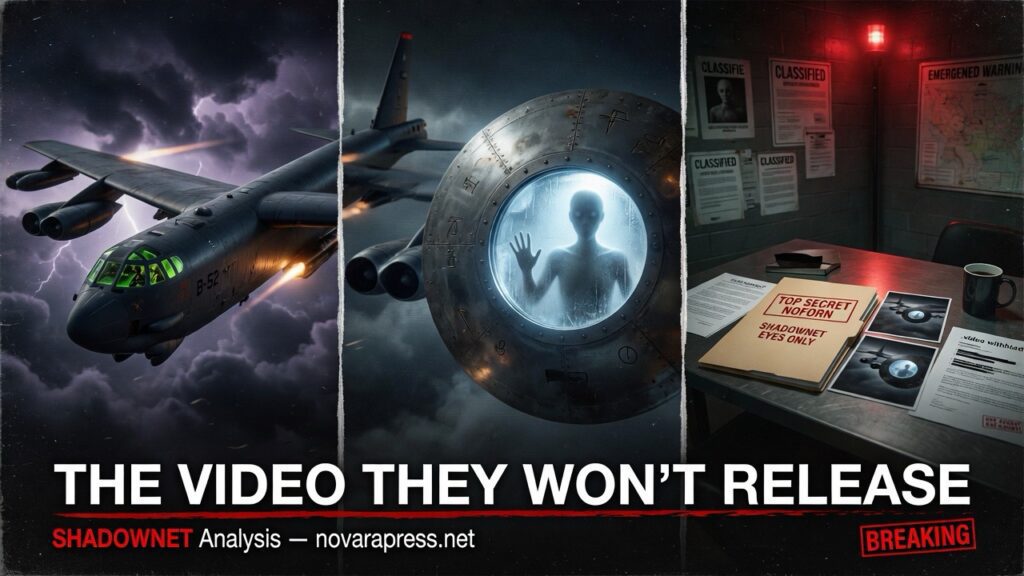
SHADOWNET ANALYSIS — SECTION 01
The B-52 UFO Video: Inside the Alleged Pentagon Footage That Could Trigger Full Disclosure
A rumored classified video, a grey figure at a window, and a growing fracture between believers and skeptics at the heart of the modern UAP disclosure movement.
SHADOWNET DESK
James Mercer — SHADOWNET Field Analysis | May 11, 2026
novarapress.net / SHADOWNET Analysis
F or years, the UFO debate survived on blurry infrared footage, radar leaks, cockpit audio, and testimony from military insiders willing to risk their clearances for a sliver of public credibility. The conversation was uncomfortable but containable — a community sustained by ambiguity, feeding itself on redacted documents and congressional hearings that confirmed everything and proved nothing.
The UFO disclosure debate has intensified following claims about a classified B-52 encounter video allegedly stored on Pentagon-level secure servers. | SHADOWNET Analysis — novarapress.net
But now, a new claim spreading through Reddit and X has reignited one of the oldest questions in modern history with a specificity that has shaken even longtime skeptics inside the community. According to multiple sources now circulating across UAP forums and disclosure networks, one alleged classified military video may show something without historical precedent in the public record: a disc-shaped craft pacing a U.S. Air Force B-52 strategic bomber, while a grey non-human figure appears to look out from inside the object.
No public footage has been released. No official confirmation exists. No evidence has been independently verified. Yet the story has detonated across Reddit after prominent UAP personalities claimed the video exists and has been viewed inside classified U.S. government systems — with at least one engineer stating he viewed it personally.
If such footage is authentic and ever released, it would not merely advance the disclosure debate. It would end it.
SECTION 01
The Reddit Thread That Reignited Disclosure Culture
The latest wave began with a viral Reddit thread posted in the r/UFOs community — a subreddit that has quietly become one of the most influential nodes in the modern disclosure ecosystem, with more than one million members and direct lines to military insiders, intelligence community veterans, and investigative journalists operating on the UAP beat.
The headline was direct and unambiguous: “The one video we need released, which will basically be disclosure: a grey alien looking out of the window of a disc, shot from a B-52.” The post quickly surged to the top of the community after referencing statements attributed to Australian investigative journalist Ross Coulthart and aerospace engineer Bob McGwier — both figures with documented credibility and significant institutional access inside the modern UAP discussion ecosystem.
The central architecture of the claim contained four distinct elements, each of which, if verified individually, would constitute a significant development. Together, they represent the most provocative disclosure-adjacent allegation to surface in years.
| Claim Element | Description | Verification Status |
|---|---|---|
| Classified video exists | Allegedly stored on SIPRNet-level secure Pentagon infrastructure | Unverified |
| B-52 platform | Footage allegedly captured from a U.S. strategic bomber in flight | Unverified |
| Disc-shaped craft pacing | Object slowed to match bomber’s airspeed, then accelerated away | Unverified |
| NHI figure visible | A humanoid “grey” entity reportedly visible through a window in the craft | Unverified |
SECTION 02
What Ross Coulthart Actually Said — And What It Means
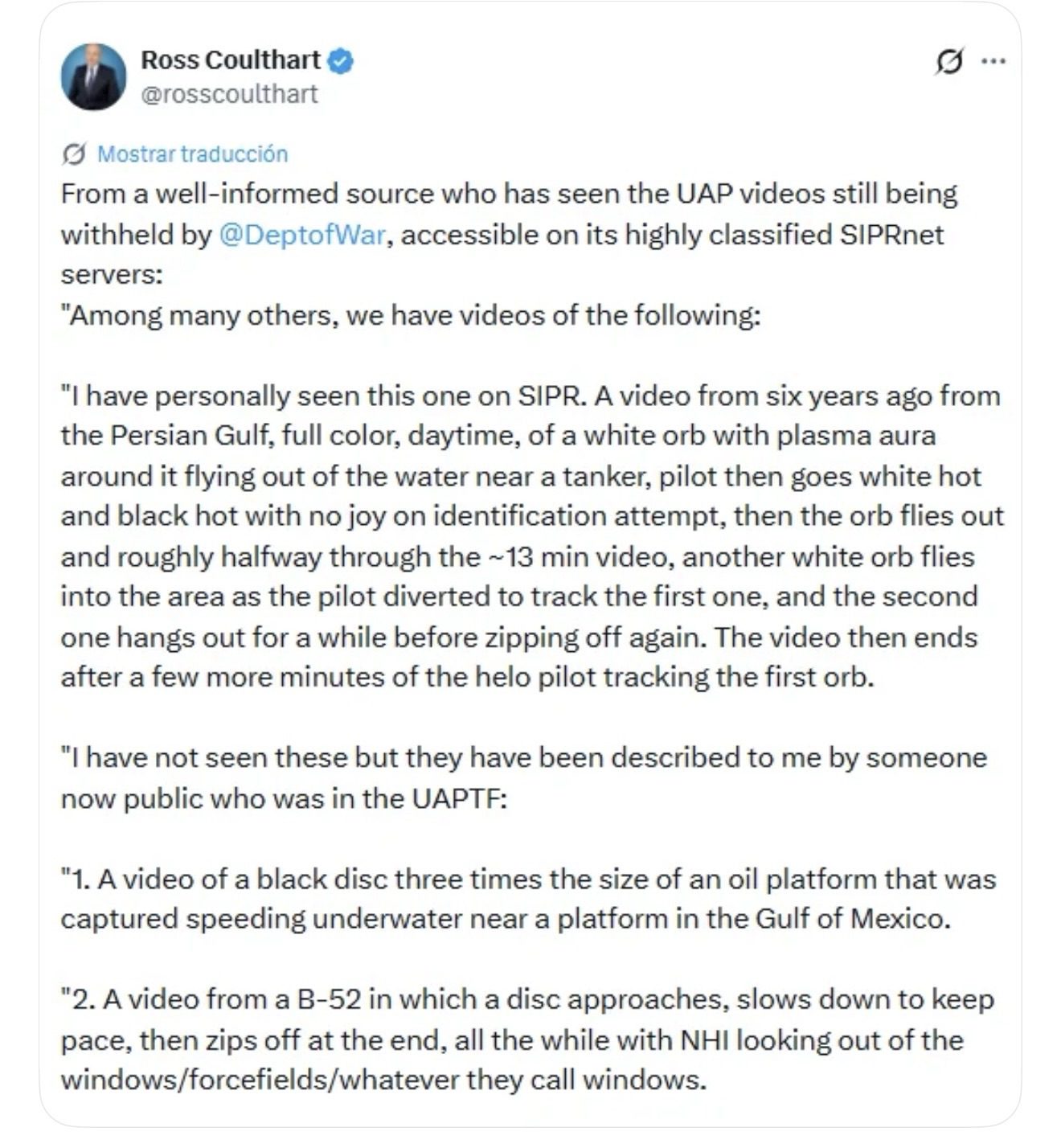
The thread traces its most explosive detail to statements attributed to Ross Coulthart — an award-winning Australian investigative journalist whose book In Plain Sight brought him into the center of the modern UAP media ecosystem. Coulthart has cultivated a reputation for sourcing information from active-duty and former military personnel with direct access to classified programs, and his claims carry weight in communities that have grown skeptical of anonymous whistleblowers.
According to screenshots spreading across multiple platforms, Coulthart referenced conversations with sources who allegedly viewed classified UAP material stored on SIPRNet — the Secret Internet Protocol Router Network used by the U.S. Department of Defense for classified communications up to the SECRET level. The mention of SIPRNet is significant. It is not a generic reference to “the government.” It implies a specific, institutional chain of custody for the footage being described.
“A video from a B-52 in which a disc approaches, slows down to keep pace, then zips off at the end — all the while with NHI looking out of the windows.”
“NHI” — Non-Human Intelligence — is a term that has migrated from fringe vocabulary into official government language. Witnesses before congressional UAP hearings have used it. Pentagon briefing documents have referenced it. Its appearance in Coulthart’s alleged statement is not accidental. It is precisely the language used by people who believe they are describing something real.
Among the alleged videos described in the circulating materials: a white orb emerging from water near a tanker in the Persian Gulf; a massive black disc moving underwater near the Gulf of Mexico; and the B-52 encounter. Each represents a distinct environmental domain — airborne, maritime surface, underwater — suggesting, if authentic, a pattern of activity operating across multiple operational theatres simultaneously.
SECTION 03
Why the B-52 Detail Changes the Conversation
The B-52 Stratofortress is not incidental to this story. It is the story. The aircraft has served in continuous frontline operations since 1955. It remains a cornerstone of America’s nuclear deterrence triad — capable of carrying both conventional and nuclear payloads — and it operates under protocols that make its flight paths and sensor systems among the most carefully monitored in the U.S. military inventory. A B-52 encounter, if real, is not a story about a Navy pilot seeing something unusual over water. It is a story about something operating in proximity to America’s most strategically sensitive aerial assets.
Inside UAP research communities, there exists a decades-long pattern of alleged sightings clustered around nuclear-connected infrastructure: missile silos in Montana, nuclear submarine berths, carrier strike groups on deterrence patrols. The pattern has never been conclusively proven — but it has been consistent enough, and sourced from enough credible military witnesses, that it cannot be dismissed as pure folklore.
If something is operating near B-52s with deliberate intent, the strategic implications dwarf the metaphysical ones. This is not a question about the cosmos. It is a question about security.
The alleged behavior described in the circulating claims — an object pacing a strategic bomber, reducing speed to match the aircraft’s velocity, then accelerating away at terminal velocity — would require propulsion and aerodynamic capabilities that no publicly known human technology can replicate at those parameters. That does not make the claim true. But it does explain why the engineering dimension of the story attracted Bob McGwier’s involvement.
SECTION 04
Bob McGwier and the Engineer Who Said He Saw It
Bob McGwier occupies an unusual position in the UAP space. He is not a television personality or a political operative. He is an engineer with documented expertise in radar, signal processing, and sensor systems — fields directly relevant to the technical evaluation of UAP footage. His involvement in the disclosure ecosystem is taken seriously by a subset of researchers precisely because his background implies the capacity to distinguish sensor artifacts from genuine anomalies.
According to screenshots spreading across Reddit and X, McGwier stated in response to the circulating video descriptions: “I have personally seen number 2.” When users allegedly pressed him on whether the entities resembled the classic “grey alien” described in decades of abduction literature, he reportedly responded with an affirmative emoji. That exchange — brief, informal, and entirely unverifiable through public channels — became one of the most viral moments in the recent UFO news cycle.
The reason is structural. The UFO community has grown deeply skeptical of anonymous sources and secondhand testimony. But McGwier is not anonymous. He has a professional identity, an institutional track record, and reputational skin in the game. If his statement is fabricated or misattributed, the cost to his credibility is significant. That calculus — not any verification of the footage itself — is what gave his alleged comment its traction.
SECTION 05
The Skeptic Surge — And Why It Matters More Than Believers Admit
Within hours of the thread going viral, a significant counter-movement emerged — not from outside the UFO community, but from inside it. Some of the most upvoted comments on the thread came from longtime community members expressing open frustration with what they described as a cycle of permanently undelivered promises. The pattern, they argued, was structurally identical to prior viral claims that produced no verifiable evidence.
The skeptical critique lands on three distinct pressure points: the absence of any authenticated frame from the alleged footage; the recurring role of the same small network of personalities in generating high-engagement disclosure claims; and the documented rise of AI image manipulation tools capable of fabricating realistic-looking UAP content at scale. Each of these concerns is legitimate on its own. Together, they form a serious epistemological challenge to community-sourced disclosure claims.
| Skeptic Argument | Community Response | SHADOWNET Assessment |
|---|---|---|
| No authenticated footage exists publicly | Classification makes release impossible without legal mechanism | Valid stalemate — neither side can resolve without release |
| Same voices make repeated unverified claims | Access to classified material requires insider trust, limiting sourcing pool | Structural conflict of interest — engagement incentives distort signaling |
| AI generation makes fabrication trivially easy | The current claim references existing classified material, not AI content | AI contamination of ecosystem is real — provenance questions now unavoidable |
SECTION 06
Scenario Matrix — Four Trajectories From This Point
SHADOWNET analysis identifies four plausible trajectories based on the current intelligence landscape. Each carries distinct implications for the UAP disclosure movement, the U.S. government’s institutional credibility, and the public’s relationship with classified information programs.
SCENARIO A — Probability: Low-Moderate
The Video Is Real And Is Released Via Legal Mechanism
A congressional UAP oversight process compels declassification through the All-domain Anomaly Resolution Office (AARO) or a similar body. The footage enters the public domain. Independent forensic analysis confirms its authenticity. The political and cultural aftermath is without historical precedent.
SCENARIO B — Probability: Moderate
The Video Exists But Remains Permanently Classified
The footage is real, but institutional forces — legal, political, and national security — prevent release indefinitely. The cycle of insider testimony continues. The public never receives confirmation. The disclosure movement fractures under the weight of permanent ambiguity.
SCENARIO C — Probability: Moderate-High
The Claims Are Misattributed Or Exaggerated
Screenshots circulating online are selectively edited or taken out of context. Coulthart and McGwier’s actual statements are more ambiguous than presented. The community processes another viral cycle with no resolution. Trust in insider sourcing erodes further, accelerating skeptic consolidation within disclosure spaces.
SCENARIO D — Probability: Low But Non-Zero
The Footage Is Fabricated As An Information Operation
The claim is a deliberate information operation designed to either discredit the legitimate UAP research community or misdirect public attention from classified human aerospace programs. Historical precedent exists for such operations. If true, the implications for how disclosure narratives are being managed from inside the national security apparatus are deeply serious.
The psychology of disclosure has always operated on deferred gratification. Communities that have spent decades expecting a definitive moment of official acknowledgment have developed an emotional dependency on proximity to that moment — the feeling of being close. Every new insider, every new alleged footage description, every congressional hearing that ends without resolution feeds that dependency while postponing its resolution.
What is different about the current moment is the institutional infrastructure that now surrounds the claim. The existence of the All-domain Anomaly Resolution Office, active UAP legislation in Congress, former intelligence officials speaking on record about non-human intelligence, and the documented confirmation of earlier UAP footage by the Pentagon itself — all of this means that the context into which the B-52 claim drops is fundamentally different from the environment that surrounded prior viral disclosure stories.
This does not make the claim true. But it does mean that the mechanisms through which such footage could theoretically be forced into the public domain now exist in ways they did not five years ago. That structural reality is why the story is being taken seriously by people who have spent years developing a refined skepticism about unverifiable insider testimony.
SHADOWNET FINAL ASSESSMENT
The B-52 UFO claim cannot be confirmed. But it cannot be confidently dismissed either — and that distinction now matters more than it once did.
The institutional landscape around UAP disclosure has shifted materially since 2017. Government bodies with statutory authority now exist. Former senior intelligence officials speak on record. Pentagon footage has been authenticated. The gap between what the U.S. government knows and what it has chosen to share with the public is no longer a matter of conspiracy theory — it is a matter of documented, acknowledged policy.
Whether the B-52 video is real, misattributed, or fabricated, the conversation it has generated reflects a legitimate institutional question: at what point does the public’s right to understand what is operating in its airspace — and potentially interacting with its nuclear assets — outweigh the national security arguments for permanent classification?
That question will not disappear if this particular claim proves false. It will simply wait for the next one.
TAGS
SOURCES
- Reddit r/UFOs community discussions and viral thread, May 2026.
- Public statements attributed to Ross Coulthart via X (formerly Twitter), circulating screenshots.
- Publicly circulating screenshots involving Bob McGwier comments on classified UAP material.
- U.S. Department of Defense — All-domain Anomaly Resolution Office (AARO) official public disclosures, 2023–2024.
- U.S. Congressional UAP hearings, House and Senate Armed Services Committees, 2022–2024.
- Pentagon confirmation of UAP footage (FLIR1, Gimbal, GoFast), 2020.
- Ross Coulthart, In Plain Sight, HarperCollins, 2021 — for contextual sourcing on insider access methodology.
- SIPRNet classification infrastructure — U.S. Defense Information Systems Agency (DISA) public documentation.