
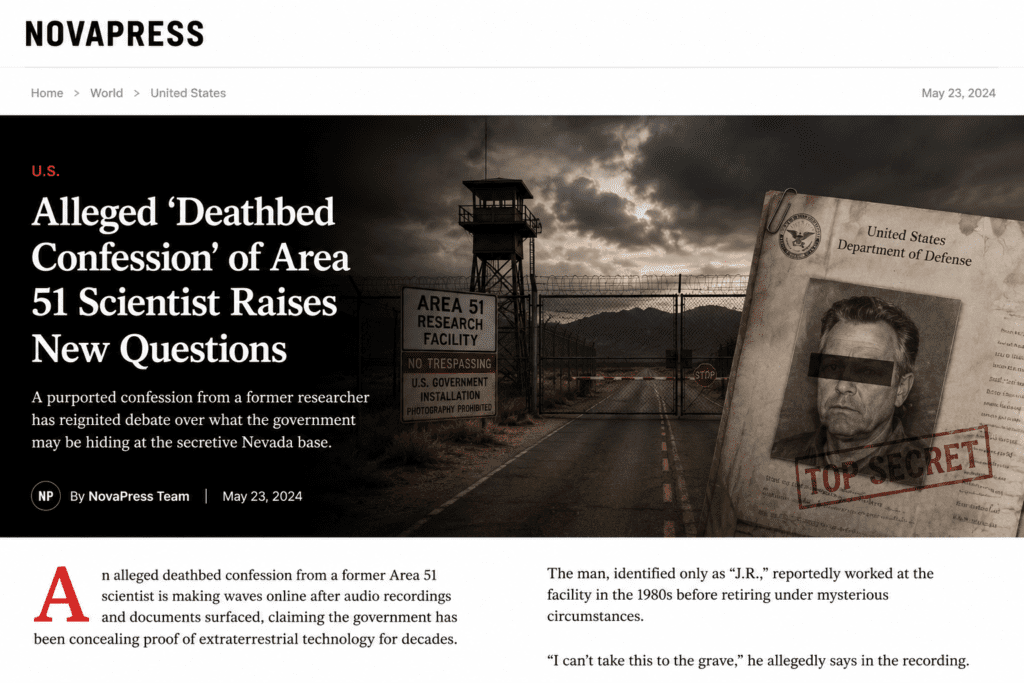
Alleged ‘Deathbed Confession’ of Area 51 Scientist Raises Eyebrows
*Claims of extraterrestrial encounters at Area 51 spark questions about secrecy and intelligence operations*
Tales of extraterrestrial encounters and top-secret technologies have long surrounded the infamous Area 51, a remote detachment of Edwards Air Force Base within the Nevada Test and Training Range. Recently, the posthumous statements of a purported Lockheed Martin scientist have reignited debates over what exactly transpires behind the heavily fortified barriers of this enigmatic location. The scientist, who claimed to have top-secret clearance, alleged in a ‘deathbed confession’ that he had direct dealings with individuals connected to physicist Edward Teller, suggesting a possible link between Teller’s post-Manhattan Project endeavors and ongoing projects at Area 51.
Background on the Confession and Key Players
The claims emerged from a video interview given by Boyd Bushman, a former engineer at Lockheed Martin. In this interview, Bushman purportedly shared details of his involvement in covert operations at Area 51, a site long associated with alien conspiracy theories. Bushman’s statements have attracted significant attention due to his reputed association with Edward Teller, a pivotal figure in the development of nuclear weapons.
Bushman asserted that approximately 13 years before his interview, he interacted with a man linked to Teller, who remained involved with secret projects at Area 51 even after J. Robert Oppenheimer’s departure. This connection, according to Bushman, was instrumental in his understanding of the alleged extraterrestrial operations taking place at the base.
While such claims are often dismissed as speculative or conspiratorial, they have nonetheless provoked a renewed interest in the extent of government secrecy surrounding military and intelligence activities at Area 51. The implications of Bushman’s statements, if true, could suggest a more profound and potentially unsettling narrative regarding the U.S. government’s engagement with non-terrestrial entities.
Analyzing the Veracity of the Claims
Assessing the credibility of Bushman’s confession is challenging, primarily due to the classified nature of the operations at Area 51. The base is a focal point for both legitimate defense research and speculative folklore. Historically, the U.S. government has acknowledged the existence of Area 51 but has consistently downplayed its significance, often attributing its activities to advanced aircraft testing.
Critics argue that Bushman’s claims lack corroborative evidence. No official documents or credible witnesses have emerged to substantiate the presence of extraterrestrial life or technologies at the site. Moreover, the reliability of deathbed confessions is often questioned, as they can be influenced by various psychological factors, including a desire to leave a lasting legacy or the effects of medication.
Nonetheless, the involvement of a reputable scientist like Edward Teller, if true, adds an intriguing dimension to these allegations. Teller’s known interest in advanced scientific research and his influential role in post-World War II military projects provide a plausible backdrop for such secretive collaborations, although there is no public record confirming his direct involvement with Area 51 in the context described by Bushman.
Implications for National Security and Intelligence
The implications of Bushman’s claims extend beyond the realm of science fiction, touching on critical aspects of national security and intelligence operations. If true, the existence of extraterrestrial technologies at a U.S. military facility could represent both a revolutionary scientific breakthrough and a potential security risk. The management of such sensitive information would require stringent intelligence measures to prevent unauthorized disclosure or exploitation by foreign adversaries.
Moreover, the alleged connection to Edward Teller raises questions about the historical continuity of secretive scientific endeavors within the U.S. defense establishment. The potential involvement of high-profile scientists in undisclosed projects underscores the intricate relationship between scientific innovation and military strategy during the Cold War and beyond.
From an intelligence perspective, the strategic manipulation of public perception through controlled leaks or disinformation campaigns could also serve as a tool to obscure the true nature of activities at Area 51. The ambiguity surrounding the base’s operations may be a deliberate tactic to maintain operational security while fostering an environment of uncertainty and speculation.
“The strategic manipulation of public perception through controlled leaks or disinformation campaigns could serve as a tool to obscure the true nature of activities at Area 51.”
James Mercer, Geopolitical Risk Analyst
The claims made by Boyd Bushman regarding extraterrestrial encounters at Area 51 remain unverifiable and speculative. However, they highlight the enduring intrigue and mystery surrounding the facility, as well as the broader challenges of balancing transparency with national security in intelligence operations. While the lack of concrete evidence precludes definitive conclusions, the continued interest in Area 51 underscores the public’s fascination with the unknown and the potential implications for defense and scientific research.
Ultimately, the narrative surrounding Area 51 serves as a reminder of the complexities inherent in managing classified military projects and the delicate interplay between government secrecy and the public’s right to information. As long as such operations remain shrouded in mystery, speculation will continue to thrive, fueled by both legitimate inquiries and unfounded conspiracy theories.
SOURCES
- 1. The Washington Post — https://www.washingtonpost.com
- 2. The New York Times — https://www.nytimes.com
- 3. BBC News — https://www.bbc.com/news
- 4. CNN — https://www.cnn.com