
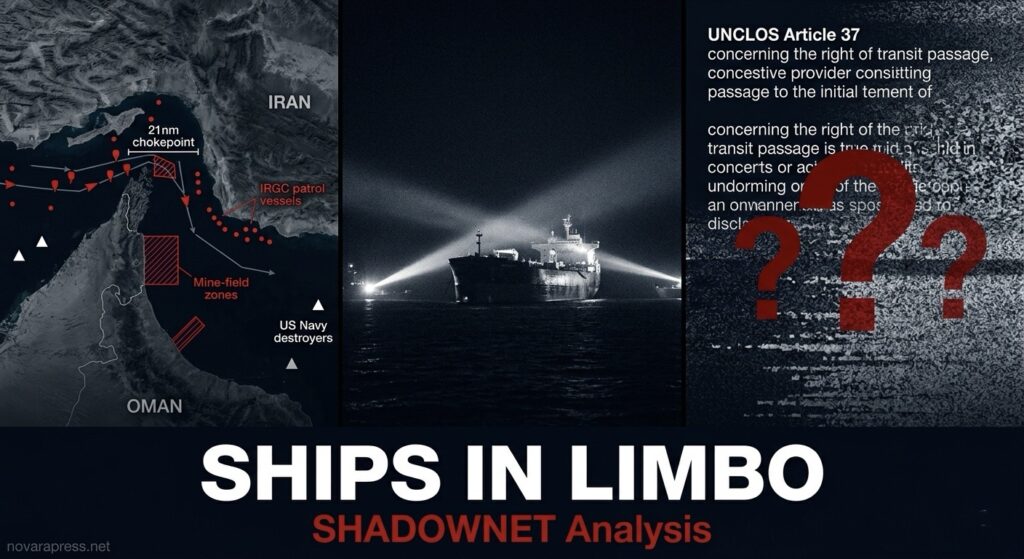
It is one of the most precise and underexamined questions of the current crisis: if the fragile US–Iran ceasefire collapses while a commercial tanker is already passing through the Strait of Hormuz, what legal framework governs that ship? Who is responsible for its crew? Can either side legally fire? The honest answer is deeply unsettling — and it exposes the catastrophic gap at the heart of modern international maritime law.
The Strait as a Legal No-Man’s Land
Even before the first shot is fired in a hypothetical resumption of hostilities, the Strait of Hormuz already exists in a legal gray zone that few analysts have been willing to confront directly. Neither the United States nor Iran has ratified the United Nations Convention on the Law of the Sea (UNCLOS) — the primary treaty governing the right of transit passage through international straits. Washington treats key elements of UNCLOS as binding customary international law; Tehran rejects the transit passage regime entirely, asserting a more limited doctrine of “innocent passage” that gives coastal states far broader authority to regulate, and even suspend, maritime traffic.
This is not a technical footnote. It is the structural flaw on which the entire crisis turns. As legal scholars at Lawfare have argued, the law of the sea and the law of naval warfare pull in opposite directions at precisely the moment they are needed most — transit passage assumes uninterrupted navigation, while the law of armed conflict permits interference with shipping. When a ceasefire collapses, both legal regimes simultaneously claim jurisdiction over the same vessel, and neither can enforce itself.
What Does “Violation” Even Mean Here?
The first obstacle to answering the question is definitional. The April 8 ceasefire agreement — brokered by Pakistan — contained enough ambiguity to guarantee precisely the dispute it was meant to prevent. Iran insists the truce covers Lebanon and the broader “axis of resistance.” The United States and Israel maintain it applies only to direct US–Iran hostilities. When US Navy Arleigh Burke-class destroyers transited the Strait on April 11 under the banner of “mine clearance operations,” Iran reportedly interpreted the maneuver as a ceasefire violation and threatened to attack the ships. CENTCOM characterized the same transit as a routine freedom-of-navigation exercise.
This is not a legal dispute. It is a definitional war conducted in parallel with the kinetic one. And it creates the precise scenario that makes mid-transit ships the most exposed objects in the entire conflict: both parties believe they are legally entitled to act, and both have the capacity to do so faster than any commercial crew can reach safe water.
Three Scenarios, Three Catastrophes
Mapping the possible sequences reveals how rapidly a mid-transit ceasefire collapse becomes unmanageable.
Scenario One: Iran Closes the Strait While Ships Are Mid-Channel
As of April 9, approximately 230 loaded oil tankers were still waiting inside the Gulf, according to Sultan Al Jaber, CEO of Abu Dhabi National Oil Company. The vessels already in transit during a ceasefire breakdown would face an immediate tactical dilemma: turn back into Iranian-controlled waters, attempt to force passage, or stop in place. Under Iran’s declared posture — that any military vessel approaching the strait would meet a “severe response,” and that commercial ships must coordinate with IRGC naval forces — even the act of continuing forward could be reframed as non-compliance. A stopped tanker in a minefield is not a neutral object. It is a target.
Scenario Two: A US Strike Occurs While Civilian Vessels Are in the Corridor
The US naval blockade, as clarified by CENTCOM, applies to ships entering or leaving Iranian ports but explicitly pledges not to impede freedom of navigation for vessels transiting to non-Iranian ports. But this distinction — clean on paper — collapses the moment a strike begins. The Strait of Hormuz is 21 nautical miles at its narrowest point. A strike on Iranian coastal infrastructure, a mine-clearance operation that Iran interprets as hostile, or even a cyber-incident triggering navigational failure could place civilian vessels in the active kill chain within minutes. The law of armed conflict imposes obligations of distinction, proportionality, and precaution — but in a narrow channel crowded with tankers, mines, and IRGC patrol boats, those obligations are physically impossible to honor simultaneously.
Scenario Three: A Third-Party Incident Triggers Escalation
This is the most likely and least discussed scenario. Iran has reportedly lost track of some of the sea mines it planted in the strait. A neutral vessel — say, an Indian or Chinese tanker that had already paid Iran’s transit toll and was following the IRGC-designated northern route — strikes a drifting mine. Who is responsible? Under the Hague VIII Convention of 1907, states are required to take all possible precautions to ensure the safety of peaceful shipping when deploying naval mines. Iran’s inability to fully account for its own mines does not legally discharge that obligation. It compounds it. But liability without enforcement is philosophy, not protection. There is no rapid-response legal mechanism that can pull a crew out of a sinking tanker in the Strait of Hormuz in the next forty-five minutes.
The “Tehran Toll Booth” and the Hostage Logic
What the current configuration actually resembles — stripped of diplomatic language — is a hostage architecture. Iran’s “coordinated route” protocol requires commercial vessels to transmit their cargo details, destination, and ownership information to IRGC maritime authorities before passage. Ships deemed linked to “hostile nations” are denied transit. This is not administration. It is leverage, operationalized. As Just Security’s analysts have noted, Iran’s toll regime violates at least three distinct provisions of UNCLOS-derived customary law: the prohibition on impeding transit passage, the ban on non-service-related fees, and the prohibition on discriminatory application of passage rights.
But the geopolitical effect is even more disturbing than the legal violation. By establishing a system where ships must register with the IRGC to pass, Iran has effectively created a database of every major commercial vessel moving through the world’s most critical energy corridor. In the event of ceasefire collapse, that database becomes a targeting list. Every ship that followed the approved northern route, paid in cryptocurrency or yuan, and coordinated with Iranian forces has, in practical terms, announced its position, identity, and cargo to the party most likely to be shooting.
What International Law Actually Offers — And Doesn’t
The prevailing scholarly view, articulated by institutions including the Institute for National Security Studies (INSS) and Chatham House, holds that the right of transit passage through the Strait of Hormuz cannot be suspended even during armed conflict. This is considered part of customary international law binding on all states regardless of UNCLOS ratification. The Israeli National Security Studies Institute states it plainly: the right of transit passage in an international strait cannot be suspended, even during armed conflict.
Iran disputes this. Tehran’s position — that it has been a “persistent objector” to the transit passage regime since UNCLOS was negotiated — carries some legal weight in the minority academic literature. The Nation has argued that because Iran explicitly objected to transit passage during UNCLOS negotiations and has maintained that objection consistently ever since, it cannot be bound by it even as customary law. This argument is a minority position but not a frivolous one. And in a kinetic crisis, legal minority positions do not protect hulls.
Meanwhile, the US blockade — however CENTCOM has defined its scope — is, under international law, an act of war. Chatham House’s analysts have stated this without ambiguity: a blockade is an act of war, and its imposition compounds the fact that the US and Israel have launched an unlawful war against Iran. The US argues its blockade targets only Iranian ports, not neutral shipping. But the practical effect on a vessel mid-transit, receiving competing navigational orders from US naval assets and IRGC patrol boats simultaneously, is indistinguishable from being caught in active combat.
The Precedent Problem: What No One Wants to Acknowledge
The 1988 Operation Praying Mantis — the largest US surface naval engagement since World War II — offers a partial precedent. It followed an Iranian mine strike on the USS Samuel B. Roberts and involved the destruction of two Iranian oil platforms and the sinking of multiple IRGC naval vessels. Critically, commercial traffic was disrupted throughout. The lesson of 1988 was not that international law protected neutral shipping — it was that the United States chose to limit its operations, not because law required it, but because political cost calculations favored restraint.
In 2026, those calculations are different. Iran has conducted at least 21 confirmed attacks on merchant ships since February 28. Over 800 commercial vessels have been stranded; 10 crew members have been killed. The International Chamber of Shipping has warned that approximately 20,000 seafarers cannot currently transit the area safely. If the ceasefire breaks while any portion of these crews is mid-channel, the political pressure on both Washington and Tehran to project strength will be overwhelming — and no court, no resolution, no UNCLOS provision will intervene between the order to fire and the moment of impact.
The Question No Diplomat Has Answered
What actually happens to a ship caught mid-transit when the ceasefire collapses? The legal answer is that the ship retains rights under customary international law that neither belligerent is obligated, in practice, to honor. The operational answer is that the vessel’s captain has approximately the same options as any civilian caught between two armies on a highway: stop, turn back, or accelerate and hope. The strategic answer is that the ship becomes a political instrument the moment shooting resumes — its flag, its cargo, its ownership structure, and its last known GPS position will all be weaponized within hours.
This is not hyperbole. It is the structure of the situation. And it is why the question — if there is a violation of the ceasefire while their ships are in transit, what happens then? — is not a footnote to the larger diplomatic drama. It is the sharpest available lens through which to understand what the current “ceasefire” actually is: not a legal instrument with enforcement mechanisms, but a temporary suspension of violence whose expiration terms are disputed by every party that signed it, and whose breakdown contingencies protect no one in the water.
Conclusion: The Strait as a Mirror
The Strait of Hormuz has always been a mirror held up to the international order. When that order was functioning — imperfectly, selectively, but functionally — the transit passage regime held. Ships moved. Oil flowed. The legal fiction of freedom of navigation was maintained because enough states with enough naval power chose to maintain it.
What the 2026 crisis has revealed is that the mirror is cracked. The legal architecture that governs the strait was built for a world where at least one major party respected the rules. Today, no party fully does. The United States applies UNCLOS selectively. Iran rejects the core transit passage regime. The IRGC has planted mines it can no longer fully locate. The ceasefire is defined differently by everyone who agreed to it. And 230 tankers sit in the Gulf, loaded, waiting, their crews in legal and physical limbo — hoping the next round of talks in Islamabad produces something that a Pakistani mediator’s statement of “remarkable wisdom” has so far failed to deliver.
The ships in the water are not symbols. They are the question.
Sources & References
- Wikipedia — 2026 Strait of Hormuz Crisis. en.wikipedia.org
- Wikipedia — 2026 Iran War Ceasefire. en.wikipedia.org
- Al Jazeera — US–Iran Ceasefire Deal: What Are the Terms, and What’s Next? (April 8, 2026). aljazeera.com
- CNBC — Iran Declares Strait of Hormuz Open to Shipping During Lebanon Ceasefire (April 17, 2026). cnbc.com
- CBS News — Live Updates: Iran Fires on Ships in Strait of Hormuz (April 18, 2026). cbsnews.com
- NBC News — Strait of Hormuz Shipping Traffic Effectively at a Standstill Despite Iran Ceasefire. nbcnews.com
- CNN — Day 49 of Middle East Conflict: Iran Declares Strait of Hormuz Open (April 17, 2026). cnn.com
- Chatham House — The Strait of Hormuz, Shipping, and Law (April 2026). chathamhouse.org
- Lawfare — The Strait of Hormuz and the Limits of Maritime Law. lawfaremedia.org
- Just Security — Mined and Blockaded: Iran’s Unlawful Mining and the US Port Blockade (April 2026). justsecurity.org
- Just Security — Continuing Crisis in Strait of Hormuz: Iran’s Hold Is Illegal and US Military Force Alone Fails. justsecurity.org
- The Nation — Only One Side Has Clearly Broken the Law in the Strait of Hormuz (April 2026). thenation.com
- INSS — The Strait of Hormuz as a Key Theater of War: The Legal Dimension. inss.org.il
- Eno Center for Transportation — The Legal Question of Tolling Hormuz. enotrans.org
- International Chamber of Shipping — Statement on freedom of navigation in the Strait of Hormuz (quoted via NBC News, April 2026).