
Hormuz on the Brink: How Iran Weaponized the World’s Most Critical Chokepoint
From the first warning shots to a fragile ceasefire to an American naval blockade — the 2026 Strait of Hormuz crisis has redrawn the rules of maritime power. This is the full picture.
The Chokepoint That Runs the World
There is a strip of water barely 33 kilometers wide at its narrowest point. Two shipping lanes, each roughly three miles across. Shallow enough that large vessels have almost no room to maneuver. And through this corridor, every single day, passes roughly 20 percent of the world’s oil supply and an equivalent share of its liquefied natural gas.
The Strait of Hormuz has always been described as a chokepoint. In 2026, it became a weapon.
What began as escalating tension between Iran and the United States culminated on February 28, 2026, when Washington and Tel Aviv launched coordinated strikes on Iranian territory under Operation Epic Fury — targeting military infrastructure, nuclear facilities, and Iranian leadership. Among those killed was Supreme Leader Ali Khamenei. Iran’s response was immediate and strategically calculated: it closed the Strait of Hormuz to all foreign shipping, triggering the most severe disruption to global energy markets since the oil crisis of the 1970s.
Anatomy of a Closure
Iran did not close the strait overnight. The architecture of the blockade was built in layers.
In the days before the US-Israeli strikes, Iranian signals were already being read by the market. War-risk insurance premiums for tankers transiting the strait nearly tripled — from 0.125 percent to as high as 0.4 percent of a vessel’s total insured value per transit. For a Very Large Crude Carrier, that translated to an additional quarter of a million dollars per crossing — before a single shot was fired.
On February 28, as Operation Epic Fury commenced, the Islamic Revolutionary Guard Corps Navy began broadcasting VHF transmissions across the strait declaring that ship passages were “not allowed.” The message carried no legal force under international law — but it carried something more effective: credibility backed by firepower.
By March 2, the IRGC made it official. A senior commander confirmed that the Strait of Hormuz was closed and warned that any vessel attempting to transit would be targeted. Two days later, the IRGCN claimed “complete control” of the waterway. The automatic identification system signals from tankers in the strait — the digital heartbeat of maritime traffic — went dark. The world’s most important energy corridor had effectively stopped.
The Geography Advantage
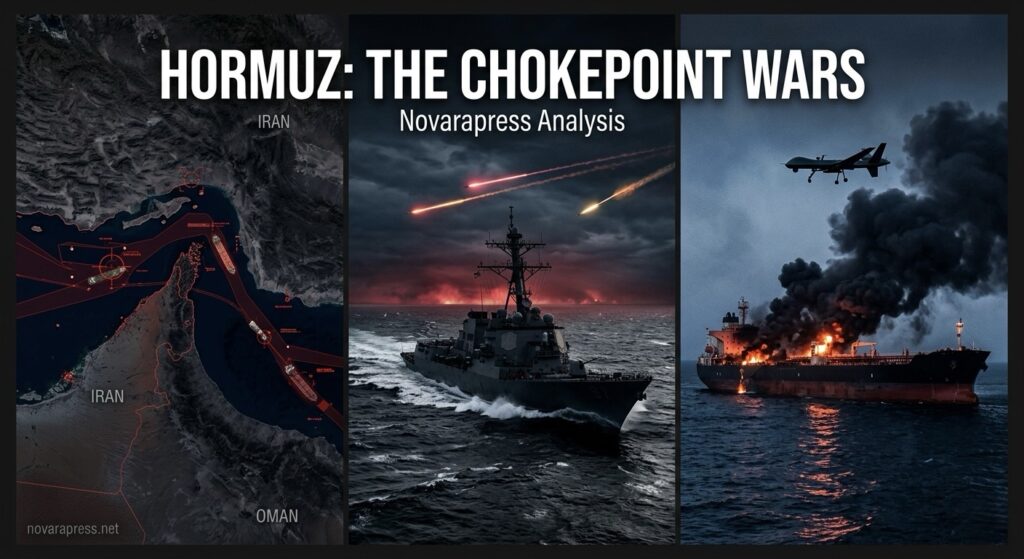
To understand why Iran can hold the strait, you have to look at a map — really look at it.
Iran’s coastline runs along the entire northern edge of the strait. Its military bases sit directly on top of the shipping lanes. The two narrow transit channels force massive, slow-moving tankers into predictable, fixed paths — turning them, as one defense analyst put it, into targets in a shooting gallery. The shallow waters prevent evasive maneuvering. The terrain compresses the battlespace to Iran’s maximum advantage.
“All in all, Hormuz’s geography amplifies Iran’s anti-access and area-denial leverage at low cost,” Lancaster University’s Professor Basil Germond told the Washington Post. Iran’s toolkit — mines laid in the shipping lanes, fast-attack boats, one-way drone swarms — is cheap to deploy and enormously expensive to counter. The IRGC does not need to match US Navy firepower. It only needs to make the passage dangerous enough that no insurer will cover it.
And it worked. Hapag-Lloyd, one of the world’s largest shipping operators, announced that its vessels would not transit the strait until “safety and security guarantees” were in place. Other major carriers followed. The Persian Gulf became a holding pen.
The Economic Shockwave
The numbers are staggering.
Brent crude oil surpassed $100 per barrel on March 8, 2026 — for the first time in four years — and peaked at $126 per barrel. The March 2026 increase in oil prices was the largest single-month rise ever recorded in the history of the global oil market. The International Monetary Fund cut its global growth forecast for 2026 to 3.1 percent, down from earlier projections, warning of drift toward an “adverse scenario” if prices remained elevated.
Beyond oil, the crisis cascaded into adjacent commodity markets. Aluminum prices surged, driven by energy-intensive smelting costs. Fertilizer supplies — heavily dependent on Gulf natural gas — tightened. Even helium, largely sourced from Qatar’s massive LNG operations, faced supply disruptions. Qatar itself, one of the world’s top LNG exporters, briefly halted production after Iranian drone strikes hit industrial facilities at Ras Laffan and Mesaieed.
The Gulf Cooperation Council — Bahrain, Kuwait, Oman, Qatar, Saudi Arabia, and the UAE — all depend on the Strait of Hormuz as their only maritime export route. The IMF downgraded the GCC’s economic growth forecast by 1.8 percentage points in March alone, setting back years of diversification efforts in a matter of weeks.
For Iran itself, the economic blowback was severe. More than 90 percent of Iran’s $109.7 billion in annual seaborne trade flows through the Strait. With no viable alternative trade routes, the US naval blockade imposed in April — cutting off Iranian ports entirely — was estimated by analysts at the Foundation for Defense of Democracies to cost Tehran approximately $435 million per day in combined economic damage.
The US Military Response: Operation Reopen
Washington did not accept the closure passively. On March 19, General Dan Caine announced the deployment of A-10 Thunderbolt II jets to strike Iranian fast-attack watercraft and AH-64 Apache gunships to intercept drone swarms threatening commercial shipping. US Central Command published strike footage within hours. Six European nations — France, Germany, Italy, Japan, the Netherlands, and the United Kingdom — declared support for the reopening campaign. Ultimately 22 countries signed a joint statement pledging contributions to ensure safe passage.
The diplomatic track ran parallel. On March 21, President Trump issued a 48-hour ultimatum to Iran: fully open the strait “without threat” or face strikes on Iranian power infrastructure. Iran responded by threatening to “completely” close the strait and strike desalination facilities critical to drinking water supplies across the region.
The assassination of Admiral Alireza Tangsiri — the IRGC naval commander overseeing the blockade — by Israeli forces on March 26 marked a direct escalation against the operational leadership of Iran’s maritime strategy.
The Ceasefire That Wasn’t
On April 8, a fragile two-week ceasefire was announced between the US and Iran, nominally designed to resume navigation through the strait. Within hours, the agreement began to unravel.
Iran announced that under the deal’s terms, ships would be required to coordinate passage with Iranian armed forces — and in some cases pay a toll for transit. Trump called the demands “extortion.” The US countered with its own proposal: American-imposed tolls and European participation in managing the corridor. Iran closed the strait again later that same day following continued Israeli strikes in Lebanon.
On April 12, talks in Islamabad between US and Iranian delegations collapsed without agreement. The following day, the United States imposed a full naval blockade on Iran — deploying more than 10,000 personnel, over a dozen warships, and carrier air assets in the Gulf of Oman and Arabian Sea to cut off Iranian seaborne trade entirely.
By April 11, Trump announced that American forces had begun “clearing” the strait — including mine-clearance operations after reports emerged that Iran had lost track of some of the mines it had laid in the shipping lanes. Several US Navy destroyers entered the strait for the first time since the conflict began. Iran threatened to attack the ships, calling it a ceasefire violation. CENTCOM characterized the operation as focused on “freedom of navigation through international waters.”
The Geopolitical Deadlock
At the United Nations, Bahrain introduced a Security Council resolution calling on all states to ensure safe passage through the strait. On April 7, Russia and China jointly vetoed the proposal, with both powers arguing it was biased against Iran and could be used to justify further military escalation. The Iranian ambassador praised the veto. Washington and Paris condemned it.
The veto crystallized a broader realignment: the Strait of Hormuz crisis is no longer purely a US-Iran confrontation. It has become a theater where the competing interests of the post-unipolar world — American naval primacy, Chinese energy dependence, Russian strategic opportunism, and Iranian defiance — are playing out simultaneously, in real time, at a chokepoint that none of them can afford to lose.
China, which imports roughly 40 percent of its oil through the Strait and purchases more than 80 percent of Iranian crude exports, faces acute exposure. Beijing has called the US blockade “dangerous and irresponsible” — but has limited leverage beyond diplomatic condemnation so long as it depends on the same corridor it is seeking to protect.
What Comes Next
As of this writing, the Strait of Hormuz remains in a state of suspended crisis. Mines persist in the shipping lanes. Major carriers refuse to transit without ironclad security guarantees. Oil prices remain elevated above $90 per barrel even after ceasefire signals provided marginal relief. Iran’s IRGC leadership insists that control of the strait is a “sovereign and legal matter” on which Tehran will make no concessions.
The fundamental equation has not changed. Geography still gives Iran asymmetric leverage over a waterway it does not need to dominate militarily — only to make too dangerous for others to use freely. The US can destroy Iranian naval assets. It cannot move Iran’s coastline.
What the 2026 Strait of Hormuz crisis has demonstrated — more clearly than any war game or strategic estimate — is that the global energy system’s single most critical vulnerability is also its most politically complex. Six weeks of conflict have produced no reopening, no stable settlement, and no exit ramp that all parties can accept.
The chokepoint remains. And so does the weapon.