
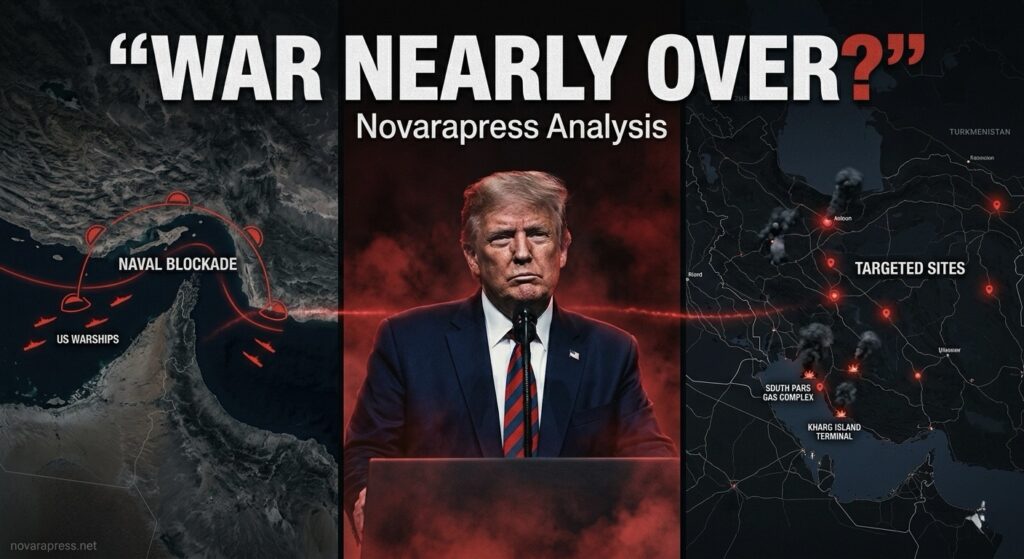
Trump Says Iran War Is “Very Close to Being Over” — But the Blockade Tells a Different Story
In a preview clip aired on Fox News Tuesday, President Donald Trump told anchor Maria Bartiromo that the US-Israeli war on Iran is “very close to being over.” It was a confident, economical sentence — the kind Trump deploys when he wants the headline without the nuance. The problem is that the past 48 hours have produced a naval blockade, a collapsed peace process, a ticking ceasefire clock, and a Chinese tanker that sailed through the “blockade” without incident. The gap between what Trump says and what is actually happening in the Strait of Hormuz has become the defining feature of this conflict.
The Rhetoric Loop
Trump has been saying the war is nearly over since the first week of fighting. Analysts at Al Jazeera noted after his April 1st primetime address that the president made four internally contradictory claims simultaneously: the war is necessary; it has already been won; it must continue; and it will wrap up soon. That rhetorical structure — victory and escalation existing in the same breath — has become a signature of how this White House manages a conflict it neither fully controls nor wants to own politically.
The Fox News clip is the latest iteration of that loop. By saying the war is “very close to being over,” Trump is doing several things at once: reassuring domestic audiences anxious about gas prices above $4 per gallon, applying psychological pressure on Tehran ahead of the April 21 ceasefire deadline, and preserving maximum ambiguity about what “over” actually means.
What the Ground Reality Looks Like
Strip away the presidential framing and the situation looks considerably less resolved. On April 13, Trump announced a naval blockade of Iranian ports — a dramatic escalation following the collapse of 21-hour marathon talks in Islamabad between US Vice President JD Vance and Iranian Foreign Minister Abbas Araghchi. Vance acknowledged that Iranian negotiators “moved in our direction… but they didn’t move far enough,” while Tehran accused Washington of “maximalism and shifting goalposts” every time a deal appeared within reach.
The blockade itself is already under strain. Reuters, citing data from MarineTraffic and Kpler, reported that a US-sanctioned Chinese tanker transited the Strait on Tuesday in apparent defiance of the interdiction order. Iran’s IRGC declared that any US naval vessel encroaching on the Strait constitutes a ceasefire violation. Senior IRGC adviser Mohsen Rezaee stated publicly that Iran has “significant untapped capabilities” and that its military “will not allow such a move.” Meanwhile, Brent crude closed at $95.20 per barrel on Friday — up more than 31% since the war began in late February — with energy analysts warning that prices will remain elevated well into late 2026 regardless of how the conflict ends, given the time required to repair damaged infrastructure and reopen the Strait to normal traffic.
The Diplomacy Dimension
Perhaps the most significant signal buried beneath Trump’s “almost over” comment is what it implies about the diplomatic track. The White House confirmed Tuesday that a second round of US-Iran talks is under active internal discussion, with Pakistan again offering Islamabad as a venue. Trump himself told reporters and The New York Post that “something could be happening” in Pakistan within two days — a rare direct hint at imminent diplomatic movement from a president who typically governs by surprise.
The ceasefire, extended two weeks after Trump’s April 7th deadline, expires on April 21. That gives negotiators less than a week. Vance’s team — alongside Steve Witkoff and Jared Kushner — has remained in contact with Iranian intermediaries since the Islamabad session. CNN reported that Trump officials are “not keen to resume the war,” partly because of its domestic economic fallout and partly because it polls poorly with the American public. Iran, for its part, has signaled it wants to maintain some form of control over the Strait even post-war, framing toll fees as war reparations — a demand Washington has flatly rejected.
The Geopolitical Stakes
The Strait of Hormuz remains the fulcrum of the entire conflict. The International Energy Agency estimates the Strait carries approximately 20% of global oil consumption, with the overwhelming share of that volume flowing to Asian markets — Japan, South Korea, China, and India. Every day the Strait remains contested, Washington’s allies in Asia absorb disproportionate economic pain while the US, as the world’s largest oil producer, insulates itself. This asymmetry is not lost on Beijing, which has watched a US-sanctioned tanker navigate the “blockade” and drawn its own conclusions about enforcement credibility.
Regionally, the war has opened a second front in Lebanon, with Israeli-Lebanese ceasefire talks resuming in Washington on Tuesday for the first time since 1983 — though Hezbollah has publicly rejected the process. Iran has made Lebanon’s inclusion in any broader ceasefire a formal condition of ending hostilities, effectively linking the two theaters and complicating any clean bilateral US-Iran deal.
And then there is the nuclear dimension — the original casus belli. Iran walked away from the Islamabad talks rather than accept US demands on enrichment. The White House accused Tehran of choosing “the pursuit of a nuclear weapon over peace.” Iran’s position, as stated by Araghchi, is that it engaged in good faith and that the US moved the goalposts. Which version is closer to accurate will determine not just whether a second Islamabad meeting happens, but whether the conflict ends before the April 21 deadline or enters a new and more dangerous phase.
Bottom Line
Trump’s “very close to being over” is not a lie and it is not the truth. It is a pressure instrument deployed in the final week of a ceasefire window, aimed simultaneously at Tehran, domestic voters, and the global oil market. Whether it produces results depends less on what Trump says on Fox News and more on what Vance, Witkoff, and Kushner can negotiate in private before Monday. The blockade is active. The ceasefire is fragile. The deadline is real. And the Strait of Hormuz — 33 kilometers wide at its narrowest point — remains the most consequential geographic chokepoint on earth.
Watch the Strait. Not the soundbite.