
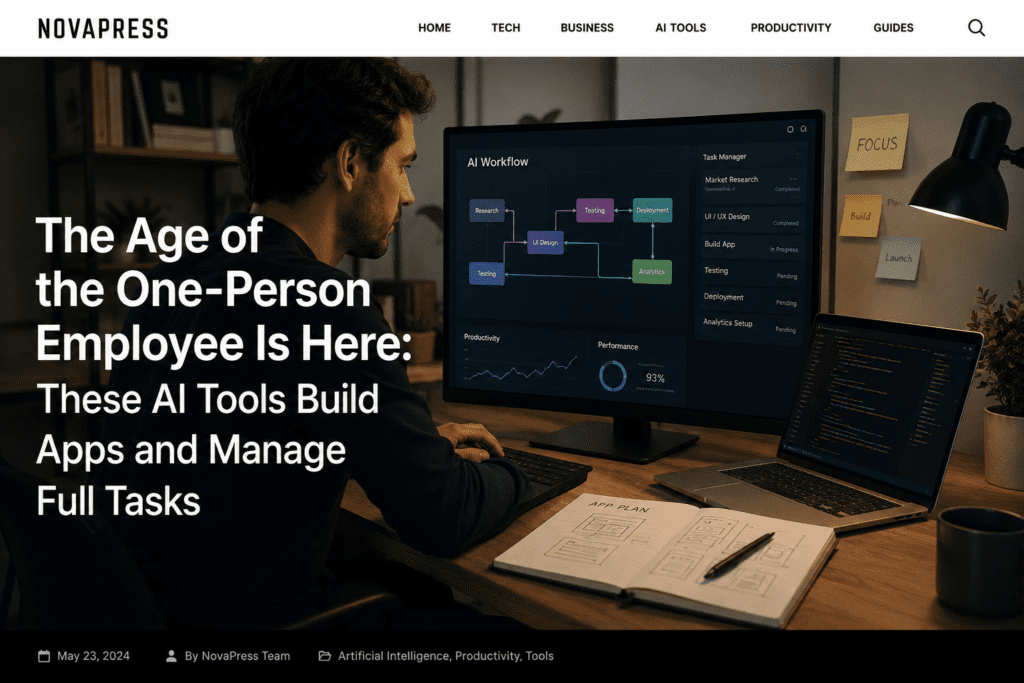
AI Tools Revolutionizing Single-Employee Operations Globally
*The integration of AI is reshaping the workforce dynamics towards a single-employee model*
T**he global employment landscape is undergoing a transformation, marked by the advent of AI technologies enabling what is termed as the ‘single-employee’ operational model. This model leverages advanced AI tools to execute tasks traditionally managed by multiple personnel, thus redefining business structures and efficiency metrics. Corporations are increasingly adopting AI solutions not just for cost-cutting but also for optimizing performance, making tech-savvy employees pivotal in this transitional phase. As AI continues to evolve, its influence on streamlining operations and consolidating job roles is becoming more pronounced, raising both opportunities and challenges in workforce management.**
AI-Powered Tools Reshaping Workflows
AI technologies are being utilized to perform complex tasks autonomously, reducing the need for large teams. Tools such as OpenAI’s GPT series enable employees to generate high-quality content, automate customer service, and perform data analysis with minimal human intervention. Similarly, machine learning algorithms can now automate processes in fields ranging from finance to healthcare, further consolidating workflow efficiency.
The influence of AI extends to software development as well, where platforms like GitHub Copilot are transforming coding practices. These tools assist programmers by auto-completing code and suggesting improvements, effectively allowing a single developer to manage what traditionally required a team. Such advancements are not only changing how tasks are executed but also who is capable of executing them, thus democratizing access to complex technical processes.
Economic Implications of the Single-Employee Model
Adopting AI-driven operational models presents significant economic benefits. Businesses can achieve substantial cost savings by reducing their workforce, thus lowering overheads. Reports suggest that industries embracing AI have seen productivity increases while maintaining or even reducing labor costs. This trend is particularly evident in sectors heavily reliant on manual data entry and repetitive tasks, which are prime candidates for automation.
However, economic implications are not universally positive. The displacement of traditional roles could lead to increased unemployment, particularly in regions or industries slow to adapt to technological advancements. This shift necessitates a re-evaluation of workforce training and education programs to ensure employees are equipped with the skills necessary to thrive in an AI-enhanced job market.
Challenges and Ethical Considerations
While the integration of AI into business operations offers numerous advantages, it also poses significant ethical challenges. The potential for job displacement raises concerns about economic inequality and access to opportunities. Furthermore, the reliance on AI for decision-making processes introduces risks related to bias and transparency. Ensuring AI systems are ethical and fair requires ongoing oversight and refinement.
Additionally, the consolidation of tasks under fewer employees increases the pressure on those individuals, potentially leading to burnout. Companies must find a balance between leveraging AI for efficiency and maintaining a sustainable workload for their employees. This involves developing new management practices that recognize the unique stressors of working alongside advanced technologies.
Future Prospects and Innovations
The future of the workforce will likely see an even greater integration of AI technologies. Innovations such as AI-driven project management tools and autonomous systems are on the horizon, promising to further streamline operations. These tools are expected to become more intuitive, allowing users with minimal technical expertise to harness their capabilities effectively.
Moreover, as AI continues to mature, it is anticipated that hybrid models will emerge, combining human creativity and strategic thinking with the efficiency of AI. This hybrid approach aims to retain the human element in decision-making while optimizing performance and reducing costs. The ongoing development and deployment of AI will require agile adaptation strategies from businesses and employees alike.
“AI’s influence on streamlining operations and consolidating job roles is becoming more pronounced.”
James Mercer
Increased AI Adoption Across Industries
As AI technologies become more accessible and affordable, their adoption across various industries is expected to accelerate, leading to widespread operational changes.
75%
The shift towards a single-employee model driven by AI technologies represents both a challenge and an opportunity for the global workforce. While the potential for increased efficiency and reduced costs is significant, the impact on employment levels and job satisfaction cannot be overlooked. Businesses must navigate this transition with a focus on ethical considerations and workforce sustainability.
In the near term, companies will need to invest in retraining and upskilling their employees to adapt to the changing landscape. Policymakers will also play a crucial role in ensuring that the benefits of AI are distributed equitably across society. As we move forward, the integration of AI into business operations will continue to reshape the fundamentals of employment, requiring continuous adaptation and innovation.
SOURCES
- 1. OpenAI — https://openai.com/
- 2. GitHub — https://github.com/features/copilot
- 3. McKinsey & Company — https://www.mckinsey.com/
- 4. World Economic Forum — https://www.weforum.org/