
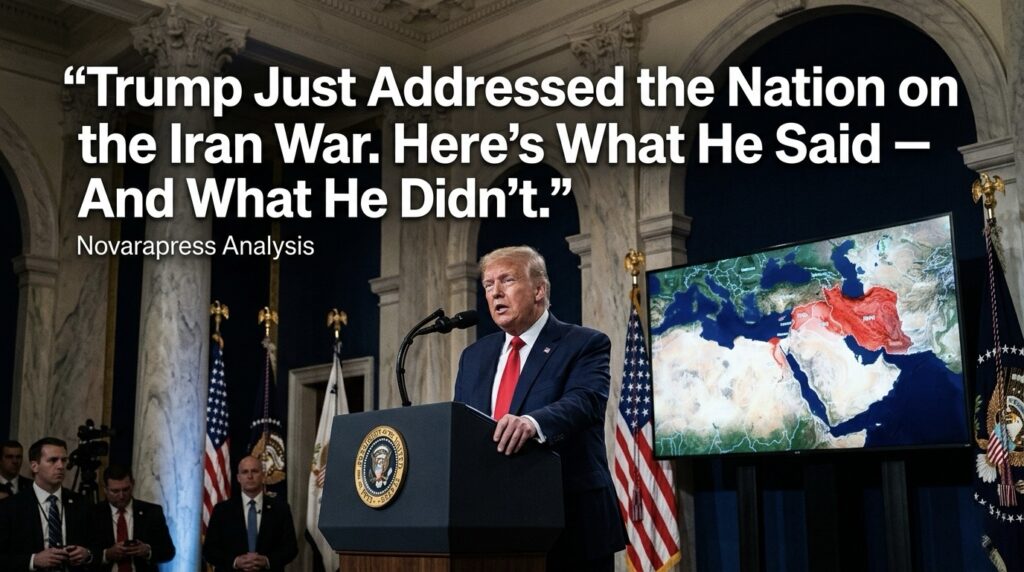
Trump just addressed the nation on the Iran war for the first time in 33 days. Here’s what he actually said — and what he didn’t.
The speech lasted 19 minutes. It was the president’s first formal national address since Operation Epic Fury began on February 28. Thirty-three days of war, thousands of strikes, six American soldiers killed, oil at $107, gas at $4 a gallon — and this was the first time Donald Trump spoke directly to the American people about what is happening and why.
What He Said
Trump declared that the war is “nearing completion” and that the US is “on track to complete all of America’s military objectives shortly — very shortly.” He said the country that launched the operation has been “eviscerated” in 32 days and compared the speed of this conflict favorably to World War II, Korea, Vietnam, Iraq, and Afghanistan — wars that lasted years.
He gave a timeline: two to three more weeks. Either Iran makes a deal, or the US will hit “each and every one of their electric generating plants very hard, and probably simultaneously.” He added: “We could hit their oil.” Oil prices jumped immediately — US crude rose to $102 a barrel during the speech.
He said regime change was not the goal. Then he said regime change has occurred anyway because Iran’s original leadership is dead. He said Iran’s nuclear program has been set back for years. He said “they will not have nuclear weapons” — then added that a future president might have to go back and “knock the hell out of them again” eventually.
He said the Strait of Hormuz will “open up naturally” when the war ends. Then he said the US will “not have anything to do with” the strait — that other countries reliant on Middle Eastern oil will have to “fend for themselves.” He said he is “absolutely” considering withdrawing from NATO because allies refused to help secure the strait.
He ended: “When it’s all over, the United States will be safer, stronger, more prosperous and greater than it has ever been before.”
What He Didn’t Say
He did not explain why Iran is still firing missiles into Gulf states if it has been “eviscerated.” He did not address the six American soldiers killed in Kuwait. He did not address the $4 gasoline or the fertilizer shortage threatening the spring harvest. He did not explain what a “deal” with Iran would look like, what Iran would have to agree to, or who is negotiating on Iran’s behalf after its supreme leader was killed. He did not address Iran’s demand for sovereignty over the Strait of Hormuz — a demand that would make any post-war settlement fundamentally different from anything the US has publicly proposed.
He did not explain what happens if two to three weeks pass and there is no deal and no opening of the strait and the US has hit the power plants and oil fields and Iran is still firing drones at Gulf cities and NATO allies are still refusing to send ships.
The Two Contradictions That Define This War
In one speech, Trump said two things that cannot both be true simultaneously.
First: The war’s objectives are being met and the US will withdraw shortly. Second: If no deal is reached in two to three weeks, the US will hit Iran’s power plants, oil wells, and Kharg Island — the escalation that would make withdrawal less likely, not more.
First: The Strait of Hormuz will open naturally when the war ends. Second: The US has nothing to do with the strait and other countries can fend for themselves.
These are not minor inconsistencies. They are the central questions that determine whether this war ends in weeks or extends indefinitely. A new CNN poll released the same day as the speech found that only one-third of Americans believe Trump has a clear plan to handle the situation in Iran. The speech, by design or by limitation, did not answer the question that poll was asking.
What Comes Next
Trump has now stated publicly, on national television, that the US will take major military action within two to three weeks if no deal is reached. That is a commitment — or a deadline — that Iran, US allies, oil markets, and the American public will hold against him regardless of what happens next.
Iran has denied seeking a ceasefire. Tehran called Trump’s claims about ongoing negotiations “deceitful.” A senior Iranian official told CNN that Trump’s remarks “reflect an unstable and eccentric personality.” Iran rejected the US 15-point peace framework weeks ago and presented its own five conditions, including recognition of sovereignty over the Strait of Hormuz.
The clock that Trump started tonight — two to three weeks — is now running. It will either produce a deal that nobody has publicly described, or it will produce an escalation that nobody has fully modeled. The speech gave the American public a timeline. It did not give them a plan.
If this analysis interests you, read next: Iran Just Turned the World’s Most Important Waterway Into a Toll Booth. Here’s How It Actually Works.