
⚡ BREAKING — April 3, 2026
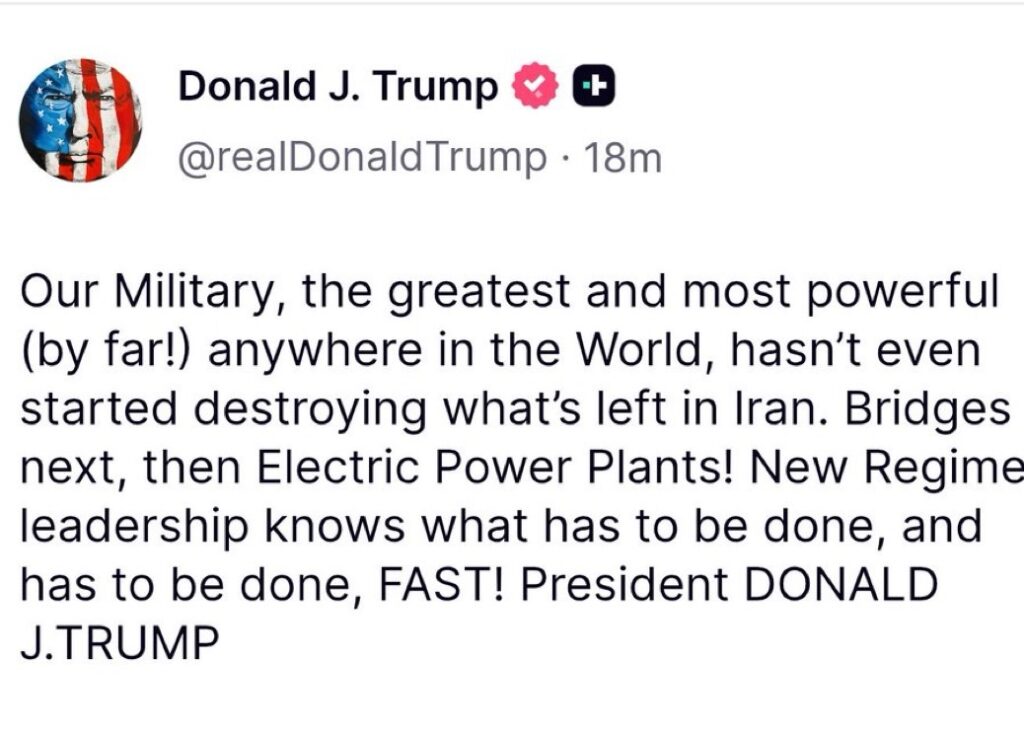
Eighteen minutes ago, Donald Trump posted this on Truth Social:
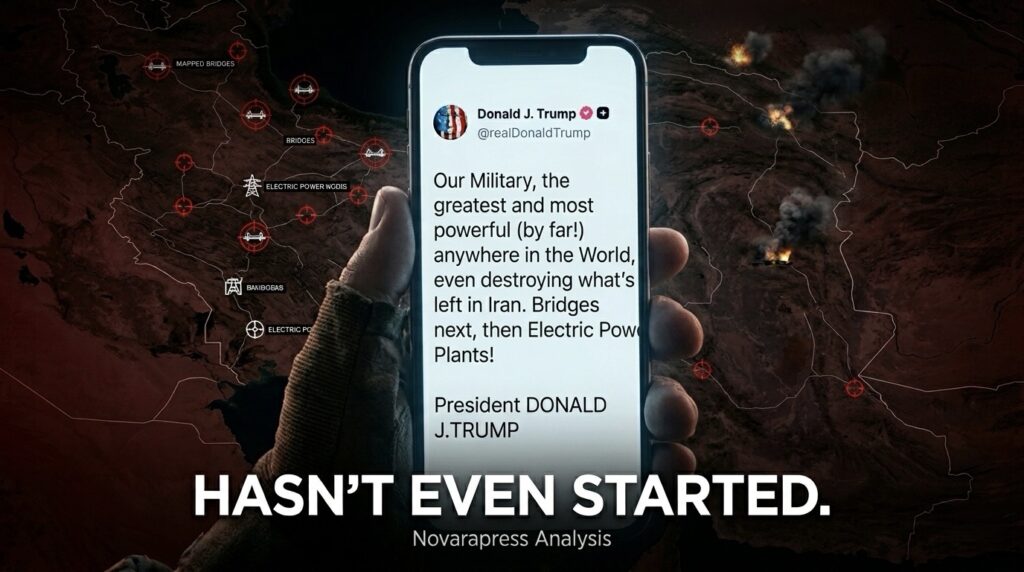
“Our Military, the greatest and most powerful (by far!) anywhere in the World, hasn’t even started destroying what’s left in Iran. Bridges next, then Electric Power Plants! New Regime leadership knows what has to be done, and has to be done, FAST! President DONALD J.TRUMP”
Read that again carefully. Three words matter more than everything else in that post: “hasn’t even started.”
Thirty-five days into a war. Over a thousand airstrikes. Iran’s supreme leader killed. Its navy destroyed. Its missile infrastructure degraded. Six American soldiers dead. Oil at $109 a barrel. And the President of the United States is telling the world that the destruction hasn’t even started yet.
What He Just Threatened
The post names two specific target categories that represent a fundamental escalation beyond anything the US has struck so far.
Bridges. Infrastructure that connects Iranian cities, moves civilian goods, and enables basic economic life. Destroying bridges is not a military operation against Iran’s war capacity. It is collective punishment against a civilian population — explicitly prohibited under the Geneva Conventions.
Electric Power Plants. Trump has threatened this before — it was the centerpiece of his April 6 ultimatum. International human rights experts and UN officials have repeatedly stated that striking power plants serving civilian populations would constitute a war crime. Hospitals, water treatment facilities, heating systems, food refrigeration — all of these depend on electricity. A country of 85 million people without power is not a military objective. It is a humanitarian catastrophe.
The post also contains a message directed at Iran’s new leadership — Mojtaba Khamenei and the government that replaced the officials killed on February 28. “New Regime leadership knows what has to be done, and has to be done, FAST.” This is not diplomacy. This is an ultimatum delivered via social media, 35 days into a war, at the moment when the only diplomatic back-channel — the one Kamal Kharazi was managing before his home was struck two days ago — has been effectively destroyed.
The Timeline That Makes This Post Alarming
To understand why this post matters, you need the context of the last 72 hours.
On April 1, Trump delivered his first national address on the war. He said the conflict was “nearing completion.” He said the US preferred a deal. He said the war would be over “very shortly.” Oil markets briefly stabilized.
Also on April 1, a US-Israeli airstrike struck the home of Kamal Kharazi — the senior Iranian diplomat coordinating back-channel talks through Pakistan for a meeting between Iranian officials and VP Vance. His wife was killed. He was hospitalized. The diplomatic channel that was supposed to produce the deal Trump was describing collapsed the same night he was describing it.
Now, two days later, Trump is posting that the military “hasn’t even started” destroying Iran — and announcing bridges and power plants as the next targets.
This is not a de-escalation trajectory. This is a president who said the war was almost over on Wednesday and is threatening its most destructive phase yet on Friday.
What “Hasn’t Even Started” Actually Means
There are two ways to read this claim, and both are alarming.
The first reading: Trump is bluffing. The post is psychological pressure designed to force Iran’s new leadership to accept a deal before the April 6 deadline. The phrase “hasn’t even started” is not literally true — the US has conducted thousands of strikes over 35 days — but it is designed to signal that far worse is possible and imminent. Under this reading, the post is a negotiating tactic, not a military order.
The second reading: Trump is telling the truth about what comes next. The strikes so far have focused on military infrastructure — missile systems, naval assets, IRGC facilities, command-and-control. The civilian infrastructure — bridges, power grids, water systems — has been largely untouched. From a purely military standpoint, it is accurate to say that the kind of total infrastructure destruction Trump is now describing has not yet happened. Under this reading, the post is a preview.
The problem is that there is no reliable way to know which reading is correct. Trump has said the war was “nearing completion” and simultaneously threatened to escalate it within the same 24-hour window. His April 6 deadline has already been extended once. His claims about ongoing negotiations have been repeatedly denied by Iran. The gap between what he says and what is happening is wide enough that neither his threats nor his assurances can be taken at face value.
What Happens to Oil, Markets, and the Global Economy
Brent crude was already at $109 before this post. The announcement of bridges and power plants as the next targets — civilian infrastructure that would trigger international condemnation and potentially expand the conflict — will push prices higher when markets open.
The April 6 deadline is three days away. If no deal is reached and the US begins striking power plants, Iran has already stated its response: expanded attacks on US assets and American technology companies in the region. The IRGC named Apple, Google, and Microsoft by name earlier this week. Iran’s foreign minister said Tehran is prepared for “at least six months” of war.
The scenario Trump is describing in this post — destroying what’s “left” in Iran, targeting bridges and power plants, demanding the new regime act “FAST” — is not a path to a two-to-three week conclusion. It is a path to a longer, more destructive, and more internationally isolated conflict in which the US has abandoned any pretense of limiting strikes to military targets.
The One Line Nobody Should Miss
“New Regime leadership knows what has to be done.”
This sentence tells you more about Trump’s theory of this war than anything else in the post. He is not talking to the Iranian people. He is not talking to US allies. He is talking directly to Mojtaba Khamenei — the man who became supreme leader after his father was killed by US and Israeli strikes on the first day of this war.
Trump is telling the son of the man he killed that the son knows what he needs to do, and he needs to do it fast. The implicit message is: your father didn’t move fast enough. You know what happened to him.
Whether that message produces compliance or escalation is the question that will determine what the next 72 hours look like. The April 6 deadline is no longer abstract. It is three days away. And the president just announced that the worst of the war hasn’t happened yet.
If this analysis interests you, read next: Trump Just Addressed the Nation on the Iran War. Here’s What He Said — And What He Didn’t.