
⚡ BREAKING — April 3, 2026
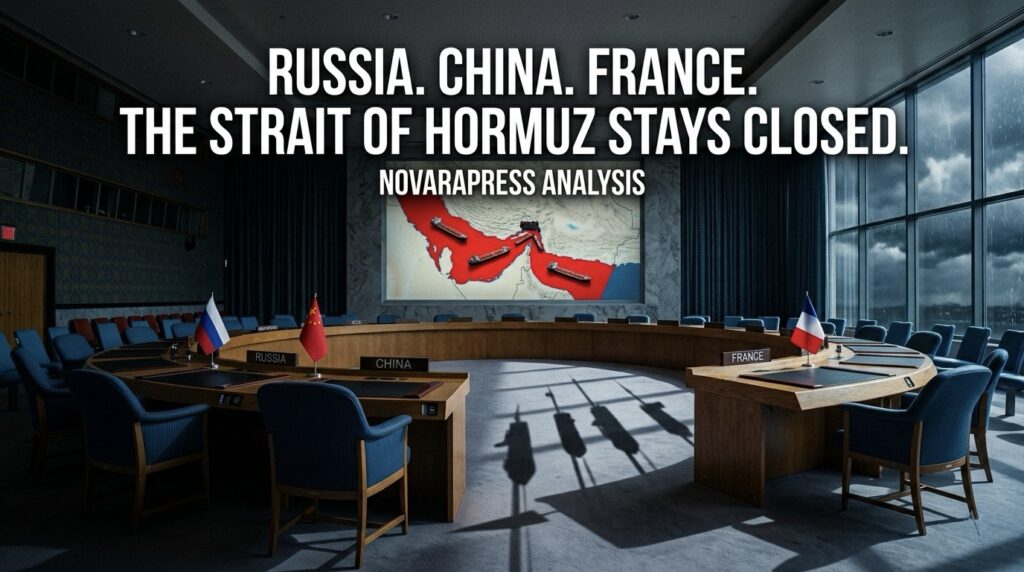
Russia. China. France.
Three of the five permanent members of the UN Security Council — each holding veto power — have blocked a resolution that would have authorized the use of force to reopen the Strait of Hormuz. The resolution was drafted by Bahrain and backed by the Gulf Arab states and the United States. The vote, originally scheduled for Friday, has been delayed after it became clear the three countries would not support any language authorizing military action.
The result: the Strait of Hormuz remains effectively closed. Oil is at $109 a barrel and rising. And the international community has just demonstrated that it cannot agree on a unified response to the worst energy crisis since the 1970s.
What the Strait of Hormuz UN Resolution Actually Said
The Strait of Hormuz UN resolution, drafted by Bahrain in its role as current Security Council chair, had already been significantly watered down in an attempt to bring Russia, China, and France on board. The original draft explicitly invoked Chapter 7 of the UN Charter — the provision that authorizes armed force to restore international peace and security. That language was removed. The revised text referred only to “defensive means” and emphasized that any intervention would be protective rather than offensive.
It was not enough. Senior UN officials told The New York Times that the three countries “opposed any language authorizing force” — in any form, defensive or otherwise.
China’s UN ambassador Fu Cong was explicit: authorizing force in the Strait of Hormuz would be “legitimizing the unlawful and indiscriminate use of force, which would inevitably lead to further escalation and serious consequences.” Russia, a long-standing ally of Tehran, echoed that position. French President Emmanuel Macron had previously called a military operation to free the waterway “unrealistic,” warning it could trigger a response from IRGC forces with significant ballistic missile capabilities along the Gulf coast.
The vote has been rescheduled for Saturday — but diplomatic sources told Reuters it remains unclear whether additional hours of negotiation will change the fundamental positions of the three veto-holding countries.
France: The Most Surprising Vote Against the Strait of Hormuz Resolution
Russia and China opposing a resolution that would authorize military action near Iran is expected. Both countries have strategic relationships with Tehran, and both have been vocal critics of the US-Israeli war since it began on February 28.
France is different. France is a NATO ally. France is a Western power that has publicly condemned Iran’s closure of the Strait of Hormuz. France hosted diplomatic meetings aimed at ending the conflict. And France, just days ago, restricted its airspace for US military overflights supplying Israel — a decision that already signaled significant distance from Washington’s position.
Now France has aligned with Russia and China to block the Strait of Hormuz UN resolution backed by the United States, the Gulf Arab states, and the Arab League. Macron’s position — that military force to reopen the strait is “unrealistic” — reflects a genuine strategic calculation: that authorizing naval action risks a direct confrontation with IRGC forces that could rapidly escalate into a broader conflict involving European interests in the region.
But the diplomatic optics are striking. The Western alliance, already under strain from Trump’s threats to withdraw from NATO, has just fractured publicly at the Security Council over the central question of the Iran war.
What This Means for the April 6 Deadline
Trump has given Iran until April 6 to reopen the Strait of Hormuz — three days from now. If no deal is reached, he has threatened to strike Iran’s electric power plants. This morning, he posted on Truth Social that the US military “hasn’t even started” destroying Iran and announced bridges and power plants as the next targets.
The Strait of Hormuz UN resolution was, in part, an attempt to establish an international legal framework for reopening the waterway that did not depend entirely on US unilateral action. If the resolution had passed, it would have authorized a multinational naval force to escort ships through the strait — providing a multilateral path that did not require Trump to choose between backing down or striking civilian infrastructure.
That path is now blocked. What remains is the original binary: Iran reopens the Strait of Hormuz, or the US strikes power plants.
Russia and China have, in effect, removed the diplomatic off-ramp that would have allowed this crisis to resolve without either Iranian capitulation or American escalation. Whether that was their intention or a principled position against authorizing force is a question each government would answer differently. The outcome is the same either way.
The Global Fracture the Strait of Hormuz Crisis Is Revealing
The Security Council vote exposes something that has been building since February 28 but has not been stated this clearly until now: the world is not unified on how to respond to the Iran war, and the divisions run through the Western alliance itself.
The United States and the Gulf Arab states are on one side. They want the Strait of Hormuz open, they support the resolution, and they are prepared to use force if necessary.
Russia and China are on the other side. They are allowing Iran to maintain its leverage, blocking any international authorization that would deprive Tehran of its last remaining card in the Strait of Hormuz crisis.
And France — along with significant divisions among the ten non-permanent Security Council members — is somewhere in between. Not opposing the war’s goals, but unwilling to authorize the means to achieve them.
This is the international order in April 2026: a war running for 35 days, an energy crisis affecting every economy on earth, an April 6 deadline carrying the threat of strikes on civilian infrastructure, and a UN Security Council that cannot agree on a Strait of Hormuz resolution.
The Strait of Hormuz carries 20 percent of the world’s oil. It has been effectively closed for over a month. Russia, China, and France have just ensured that the only way it reopens is either through a deal between Washington and Tehran — which the diplomatic back-channel lost its coordinator when Kharazi’s home was struck two days ago — or through unilateral American military action that the rest of the world has declined to sanction.
Three days remain until April 6. The Security Council has spoken. And what it has said, on the question of the Strait of Hormuz, is: you are on your own.
If this analysis interests you, read next: Trump Just Said the Destruction of Iran “Hasn’t Even Started.” Here’s What That Actually Means.