
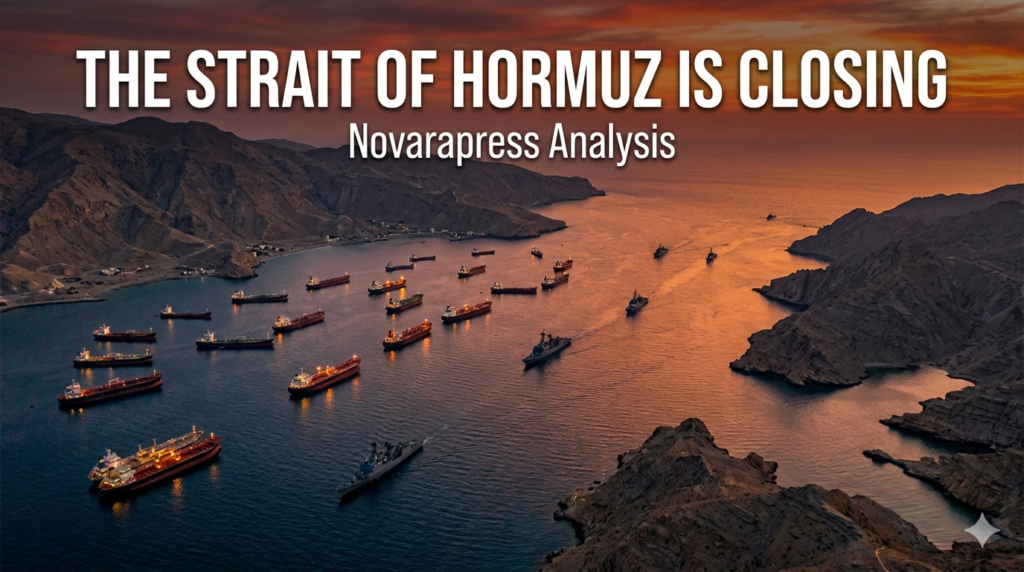
On March 2, 2026, a senior commander of Iran’s Revolutionary Guard said four words that changed the global economy: “The strait is closed.” He was not bluffing. Within days, tanker traffic through the Strait of Hormuz — the 21-mile waterway between Iran and Oman through which 20 percent of the world’s oil flows every day — had dropped by 70 percent. Then it dropped to near zero.
The International Energy Agency’s head described what followed as “the greatest global energy security challenge in history.” The comparison is not hyperbole. The 1973 oil embargo removed about 7 percent of global oil supply. The Iranian Revolution in 1979 removed about 4 percent. The closure of the Strait of Hormuz removes 20 percent — and unlike previous crises, it affects not just oil but liquefied natural gas, fertilizer, aluminum, and dozens of other commodities that flow through the same narrow passage.
The economic consequences are not theoretical. They are unfolding right now, in every country on earth that buys energy, ships goods, or eats food.
The 21 Miles That Run the World
To understand why the Strait matters so much, start with the numbers. In 2024, approximately 20 million barrels of oil per day transited the Strait — roughly 27 percent of all seaborne crude and petroleum products globally. Add liquefied natural gas, and the figure rises further: Qatar, the world’s largest LNG exporter, ships virtually all of its product through the Strait. Europe gets 12 to 14 percent of its LNG from Qatar. Japan and South Korea get the majority of their energy imports through the same passage.
The Strait also carries approximately one-third of the world’s fertilizer trade — including nearly half of global urea and 30 percent of ammonia production from Gulf facilities. Aluminum from Gulf smelters, helium from Qatar’s gas fields, petrochemical inputs for plastics and pharmaceuticals — all of it moves through 21 miles of water between Iran’s southern coast and the Omani peninsula of Musandam.
There is no realistic alternative route for most of this traffic. Saudi Arabia and the UAE have pipelines that can bypass the Strait — but their combined capacity is estimated at 2.6 to 5.5 million barrels per day. That is significant. It is not remotely sufficient to replace 20 million barrels per day of transit. The implied net shortfall, once bypass capacity is subtracted, is between 14.5 and 16.5 million barrels per day. No strategic reserve release, no demand reduction program, and no alternative supply source can bridge that gap quickly.
What Has Already Happened to Prices
Brent crude oil was trading at approximately $69 per barrel on February 27, 2026 — the day before the US and Israeli strikes on Iran began. By March 8, it had crossed $100 per barrel for the first time in four years. By mid-March it peaked at $126. As of March 31, it is trading around $115, with fresh upward pressure following the drone strike on the Al-Salmi tanker in Dubai’s port.
Wall Street analysts and US government officials are beginning to model scenarios in which oil reaches $200 per barrel if the Strait remains closed through the summer. The Dallas Federal Reserve’s research division has modeled a scenario in which a one-quarter closure of the Strait reduces global real GDP growth by an annualized 2.9 percentage points. Bloomberg Economics estimates that at $170 per barrel, the impact on inflation and growth “roughly doubles” from current levels — producing what it describes as “a stagflationary shock that could shift everything from the path ahead for central banks to the outcome of the US midterm elections.”
The fertilizer price spike is less visible but potentially more consequential for long-term food security. Urea prices have risen from $475 per metric ton before the war to $680 per metric ton as of late March — a 43 percent increase. This is happening during the spring planting window for corn, soybeans, and wheat in the Northern Hemisphere. Higher fertilizer costs reduce planting and yields. Lower yields increase food prices. The consequences of what happens to agricultural inputs in March 2026 will be visible in grocery stores in 2027.
Who Gets Hit First and Hardest
The pain from the Strait closure is not distributed equally. It arrives at different speeds in different countries, depending on their energy import dependence, their strategic reserve levels, and their ability to access alternative supplies.
Asia faces the greatest immediate exposure. China, India, Japan, and South Korea together account for 75 percent of oil exports and 59 percent of LNG exports that normally transit the Strait. Japan holds emergency oil reserves equivalent to about 254 days of domestic consumption — substantial insulation. South Korea holds about 208 days. China’s reserves are less transparent, but analyst estimates suggest roughly 900 million barrels, equivalent to about three months of imports.
India is more exposed. Official figures suggest storage covering about 74 days, but industry sources have indicated actual inventories closer to 20 to 25 days. More than half of India’s LNG imports are Gulf-linked. About 60 percent of its oil imports come from the Middle East. The US Treasury granted India a temporary 30-day emergency waiver in early March to purchase stranded Russian oil cargoes — a recognition that India’s vulnerability required special accommodation.
Pakistan and Bangladesh face the most acute near-term risk. Both countries have limited storage capacity and procurement flexibility. Pakistan was already running a shortfall of more than 1,300 million cubic feet of gas per day before the conflict began. A prolonged Strait closure for these countries does not produce gradual price increases — it produces power outages and industrial shutdowns.
Europe’s position is complicated by the timing. The conflict arrived when European gas storage was at historically low levels — approximately 30 percent capacity following a harsh winter. Dutch TTF gas benchmarks have nearly doubled to over €60 per megawatt-hour. The European Central Bank postponed planned interest rate cuts on March 19, raised its inflation forecast, and cut GDP growth projections. UK inflation is expected to breach 5 percent in 2026. Chemical and steel manufacturers across Europe have imposed surcharges of up to 30 percent to offset surging electricity costs.
The Gulf States’ Impossible Position
The bitter irony of the Strait closure is that the countries most dependent on it for their economic survival are the Gulf states themselves — including Iran.
Kuwait, Iraq, Saudi Arabia, and the UAE collectively saw their oil production drop by at least 10 million barrels per day by mid-March, as local storage filled up and the inability to export forced production curtailments. QatarEnergy declared force majeure on all its LNG export contracts — an extraordinary step that exposes Qatar to billions in contract penalties and destroys the commercial relationships it has spent decades building.
The Gulf Cooperation Council’s economic model — built on hydrocarbon exports, expatriate labor, and the infrastructure of a globally connected commercial hub — has experienced what Wikipedia’s economic impact page describes as a “systemic collapse.” Dubai, which processed tens of millions of tourists annually and positioned itself as the world’s logistics center, has seen hotel bookings collapse. Its airport has been hit by missile debris. Its port had a fully loaded tanker set on fire in its anchorage.
Iranian strikes on desalination plants — the source of 99 percent of drinking water in Kuwait and Qatar — have introduced a dimension beyond economic disruption into what threatens to become a humanitarian crisis in the Gulf states.
What Strategic Reserves Can and Cannot Do
The IEA announced on March 11 its largest-ever coordinated release of strategic oil reserves — 400 million barrels — from member country stockpiles. The US Energy Secretary indicated the release could reach 3 million barrels per day. This is a significant intervention. It is not a solution.
The math is straightforward. If the Strait closure removes a net 14 to 16 million barrels per day from global supply, and the IEA release provides 2 to 3 million barrels per day of relief, the gap remains enormous. Strategic reserves buy time — they reduce the probability of an immediate catastrophic supply collapse like the literal shortages of the 1970s. They do not make a prolonged closure economically harmless.
More fundamentally, strategic reserves address crude oil supply. They do not address LNG shortfalls, fertilizer supply disruptions, aluminum production constraints, or the shipping insurance and logistics costs that are cascading through every supply chain connected to the Persian Gulf region. The economic shock from the Strait closure is not only an oil story. It is a story about the fragility of every global supply chain that passes through, or depends on inputs from, the world’s most consequential 21 miles of water.
The Political Arithmetic
Every day the Strait remains effectively closed, the political pressure on both sides of the conflict intensifies — but not symmetrically.
For the United States, $4 gasoline and rising food prices are arriving exactly when the Trump administration faces midterm elections. The Federal Reserve faces a stagflation scenario — rising inflation and slowing growth simultaneously — that limits its ability to respond through conventional monetary policy. The political coalition that elected Trump was promised lower energy prices. It is experiencing the opposite.
For Iran, the economic pressure is even more severe. Iran’s own economy depends on oil exports that cannot flow through a closed Strait. The regime needs revenue to fund its military operations and maintain domestic political stability simultaneously — a constraint that gives it strong incentives to eventually negotiate an off-ramp, even as it continues striking to demonstrate that it cannot be forced out without a price.
The tragedy of the Strait of Hormuz crisis is that its resolution — some form of agreement that allows shipping to resume — is in the economic interest of almost every actor involved, including Iran. The obstacle is not economics. It is the political and military logic of a conflict that has already cost thousands of lives and in which neither side can be seen to capitulate without paying a domestic political price that its leadership calculates as too high.
The 21 miles between Iran and Oman will reopen. The question is how much economic damage accumulates before they do — and how many of the supply chains, commercial relationships, and economic models that were built on the assumption of open passage will survive the interval.
Iran’s New Demand: Sovereignty Over the Strait
In the final week of March, Iran added a demand that had never appeared in previous negotiations: formal international recognition of Iranian sovereignty over the Strait of Hormuz — and the right to collect tolls from vessels transiting it.
Iranian lawmakers are considering a bill that would require all ships using the Strait to pay approximately $2 million per transit. At 20 million barrels per day moving through the waterway on roughly 10 very large crude carriers, that translates to $20 million per day — or approximately $600 million per month from oil alone. Including LNG shipments, the figure could exceed $800 million monthly. For comparison, Egypt earns between $700 and $800 million per month from the Suez Canal in normal years.
US Secretary of State Marco Rubio described the proposal as “illegal, unacceptable, and dangerous to the world.” G7 foreign ministers stressed “the absolute necessity” of restoring “safe and toll-free freedom of navigation.” International maritime law experts are clear that no coastal state has the legal right to charge fees in an international strait.
Iran’s new supreme leader Mojtaba Khamenei — son of the assassinated Ali Khamenei — used his first public address to say that the leverage of blocking the Strait “must continue to be used.” What began as a military tactic has become a strategic asset Iran is now attempting to institutionalize permanently.
This changes the negotiating calculus entirely. The question is no longer simply when the Strait reopens. It is what kind of Strait reopens — and whether the world accepts an Iran that taxes the global economy for the privilege of accessing it.
If this analysis interests you, read next: Iran Just Struck an Oil Tanker Near Dubai. Here’s What That Actually Means.