
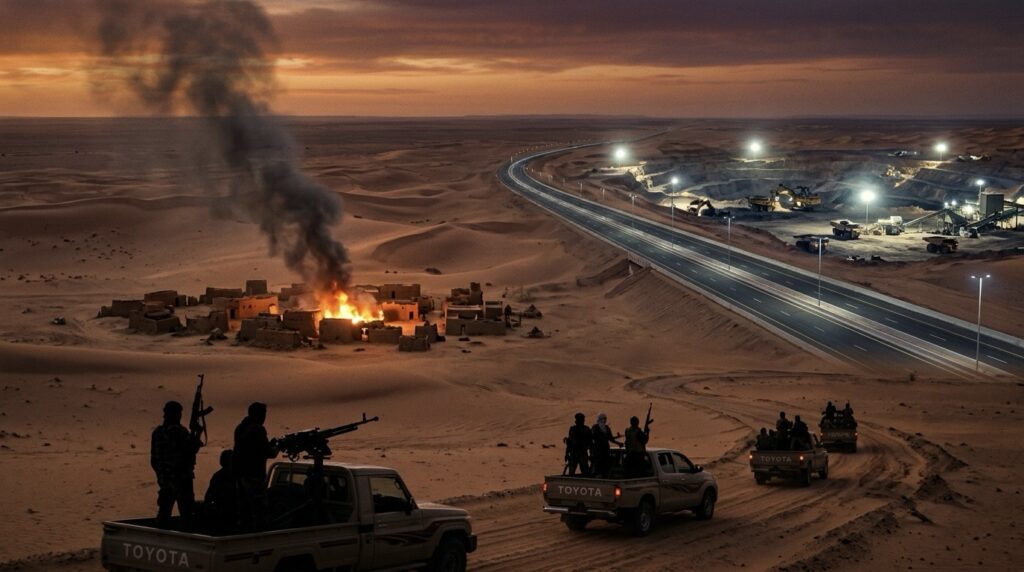
In August 2023, a group of soldiers surrounded the presidential palace in Niamey, Niger, and detained the elected president. It was the seventh coup in West and Central Africa in three years.
The world barely noticed. There was no emergency UN session. No NATO response. No coordinated sanctions with teeth. Western ambassadors issued statements. France evacuated its citizens. And within weeks, the news cycle moved on.
But something larger was happening — something that the coup itself was only a symptom of. The Sahel, the vast semi-arid belt stretching from Senegal to Sudan, was becoming the most contested territory on the planet. And almost nobody in the West had a map.
The Strip of Land Everyone Is Fighting Over
The Sahel covers over five million square kilometers and sits at the intersection of everything that matters in 21st-century geopolitics: climate change, migration, Islamic insurgency, Chinese investment, Russian military expansion, French colonial legacy, and some of the largest untapped mineral deposits on Earth.
Beneath the sand of Mali, Niger, and Burkina Faso lie uranium, gold, lithium, and manganese. Niger alone supplies roughly 15 percent of the European Union’s uranium — the fuel for the nuclear power plants that keep French lights on. The same country that France could not protect from a coup.
This is not a coincidence. It is a pattern. The places the world fights over most bitterly are rarely the places with the most visible crises. They are the places with the most valuable ground.
How It Started: The Libyan Unraveling
To understand the Sahel today, you have to go back to 2011 — and to a decision made in Washington, London, and Paris that nobody has fully accounted for.
When NATO intervened in Libya and Muammar Gaddafi fell, his vast weapons arsenals — accumulated over decades — did not disappear. They dispersed. Truckloads of rifles, missiles, and heavy weapons moved south across the Sahara, flowing into Mali, Niger, and Chad. Armed groups that had fought for Gaddafi returned home with weapons and organizational experience they had not possessed before.
Within a year of Gaddafi’s death, northern Mali had fallen to a coalition of Tuareg separatists and jihadist groups. France intervened militarily in 2013 to prevent a complete collapse. That intervention, called Operation Serval and later expanded to Operation Barkhane, lasted nearly a decade — and ultimately failed.
The 2011 Libya intervention did not cause the Sahel crisis alone. But it poured accelerant on a fire that was already smoldering. The weapons are still circulating. The armed groups are still fighting. And Libya itself remains a failed state hosting competing militias, Russian mercenaries, and Turkish-backed factions — a permanent source of instability feeding directly into the Sahel.
France’s Exit and the Vacuum It Left
Between 2021 and 2023, France was expelled from Mali, Burkina Faso, and Niger — three countries where its forces had been fighting jihadist insurgencies for years. The expulsions were not clean military defeats. They were political rejections, driven by populations who associated the French military presence with continued instability rather than security.
The grievance was not entirely unfair. A decade of French military operations had not stopped the insurgencies from expanding. By 2023, jihadist violence in the Sahel had spread further south than at any point since the crisis began, reaching coastal West African countries — Benin, Togo, Ghana — that had previously been stable.
France left. And into the vacuum walked Wagner.
In Mali and Burkina Faso, Russian mercenaries replaced French forces almost immediately after the expulsions. They came with fewer conditions, fewer press conferences, and fewer questions about civilian casualties. They also came with a business model: in exchange for security services, they secured access to gold mines and other resource extraction operations.
The transition from French troops to Wagner fighters was not simply a change of foreign military presence. It was a change in the entire logic of external engagement — from a model based on counterterrorism and nominal governance support to a model based on resource extraction and regime protection.
The Jihadist Geography
The insurgencies spreading across the Sahel are not a single movement. They are a fragmented ecosystem of armed groups, some affiliated with al-Qaeda through Jama’at Nusrat al-Islam wal-Muslimin, others pledging allegiance to the Islamic State in the Greater Sahara.
What unites them is not ideology alone but opportunity. The Sahel’s governments have historically been among the weakest on the continent — unable to deliver services, unable to project authority into rural areas, and unable to address the ethnic and economic grievances that jihadist recruiters exploit.
The Fulani pastoral community, spread across multiple Sahelian countries, has been particularly targeted by both jihadist recruiters and state security forces. Caught between armed groups demanding collaboration and armies treating them as collective suspects, many communities have been pushed toward the insurgencies not out of ideological conviction but out of survival calculation.
This is how insurgencies sustain themselves in the Sahel. Not through popular enthusiasm for a caliphate, but through the systematic failure of states to offer any alternative.
China’s Quiet Entry
While Russia entered the Sahel with guns, China entered with contracts.
Chinese investment in Sahelian infrastructure — roads, mines, telecommunications networks — has expanded steadily over the past decade, largely beneath the radar of Western media coverage focused on jihadist violence and coups. China does not ask about governance standards or human rights records. It asks about repayment schedules and resource access.
This approach has made China the preferred infrastructure partner for several Sahelian governments, regardless of their political character. Juntas and elected governments alike have signed Chinese contracts, because the alternative — Western aid with its attached conditionalities — has become politically toxic in countries where anti-Western sentiment is running at historic highs.
The mineral wealth beneath the Sahel is a significant part of what makes this investment rational from Beijing’s perspective. Lithium for electric vehicle batteries. Uranium for energy security. Manganese for steel production. The Sahel sits on resources that the global green energy transition will require in enormous quantities — and China is positioning itself to control significant portions of that supply chain.
The Migration Connection Europe Cannot Ignore
For European policymakers, the Sahel crisis has a dimension that makes it impossible to treat as a distant African problem: migration.
The routes that move people from sub-Saharan Africa to the Mediterranean run directly through the Sahel. The collapse of state authority in Mali, Niger, and Libya has removed the checkpoints, border controls, and migration management infrastructure that previously existed along these routes. The same networks that move weapons also move people — for a price.
Niger was, until its 2023 coup, a key partner in Europe’s migration containment strategy. The EU had invested hundreds of millions of euros in Nigerien border management. After the coup, the new military government suspended cooperation agreements with the EU and expelled the US military from its drone base — the most significant American intelligence asset in the region.
The Sahel is not a problem Europe can outsource. The instability produces the migration flows that are reshaping European domestic politics. The mineral wealth beneath it powers the energy transition European governments have committed to. And the armed groups spreading through it have repeatedly demonstrated the capacity to reach beyond the region.
Why This Is the New Middle East
The Middle East dominated global geopolitics for the second half of the 20th century because it sat at the intersection of oil, religion, Cold War competition, and strategic geography. Every major power had interests there. Every conflict drew external intervention. Every instability had global consequences.
The Sahel in 2025 sits at a similar intersection — minerals instead of oil, jihadist insurgency instead of pan-Arab nationalism, Russian and Chinese competition instead of Soviet-American rivalry, migration instead of refugees from a single conflict, climate displacement instead of water scarcity from overextraction.
The parallels are not perfect. They never are. But the structural logic is the same: a region where local crises and global interests collide, where external powers intervene for reasons that have nothing to do with the welfare of local populations, and where the consequences of getting it wrong extend far beyond the region itself.
The Middle East took decades to produce the crises the world is still managing today. The Sahel may not take that long.
The coups, the insurgencies, the mercenaries, the Chinese contracts, the uranium beneath the sand — these are not separate stories. They are the same story, told from different angles.
And it is only beginning.
If this analysis interests you, read next: The Wagner Playbook: How Private Armies Replaced Diplomacy